News Detail
Data-driven modelling of residual flows
February 24, 2026 |
More water in rivers or more water entering turbines for hydropower generation? Since 1975, this question has raised two others. For that year, the new water resource management article (24bis, now Art. 76) was included in the Federal Constitution. Here, it is specified that the Confederation shall legislate to ensure appropriate residual flows, also called “environmental flows”. But what does “appropriate” mean, and how many more kilowatt-hours of electricity could theoretically be produced if “appropriate” meant almost no water or none at all?
With aquatic ecosystems under growing pressure [1,2], increasingly precise answers have since been provided to the first question (see, e.g. [3] and [4]); however, previous estimates concerning “production losses” resulting from the current residual flow requirements of the Waters Protection Act (WPA) have varied widely. These estimates are not a trivial matter, for various reasons, including the fact that, for existing hydropower plants, two different legal procedures exist with regard to residual flows – one for a current concession and another when a concession is to be renewed. To complicate matters, minimum residual flows are to be increased in the light of a weighing of interests, but exceptions involving reductions are also possible. Crucially, however, details of the decisions made have not so far been available to the public for inspection.
Modelling involving discharge time series for the first time
Now, a group of researchers from WSL, Bern University and Eawag has systematically collected data on legal, hydrological and technical attributes for 252 large-scale hydropower plants (installed capacity ≥ 3 MW). Included in the database [5] are 160 run-of-river plants, 75 storage plants, 16 pumped-storage plants and 1 closed-loop pumped-storage plant. Together, these plants have an expected annual output of 31,540 GWh – over 84% of Switzerland’s total domestic hydropower generation. The database can be easily linked to the national hydropower statistics (WASTA); in addition, to determine the proportions of process water, residual flows and spills, hydrological discharge time series for the respective catchments were taken into account for the first time.
An initial analysis was conducted by the database authors for 217 hydropower plants for which residual flow levels are currently specified and adequate data is available: the simulation shows an annual decrease in production resulting from the residual flow requirements of 1113 GWh. This is equivalent to around 3% of total expected annual domestic hydropower production. The winter months (October to March) account for almost 70% (771 GWh) of the decrease in production. [6]
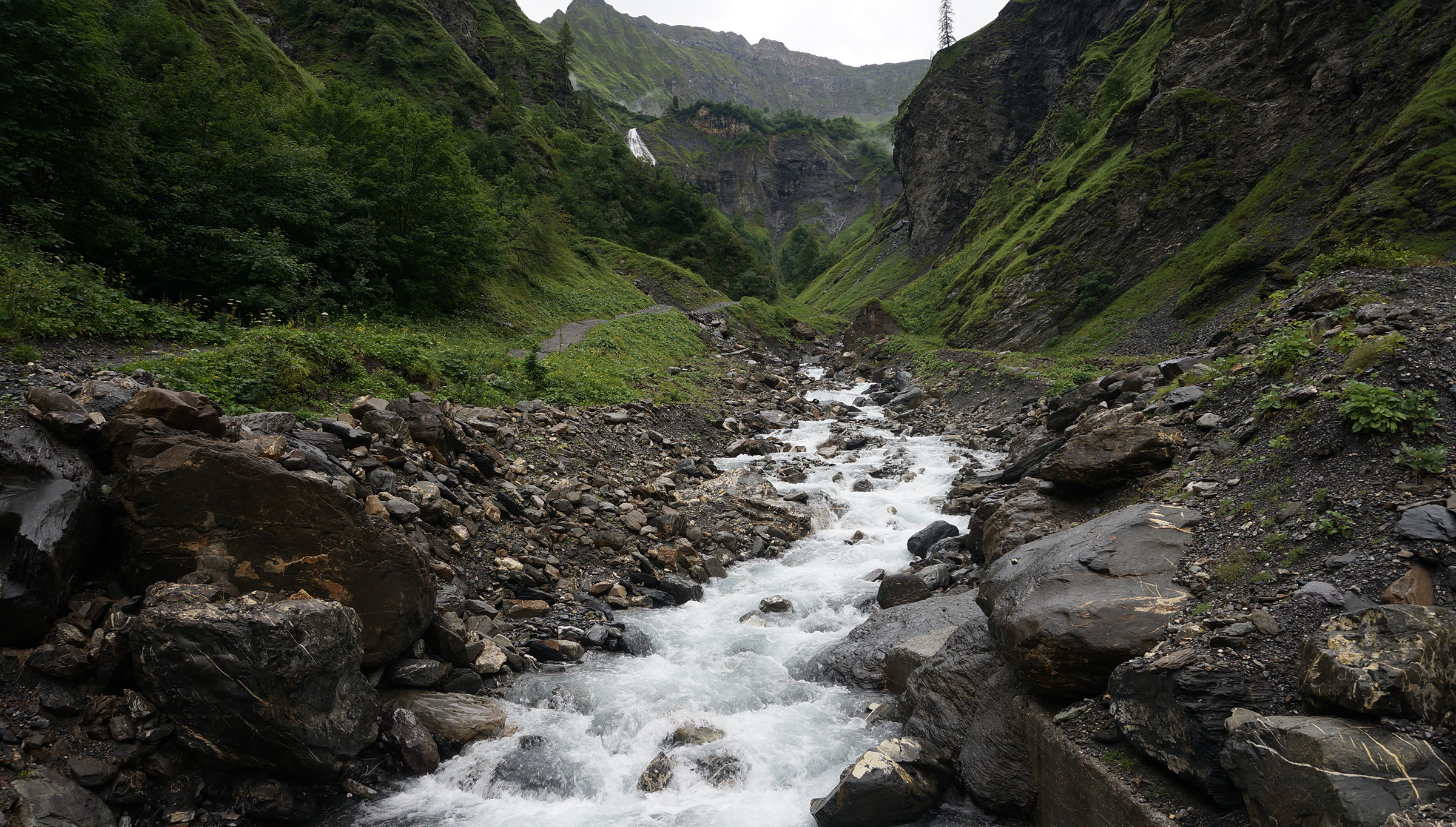
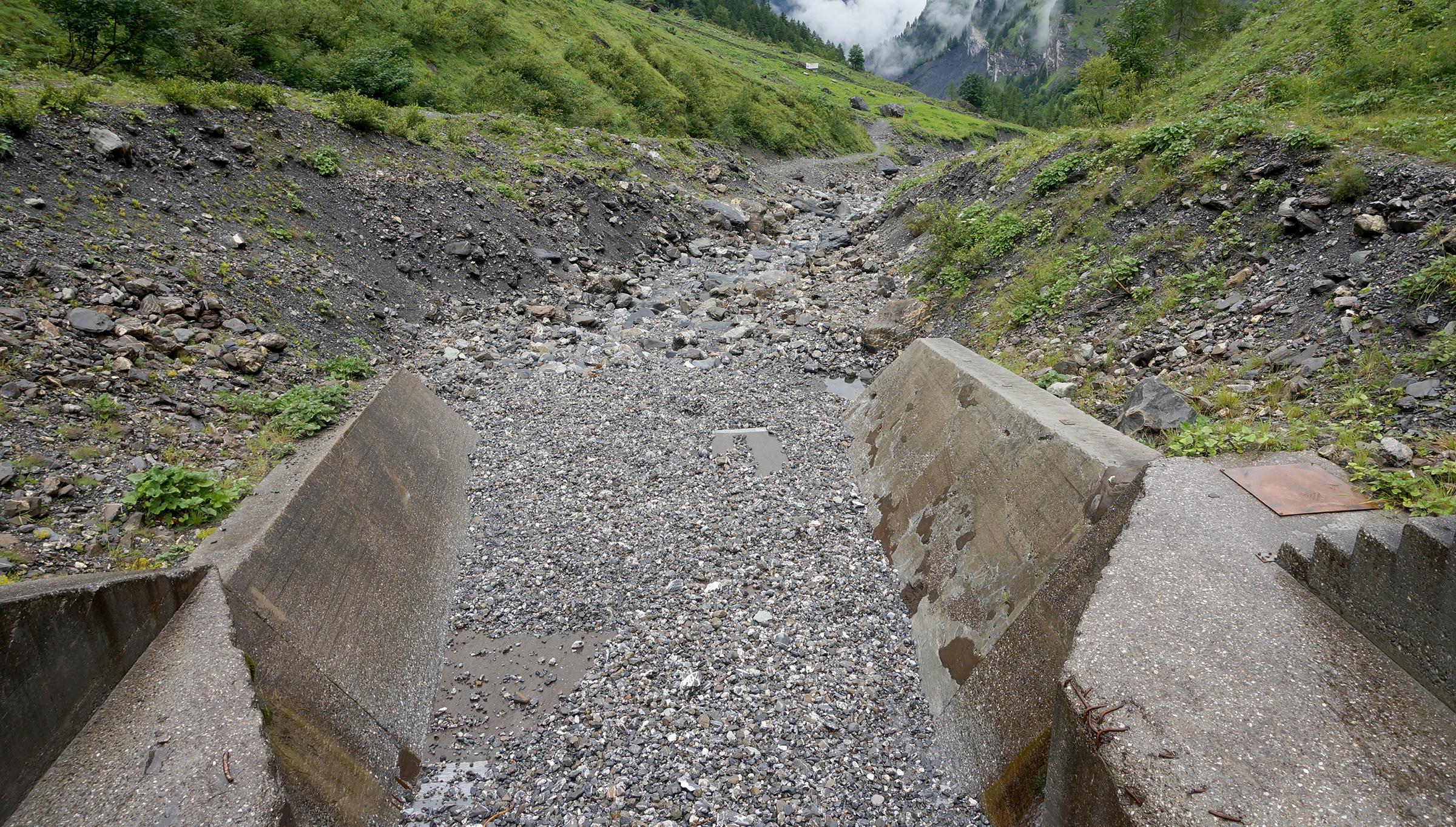
The Gufelbach stream in the Weisstannental valley (SG) before and after diversion for hydropower use. (Eawag, Andri Bryner)
Concerns arising from future concession renewals
In the coming years up to 2050, and especially from 2035 onwards, the concessions for numerous major plants are due to expire. In the new concessions, the residual flow provisions of the WPA will then have to be taken into account. Concerns among policymakers that this wave of concession renewals will lead to excessive losses of output are apparent from a postulate submitted by the National Council’s Environment and Energy Committee, [7] calling for an amendment to the legislation. Supporters of the proposal argue that this is necessary in order to achieve the goals of the energy transition. Opponents describe it as a weakening of water protection regulations already subject to sluggish implementation. The Residual Flows database now makes robust data available to support evidence-based decision-making.
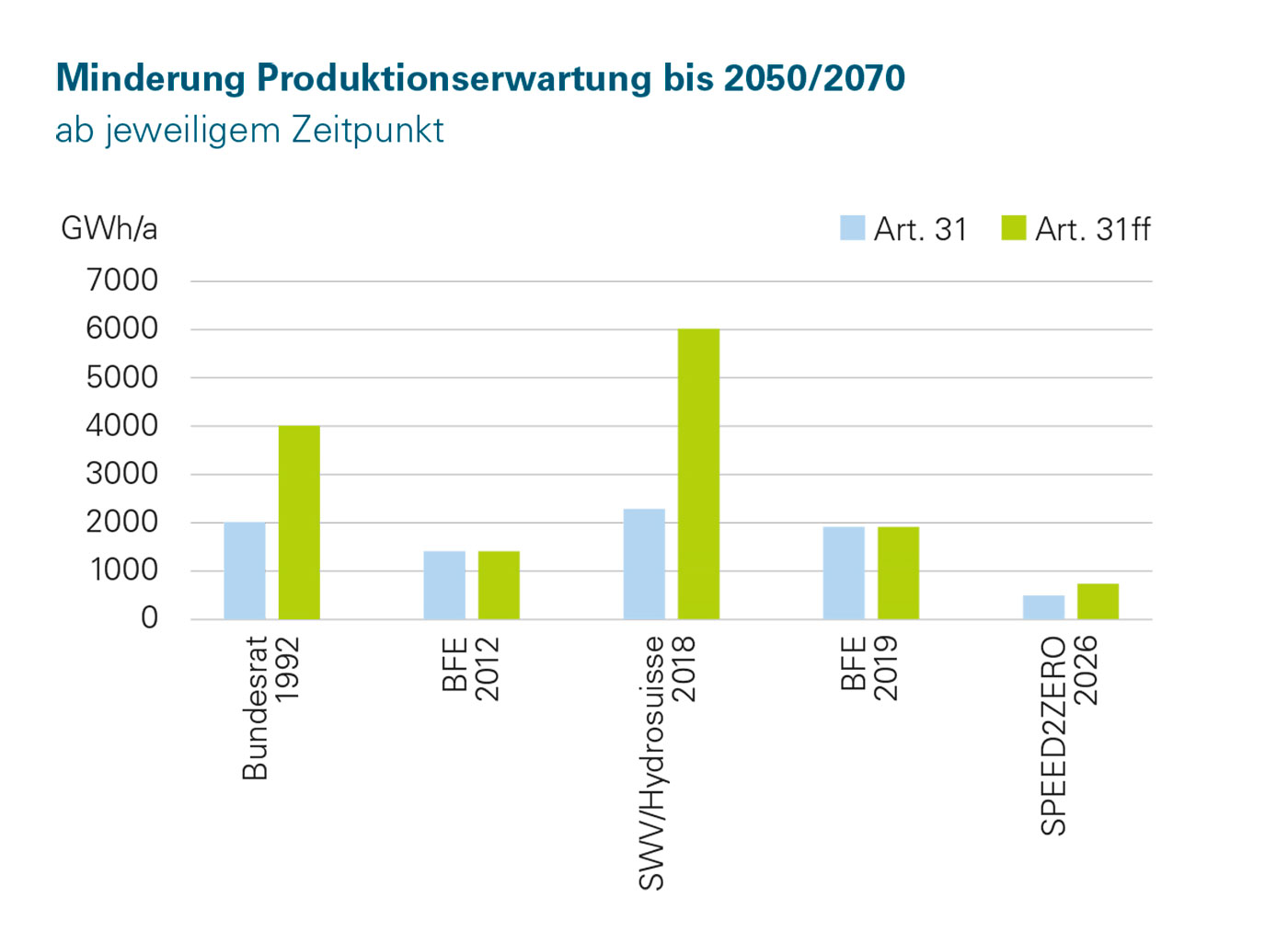
The Residual Flows database is a project carried out under SPEED2ZERO, a joint initiative supported by the ETH Board, involving the institutions of the ETH Domain and their partners. For the closing event in Bern, modelling has now also been performed for the first time to determine the impacts of residual flow requirements for the period up to 2050. According to this study, strict application of Art. 31 para. 1 WPA will result in an additional decrease in production of 484 GWh up to 2050. Together with the existing decreases in production, the total for 2050 is thus 1597 GWh. Details of the simulations can be found in the Appendix.
To produce an order-of-magnitude estimate of the impacts of a marked increase in water releases under Art. 33 WPA (weighing of interests), a scenario involving seasonally variable required water endowments was also simulated. Here, the authors rely on a pattern frequently prescribed today, with a dynamic increase in residual flows from April, a doubling from June to August, and a decline to Art. 31 para. 1 WPA levels in November (for details see the Appendix). The authors conclude that such an increase in minimum residual flows would result in a decrease of around 725 GWh in expected annual production in 2050; together with the amount already calculated, the total decrease would thus be 1838 GWh per year. With regard to the 2050 expansion target of 39,200 GWh, this represents an additional decrease of just under 2% (between now and 2050), or an overall decrease of around 4.5%.
Significant overestimates
In the official booklet issued for the popular vote on the WPA in 1992, it was stated that the residual flow requirements specified in Article 31 would reduce hydropower output by almost 6% – equivalent to around 2000 GWh per year – by 2070. In addition, a further decrease in production “of the same order of magnitude” was assumed as a consequence of the weighing of interests specified in Article 33. Altogether, Parliament and voters thus assumed that there would be a decrease of around 4000 GWh per year, or 12% of the expected annual production. According to the projections now calculated for the period up to 2050, the decrease due to the schematically determined minimum residual flows from Art. 31 amounts to around 1600 GWh per year, i.e. is close to the figure estimated 35 years ago. However, the forecast that another 2000 GWh per year would be lost as a result of increases in minimum residual flows turns out to be incorrect. The fear that the upcoming concession renewals could lead to a particularly high decrease in expected production between now and 2050 is also mitigated by the simulation: the figure lies between 484 and 725 GWh – less than 2% of expected production for 2050. Finally, it should also be borne in mind that since 1992, Swiss hydropower production has been increased by more than 4000 GWh as a result of new and expanded plants and technical improvements.
Losses or the price of environmentally sound hydropower?
“In discussing the impacts on production arising from the residual flow requirements of the WPA, it should be borne in mind that, in the current societal context, even in the absence of these requirements, hydropower generation without any residual flows would surely be inconceivable. The associated impacts on production should thus not be regarded as “production losses”, but as the price to be paid for ensuring that hydropower operations following concession renewals can be considered to be environmentally sound.” Quotation from UVEK/BAFU 2019 [8]
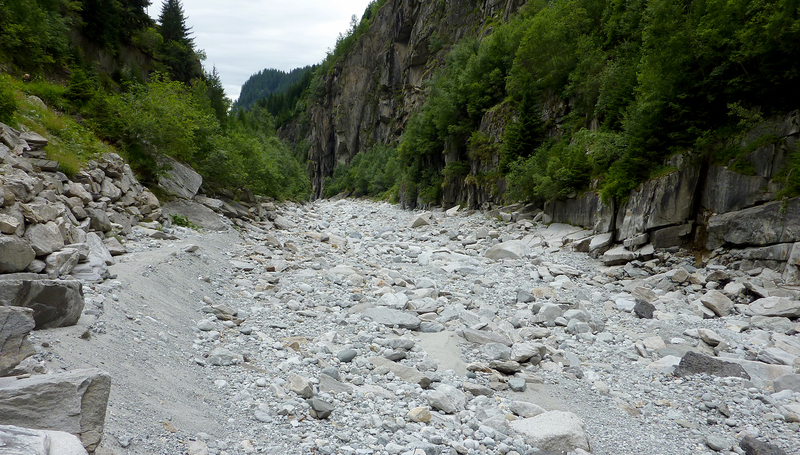
Cover picture: Below dams that were licensed before 1992, there is still hardly any residual water flowing in many places. (zvg)
Publications
| [1] | Biodiversität der Gewässer (BAFU 2022); https://www.bafu.admin.ch/de/biodiversitaet-der-gewaesser |
| [2] | Unsere Fische: Vielfalt schafft Vielfalt (BAFU 2026); https://www.bafu.admin.ch/de/fischvielfalt |
| [3] | Dönni, W., Boller, L., Zaugg, C. (2016): Mindestwassertiefen für See- und Bachforellen – Biologische Grundlagen und Empfehlungen. Studie im Auftrag des Bundesamtes für Umwelt. https://www.bafu.admin.ch/dam/en/sd-web/Rb10nEO8TjeW/mindestwassertiefen-forelle.pdf |
| [4] | Mindestwasserführung: Handlungsanleitung zur Festlegung und Überwachung des Mindestabflusses; LUBW Landesanstalt für Umwelt Baden-Württemberg, 2019. https://pudi.lubw.de/detailseite/-/publication/10039 |
| [5] | Wechsler, T., Baumann, H., Hurni, M., & Schaefli, B. (2025a). Restwasser-Datenbank: eine schweizweite Datengrundlage zu festgelegten Dotierwassermengen bei Ausleitkraftwerken (≥ 3 MW). Eidg. Forschungsanstalt für Wald, Schnee und Landschaft WSL. https://www.dora.lib4ri.ch/wsl/islandora/object/wsl:42014 |
| [6] | Wechsler, T., Baumann, H., Hurni, M., & Schaefli, B. (2025b). Auswirkungen der Restwasserbestimmungen auf die Wasserkraftproduktion in der Schweiz. aqua viva 3/2025. |
| [7] | Anpassung der Restwasserbestimmungen für bestehende Wasserkraftwerke bei gleichzeitiger Verbesserung der Biodiversität der Gewässer. Postulat 23.3007, pendent beim Bundesrat. |
| [8] | Eidgenössisches Departement für Umwelt, Verkehr, Energie und Kommunikation UVEK, Bundesamt für Umwelt BAFU, Abteilung Wasser (08.07.2019): Auswirkungen des Vollzugs der Restwasserbestimmungen im Gewässerschutzgesetz (GSchG) auf die Produktion bei Wasserkraftwerken |