News Detail

Fascinating microorganisms in perialpine lakes

May 14, 2019 | Christine Arnold

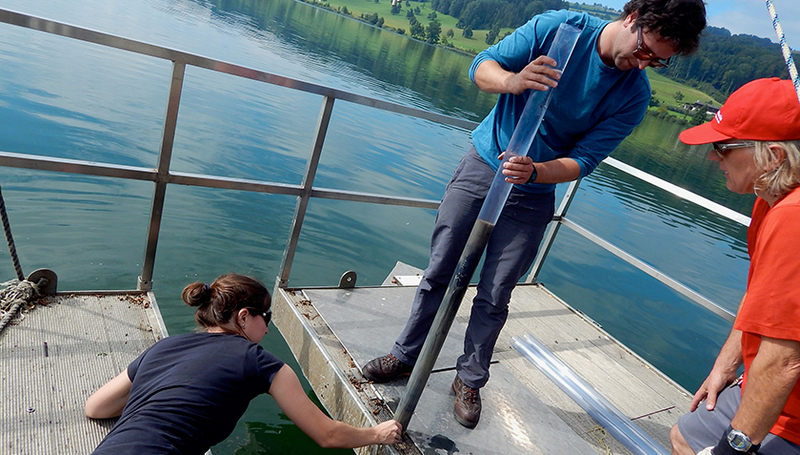
Cyanobacteria were among the first organisms to produce oxygen, which meant they were a significant milestone in the evolution of plants and animals. Countless species of cyanobacteria inhabit almost all habitats around the world. For her doctorate at Eawag, Marie-Eve Monchamp analysed sediment cores from ten different lakes around the fringes of the Alps, thus gaining an insight into the communities of cyanobacteria living over the past 100 years.

The lakes in the perialpine regions of Europe are home to a particular community of cyanobacteria which Marie-Eve Monchamp investigated in connection with her doctoral thesis at Eawag. “We collected sediment cores from ten lakes in Switzerland, Italy and France, and analysed the cyanobacterial DNA extracted from these cores”, she explains. Monchamp and her team were able to use the data to then reconstruct the time and place that the bacterial communities lived. They established that although the overall number of different species in the lakes had not significantly decreased over the past 100 years, the communities across the various lakes became more and more homogeneous as time went on. The species that benefited the most from the changing conditions in the lakes were those that were able to adapt quickly. This can be problematical, as “it is these species, in particular, that are often toxic”, says Monchamp.

Temperature affects species diversity

The researchers have now drilled down further into the data to find out whether and how human activity affects the biodiversity of these cyanobacteria, and to investigate questions such as whether detergent and fertiliser run-offs affect the cyanobacteria communities, and how the bacteria react to rising temperatures.

The researchers represented the communities of cyanobacteria found in the sediment cores in the form of a phylogenetic tree. Monchamp explains: “Where the species are randomly distributed around the branches of the phylogenetic tree and no clear pattern can be identified, nothing seems to affect their diversity. However, where they are grouped, or distributed extremely evenly, this is an indicator that they are very susceptible to external influencing factors.”

The photosynthesizing cyanobacteria in the ten lakes seem to be moderately affected by external circumstances: In 44 out of 76 species, just over half of the family trees studied were grouped, and the rest were randomly distributed. Comparisons with data on water quality and temperature led the researchers to the conclusion that temperature, especially, was a factor that worked in favour of some species and led to the disappearance of others. “From earlier analyses, we had realised that the stability of the water stratification is also important”, Monchamp adds. Nutrients such as phosphorus and nitrogen on the other hand did not seem to have an impact on the diversity of the cyanobacterial community.
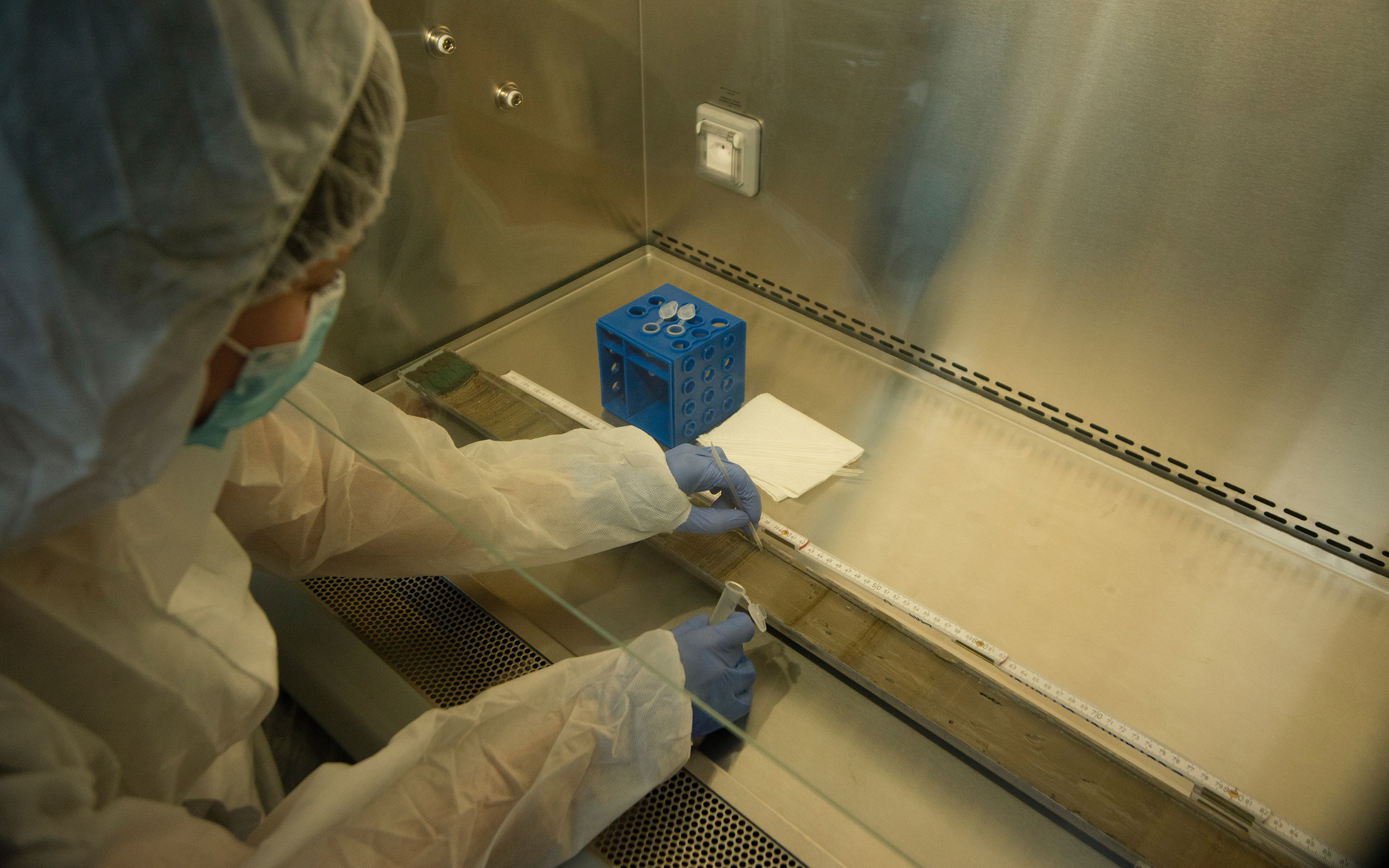
 

In the laboratory, researchers analyse the DNA of cyanobacteria extracted from lake sediment cores.
(Photo: Eawag)

Data that nobody had expected

During her analyses of the sediment cores, Monchamp came across cyanobacteria that were not part of the photosynthetic group, but did not pay too much attention to them at first. However, when the bacteria started to appear in large numbers in the cores taken from all of the lakes and from all time periods represented by the cores, she became curious: “The data were too interesting to ignore.” She and her team found 63 taxonomic units of non-photosynthesizing cyanobacteria in both the Melainabacteria and the Sericytochromatia phyla.

Partly because they are very hard to culture in the laboratory, very little research has been done on non-photosynthesizing cyanobacteria to date. Although these bacteria are related to the photosynthesizing species, they have a completely different metabolism and are extremely diverse: they occur in ecosystems both with and without oxygen, with and without light, and irrespective of the quantities of nutrients available. Some non-photosynthesizing cyanobacteria also live in the digestive tracts of animals.

Similar questions, different answers

The researchers started to look for patterns that they had found with photosynthesizing bacteria. “What we found agreed with the minimal amount of information that was available in the literature”, Monchamp explains. Analysis of the phylogenetic tree revealed that Melainabacteria and Sericytochromatia appeared not to be affected by environmental factors such as temperature or nutrient availability. Out of the ten lakes that were studied, only the species composition in Lake Annecy had changed over the last 100 years. This was a somewhat surprising finding to Monchamp, as Lake Annecy is relatively less disturbed in comparison to the other lakes. “We had expected the population to be the most stable under such constant environmental conditions”, she explains. On the other hand, it was less of a surprise to her that the biodiversity of the non-photosynthesizing cyanobacteria had not increased during the period in question, in contrast to that of the photosynthesizing cyanobacteria. “They have an entirely different metabolism, so it’s no surprise that they also behave differently.”
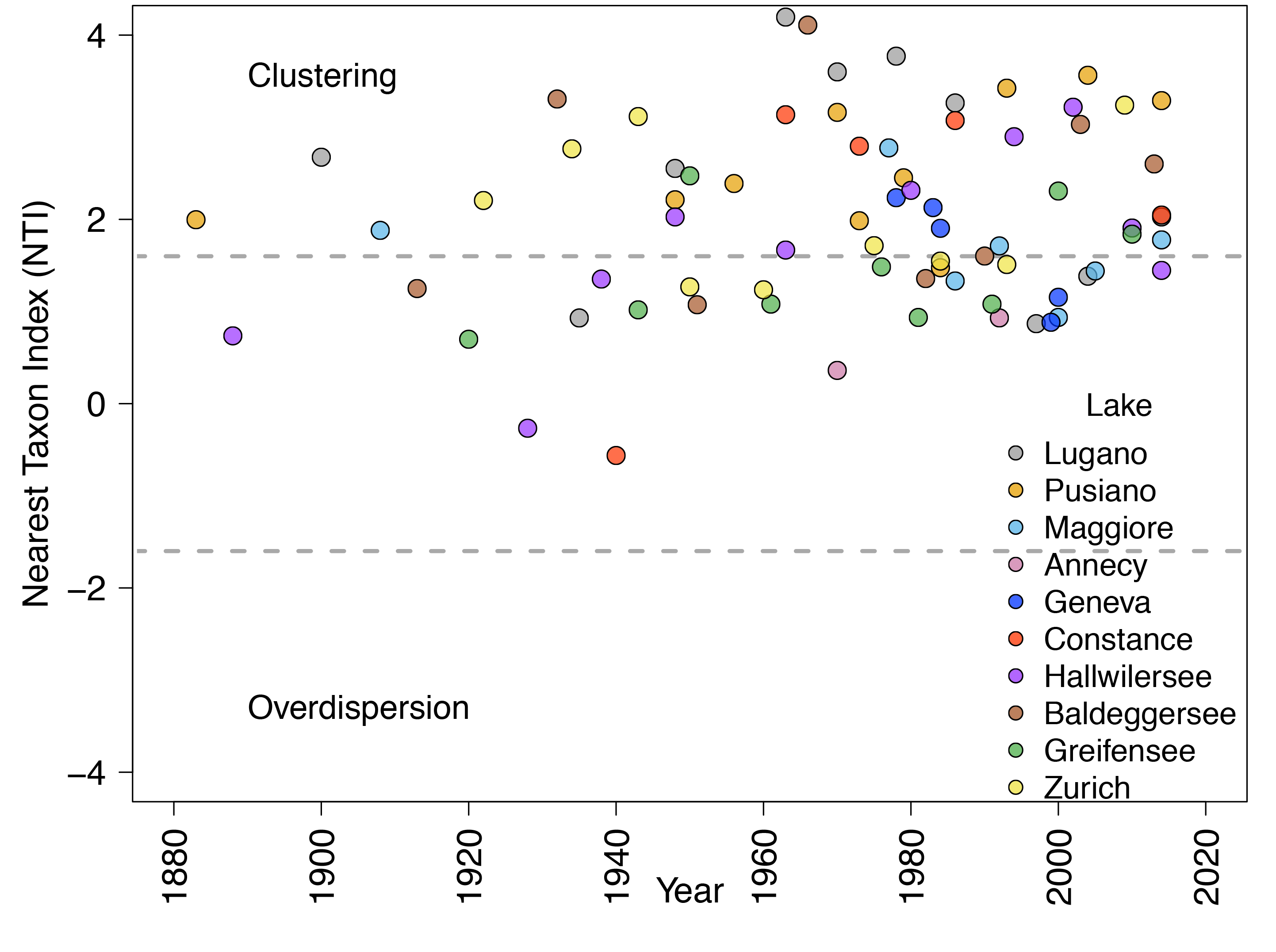
A data point for every community of photosynthesizing cyanobacteria studied shows whether the composition of the community is random (middle section) or whether it is affected by environmental factors (above or below the dashed lines).
(Source: Monchamp et al., 2019)

Interest aroused among the research community

The findings have created quite a stir in the academic community. “I posted the initial findings on Twitter, which aroused a lot of interest”, says Monchamp. Although the presence of non-photosynthesizing cyanobacteria in other aquatic ecosystems had been documented, nobody had studied them within their natural habitat. “Our data collected over a relatively long period of time and a wide geographical area provide an interesting insight into where they live”, says Monchamp. “Further research can now build on this foundation to investigate the ecology of non-photosynthesizing cyanobacteria.”

Original publications

Extbase Variable Dump
array(2 items)
   publications => '18744,16026,18412' (17 chars)
   libraryUrl => '' (0 chars)
Extbase Variable Dump
array(3 items)
   0 => Snowflake\Publications\Domain\Model\Publicationprototypepersistent entity (uid=18744, pid=124)
      originalId => protected18744 (integer)
      authors => protected'Monchamp, M.-E.; Spaak, P.; Pomati, F.' (53 chars)
      title => protected'High dispersal levels and lake warming are emergent drivers of cyanobacteria
         l community assembly in peri-Alpine lakes
' (117 chars) journal => protected'Scientific Reports' (18 chars) year => protected2019 (integer) volume => protected9 (integer) issue => protected'' (0 chars) startpage => protected'7366 (8 pp.)' (12 chars) otherpage => protected'' (0 chars) categories => protected'' (0 chars) description => protected'Disentangling the relative importance of deterministic and stochastic proces
         ses in shaping natural communities is central to ecology. Studies about comm
         unity assembly over broad temporal and spatial scales in aquatic microorgani
         sms are scarce. Here, we used 16S rDNA sequence data from lake sediments to
         test for community assembly patterns in cyanobacterial phylogenies across te
         n European peri-Alpine lakes and over a century of eutrophication and climat
         e warming. We studied phylogenetic similarity in cyanobacterial assemblages
         over spatial and temporal distance, and over environmental gradients, compar
         ing detected patterns with theoretical expectations from deterministic and s
         tochastic processes. We found limited evidence for deviation of lake communi
         ties from a random assembly model and no significant effects of geographic d
         istance on phylogenetic similarity, suggesting no dispersal limitation and h
         igh levels of stochastic assembly. We detected a weak influence of phosphoru
         s, but no significant effect of nitrogen levels on deviation of community ph
         ylogenies from random. We found however a significant decay of phylogenetic
         similarity for non-random communities over a gradient of air temperature and
          water column stability. We show how phylogenetic data from sedimentary arch
         ives can improve our understanding of microbial community assembly processes
         , and support previous evidence that climate warming has been the strongest
         environmental driver of cyanobacterial community assembly over the past cent
         ury.
' (1524 chars) serialnumber => protected'2045-2322' (9 chars) doi => protected'10.1038/s41598-019-43814-2' (26 chars) uid => protected18744 (integer) _localizedUid => protected18744 (integer)modified _languageUid => protectedNULL _versionedUid => protected18744 (integer)modified pid => protected124 (integer)
1 => Snowflake\Publications\Domain\Model\Publicationprototypepersistent entity (uid=16026, pid=124) originalId => protected16026 (integer) authors => protected'Monchamp, M.-E.; Spaak, P.; Domaizon, I.; Dubois, N.; Bo
         uffard, D.; Pomati, F.
' (108 chars) title => protected'Homogenization of lake cyanobacterial communities over a century of climate
         change and eutrophication
' (101 chars) journal => protected'Nature Ecology & Evolution' (26 chars) year => protected2018 (integer) volume => protected2 (integer) issue => protected'' (0 chars) startpage => protected'317' (3 chars) otherpage => protected'324' (3 chars) categories => protected'' (0 chars) description => protected'Human impacts on biodiversity are well recognized, but uncertainties remain
         regarding patterns of diversity change at different spatial and temporal sca
         les. Changes in microbial assemblages are, in particular, not well understoo
         d, partly due to the lack of community composition data over relevant scales
          of space and time. Here, we investigate biodiversity patterns in cyanobacte
         rial assemblages over one century of eutrophication and climate change by se
         quencing DNA preserved in the sediments of ten European peri-Alpine lakes. W
         e found species losses and gains at the lake scale, while species richness i
         ncreased at the regional scale over approximately the past 100 years. Our da
         ta show a clear signal for beta diversity loss, with the composition and phy
         logenetic structure of assemblages becoming more similar across sites in the
          most recent decades, as have the general environmental conditions in and ar
         ound the lakes. We attribute patterns of change in community composition to
         raised temperatures affecting the strength of the thermal stratification and
         , as a consequence, nutrient fluctuations, which favoured cyanobacterial tax
         a able to regulate buoyancy. Our results reinforce previous reports of human
         -induced homogenization of natural communities and reveal how potentially to
         xic and bloom-forming cyanobacteria have widened their geographic distributi
         on in the European temperate region.
' (1404 chars) serialnumber => protected'' (0 chars) doi => protected'10.1038/s41559-017-0407-0' (25 chars) uid => protected16026 (integer) _localizedUid => protected16026 (integer)modified _languageUid => protectedNULL _versionedUid => protected16026 (integer)modified pid => protected124 (integer)
2 => Snowflake\Publications\Domain\Model\Publicationprototypepersistent entity (uid=18412, pid=124) originalId => protected18412 (integer) authors => protected'Monchamp, M.-E.; Spaak, P.; Pomati, F.' (53 chars) title => protected'Long term diversity and distribution of non-photosynthetic cyanobacteria in
         peri-Alpine lakes
' (93 chars) journal => protected'Frontiers in Microbiology' (25 chars) year => protected2019 (integer) volume => protected9 (integer) issue => protected'' (0 chars) startpage => protected'3344 (11 pp.)' (13 chars) otherpage => protected'' (0 chars) categories => protected'Melainabacteria; ML635J-21; Sericytochromatia; metabarcoding; sedimentary DN
         A; distance-decay relationship; meta-community; anthropocene
' (136 chars) description => protected'The phylum Cyanobacteria comprises a non-photosynthetic lineage. The diversi
         ty and distribution of non-photosynthetic cyanobacteria (NCY) across aquatic
          environments are currently unknown, including their ecology. Here, we repor
         t about composition and phylogenetic diversity of two clades of NCY in ten l
         akes of the European peri-Alpine region, over the past ~100 years. Using 16S
          rDNA sequences obtained from dated sediment cores, we found almost equal pr
         oportion of taxa assigned to Melainabacteria and the deepest-branching group
          Sericytochromatia (ML635J-21) (63 total detected taxa). The topology of our
          reconstructed phylogenies reflected evolutionary relationships expected fro
         m previous work, that is, a clear separation between the deepest branching S
         ericytochromatia, the Melainabacteria, and the photosynthetic cyanobacteria
         clades. While different lakes harbored distinct NCY communities, the diversi
         ty of NCY assemblages within and between lakes (alpha and beta diversity) di
         d not significantly change over the last century. This is in contrast with w
         hat was previously reported for photosynthetic cyanobacteria. Unchanged comm
         unity phylogenetic similarity over geographic distance indicated no dispersa
         l limitation of NCY at the regional scale. Our results solicit studies linki
         
         
         -scale anthropogenic environmental changes. This is the first attempt to stu
         dy the diversity and distribution of NCY taxa across temperate lakes. It pro
         vides a first step towards understanding their distribution and ecological f
         unction in pelagic aquatic habitats, where these organisms seem to be preval
         ent.
' (1752 chars) serialnumber => protected'' (0 chars) doi => protected'10.3389/fmicb.2018.03344' (24 chars) uid => protected18412 (integer) _localizedUid => protected18412 (integer)modified _languageUid => protectedNULL _versionedUid => protected18412 (integer)modified pid => protected124 (integer)
Monchamp, M.-E.; Spaak, P.; Pomati, F. (2019) High dispersal levels and lake warming are emergent drivers of cyanobacterial community assembly in peri-Alpine lakes, Scientific Reports, 9, 7366 (8 pp.), doi:10.1038/s41598-019-43814-2, Institutional Repository
Monchamp, M.-E.; Spaak, P.; Domaizon, I.; Dubois, N.; Bouffard, D.; Pomati, F. (2018) Homogenization of lake cyanobacterial communities over a century of climate change and eutrophication, Nature Ecology & Evolution, 2, 317-324, doi:10.1038/s41559-017-0407-0, Institutional Repository
Monchamp, M.-E.; Spaak, P.; Pomati, F. (2019) Long term diversity and distribution of non-photosynthetic cyanobacteria in peri-Alpine lakes, Frontiers in Microbiology, 9, 3344 (11 pp.), doi:10.3389/fmicb.2018.03344, Institutional Repository

Cyanobacteria

Cyanobacteria have a major role to play in the global cycles of carbon dioxide and oxygen. In lay terms, these unicellular organisms are often referred to as blue-green algae, but from a biological standpoint they are classified as bacteria. As some of the first living organisms, over two billion years ago the ancestors of modern cyanobacteria were able to split water and produce oxygen. They were photosynthesizers, and so they increased the amount of oxygen in the atmosphere. Around 2,000 species of these organisms have been identified, and they form the lowest rung of the food chain for many animals. Cyanobacteria have adapted to extreme conditions and have colonised deserts, freshwater and saltwater environments, hot springs and salt-containing rocks, and can be found the world over, from the tropics to the poles.