News Detail

Fluoride in groundwater: global map shows all risk areas for the first time

August 11, 2022 | Isabel Plana

As an additive in toothpaste, it protects our teeth from decay. But when fluoride occurs in nature in larger quantities and accumulates in groundwater, it can become a hazard for our health. For the first time, Eawag scientists have produced a detailed map of global fluoride contamination in groundwater and shown which regions of the world are particularly affected.

Not every pollutant in man-made. Some occur naturally in rock and thus also in groundwater. For example fluoride, which has a toxic effect when ingested in large quantities and causes bones and joints to degenerate. Besides geology, climate is a decisive factor for fluoride accumulation in groundwater. Concentrations are particularly high in hot, dry regions: On the one hand, because higher temperatures favour weathering and thus the dissolution of fluoride from the rock, and on the other hand, because the fluoride remains in the groundwater for a longer period of time, as this is renewed only very slowly due to the low amounts of precipitation. The assumption is obvious that with climate change and the advancing desertification in many parts of the earth, the fluoride problem could also become more acute.

To make matters worse, fluoride often goes undetected because it is odourless and invisible. Only water analyses provide information about excessive concentrations. In many countries of the global south, however, groundwater is hardly tested, and quite a few people get their water directly from a groundwater pump. The risk areas are therefore not widely known, and there are many gaps,” says Joel Podgorski, who is doing research on water resources and drinking water at Eawag. “We wanted to fill these gaps with our work to create a basis for better groundwater monitoring.”

Machine-Learning closes gaps in knowledge

Joel Podgorski and his colleague Michael Berg have developed a model based on machine learning. Based on certain soil properties as well as topographical, geological and climatic factors, this model calculates the probability of the fluoride content being above the health-relevant threshold limits of 1.5 milligrams per litre. A prerequisite for the model to function is sufficient measurement data to train the computer algorithm. “Our first trial a few years ago failed because we had too little measurement data for a reliable model,” says Podgorski.. In the meantime, however, more and more countries are making their data publicly accessible. That is why the two researchers were able to create a database of 400,000 fluoride measurements in groundwater - the largest global dataset to date.
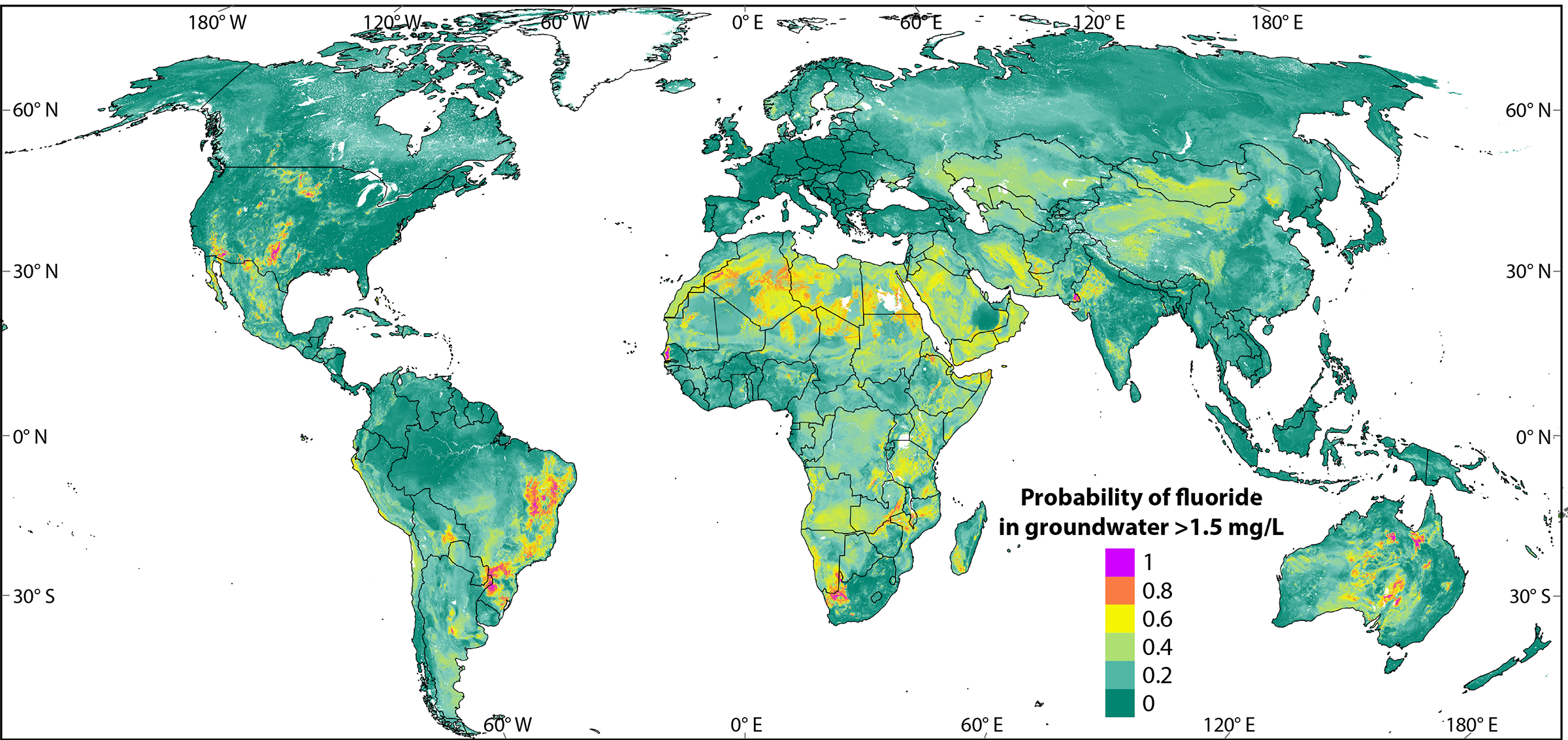
 

The map shows the nationwide probability of fluoride concentration in groundwater exceeding the threshold limits set by the World Health Organisation. Virtually all of Africa and large parts of Asia have potentially hazardous fluoride exposure. An interactive version of the map is available on the GIS-Platform gapmaps.org.

The result is a map that shows, with a high resolution of 250 metres, where there is a risk of fluoride limits being exceeded. “We see that the concentrations are likely to be too high in southern America, Central Asia, China and Mongolia, for example. In countries where groundwater has hardly been tested so far”, says Podgorski. The risk is low in Switzerland and Europe. “Our results thus provide new information for researchers and authorities on-site and give an important impetus to take a closer look at groundwater in the affected regions in the future and to take measures, such as campaigns to sensitise the population or defluoridate drinking water.” Podgorski was surprised that the model also predicts high fluoride concentrations for areas in north-eastern Brazil. “This doesn’t fit the usual pattern of dry areas having high fluoride levels in groundwater.” This is an interesting result, which encourages a more detailed investigation of the situation in this region in a future study - as Podgorski and other researchers have already done recently for Ghana and Pakistan.

Many people affected, many open questions

In addition to the risk areas, the two researchers also calculated how many people worldwide are at risk from fluoride exposure. To do this, they not only used population figures, but also took into account data on water consumption. Because whether fluoride is problematic ultimately depends on where people get their drinking water from, whether it comes treated from a tap or directly from a groundwater pump. The calculation showed that potentially around 180 million people worldwide are exposed to fluoride contaminated groundwater. And almost exclusively in Asia and Africa.
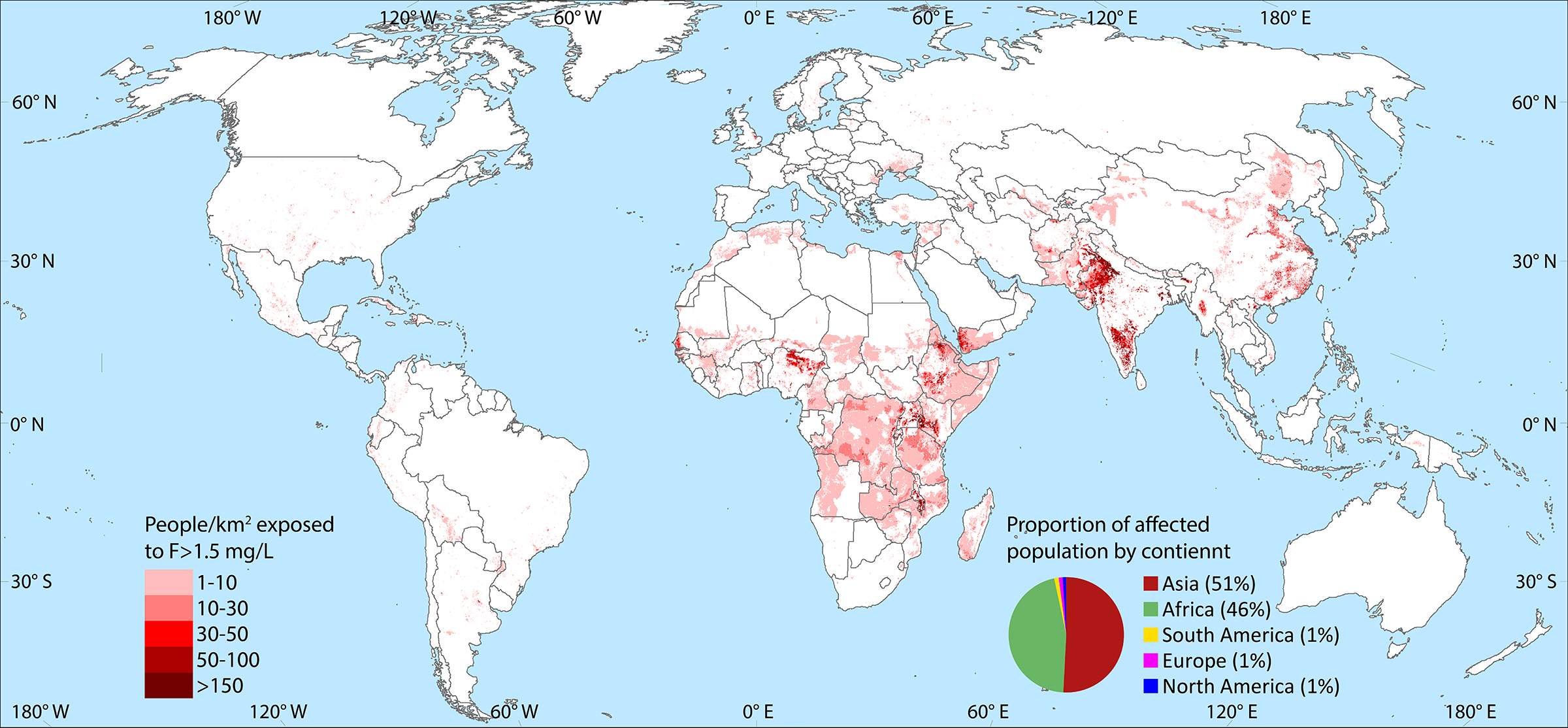
 

Excessive fluoride concentrations are not only hazardous where people draw untreated drinking water from wells and groundwater pumps. In Australia, for example, practically no-one is at risk, even though fluoride levels in groundwater are above the threshold limits in many places. In Africa and Asia, on the other hand, a total of 170 million people are affected. An interactive version of the map is available on the GIS-Platform gapmaps.org.

The extent to which fluoride form groundwater finds its way into agricultural products and thus into foodstuffs, as is the case with the heavy metal arsenic in rice, has so far been little researched. “I am always amazed at how many issues related to fluoride are still unresolved,” says Podgorski. “There is a lot of research that still needs to be done. Especially as climate change could exacerbate fluoride exposure in many regions. I think our map not only creates an important basis for preventive measures, but also for further research questions.”
 

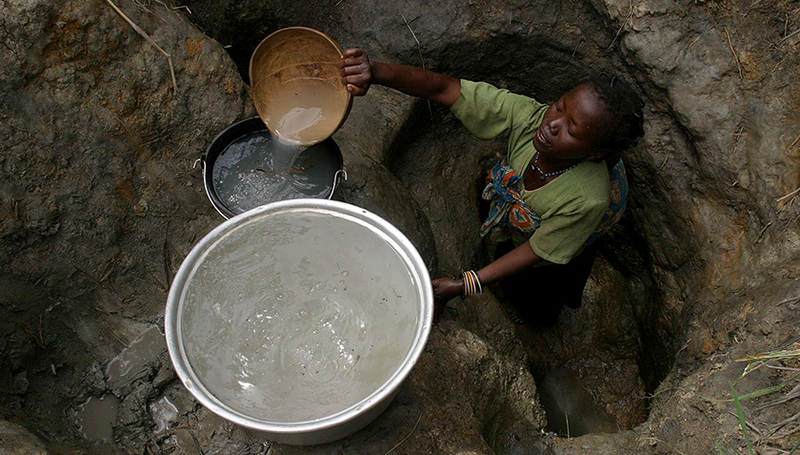
Cover picture: Drawing water daily from a water hole in the Central African Republic. (Photo: Unicef/Pierre Hotz)
 

Original publication

Extbase Variable Dump
array(2 items)
   publications => '25552' (5 chars)
   libraryUrl => '' (0 chars)
Extbase Variable Dump
array(1 item)
   0 => Snowflake\Publications\Domain\Model\Publicationprototypepersistent entity (uid=25552, pid=124)
      originalId => protected25552 (integer)
      authors => protected'Podgorski, J.; Berg, M.' (33 chars)
      title => protected'Global analysis and prediction of fluoride in groundwater' (57 chars)
      journal => protected'Nature Communications' (21 chars)
      year => protected2022 (integer)
      volume => protected13 (integer)
      issue => protected'1' (1 chars)
      startpage => protected'4232 (9 pp.)' (12 chars)
      otherpage => protected'' (0 chars)
      categories => protected'' (0 chars)
      description => protected'The health of millions of people worldwide is negatively impacted by chronic
          exposure to elevated concentrations of geogenic fluoride in groundwater. Du
         e to health effects including dental mottling and skeletal fluorosis, the Wo
         rld Health Organization maintains a maximum guideline of 1.5 mg/L in drink
         ing water. As groundwater quality is not regularly tested in many areas, it
         is often unknown if the water in a given well or spring contains harmful lev
         els of fluoride. Here we present a state-of-the-art global fluoride hazard m
         ap based on machine learning and over 400,000 fluoride measurements (10% of
         which >1.5 mg/L), which is then used to estimate the human population a
         t risk. Hotspots indicated by the groundwater fluoride hazard map include pa
         rts of central Australia, western North America, eastern Brazil and many are
         as of Africa and Asia. Of the approximately 180 million people potentially a
         ffected worldwide, most reside in Asia (51–59% of total) and Africa (37-46
         % of total), with the latter representing 6.5% of the continent’s populati
         on. Africa also contains 14 of the top 20 affected countries in terms of pop
         ulation at risk. We also illuminate and discuss the key globally relevant hy
         drochemical and environmental factors related to fluoride accumulation.
' (1287 chars) serialnumber => protected'' (0 chars) doi => protected'10.1038/s41467-022-31940-x' (26 chars) uid => protected25552 (integer) _localizedUid => protected25552 (integer)modified _languageUid => protectedNULL _versionedUid => protected25552 (integer)modified pid => protected124 (integer)
Podgorski, J.; Berg, M. (2022) Global analysis and prediction of fluoride in groundwater, Nature Communications, 13(1), 4232 (9 pp.), doi:10.1038/s41467-022-31940-x, Institutional Repository

More work on the topic

Extbase Variable Dump
array(2 items)
   publications => '24949,24363' (11 chars)
   libraryUrl => '' (0 chars)
Extbase Variable Dump
array(2 items)
   0 => Snowflake\Publications\Domain\Model\Publicationprototypepersistent entity (uid=24949, pid=124)
      originalId => protected24949 (integer)
      authors => protected'Ling, Y.; Podgorski, J.; Sadiq, M.; Rasheed, H.; Eqani,&
         nbsp;S. A. M. A. S.; Berg, M.
' (130 chars) title => protected'Monitoring and prediction of high fluoride concentrations in groundwater in
         Pakistan
' (84 chars) journal => protected'Science of the Total Environment' (32 chars) year => protected2022 (integer) volume => protected839 (integer) issue => protected'' (0 chars) startpage => protected'156058 (9 pp.)' (14 chars) otherpage => protected'' (0 chars) categories => protected'aquifers; geogenic groundwater pollution; drinking water quality; human heal
         th threat; fluorosis; random forest modeling
' (120 chars) description => protected'Concentrations of naturally occurring fluoride in groundwater exceeding the
         WHO guideline of 1.5 mg/L have been detected in many parts of Pakistan. This
          may lead to dental or skeletal fluorosis and thereby poses a potential thre
         at to public health. Utilizing a total of 5483 fluoride concentrations, comp
         rising 2160 new measurements as well as those from other sources, we have ap
         plied machine learning techniques to predict the probability of fluoride in
         groundwater in Pakistan exceeding 1.5 mg/L at a 250 m spatial resolution. Cl
         imate, soil, lithology, topography, and land cover parameters were identifie
         d as effective predictors of high fluoride concentrations in groundwater. Ex
         cellent model performance was observed in a random forest model that achieve
         d an Area Under the Curve (AUC) of 0.92 on test data that were not used in m
         odeling. The highest probabilities of high fluoride concentrations in ground
         water are predicted in the Thar Desert, Sargodha Division, and scattered alo
         ng the Sulaiman Mountains. Applying the model predictions to the population
         density and accounting for groundwater usage in both rural and urban areas,
         we estimate that about 13 million people may be at risk of fluorosis due to
         consuming groundwater with fluoride concentrations >1.5 mg/L in Pakistan,
          which corresponds to ~6% of the total population. Both the fluoride predict
         ion map and the health risk map can be used as important decision-making too
         ls for authorities and water resource managers in the identification and mit
         igation of groundwater fluoride contamination.
' (1566 chars) serialnumber => protected'0048-9697' (9 chars) doi => protected'10.1016/j.scitotenv.2022.156058' (31 chars) uid => protected24949 (integer) _localizedUid => protected24949 (integer)modified _languageUid => protectedNULL _versionedUid => protected24949 (integer)modified pid => protected124 (integer)
1 => Snowflake\Publications\Domain\Model\Publicationprototypepersistent entity (uid=24363, pid=124) originalId => protected24363 (integer) authors => protected'Araya, D.; Podgorski, J.; Kumi, M.; Mainoo, P. A.;
         Berg, M.
' (89 chars) title => protected'Fluoride contamination of groundwater resources in Ghana: country-wide hazar
         d modeling and estimated population at risk
' (119 chars) journal => protected'Water Research' (14 chars) year => protected2022 (integer) volume => protected212 (integer) issue => protected'' (0 chars) startpage => protected'118083 (10 pp.)' (15 chars) otherpage => protected'' (0 chars) categories => protected'Africa; drinking water resources; human health; fluorosis; random forest mod
         eling; groundwater pollution; geogenic contamination
' (128 chars) description => protected'Most people in Ghana have no or only basic access to safely managed water. E
         specially in rural areas, much of the population relies on groundwater for d
         rinking, which can be contaminated with fluoride and lead to dental fluorosi
         s. Children under the age of two are particularly susceptible to the adverse
          effects of fluoride and can retain 80-90% of a fluoride dose, compared to 6
         0% in adults. Despite numerous local studies, no spatially continuous pictur
         e exists of the fluoride contamination across Ghana, nor is there any estima
         te of what proportion of the population is potentially exposed to unsafe flu
         oride levels. Here, we spatially model the probability of fluoride concentra
         tions exceeding 1.0 mg/L in groundwater across Ghana to identify risk areas
          and estimate the number of children and adults exposed to unsafe fluoride l
         evels in drinking water. We use a set of geospatial predictor variables with
          random forest modeling and evaluate the model performance through spatial c
         ross-validation. We found that approximately 15% of the area of Ghana, mainl
         y in the northeast, has a high probability of fluoride contamination. The to
         tal at-risk population is about 920,000 persons, or 3% of the population, wi
         th an estimated 240,000 children (0-9 years) in at-risk areas. In some distr
         icts, such as Karaga, Gushiegu, Tamale and Mion, 4 out of 10 children are po
         tentially exposed to fluoride poisoning. Geology and high evapotranspiration
          are the main drivers of fluoride enrichment in groundwater. Consequently, c
         limate change might put even greater pressure on the area's water resources.
          Our hazard maps should raise awareness and understanding of geogenic fluori
         de contamination in Ghana and can advise decision making at local levels to
         avoid or mitigate fluoride-related risks.
' (1789 chars) serialnumber => protected'0043-1354' (9 chars) doi => protected'10.1016/j.watres.2022.118083' (28 chars) uid => protected24363 (integer) _localizedUid => protected24363 (integer)modified _languageUid => protectedNULL _versionedUid => protected24363 (integer)modified pid => protected124 (integer)
Ling, Y.; Podgorski, J.; Sadiq, M.; Rasheed, H.; Eqani, S. A. M. A. S.; Berg, M. (2022) Monitoring and prediction of high fluoride concentrations in groundwater in Pakistan, Science of the Total Environment, 839, 156058 (9 pp.), doi:10.1016/j.scitotenv.2022.156058, Institutional Repository
Araya, D.; Podgorski, J.; Kumi, M.; Mainoo, P. A.; Berg, M. (2022) Fluoride contamination of groundwater resources in Ghana: country-wide hazard modeling and estimated population at risk, Water Research, 212, 118083 (10 pp.), doi:10.1016/j.watres.2022.118083, Institutional Repository

Funding / Partnerships

The work was supported by the Swiss Agency for Cooperation and Development (SDC).