
News Detail
Green and blue food webs are wired differently
November 7, 2022 |
Biodiversity emerges not only from the sum of all species present, but rather from the interactions between them. The most basic form of interaction is the feeding relationship. Recording all the feeding relationships between species of an ecosystem results in a complex network, known as a food web. The fact that food webs differ becomes clear when looking at terrestrial (green) and aquatic (blue) ecosystems – after all, rivers and meadows accommodate different communities. "At first glance, this observation seems trivial," says Florian Altermatt, Professor of Aquatic Ecology at the University of Zurich and group leader at Eawag. "But in fact, we still know little about how green and blue food webs are structured, how they differ structurally, and whether they respond differently to land use and climate influences." Previous studies have examined food webs either limited to a specific site or isolated to a particular animal or plant species – a large-scale analysis encompassing many sites and species across aquatic and terrestrial ecosystems has never been done before.
Altermatt and Eawag postdoctoral researcher Hsi-Cheng Ho, together with researchers from the Swiss Federal Institute for Forest, Snow and Landscape Research WSL, ETH Zurich and the Universities of Bern and Zurich, wanted to close this gap. As part of the "Blue-Green Biodiversity" research initiative (see box at the end), they investigated for the first time for a large, contiguous area – the territory of Switzerland – how green and blue food webs are structured and how they change in response to climatic and human influences.
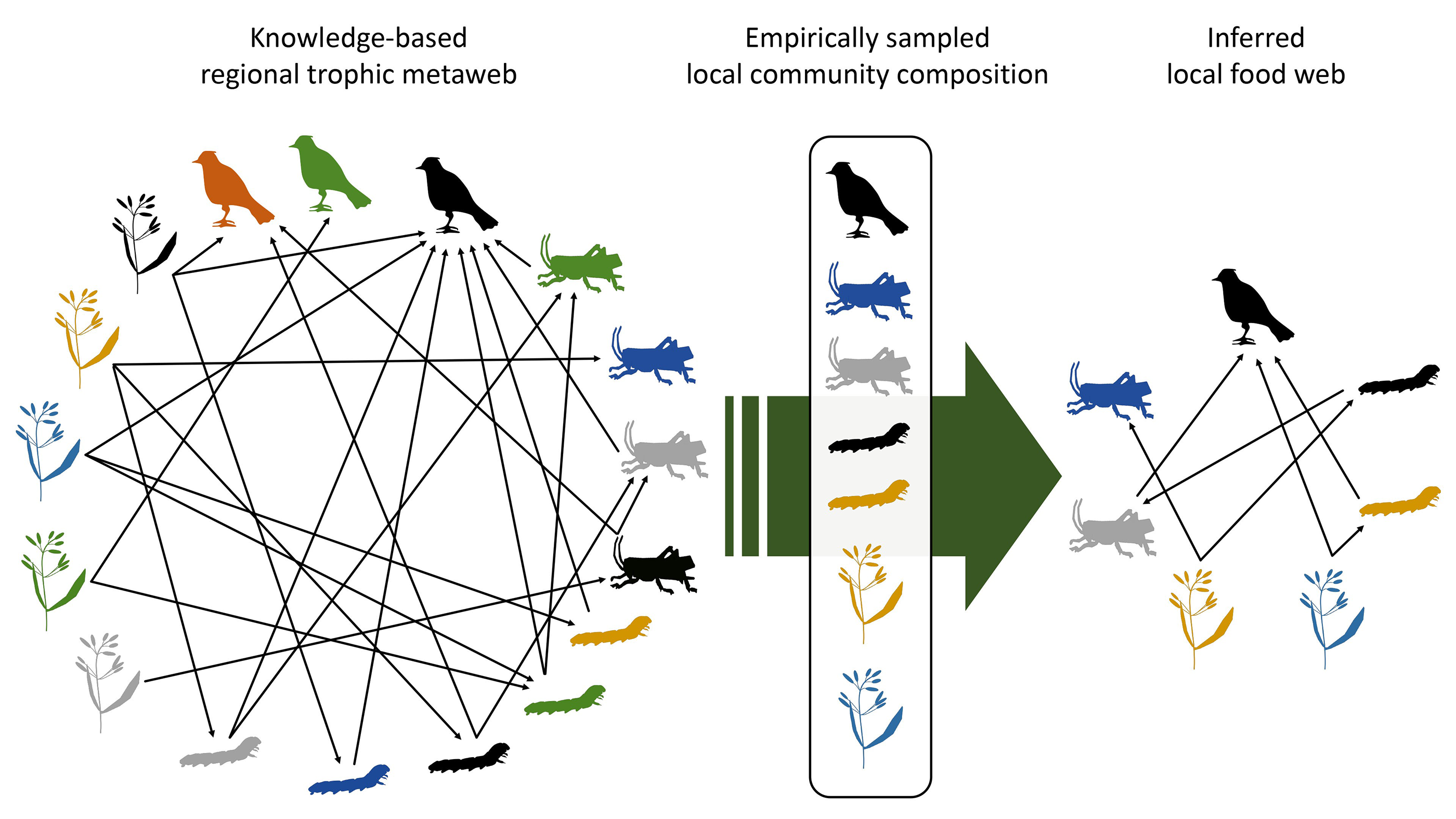
Food web diagram: The food web of a locally observed species community can be inferred from the knowledge-based feeding relationships between different species. (Graphic: Eawag)
Almost 1,000 food webs studied
The comprehensive study was based on data from biodiversity monitoring programmes of the Swiss Confederation, the Swiss Centre for the Cartography of Fauna "Info Fauna" and Eawag, all of which document the occurrence of various animal and plant species at nearly 1,000 sites distributed representatively throughout Switzerland. Based on these occurrences, species interactions were derived and potential food webs reconstructed. At half of these sites, the scientists studied the terrestrial food webs formed by plants, butterflies, grasshoppers and birds; at the other half, they looked at aquatic food webs of fish, aquatic insects and other water invertebrates. The researchers used certain criteria to analyse how the individual food webs are structured. For example, how many connections, i.e. feeding relationships, there are in total and whether these relationships are spread evenly within the food web or, like hotspots, are only to be expected in some species communities.
The next step was to determine the predominant land use – including forest and agriculture – and elevation above sea level for each site. "Elevation and climate change affect food webs in a similar way because they affect the occurrence of organisms through temperature. Elevation can therefore be seen as a proxy for the potential of climate change – taking into account a few other factors," Ho explains. Finally, depending on land use and altitude, i.e. climate, the researchers compared all food webs with each other.
Protecting biodiversity intelligently
The comparison shows that green and blue food webs are fundamentally different in their structural characteristics and that they also respond differently to changes in land use and elevation. "In green food webs, for example, we observe fewer food niches with decreasing altitude, i.e. increasing temperature," Ho says. Hence, specialists that have a narrow food spectrum, such as larvae of butterflies feeding on only one particular plant, are likely to have a harder time in a warmer climate. "What's interesting," Ho continued, "is that the blue food webs behave in exactly the opposite way. The food niches, to stick with this metric, become more numerous the lower the elevation. So rising temperatures result in other changes in aquatic food webs." There, specialists may benefit from rising temperatures.
These findings shed new light on measures to protect biodiversity. Preserving as many species as possible – the goal of most efforts to date – may not always be the most effective approach, as Altermatt points out. "The key is to first protect the species that are most important to the food web." He compares it to clockwork: "Some cogs you can leave out and the clock still works. Others, however, are essential; without them, the clock doesn't work any more." But to know which cogs, or species, are essential, you need to know the blueprint and logic of the clockwork, or food web. With their work, Ho, Altermatt and their colleagues have laid the foundation.
Blue-Green Biodiversity Research Initiative
The research project "The architecture of community structure, functional traits and trophic networks across blue-green ecosystems" contributes to the Blue-Green Biodiversity research initiative - an Eawag-WSL collaboration addressing biodiversity at the interface of aquatic and terrestrial ecosystems. The initiative is funded by the ETH Board.
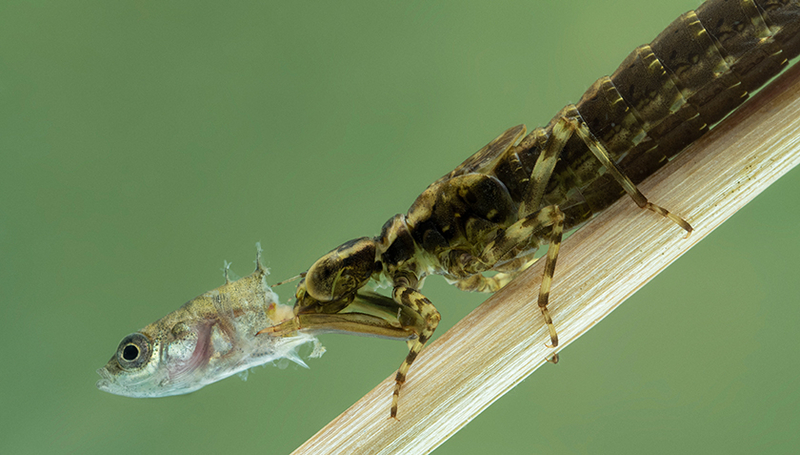
Cover picture: Aquatic food web: Dragonfly nymph (Epiprocta species) eats a three-spined stickleback (Gasterosteus aculeatus). (Photo: Ernie Cooper, Shutterstock)