News Detail

Improved health check for running waters

December 2, 2019 | Bärbel Zierl

Invertebrates on the beds of water bodies are observed closely, for they serve as indicators for the ecological status of running waters. A new Swiss-wide study by the aquatic research institute Eawag shows which species are especially good indicators, and how the monitoring and management of surface waters can be further improved.

If one turns a stone over in a river or stream, it swarms with tiny animals: caddisflies, water beetles, freshwater shrimp, and snails. The invertebrates living on the beds of water bodies that can be seen with the naked eye, called macroinvertebrates, are rather unimposing, but for science and the protection of surface waters they are of great importance. Several species in this group are very sensitive to changes in their environment, for example pollutants or construction along the shore or in the catchment area of the water body. On the other hand, some other species are tolerant to such influences. The diversity of the small animals therefore allows important conclusions concerning the water itself and the aquatic ecosystem as well. Sometimes they can even point to the causes of worsening ecological conditions.

Swiss-wide model-supported analysis of small invertebrates

For the first time, Eawag researchers Nele Schuwirth and Bogdan Caradima, together with colleagues in the Department of Systems Analysis, Integrated Assessment and Modelling, have carried out a combined analysis of cantonal and federal monitoring data on macroinvertebrates. For this study they used the database MIDAT of the “Schweizerisches Zentrum für die Kartografie der Fauna (SZKF)”. This database contains the macroinvertebrate data of the biodiversity monitoring BDM, the National Surface Water Quality Monitoring Programme NAWA and 14 cantonal monitoring programmes.

Because the programmes contain data on invertebrates identified at different taxonomic levels – family, genus, species - , the datasets first had to be harmonized. Then the researchers used statistical models to analyse the data and identify major direct and indirect influence factors for the occurrence of each taxonomic group. These included, among others, water temperature, use of insecticides in the catchment area, flow velocity, agricultural land use and forest cover along the river banks, urban area and livestock units in the catchment. Some of these influence factors, such as water temperature, are known to affect the organisms directly. Others serve as indicators for influence factors that cannot be measured directly. For example, the forestation of the riparian zone can lead to more leaf litter input, shading of the water body and reduced input of nutrients and pollutants from the catchment area.
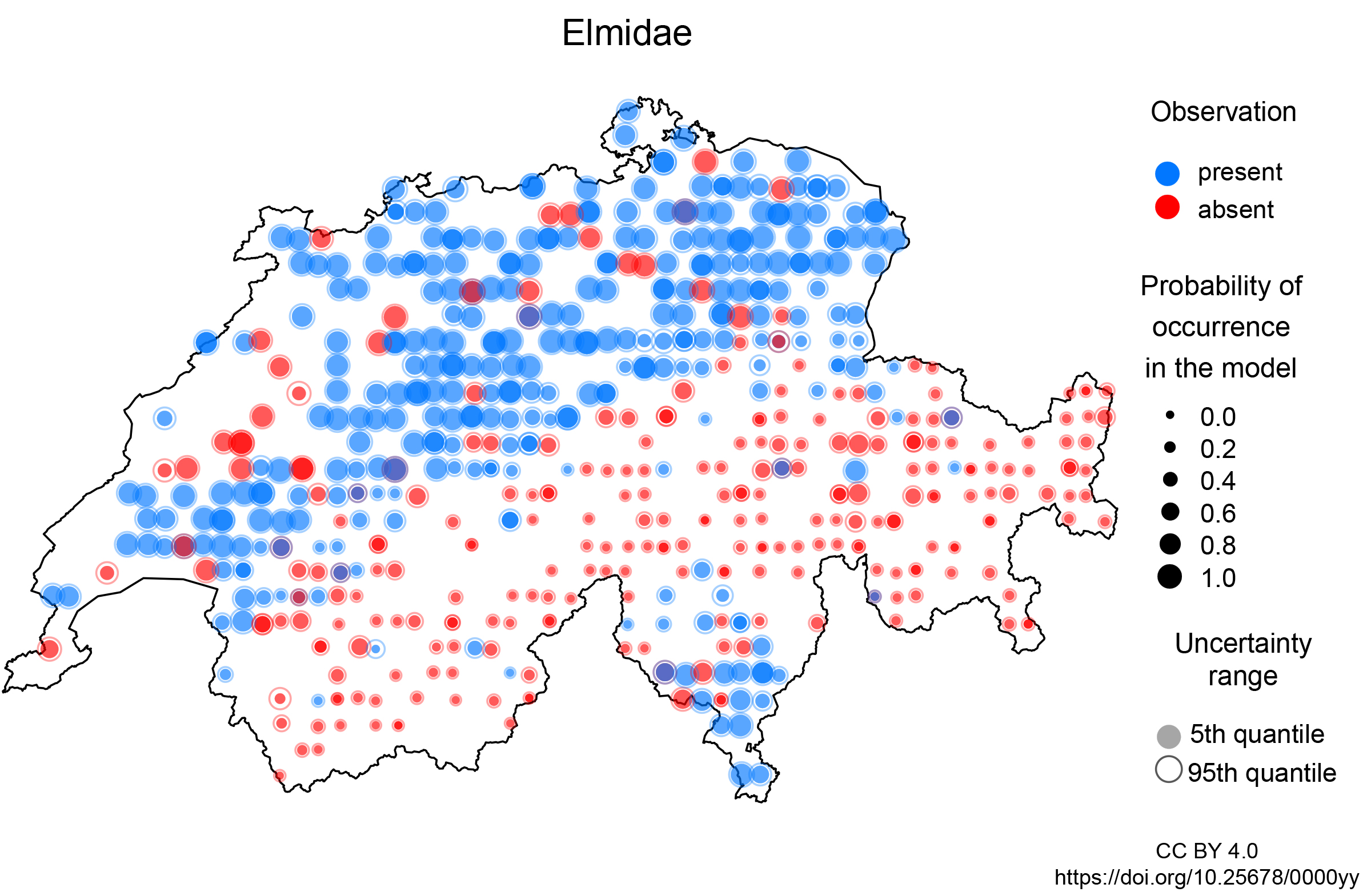
Occurrence of the beetle family Elmidae in Switzerland in the biodiversity monitoring data and in the model. Large blue dots and small red dots indicate an agreement between observation and model.

From the results, the researchers have derived recommendations for the design of the monitoring programmes and surface water manageme

Identification of causes by determination of species

Investigations and evaluation of macroinvertebrates in Swiss running waters have been carried out according to the Swiss modular concept for stream assessment since 2010. It requires the recording of the organisms on the family level. The model analysis generally confirms the assessment method: families classified as sensitive respond more strongly in the model to anthropogenic stressors. At the same time, the study shows that a finer taxonomic resolution, namely the identification of species, would provide additional valuable information. This would allow a better identification of the specific causes that could influence water or water-body quality.

More data, increased validity

The greater the volume of data available for analysis, the higher the statistical power. For future analyses it is therefore essential that as many monitoring programs as possible submit their macroinvertebrate data as well as additional information like substrate data to the MIDAT database.

Unified monitoring concepts

Today, Cantons identify different groups of macroinvertebrates down to the species level. For a Swiss-wide evaluation, it would make sense to always identify the same groups in this detailed taxonomic resolution. A unified list of taxa for species identification would therefore be an advantage. The Eawag study can contribute to judging for which groups this would be especially valuable.

Extended monitoring design

To better disentangle major influence factors on freshwater communities, it is worthwhile to include additional locations to the monitoring programme. Locations with rare combinations of influence factors are especially valuable for the analysis, such as sites with low water temperature and impaired water quality.

Integral management of surface waters

Plants and animals living in surface water ecosystems are typically sensitive to multiple stressors, for example poor water quality, monotonous high flow velocity, and increased water temperatures. In considering measures to improve the ecological status of surface waters, a combination of measures should be recommended, as far as possible and necessary. For example a restoration combined with upgrading of water treatment plants and reduction of harmful agricultural inputs upstream.

Schuwirth and Caradima have published a  more detailed summary of the results in today’s issue of the journal Aqua & Gas, in cooperation with the Federal Office for the Environment FOEN and the Atelier für Naturschutz und Umweltfragen AG UNA: “Analyse schweizweiter Makrozoobenthosdaten: Erkenntnisse über anthropogene Einflüsse und Monitoring Design”.

Extbase Variable Dump
array(2 items)
   publications => '19054,20100' (11 chars)
   libraryUrl => '' (0 chars)
Extbase Variable Dump
array(2 items)
   0 => Snowflake\Publications\Domain\Model\Publicationprototypepersistent entity (uid=19054, pid=124)
      originalId => protected19054 (integer)
      authors => protected'Caradima, B.; Schuwirth, N.; Reichert, P.' (56 chars)
      title => protected'From individual to joint species distribution models: a comparison of model
          complexity and predictive performance
' (114 chars) journal => protected'Journal of Biogeography' (23 chars) year => protected2019 (integer) volume => protected46 (integer) issue => protected'10' (2 chars) startpage => protected'2260' (4 chars) otherpage => protected'2274' (4 chars) categories => protected'benthic macroinvertebrates; biodiversity; hierarchical multispecies models;
         joint models; predictive modelling; richness; species distribution models; s
         tacked individual models
' (176 chars) description => protected'<em>Aim:</em> Species distribution models (SDMs) are widely used to study ge
         ographic distributions of taxa in response to natural and anthropogenic envi
         ronmental conditions. For a community, common approaches include fitting ind
         ividual SDMs (iSDMs) to all taxa or directly modelling community properties
         such as richness. However, the parameters of iSDMs are difficult to identify
          for rare taxa, and community properties do not reveal taxon‐specific resp
         onses. Individual models can be combined into a hierarchical multispecies di
         stribution model (mSDM) that constrains taxon‐specific parameters accordin
         g to overarching community parameters, or a joint model (jSDM) in which inte
         rdependencies between taxa are jointly inferred. We compare how individual,
         hierarchical multispecies and joint SDMs differ in quality of fit, explanato
         ry power and predictive performance, and analyse how these properties depend
          on the prevalence of taxa.<br /><em>Taxa:</em> Presence–absence observati
         ons of 245 benthic macroinvertebrate taxa identified at a mixed taxonomic re
         solution.<br /><em>Location:</em> Four hundred and ninety‐two sites in riv
         ers throughout Switzerland.<br /><em>Methods:</em> Individual, hierarchical
         and joint hierarchical generalized linear models (GLM) were developed for al
         l taxa. Parameters were estimated using maximum likelihood estimation or Bay
         esian inference with Hamiltonian Markov chain Monte Carlo simulations. Predi
         ctive performance was assessed with cross‐validation. In addition, the pre
         dicted family and species richness of the models was compared with a GLM for
          richness.<br /> Results: Individual models show a slightly higher quality o
         f fit largely due to overfitting for rare taxa. The mSDM achieves a similar
         quality of fit and explanatory power, mitigates overfitting for rare taxa an
         d considerably improves predictive performance over the whole community. The
          joint models further improve the quality of fit, but decrease predictive pe
         rformance and increase p...
' (2371 chars) serialnumber => protected'0305-0270' (9 chars) doi => protected'10.1111/jbi.13668' (17 chars) uid => protected19054 (integer) _localizedUid => protected19054 (integer)modified _languageUid => protectedNULL _versionedUid => protected19054 (integer)modified pid => protected124 (integer)
1 => Snowflake\Publications\Domain\Model\Publicationprototypepersistent entity (uid=20100, pid=124) originalId => protected20100 (integer) authors => protected'Vermeiren,&nbsp;P.; Reichert,&nbsp;P.; Schuwirth,&nbsp;N.' (57 chars) title => protected'Integrating uncertain prior knowledge regarding ecological preferences into
         multi-species distribution models: effects of model complexity on predictive
          performance
' (164 chars) journal => protected'Ecological Modelling' (20 chars) year => protected2020 (integer) volume => protected420 (integer) issue => protected'' (0 chars) startpage => protected'108956 (15 pp.)' (15 chars) otherpage => protected'' (0 chars) categories => protected'Bayesian inference; ecological niches; hierarchical modelling; multiple stre
         ssors; macroinvertebrates
' (101 chars) description => protected'Species distribution models (SDMs) are often criticised for lacking explicit
          linkage to ecological concepts. We aim to improve the ecological basis of S
         DMs by integrating prior knowledge about ecological preferences of organisms
         . Additionally, we aim to support a systematic, data-driven review of such p
         rior knowledge by confronting it with independent monitoring data using Baye
         sian inference. We developed a series of multi-species distribution models (
         MSDMs) with increasing complexity to predict the probability of occurrence o
         f taxa at sampling sites based on habitat suitability functions that are par
         ameterized with prior ecological knowledge. We subsequently assessed the mod
         els` predictive performance with 3-fold cross-validation. So far, if ecologi
         cal preferences or functional traits have been used in SDMs, they were mainl
         y used as fixed inputs without considering their uncertainty. We take the ad
         ditional step of considering uncertainty about preference parameters by incl
         uding them as uncertain prior information that is subsequently updated with
         Bayesian inference. We apply the series of models in a case study on macroin
         vertebrates in Swiss streams. We analyse differences in the quality of fit,
         changes in predictive performance, and the potential to learn about the para
         meters from the data. We consider ecological preferences for natural and hum
         an modified environmental factors including temperature, flow velocity, orga
         nic matter concentration, insecticide pollution, and substratum. Results ind
         icate that updating prior knowledge on ecological preferences with Bayesian
         inference, rather than using it as fixed input, improves model fit and predi
         ctive performance. For example, the predictive performance measured by the d
         eviance for validation data improves by 17 % and the explanatory power incre
         ases 3.8 times from a model that treats ecological preferences as fixed scor
         es to a model that treats them as uncertain parameters. The spatial distribu
         tion of many taxa, inclu...
' (2694 chars) serialnumber => protected'0304-3800' (9 chars) doi => protected'10.1016/j.ecolmodel.2020.108956' (31 chars) uid => protected20100 (integer) _localizedUid => protected20100 (integer)modified _languageUid => protectedNULL _versionedUid => protected20100 (integer)modified pid => protected124 (integer)
Caradima, B.; Schuwirth, N.; Reichert, P. (2019) From individual to joint species distribution models: a comparison of model complexity and predictive performance, Journal of Biogeography, 46(10), 2260-2274, doi:10.1111/jbi.13668, Institutional Repository
Vermeiren, P.; Reichert, P.; Schuwirth, N. (2020) Integrating uncertain prior knowledge regarding ecological preferences into multi-species distribution models: effects of model complexity on predictive performance, Ecological Modelling, 420, 108956 (15 pp.), doi:10.1016/j.ecolmodel.2020.108956, Institutional Repository

Funding

The studies were co-funded by the Federal Office for the Environment (FOEN) and the EU Horizon 2020-Programme (Projekt Aquacross, Grant agreement No. 642317).