
News Detail
New method for monitoring groundwater recharge
April 14, 2026 |
Everyone wants to use the groundwater: Traditionally, it has been used primarily to supply drinking water, but agriculture and industry are also showing increasing interest in this water resource. It is also used in the production of geothermal energy. It is therefore no surprise that this underground resource is coming under pressure and is at risk of being overexploited. This is particularly true during prolonged dry spells in summer and autumn – and these are becoming more frequent as a result of climate change. This not only causes temperatures to rise, but also alters rainfall patterns. Although the total amount of water remains roughly the same over the course of the year, there is more rainfall in winter than there used to be, and less in summer.
In addition: Climate change not only has a direct impact, but also triggers a cascade of effects. If, for example, the water table drops during a prolonged dry spell, the soil will also be dry, and more irrigation will be required. This causes the water table to drop even further.
Limited information about the subsoil
“In response to this trend, many regions around the world where water is scarce have implemented measures for artificial groundwater recharge,” says Jared van Rooyen from the Water Resources & Drinking Water Department at the Aquatic Research Institute Eawag. In many regions, river water is channelled into infiltration ditches, among other measures, to artificially replenish the groundwater. However, according to van Rooyen, “these interventions are often carried out with limited information about how much water is needed to replenish groundwater aquifers, how long this process takes, and how quickly the water flows underground.” However, a sufficiently long residence time is crucial for the quality of the groundwater. For example, in order for river water fed into the system to be used as drinking water, the law stipulates that it must first flow through the ground for ten days, thereby being purified naturally.
What hinders a better understanding is the invisible nature of groundwater. Unlike surface waters, changes in groundwater aquifers cannot be observed without targeted monitoring or modelling. “To tackle these challenges,” says Jared van Rooyen, “our method offers a new solution.” It uses the tritium-enriched cooling water discharged by nuclear power stations into major rivers as a tracer, enabling the quantitative determination of groundwater recharge rates, flow times and mixing processes in groundwater recharge systems." Among other things, this makes it easier to comply with the legal requirements designed to ensure the quality of groundwater.
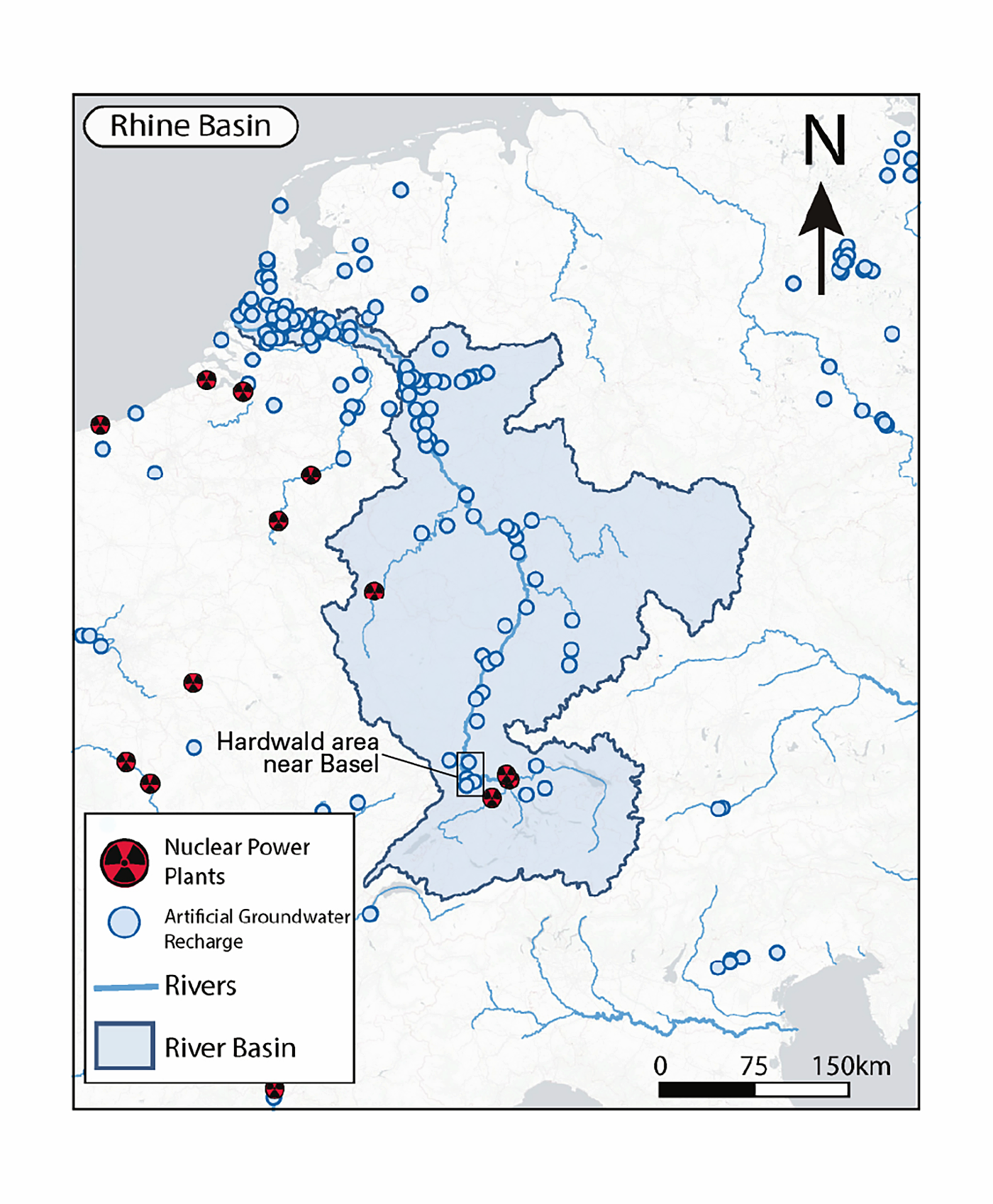
Locations of nuclear power stations and groundwater recharge systems in the Rhine catchment area. The three nuclear power stations, which discharge their cooling water into the river upstream of Hardwald, produce clearly detectable tritium signals downstream along the entire length of the Rhine. (Graphic: Jared van Rooyen, Eawag)
Impact on the design and operation of groundwater recharge schemes
Van Rooyen has just published an article on this method in the journal *Nature Water*, in collaboration with colleagues from Eawag and the Universities of Basel, Bern and Lausanne. “It represents a globally applicable, non-invasive method for quantifying transport times in the subsurface without the use of artificial tracers,” say the authors. Tritium, a radioactive isotope of hydrogen, enters Europe’s major rivers via the cooling water from nuclear power stations as part of water molecules; the water in these rivers is used for both natural and artificial groundwater recharge along their courses. The method is widely applicable: According to the study, at least 26 major river basins worldwide meet the spatial and hydrological criteria for using tritium-enriched cooling water from nuclear power plants as an environmental tracer to assess the performance of groundwater recharge systems. “Assessments carried out using this method have significant implications for the design and operation of these systems,” write the authors of the study.
A practical example: If this tracer reveals excessively high flow rates, infiltration and groundwater abstraction must be adjusted so that the residence times in the subsurface comply with legal requirements and the natural purification process can be ensured. The distribution of flow times determined using the new tracer method also provides a basis for defining the boundaries of protection zones around the wells from which the enriched groundwater is extracted. Furthermore, the tracers presented by the researchers for determining groundwater dynamics – including not only cooling water but also natural water isotope signatures in river water – are also important for protecting groundwater from overexploitation.
Measurements at Switzerland’s largest groundwater recharge area
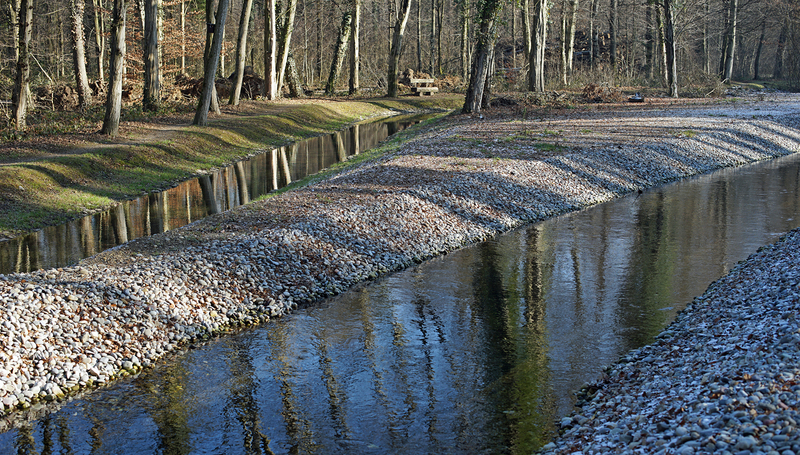
The study by Jared van Rooyen and the team led by Oliver Schilling, group leader in the Water Resources & Drinking Water Department at Eawag and assistant professor at the University of Basel, who provided technical guidance for the study, is based, among other things, on measurements taken in the Hardwald area near Basel. Around 15 million cubic metres of drinking water are extracted there each year to supply the entire region, and the groundwater is replenished using pre-treated water from the River Rhine. For the researchers, this site was of interest not only because of the large-scale artificial groundwater recharge taking place there, but above all because three nuclear power stations further upstream discharge their cooling water into the river. These discharges produce clearly detectable tritium signals downstream in the Rhine basin, not only in Basel but along the entire length of the Rhine to its mouth on the Atlantic – in other words, across Europe.
The fact that tritium can be detected over such a wide area in cooling water makes it particularly suitable as an environmental tracer. Jared van Rooyen says: "The widespread presence of nuclear power stations in large river basins offers a unique opportunity to evaluate strategies for the artificial recharge of groundwater using cooling water signatures. And on a continental scale."
Groundwater is our most important source of drinking water, but it is under pressure from climate change, pollutants and conflicts of use. The use and protection of groundwater were therefore the focus of the latest Eawag Info Day in September 2025. You can read the contributions on our website.
Cover picture: The study is based, among other things, on measurements taken in the Hardwald area near Basel, where the groundwater is replenished by pre-treated water from the Rhine and around 15 million cubic metres of drinking water are extracted annually for the entire region. (Photo: Hardwasser Ltd)