
News Detail
Otto Jaag Prize awarded twice for 2025
March 13, 2026 |
Thanks to an increase in the Otto Jaag Water Protection Prize by former Eawag Director Janet Hering, two prizes for outstanding doctoral theses were awarded in 2025. They went to environmental chemist Johannes Raths and evolutionary biologist Grégoire Saboret.
Food chain reconstructed thanks to isotope analysis
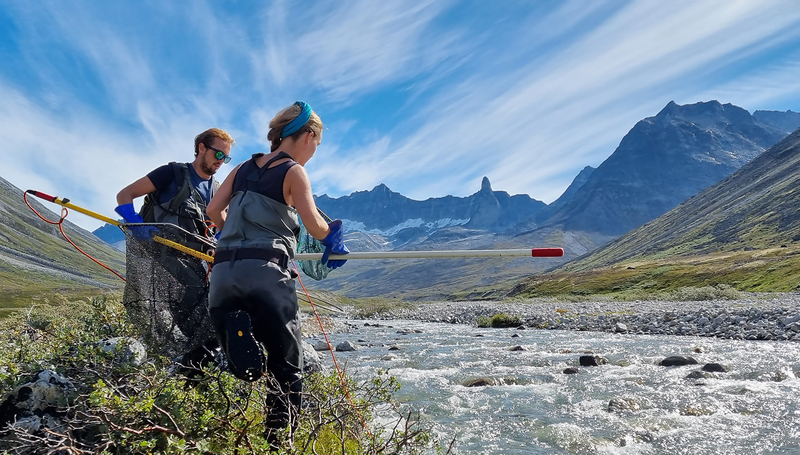
Grégoire Saboret conducted his research at Eawag in Kastanienbaum under the supervision of Prof. Carsten Schubert (Surface Water Department). Under the joint supervision of Dr Jakob Brodersen and Dr Blake Matthews (Fish Ecology and Evolution Department), he further developed isotope analyses of amino acids and applied them specifically to fish. This enabled him to expand our understanding of food webs, as the markers provide information about primary producers (algae and bacteria) and all intermediate consumers on which they fed. Among other things, Saboret has shown how eutrophication of lakes affects production sources in the food webs of Swiss lakes and how the current melting of glaciers in Greenland is changing the diet of fish.
Fish eyes with annual rings
Grégoire Saboret has received a mobility grant from the Swiss National Science Foundation and is currently at the University of California in Santa Cruz. However, he continues to conduct research and publish articles together with colleagues at Eawag. A publication is currently in preparation that analyses carbon and nitrogen isotopes from the lenses of fish eyes. As the lenses grow in rings, these rings, similar to the annual rings of a tree, form an archive that provides information about the entire life cycle of the fish.
How aquatic invertebrates absorb pollutants
Johannes Raths conducted research for his dissertation in the Environmental Chemistry Department under the supervision of Prof. Juliane Hollender. The work examined toxicokinetic processes in aquatic organisms, i.e. how pesticides and pharmaceuticals are absorbed, accumulate, change in the organism and, eventually, are excreted again. These mechanisms form a bridge between water pollution on the one hand and its effect on aquatic communities and ecosystems on the other. "Effective protection of water bodies is really only possible if we understand these processes and how they change in the context of global environmental change," says supervisor Prof. Juliane Hollender. She is convinced that Rath's interdisciplinary research will find its way into both textbooks and practice.
Unfortunately, neither of the two award-winning researchers was able to attend the ceremony on ETH Day last November. When asked, both Raths and Saboret said they considered the award a great honour and emphasised the support they had received at Eawag. Saboret emphasised that the prize was also recognition for work that honours the protection of aquatic ecosystems. Raths, meanwhile, focuses on the interaction between climate change and environmental pollution in his work: this will continue to occupy us intensively in the future.
New candidates wanted
The Otto Jaag Water Protection Prize is awarded to the best dissertation, and in special cases also the best master's thesis, at ETH Zurich in the field of water protection and hydrology. Members of the teaching staff at ETH Zurich are eligible to nominate candidates for the prize. The prize money is CHF 5,000. Nominations for the 2026 prize can be submitted until 1 June.
Dissertations
Further original papers
Cover picture: The melting of glaciers is changing food webs in aquatic environments, as seen here in Greenland, but also in alpine regions. (Foto: Coralie Moccetti)