Remarque: ce texte a été traduit automatiquement en français avec DeepL Pro. Pour l'article original, veuillez sélectionner l'allemand ou l'anglais (changement de langue en haut de la page).
Utiliser des marqueurs isotopiques pour décomposer les réseaux trophiques et leurs modifications ainsi que suivre les voies et l'accumulation de polluants dans les organismes aquatiques - le prix Otto-Jaag pour la protection des eaux a été décerné en 2025 pour deux thèses de doctorat passionnantes et très actuelles sur le plan thématique.
Grâce à une augmentation du prix Otto Jaag pour la protection des eaux par l'ancienne directrice de l'Eawag, Janet Hering, deux prix ont pu être décernés en 2025 pour d'excellentes thèses de doctorat. Ils ont été décernés au chimiste de l'environnement Johannes Raths et au biologiste de l'évolution Grégoire Saboret.
Une chaîne alimentaire reconstituée grâce à l'analyse isotopique
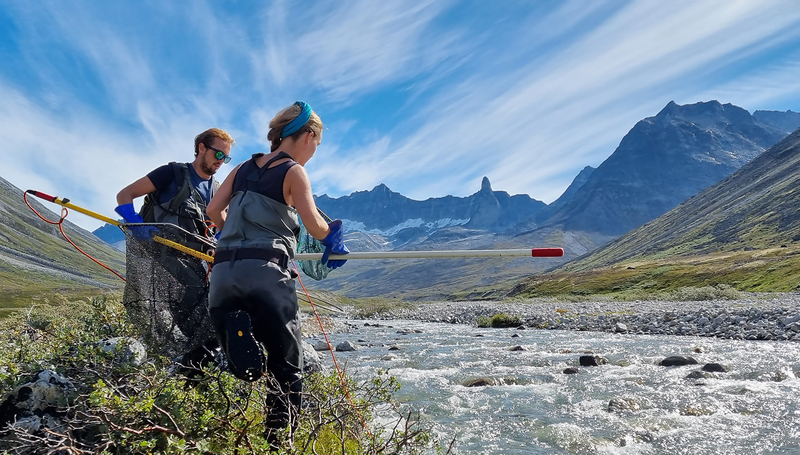
Grégoire Saboret a effectué ses recherches à l'Eawag à Kastanienbaum sous la direction du professeur Carsten Schubert (département Eaux de surface). Jakob Brodersen et le Dr Blake Matthews (département Écologie et évolution des poissons), il a poursuivi le développement des analyses isotopiques des acides aminés et les a appliquées notamment aux poissons. Il a ainsi pu élargir la compréhension des réseaux alimentaires, car les marqueurs renseignent sur les producteurs primaires (algues et bactéries) et sur tous les consommateurs intermédiaires dont ils se sont nourris. Saboret a notamment montré comment l'eutrophisation des lacs influence les sources de production dans les réseaux alimentaires des lacs suisses ou comment, actuellement, la fonte des glaciers au Groenland modifie l'alimentation des poissons.
Des yeux de poisson avec des cernes
Grégoire Saboret a obtenu une bourse de mobilité du Fonds national et séjourne actuellement à l'Université de Californie à Santa Cruz. Il continue toutefois à faire de la recherche et à publier en collaboration avec des collègues de l'Eawag. Une publication est actuellement en préparation, qui analyse les isotopes du carbone et de l'azote provenant des lentilles des yeux de poisson. Comme les lentilles poussent en forme d'anneaux, ces anneaux forment, comme les cernes d'un arbre, des archives qui fournissent des informations sur l'ensemble du cycle de vie du poisson.
Comment les organismes aquatiques absorbent les polluants
Johannes Raths a effectué ses recherches pour sa thèse dans le département de chimie environnementale, sous la direction du Dr Juliane Hollender. Son travail a étudié les processus toxicocinétiques chez les organismes aquatiques, c'est-à-dire par exemple comment les pesticides et les médicaments sont absorbés, s'accumulent, se modifient dans l'organisme et sont éventuellement éliminés. Ces mécanismes constituent un pont entre la pollution des eaux d'une part et son impact sur les communautés aquatiques et les écosystèmes d'autre part. "Une protection efficace des eaux n'est en fait possible que si nous comprenons ces processus et leur évolution dans le cadre des changements globaux de l'environnement", explique la responsable de l'encadrement, le professeur Juliane Hollender. Elle est convaincue que les recherches interdisciplinaires de Rath trouveront un écho aussi bien dans les manuels scolaires que dans la pratique.
Les deux chercheurs récompensés n'ont malheureusement pas pu participer à la remise des prix lors de la journée de l'ETH en novembre dernier. Interrogés, Raths et Saboret ont tous deux déclaré qu'ils considéraient cette distinction comme un grand honneur et ont souligné le soutien dont ils ont bénéficié à l'Eawag. Saboret souligne que le prix est également une reconnaissance pour un travail qui honore la protection des écosystèmes aquatiques. Raths, quant à lui, met en avant l'interaction entre le changement climatique et la pollution dans ses travaux : "Cela nous occupera encore beaucoup à l'avenir.
Recherche de nouveaux candidats
Le prix Otto-Jaag pour la protection des eaux récompense la meilleure thèse de doctorat, ou dans des cas particuliers le meilleur travail de master, de l'ETH Zurich dans le domaine de la protection et de la connaissance des eaux. Les membres du corps enseignant de l'ETH Zurich sont habilités à proposer des projets pour le prix. Le montant du prix est de 5000 francs. Les candidatures pour le prix 2026 peuvent être déposées jusqu'au 1er juin.
array(2 items)0 => Snowflake\Publications\Domain\Model\Publicationprototypepersistent entity (uid=36402, pid=124)originalId => protected36402 (integer)
authors => protected'Raths, J.' (14 chars)
title => protected'Bioaccumulation of polar organic contaminants in aquatic invertebrates: impa ct of climate, uptake pathways and spatial distribution' (131 chars)
journal => protected'' (0 chars)
year => protected2023 (integer)
volume => protected0 (integer)
issue => protected'' (0 chars)
startpage => protected'288 p' (10 chars)
otherpage => protected'' (0 chars)
categories => protected'' (0 chars)
description => protected'Global freshwater resources are threatened by a range of human activities in cluding pollution and accelerating global climate change. Environmental cont aminants are numerous and can form complex contamination patterns and mixtur es in aquatic systems. The vast majority of organic contaminants originates from human use and enters aquatic environments from agricultural, industrial and household emissions. Pharmaceuticals and pesticides are contaminants of particular concern as they are specifically designed to be biologically act ive and thus cause adverse effects on non-target organisms such as aquatic i nvertebrates. Aquatic invertebrates, including amphipods, provide important ecological functions such as detritus processing and transfer of energy to h igher trophic levels that maintain the functionality and diversity of aquati c ecosystems. [...]' (855 chars)
serialnumber => protected'' (0 chars)
doi => protected'10.3929/ethz-b-000641995' (24 chars)
uid => protected36402 (integer)
_localizedUid => protected36402 (integer)modified_languageUid => protectedNULL
_versionedUid => protected36402 (integer)modifiedpid => protected124 (integer)1 => Snowflake\Publications\Domain\Model\Publicationprototypepersistent entity (uid=36404, pid=124)originalId => protected36404 (integer)
authors => protected'Saboret, G.' (16 chars)
title => protected'Trophic dynamics in meta-ecosystems: insights from compound-specific stable isotopes' (84 chars)
journal => protected'' (0 chars)
year => protected2024 (integer)
volume => protected0 (integer)
issue => protected'' (0 chars)
startpage => protected'197 p' (10 chars)
otherpage => protected'' (0 chars)
categories => protected'' (0 chars)
description => protected'Food webs are crucial for understanding how carbon and nutrients flow within ecosystems, influencing sustainability and carbon fluxes. Ecosystems are in terconnected, exchanging energy, nutrients, and organic matter—a concept c aptured by meta-ecosystem theory. Consequently, changes in one ecosystem can have cascading effects on others. This interconnectedness becomes increasin gly important as global change drives significant alterations in food webs. Therefore, there is a pressing need to characterize food web functioning in complex settings, such as meta-ecosystems, and to study how these webs are i mpacted by global change. [...]' (639 chars)
serialnumber => protected'' (0 chars)
doi => protected'10.3929/ethz-b-000699978' (24 chars)
uid => protected36404 (integer)
_localizedUid => protected36404 (integer)modified_languageUid => protectedNULL
_versionedUid => protected36404 (integer)modifiedpid => protected124 (integer)
Bioaccumulation of polar organic contaminants in aquatic invertebrates: impact of climate, uptake pathways and spatial distribution
Global freshwater resources are threatened by a range of human activities including pollution and accelerating global climate change. Environmental contaminants are numerous and can form complex contamination patterns and mixtures in aquatic systems. The vast majority of organic contaminants originates from human use and enters aquatic environments from agricultural, industrial and household emissions. Pharmaceuticals and pesticides are contaminants of particular concern as they are specifically designed to be biologically active and thus cause adverse effects on non-target organisms such as aquatic invertebrates. Aquatic invertebrates, including amphipods, provide important ecological functions such as detritus processing and transfer of energy to higher trophic levels that maintain the functionality and diversity of aquatic ecosystems. [...]
Raths, J. (2023) Bioaccumulation of polar organic contaminants in aquatic invertebrates: impact of climate, uptake pathways and spatial distribution, 288 p, doi:10.3929/ethz-b-000641995, Institutional Repository
Trophic dynamics in meta-ecosystems: insights from compound-specific stable isotopes
Food webs are crucial for understanding how carbon and nutrients flow within ecosystems, influencing sustainability and carbon fluxes. Ecosystems are interconnected, exchanging energy, nutrients, and organic matter—a concept captured by meta-ecosystem theory. Consequently, changes in one ecosystem can have cascading effects on others. This interconnectedness becomes increasingly important as global change drives significant alterations in food webs. Therefore, there is a pressing need to characterize food web functioning in complex settings, such as meta-ecosystems, and to study how these webs are impacted by global change. [...]
array(4 items)0 => Snowflake\Publications\Domain\Model\Publicationprototypepersistent entity (uid=33871, pid=124)originalId => protected33871 (integer)
authors => protected'Saboret, G.; Moccetti, C.; Wassenaar, L. I.; Matthews,&n bsp;B.; Aquino, N. J.; Janssen, D. J.; Brodersen, J .; Schubert, C. J.' (180 chars)
title => protected'Impact of glaciers on trophic dynamics and polyunsaturated fat accumulation in Southern Greenland Fjord ecosystems' (114 chars)
journal => protected'Global Change Biology' (21 chars)
year => protected2025 (integer)
volume => protected31 (integer)
issue => protected'1' (1 chars)
startpage => protected'e70044 (19 pp.)' (15 chars)
otherpage => protected'' (0 chars)
categories => protected'amino acid isotope; arctic char; fjord; food web; glacier; Greenland; polyun saturated fatty acid; trophic position' (114 chars)
description => protected'The primary production of fjords across the Arctic and Subarctic is undergoi ng significant transformations due to the climatically driven retreat of gla ciers and ice sheets. However, the implications of these changes for upper t rophic levels remain largely unknown. In this study, we employ both bulk and compound-specific stable isotope analyses to investigate how shifts at the base of fjord food webs impact the carbon and energy sources of consumers. F ocusing on two rapidly changing fjords in Southern Greenland, we used the mi gratory Arctic char as an indicator species, sampling populations along envi ronmental gradients within the fjords, building upon the assumption that cha r populations feed primarily close to their natal stream, thereby integratin g a dietary gradient. Our analysis of bulk stable isotopes in Arctic char ti ssue confirmed this premise, revealing a consistent change in resource use f rom the outer to the inner fjord, which nonetheless served as preferred feed ing grounds. Essential amino acid analysis further indicated shifts in carbo n and nitrogen sources, consistent with changes in nutrient use near glacier inputs characterized by low turbidity and high iron levels. Notably, these changes in the source of primary production were associated with shifts in t rophic positions and the transfer of polyunsaturated fatty acids, with Arcti c char in glacier-influenced inner fjords feeding at lower trophic level (si ze-corrected) and accumulating higher levels of high-quality docosahexaenoic acid (DHA). These findings highlight the usefulness of new analytical tools in revealing that glacial retreat can substantially alter food web dynamics , enhancing both carbon flow and the nutritional quality of fish in fjord ec osystems. The two Southern Greenland fjords studied could represent the futu re of other fjords, where retreating glaciers become land-terminating and gl acial inputs decrease. Our study underscores the critical role of glacier dy namics in affecting high...' (2075 chars)
serialnumber => protected'1354-1013' (9 chars)
doi => protected'10.1111/gcb.70044' (17 chars)
uid => protected33871 (integer)
_localizedUid => protected33871 (integer)modified_languageUid => protectedNULL
_versionedUid => protected33871 (integer)modifiedpid => protected124 (integer)1 => Snowflake\Publications\Domain\Model\Publicationprototypepersistent entity (uid=33076, pid=124)originalId => protected33076 (integer)
authors => protected'Saboret, G.; Drost, B. J. W.; Kowarik, C.; Schubert , C. J.; Gossner, M. M.; Ilić, M.' (135 chars)
title => protected'Quantifying the utilisation of blue, green and brown resources by riparian p redators: a combined use of amino acid isotopes and fatty acids' (139 chars)
journal => protected'Methods in Ecology and Evolution' (32 chars)
year => protected2024 (integer)
volume => protected15 (integer)
issue => protected'8' (1 chars)
startpage => protected'1450' (4 chars)
otherpage => protected'1462' (4 chars)
categories => protected'amino acids; CSIA; food webs; MixSIAR; nutrient fluxes; polyunsaturated fatt y acids; spiders; stable isotopes' (109 chars)
description => protected'1. Global change drives multiple facets of biodiversity including interactio n diversity, which is fundamental for ecosystem functioning. However, studyi ng trophic interactions is challenging in meta-ecosystems, that is ecosystem s connected by spatial flows of energy, materials and organisms across ecosy stem boundaries. While analytical methods based on abundances of polyunsatur ated fatty acids (PUFAs) and stable isotopes of amino acids (AAs) are being increasingly used, it has never been explored if both approaches could be: ( i) combined in mixing models to enhance precision in dietary inference (ii) compared to disentangle transfers of various PUFAs and proteins in food webs in the wild.<br />2. We explore the utility of analytical approaches based on PUFA abundances and AA isotopes to resolve resource transfers in a natura l riparian food web. We focus on spiders and their potential prey from blue, green and brown sources to address three important and persisting methodolo gical issues in food-web ecology, namely whether (i) essential AA carbon iso topes can resolve protein origin from blue, green and brown resources, (ii) PUFA relative abundance and AA isotopes can be combined in a mixing model to provide higher precision estimates (i.e. narrower intervals) and (iii) comb ining the two approaches can unveil the coupling of protein and PUFA transfe rs in food webs. 3. Our research demonstrates the power of AA isotopes and P UFAs to distinguish blue, green, and brown sources and their transfer up to consumers. We show that combining PUFA relative abundance and AA isotopes in a mixing model provides overall estimates similar to the individual estimat es but significantly increases precision. In addition, we showcase how combi ning approaches unveil the coupling of protein and PUFA transfers. For insta nce, we show that most PUFAs are less concentrated from prey to predators, r elative to proteins, highlighting uncoupling of PUFAs and protein transfer a long food chains.<br />4...' (2301 chars)
serialnumber => protected'2041-210X' (9 chars)
doi => protected'10.1111/2041-210X.14371' (23 chars)
uid => protected33076 (integer)
_localizedUid => protected33076 (integer)modified_languageUid => protectedNULL
_versionedUid => protected33076 (integer)modifiedpid => protected124 (integer)2 => Snowflake\Publications\Domain\Model\Publicationprototypepersistent entity (uid=36402, pid=124)originalId => protected36402 (integer)
authors => protected'Raths, J.' (14 chars)
title => protected'Bioaccumulation of polar organic contaminants in aquatic invertebrates: impa ct of climate, uptake pathways and spatial distribution' (131 chars)
journal => protected'' (0 chars)
year => protected2023 (integer)
volume => protected0 (integer)
issue => protected'' (0 chars)
startpage => protected'288 p' (10 chars)
otherpage => protected'' (0 chars)
categories => protected'' (0 chars)
description => protected'Global freshwater resources are threatened by a range of human activities in cluding pollution and accelerating global climate change. Environmental cont aminants are numerous and can form complex contamination patterns and mixtur es in aquatic systems. The vast majority of organic contaminants originates from human use and enters aquatic environments from agricultural, industrial and household emissions. Pharmaceuticals and pesticides are contaminants of particular concern as they are specifically designed to be biologically act ive and thus cause adverse effects on non-target organisms such as aquatic i nvertebrates. Aquatic invertebrates, including amphipods, provide important ecological functions such as detritus processing and transfer of energy to h igher trophic levels that maintain the functionality and diversity of aquati c ecosystems. [...]' (855 chars)
serialnumber => protected'' (0 chars)
doi => protected'10.3929/ethz-b-000641995' (24 chars)
uid => protected36402 (integer)
_localizedUid => protected36402 (integer)modified_languageUid => protectedNULL
_versionedUid => protected36402 (integer)modifiedpid => protected124 (integer)3 => Snowflake\Publications\Domain\Model\Publicationprototypepersistent entity (uid=31058, pid=124)originalId => protected31058 (integer)
authors => protected'Raths, J.; Schinz, L.; Mangold-Döring, A.; Hollender, J .' (77 chars)
title => protected'Elimination resistance: characterizing multi-compartment toxicokinetics of t he neonicotinoid thiacloprid in the amphipod <em>Gammarus pulex</em> using b ioconcentration and receptor-binding assays' (195 chars)
journal => protected'Environmental Science and Technology' (36 chars)
year => protected2023 (integer)
volume => protected57 (integer)
issue => protected'24' (2 chars)
startpage => protected'8890' (4 chars)
otherpage => protected'8901' (4 chars)
categories => protected'bioaccumulation; invertebrates; micropollutants; organic contaminants; insec ticides' (83 chars)
description => protected'Delayed toxicity is a phenomenon observed for aquatic invertebrates exposed to nicotinic acetylcholine receptor (nAChR) agonists, such as neonicotinoids . Furthermore, recent studies have described an incomplete elimination of ne onicotinoids by exposed amphipods. However, a mechanistic link between recep tor binding and toxicokinetic modeling has not been demonstrated yet. The el imination of the neonicotinoid thiacloprid in the freshwater amphipod <em>Ga mmarus pulex</em> was studied in several toxicokinetic exposure experiments, complemented with in vitro and in vivo receptor-binding assays. Based on th e results, a two-compartment model was developed to predict the uptake and e limination kinetics of thiacloprid in <em>G. pulex</em>. An incomplete elimi nation of thiacloprid, independent of elimination phase duration, exposure c oncentrations, and pulses, was observed. Additionally, the receptor-binding assays indicated irreversible binding of thiacloprid to the nAChRs. Accordin gly, a toxicokinetic-receptor model consisting of a structural and a membran e protein (including nAChRs) compartment was developed. The model successful ly predicted internal thiacloprid concentrations across various experiments. Our results help in understanding the delayed toxic and receptor-mediated e ffects toward arthropods caused by neonicotinoids. Furthermore, the results suggest that more awareness toward long-term toxic effects of irreversible r eceptor binding is needed in a regulatory context. The developed model suppo rts the future toxicokinetic assessment of receptor-binding contaminants.' (1593 chars)
serialnumber => protected'0013-936X' (9 chars)
doi => protected'10.1021/acs.est.3c01891' (23 chars)
uid => protected31058 (integer)
_localizedUid => protected31058 (integer)modified_languageUid => protectedNULL
_versionedUid => protected31058 (integer)modifiedpid => protected124 (integer)
Impact of glaciers on trophic dynamics and polyunsaturated fat accumulation in Southern Greenland Fjord ecosystems
The primary production of fjords across the Arctic and Subarctic is undergoing significant transformations due to the climatically driven retreat of glaciers and ice sheets. However, the implications of these changes for upper trophic levels remain largely unknown. In this study, we employ both bulk and compound-specific stable isotope analyses to investigate how shifts at the base of fjord food webs impact the carbon and energy sources of consumers. Focusing on two rapidly changing fjords in Southern Greenland, we used the migratory Arctic char as an indicator species, sampling populations along environmental gradients within the fjords, building upon the assumption that char populations feed primarily close to their natal stream, thereby integrating a dietary gradient. Our analysis of bulk stable isotopes in Arctic char tissue confirmed this premise, revealing a consistent change in resource use from the outer to the inner fjord, which nonetheless served as preferred feeding grounds. Essential amino acid analysis further indicated shifts in carbon and nitrogen sources, consistent with changes in nutrient use near glacier inputs characterized by low turbidity and high iron levels. Notably, these changes in the source of primary production were associated with shifts in trophic positions and the transfer of polyunsaturated fatty acids, with Arctic char in glacier-influenced inner fjords feeding at lower trophic level (size-corrected) and accumulating higher levels of high-quality docosahexaenoic acid (DHA). These findings highlight the usefulness of new analytical tools in revealing that glacial retreat can substantially alter food web dynamics, enhancing both carbon flow and the nutritional quality of fish in fjord ecosystems. The two Southern Greenland fjords studied could represent the future of other fjords, where retreating glaciers become land-terminating and glacial inputs decrease. Our study underscores the critical role of glacier dynamics in affecting high-level consumers, such as salmonids, with implications for fjords globally.
Saboret, G.; Moccetti, C.; Wassenaar, L. I.; Matthews, B.; Aquino, N. J.; Janssen, D. J.; Brodersen, J.; Schubert, C. J. (2025) Impact of glaciers on trophic dynamics and polyunsaturated fat accumulation in Southern Greenland Fjord ecosystems, Global Change Biology, 31(1), e70044 (19 pp.), doi:10.1111/gcb.70044, Institutional Repository
Quantifying the utilisation of blue, green and brown resources by riparian predators: a combined use of amino acid isotopes and fatty acids
1. Global change drives multiple facets of biodiversity including interaction diversity, which is fundamental for ecosystem functioning. However, studying trophic interactions is challenging in meta-ecosystems, that is ecosystems connected by spatial flows of energy, materials and organisms across ecosystem boundaries. While analytical methods based on abundances of polyunsaturated fatty acids (PUFAs) and stable isotopes of amino acids (AAs) are being increasingly used, it has never been explored if both approaches could be: (i) combined in mixing models to enhance precision in dietary inference (ii) compared to disentangle transfers of various PUFAs and proteins in food webs in the wild. 2. We explore the utility of analytical approaches based on PUFA abundances and AA isotopes to resolve resource transfers in a natural riparian food web. We focus on spiders and their potential prey from blue, green and brown sources to address three important and persisting methodological issues in food-web ecology, namely whether (i) essential AA carbon isotopes can resolve protein origin from blue, green and brown resources, (ii) PUFA relative abundance and AA isotopes can be combined in a mixing model to provide higher precision estimates (i.e. narrower intervals) and (iii) combining the two approaches can unveil the coupling of protein and PUFA transfers in food webs. 3. Our research demonstrates the power of AA isotopes and PUFAs to distinguish blue, green, and brown sources and their transfer up to consumers. We show that combining PUFA relative abundance and AA isotopes in a mixing model provides overall estimates similar to the individual estimates but significantly increases precision. In addition, we showcase how combining approaches unveil the coupling of protein and PUFA transfers. For instance, we show that most PUFAs are less concentrated from prey to predators, relative to proteins, highlighting uncoupling of PUFAs and protein transfer along food chains. 4. We show for the first time the effectiveness of combining AA isotopes and PUFA abundances, particularly relevant for complex trophic interactions in a meta-ecosystem context. Our study illustrates the trophic uncoupling of proteins and PUFAs, highlighting the necessity in combining both approaches.
Saboret, G.; Drost, B. J. W.; Kowarik, C.; Schubert, C. J.; Gossner, M. M.; Ilić, M. (2024) Quantifying the utilisation of blue, green and brown resources by riparian predators: a combined use of amino acid isotopes and fatty acids, Methods in Ecology and Evolution, 15(8), 1450-1462, doi:10.1111/2041-210X.14371, Institutional Repository
Bioaccumulation of polar organic contaminants in aquatic invertebrates: impact of climate, uptake pathways and spatial distribution
Global freshwater resources are threatened by a range of human activities including pollution and accelerating global climate change. Environmental contaminants are numerous and can form complex contamination patterns and mixtures in aquatic systems. The vast majority of organic contaminants originates from human use and enters aquatic environments from agricultural, industrial and household emissions. Pharmaceuticals and pesticides are contaminants of particular concern as they are specifically designed to be biologically active and thus cause adverse effects on non-target organisms such as aquatic invertebrates. Aquatic invertebrates, including amphipods, provide important ecological functions such as detritus processing and transfer of energy to higher trophic levels that maintain the functionality and diversity of aquatic ecosystems. [...]
Raths, J. (2023) Bioaccumulation of polar organic contaminants in aquatic invertebrates: impact of climate, uptake pathways and spatial distribution, 288 p, doi:10.3929/ethz-b-000641995, Institutional Repository
Elimination resistance: characterizing multi-compartment toxicokinetics of the neonicotinoid thiacloprid in the amphipod Gammarus pulex using bioconcentration and receptor-binding assays
Delayed toxicity is a phenomenon observed for aquatic invertebrates exposed to nicotinic acetylcholine receptor (nAChR) agonists, such as neonicotinoids. Furthermore, recent studies have described an incomplete elimination of neonicotinoids by exposed amphipods. However, a mechanistic link between receptor binding and toxicokinetic modeling has not been demonstrated yet. The elimination of the neonicotinoid thiacloprid in the freshwater amphipod Gammarus pulex was studied in several toxicokinetic exposure experiments, complemented with in vitro and in vivo receptor-binding assays. Based on the results, a two-compartment model was developed to predict the uptake and elimination kinetics of thiacloprid in G. pulex. An incomplete elimination of thiacloprid, independent of elimination phase duration, exposure concentrations, and pulses, was observed. Additionally, the receptor-binding assays indicated irreversible binding of thiacloprid to the nAChRs. Accordingly, a toxicokinetic-receptor model consisting of a structural and a membrane protein (including nAChRs) compartment was developed. The model successfully predicted internal thiacloprid concentrations across various experiments. Our results help in understanding the delayed toxic and receptor-mediated effects toward arthropods caused by neonicotinoids. Furthermore, the results suggest that more awareness toward long-term toxic effects of irreversible receptor binding is needed in a regulatory context. The developed model supports the future toxicokinetic assessment of receptor-binding contaminants.
Raths, J.; Schinz, L.; Mangold-Döring, A.; Hollender, J. (2023) Elimination resistance: characterizing multi-compartment toxicokinetics of the neonicotinoid thiacloprid in the amphipod Gammarus pulex using bioconcentration and receptor-binding assays, Environmental Science and Technology, 57(24), 8890-8901, doi:10.1021/acs.est.3c01891, Institutional Repository
Photo de couverture : La fonte des glaciers modifie les réseaux alimentaires dans les eaux, comme ici au Groenland, mais aussi dans les régions alpines. (Photo : Coralie Moccetti)
Partager avec d'autres
Activation des boutons des médias sociaux
Il est possible que des données soient transmises aux réseaux lors de l’activation des boutons des médias sociaux.