News Detail

Review of the Water Policy 2022

The hot summer of 2022 made water supply security a political issue in the Federal Parliament. Other issues included the implementation deficit in the designation of groundwater protection zones, hardly degradable "perpetual" chemicals and the growing pressure to produce more electricity from hydropower.

In 2022, the persistently high temperatures and drought in June to August will not only lead to low water levels, excessively warm waters and a high risk of forest fires, but also to parliamentary proposals for savings or optimised use of water resources. The focus on improved groundwater protection can be traced back to the two popular initiatives of 2021, the increased concentrations of degradation products of the banned pesticide chlorothalonil and the report of the National Council's Business Audit Commission on inadequate enforcement.
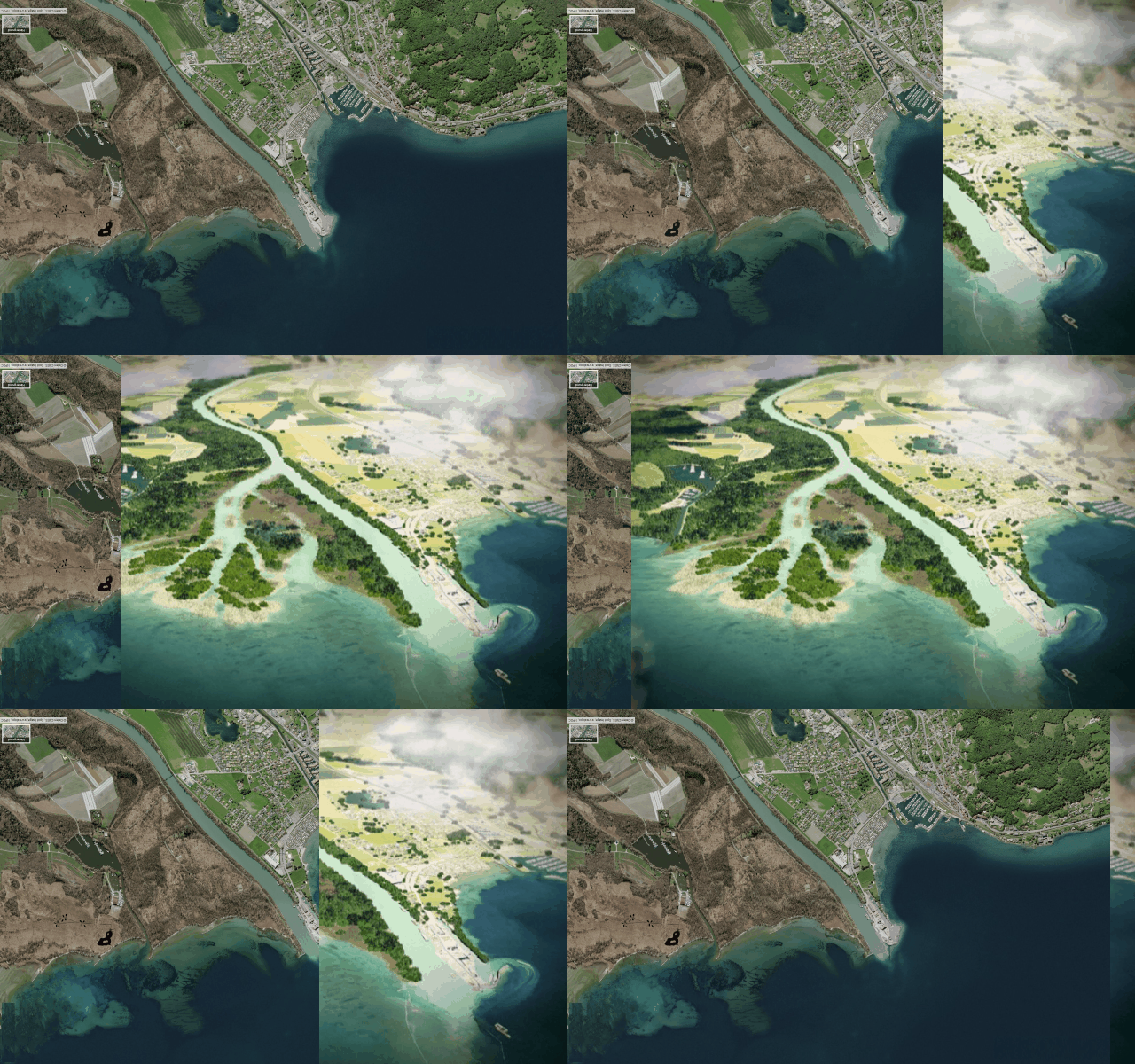
Large-scale revitalisation projects take time to implement. The cantons of Valais and Vaud are increasing flood protection as part of the third correction of the Rhône and are also planning an ecological upgrade of the Rhône delta in Lake Geneva (swisstopo, rotated 180 degrees, left; visualisation 3e correction du Rhône, right).

Conflicting goals are becoming very apparent

In the case of forever chemicals, two triggers can be identified: the new findings on their toxicity and the high presence of the topic in the media. Finally, the concern about an impending (winter) electricity shortfall is leading to great pressure to further expand Swiss hydropower. It is obvious that this accentuates the conflicting goals of watercourse and landscape protection.

The article just published in the magazine Aqua&Gas gives - for the sixth time in a row - a rough overview of political events and debates on the topic of water and water bodies in 2022. In the online version of the article, the initiatives, reports and judgements are directly linked.

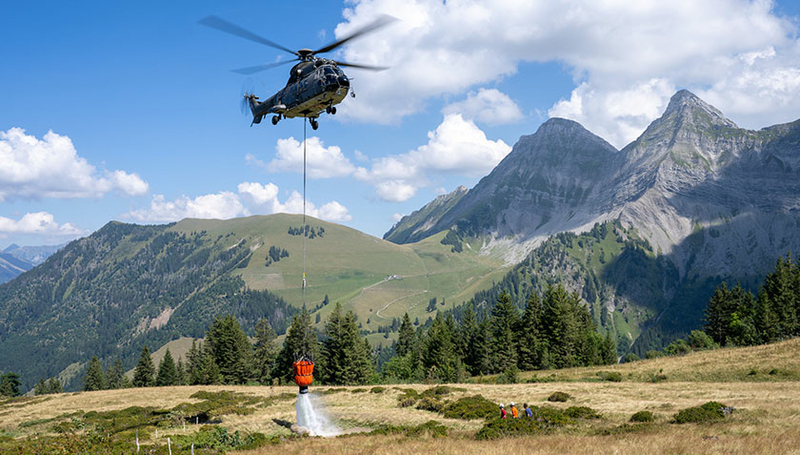
Cover picture: The dry summer of 2022 led to unconventional solutions - such as supplying water to an alp near Grandvillard/FR with army helicopters.
(Picture: DDPS, Jonas Kambli)
 

Original publication

Extbase Variable Dump
array(3 items)
   publications => '30790' (5 chars)
   libraryUrl => '' (0 chars)
   layout => '0' (1 chars)
Extbase Variable Dump
array(1 item)
   0 => Snowflake\Publications\Domain\Model\Publicationprototypepersistent entity (uid=30790, pid=124)
      originalId => protected30790 (integer)
      authors => protected'Bryner, A.; Fischer, M.; Vollenweider, S.' (56 chars)
      title => protected'Wasserpolitischer Jahresrückblick 2022' (39 chars)
      journal => protected'Aqua & Gas' (10 chars)
      year => protected2023 (integer)
      volume => protected103 (integer)
      issue => protected'5' (1 chars)
      startpage => protected'70' (2 chars)
      otherpage => protected'80' (2 chars)
      categories => protected'' (0 chars)
      description => protected'Das wasserpolitische Jahr 2022 ist geprägt von einem heissen und vielerorts
          trockenen Sommer. Das verstärkt die Sorge um ausreichend verfügbares Wass
         er genauso wie den Willen, ein Wassermanagement einzuführen oder zu verbess
         ern. Politische Aktivität lösen auch der vom Bundesrat vorgelegte Bericht
         zur Wasserversorgungssicherheit sowie der kritische Bericht der nationalrät
         lichen Geschäftsprüfungskommission zum Vollzugsdefizit beim Ausscheiden vo
         n Grundwasserschutzzonen aus. Im zweiten Halbjahr rücken der steigende Stro
         mbedarf und die «ewigen Chemikalien» in den Fokus.
' (584 chars) serialnumber => protected'2235-5197' (9 chars) doi => protected'' (0 chars) uid => protected30790 (integer) _localizedUid => protected30790 (integer)modified _languageUid => protectedNULL _versionedUid => protected30790 (integer)modified pid => protected124 (integer)
Bryner, A.; Fischer, M.; Vollenweider, S. (2023) Wasserpolitischer Jahresrückblick 2022, Aqua & Gas, 103(5), 70-80, Institutional Repository

Online Version with direct links.