News Detail

Safe to cross: low risk of coronavirus infection from high-touch surfaces

February 4, 2021 | Andri Bryner

Surfaces which are frequently touched by many different people may be contaminated with the coronavirus, but the risk of infection via this route is low. However, regular collection of samples from door handles, buttons or keypads could be useful for monitoring the course of the pandemic.

Have you ever tried pressing the button at a pedestrian crossing with your elbow? Tricky, isn’t it? Two studies co-authored by Eawag scientists have now shown that we should not be too concerned about contracting the novel coronavirus from buttons or keypads – at least compared to other possible transmission routes.

Eight per cent of samples positive

In the first study, between April and June 2020, almost 350 surface samples were collected from business-entrance door handles, dustbin handles, ATM keypads, petrol pumps – and traffic-light buttons. Of these samples, 29 (approx. 8 %) were positive for genetic material from the coronavirus. However, the concentrations were so low that the risk of infection from touching a contaminated surface was also estimated to be low – “less than 5 in 10,000”, according to Timothy Julian of Eawag’s Environmental Microbiology department. The study – carried out in Somerville (a suburb of Boston, Massachusetts, with a population of around 80,000) – was led by PhD student Abigail Harvey and Professor Amy Pickering of Tufts University.

Sampling: an early warning system

Despite the reassuring news that high-touch surfaces probably play a minimal role in coronavirus community transmission, the scientists suggest that sampling should be regularly performed: the surfaces were touched by different people up to 30 times an hour, and there was good agreement between the positivity rate of surface samples and the trend in new cases of infection detected by clinical testing. Timothy Julian concludes: “As with wastewater sampling, surveillance of SARS-CoV-2 RNA on high-touch surfaces could be a useful tool – in addition to clinical tests – for providing early warning of COVID-19 case trends.”

Handwashing – the best strategy

In the second study, led by Ana Karina Pitol of Imperial College, London, risk assessment models were used to evaluate the effectiveness of surface and hand disinfection in reducing the risk of transmission via contaminated surfaces. The results are unequivocal: while the effectiveness of surface disinfection is dependent on numerous factors and is relatively limited, hand disinfection substantially reduces the risks of infection. Under certain conditions, however, the risks of transmission via buttons, keypads or handles may become non-negligible. As Timothy Julian emphasises, “Taking into account the dozens of objects contacted every hour, a person’s risk of infection will of course increase if a lot of people are carrying the virus – although the risk from other transmission routes would then also increase, particularly if social distancing is not observed, or in crowded spaces.”

Not comparable to dishes or tables

Not included in these studies were surfaces which people may contaminate over longer periods, such as dishes or tables in restaurants. Timothy Julian says: “The likelihood that someone will cough or sneeze over a table, and that droplets with high viral loads will be found there, is much greater than in the case of a button or a door handle – so it remains very important that tables are disinfected and dishes properly washed.”

Cover picture: Eawag, Andri Bryner

Original publications
Extbase Variable Dump
array(2 items)
   publications => '22223,22213' (11 chars)
   libraryUrl => '' (0 chars)
Extbase Variable Dump
array(2 items)
   0 => Snowflake\Publications\Domain\Model\Publicationprototypepersistent entity (uid=22223, pid=124)
      originalId => protected22223 (integer)
      authors => protected'Harvey, A. P.; Fuhrmeister, E. R.; Cantrell, M.&nbs
         p;E.; Pitol, A. K.; Swarthout, J. M.; Powers, J.&nb
         sp;E.; Nadimpalli, M. L.; Julian, T. R.; Pickering,&nbsp
         ;A. J.
' (239 chars) title => protected'Longitudinal monitoring of SARS-CoV-2 RNA on high-touch surfaces in a commun
         ity setting
' (87 chars) journal => protected'Environmental Science and Technology Letters' (44 chars) year => protected2021 (integer) volume => protected8 (integer) issue => protected'2' (1 chars) startpage => protected'168' (3 chars) otherpage => protected'175' (3 chars) categories => protected'' (0 chars) description => protected'Environmental surveillance of surface contamination is an unexplored tool fo
         r understanding transmission of SARS-CoV-2 in community settings. We conduct
         ed longitudinal swab sampling of high-touch non-porous surfaces in a Massach
         usetts town during a COVID-19 outbreak from April to June 2020. Twenty-nine
         of 348 (8.3%) surface samples were positive for SARS-CoV-2 RNA, including cr
         osswalk buttons, trash can handles, and door handles of essential business e
         ntrances (grocery store, liquor store, bank, and gas station). The estimated
          risk of infection from touching a contaminated surface was low (less than 5
          in 10,000) by quantitative microbial risk assessment, suggesting fomites pl
         ay a minimal role in SARS-CoV-2 community transmission. The weekly percentag
         e of positive samples (out of n = 33 unique surfaces per week) best predicte
         d variation in city-level COVID-19 cases with a 7-day lead time. Environment
         al surveillance of SARS-CoV-2 RNA on high-touch surfaces may be a useful too
         l to provide early warning of COVID-19 case trends.
' (1039 chars) serialnumber => protected'' (0 chars) doi => protected'10.1021/acs.estlett.0c00875' (27 chars) uid => protected22223 (integer) _localizedUid => protected22223 (integer)modified _languageUid => protectedNULL _versionedUid => protected22223 (integer)modified pid => protected124 (integer)
1 => Snowflake\Publications\Domain\Model\Publicationprototypepersistent entity (uid=22213, pid=124) originalId => protected22213 (integer) authors => protected'Pitol, A. K.; Julian, T. R.' (47 chars) title => protected'Community transmission of SARS-CoV-2 by surfaces: risks and risk reduction s
         trategies
' (85 chars) journal => protected'Environmental Science and Technology Letters' (44 chars) year => protected2021 (integer) volume => protected8 (integer) issue => protected'3' (1 chars) startpage => protected'263' (3 chars) otherpage => protected'269' (3 chars) categories => protected'' (0 chars) description => protected'SARS-CoV-2, the virus responsible for the COVID-19 pandemic, is perceived to
          be primarily transmitted via person-to-person contact through droplets prod
         uced while talking, coughing, and sneezing. Transmission may also occur thro
         ugh other routes, including contaminated surfaces; nevertheless, the role th
         at surfaces have on the spread of the disease remains contested. Here, we us
         e the Quantitative Microbial Risk Assessment framework to examine the risks
         of community transmission of SARS-CoV-2 through surfaces and to evaluate the
          effectiveness of hand and surface disinfection as potential interventions.
         Using conservative assumptions on input parameters of the model (e.g., dose-
         response relationship, ratio of genome copies to infective virus), the avera
         ge of the median risks for single hand-to-surface contact followed by hand-t
         o-face contact range from 1.6 × 10⁻⁴ to 5.6 × 10⁻⁹ for modeled prevalence
         rates of 0.2%-5%. For observed prevalence rates (0.2%, 1%), this corresponds
          to a low risk of infection (<10-6). Hand disinfection substantially redu
         ces risks of transmission independently of the disease's prevalence and cont
         act frequency. In contrast, the effectiveness of surface disinfection is hig
         hly dependent on the prevalence and the frequency of contacts. The work supp
         orts the current perception that contaminated surfaces are not a primary mod
         e of transmission of SARS-CoV-2 and affirms the benefits of making hand disi
         nfectants widely available.
' (1471 chars) serialnumber => protected'' (0 chars) doi => protected'10.1021/acs.estlett.0c00966' (27 chars) uid => protected22213 (integer) _localizedUid => protected22213 (integer)modified _languageUid => protectedNULL _versionedUid => protected22213 (integer)modified pid => protected124 (integer)
Harvey, A. P.; Fuhrmeister, E. R.; Cantrell, M. E.; Pitol, A. K.; Swarthout, J. M.; Powers, J. E.; Nadimpalli, M. L.; Julian, T. R.; Pickering, A. J. (2021) Longitudinal monitoring of SARS-CoV-2 RNA on high-touch surfaces in a community setting, Environmental Science and Technology Letters, 8(2), 168-175, doi:10.1021/acs.estlett.0c00875, Institutional Repository
Pitol, A. K.; Julian, T. R. (2021) Community transmission of SARS-CoV-2 by surfaces: risks and risk reduction strategies, Environmental Science and Technology Letters, 8(3), 263-269, doi:10.1021/acs.estlett.0c00966, Institutional Repository

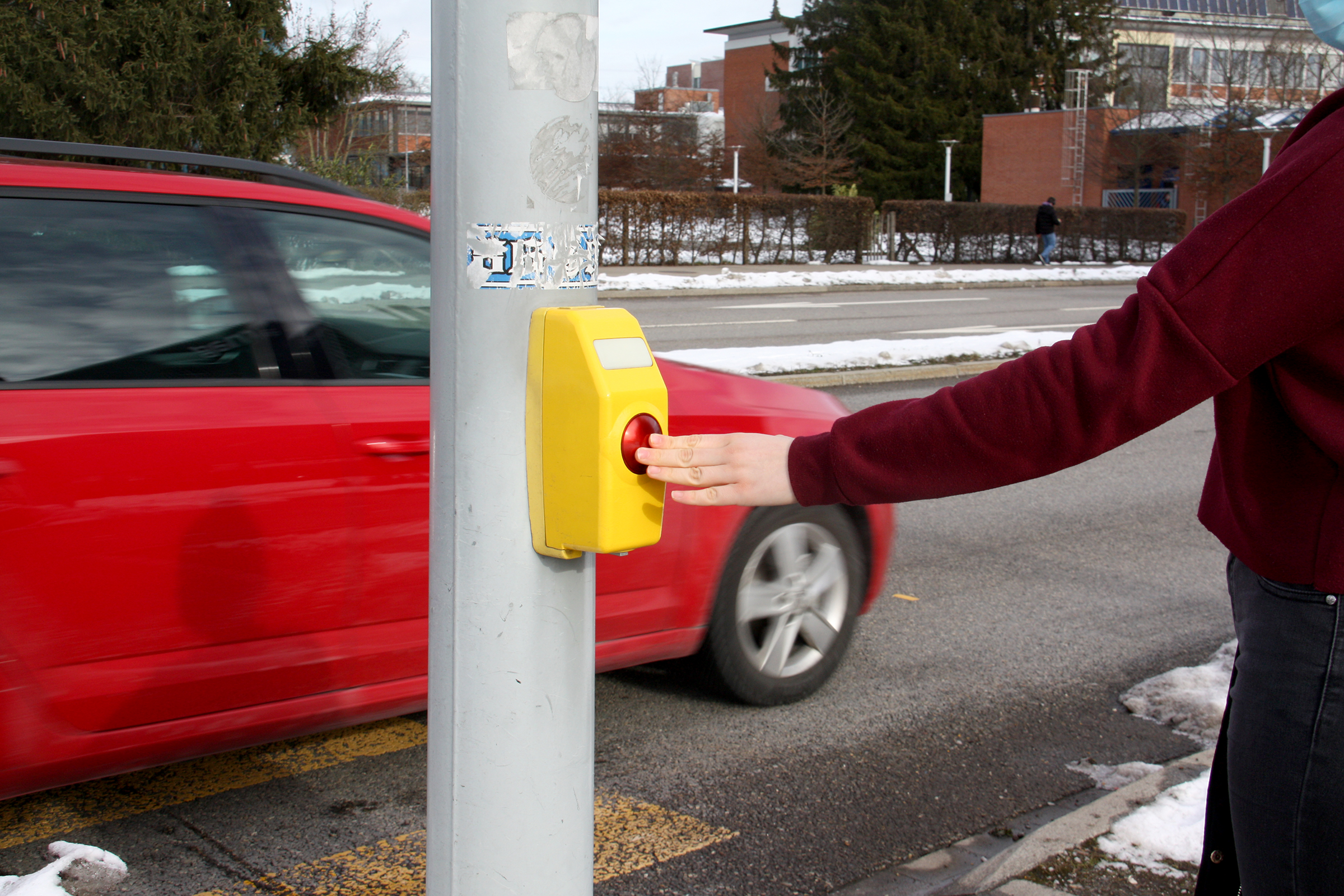
The risk that traces of coronavirus on a traffic-light button will be sufficient to cause infection – before pedestrians next wash their hands (!) – is very low.
(Photo: Eawag, Andri Bryner)