
News Detail
The waters of the Zambezi: time to act
June 1, 2021 |
The Zambezi and Kafue Rivers in southern Africa still carry very clean water today. Only below dams do they suffer from increased water temperatures, lack of oxygen and loss of sediments. Smaller tributaries, however, are showing signs of pollution. These are the results of four field campaigns conducted by the aquatic research institute Eawag in central and southern Zambia in 2018 and 2019 in collaboration with the ETH Zurich and the University of Zambia. The results were published today in the journal Environmental Science: Processes and Impacts.
Scott Winton, lead author of the study and postdoctoral researcher at Eawag and the ETH Zurich, warns of the consequences of future development, for the catchment area of the two rivers is changing rapidly. Population and cities are growing quickly, agriculture is spreading and intensifying, and hydropower plants are being built. In the following interview, Scott Winton reports on the most important findings of the field campaigns and where the challenges for the sustainable development of the Zambezi River Basin lie.
Scott Winton, how did you experience the water landscape? Were you surprised by the high water quality of the two main rivers Zambezi and Kafue?
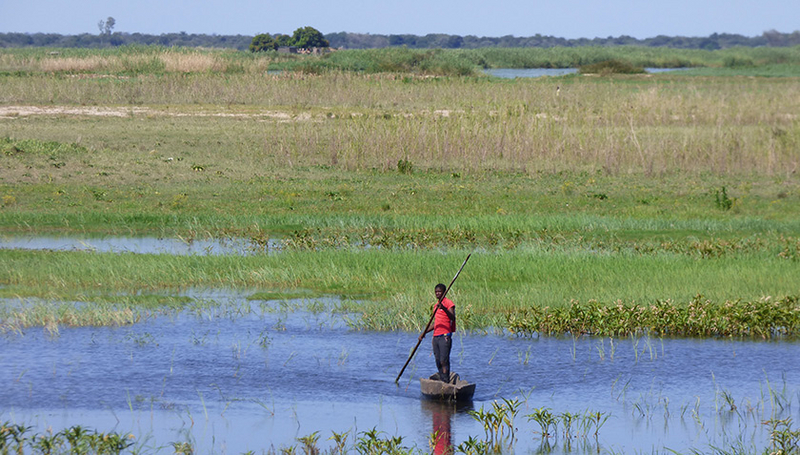
Scott Winton: Yes, coming from the USA and living in Europe, where with few exceptions major rivers show obvious chemical signatures of human pollution, it was a big surprise to see this huge river in Africa, the Zambezi, and find it so clean. People drink the river water without any treatment. And when we brought samples back to the Eawag laboratories, the technicians were shocked. The river water seemed to be even cleaner than the highly purified water used for laboratory processes.
What kind of pollution did you find in the tributaries?
In small tributaries draining from more densely populated areas, we found elevated nutrients and ions such as sodium and chlorine – pollutants typical of urban wastewater. Close to some industrial agricultural plots we found a stream with very high nitrate concentrations, indicative of fertiliser leaching.
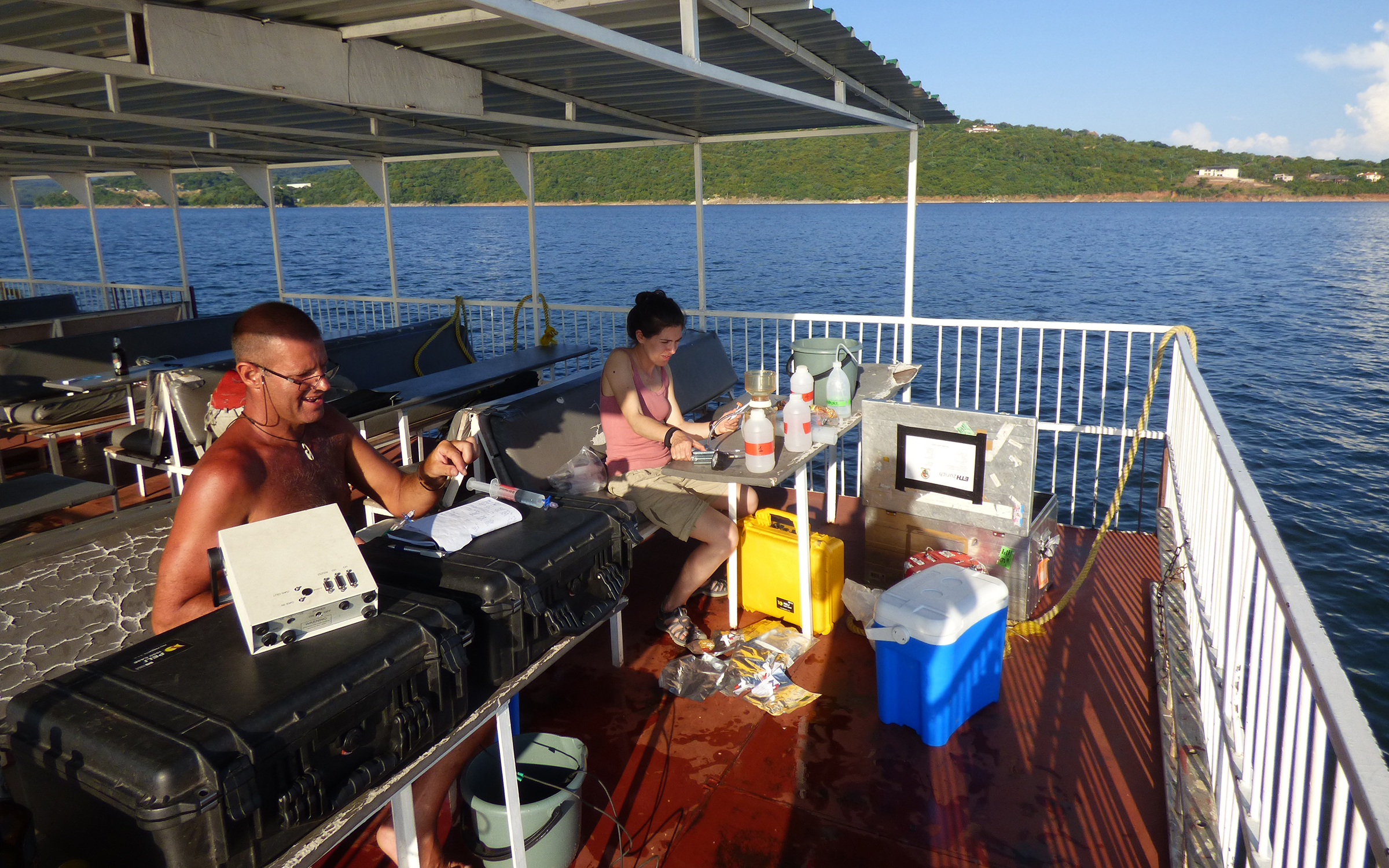
Cristian Teodoru and Elisa Calamita, co-authors of the study, on Lake Kariba, a reservoir of the zambezi.
(Photo: R. Scott Winton)
In the article, you assume that urbanisation, intensification of agriculture and the development of hydropower will further deteriorate water quality. What changes exactly do you expect?
Basically, we expect to find similar pollutants as mentioned before, but in higher concentrations. Water quality impacts are additive, so the more sources you have on your landscapes and along your rivers, the more pollutants you will find in surface waters. We should expect water quality to deteriorate in sync with development.
Will the situation deteriorate mainly in the tributaries or are the main rivers Zambezi and Kafue also threatened?
The immense size of the Zambezi and Kafue Rivers and their watersheds mean that any pollutants reaching these bodies become highly diluted by flows of hundreds or thousands of cubic metres per second. The big rivers are largely the sum of their tributaries, so it will take a lot of polluted tributaries before the big ones become compromised. A greater threat to the major rivers is probably damming, which can create thermal pollution and leave downstream waters without oxygen.
You also write that governments, managers and industry have the opportunity to mitigate water degradation. What measures do you recommend?
Each source has its own suite of mitigation options. For urban wastewater, it is mainly treatment plants and wetlands; for agriculture it is riparian buffers and wetlands; for dams, environmental flows and selective withdrawal systems. These practices are well known and in Zambia many of these approaches are already being implemented. The key to avoid water quality degradation will be to ensure that mitigation measures are able to scale with population and economic growth. This will be a challenge because the pace of growth is so rapid and there will be as is the case everywhere and always, pressure to cut short-term infrastructure costs and forego environmental protection.
Cover picture: R. Scott Winton