
News Detail
Glacial melt threatens habitats of alpine river organisms
May 8, 2023 |
Alpine regions are particularly affected by climate change – they are warming up faster than the global average. This is particularly detrimental to the endemic organisms there, which can only migrate to other regions with difficulty due to geographical barriers. This poses great challenges especially for water organisms. Accustomed to cold water, their only option is to flee “upstream”. And if a glacier disappears completely, they will disappear too.
To ensure the survival of these species, it is important not only to locate future new habitats, but also to protect them accordingly. Christopher Robinson of Eawag’s Aquatic Ecology department and colleagues from WSL and from the UK, Austria, France and Italy have now developed a method for modelling these future areas so that appropriate protective measures can be taken at an early stage. Their results have just been published in the renowned journal “Nature Ecology & Evolution”.
Projections up to the year 2100
To do this, the researchers used the projections of the global glacier evolution model, which predicts the spread and retreat of existing glaciers in the coming years. From this, it is possible to deduce how the bodies of water in the regions currently still covered in ice will change when the glacier melts. In combination with temperature forecasts, the team was also able to model how the existing bodies of water and indigenous habitats will develop for a total of 15 species of invertebrates and where these will find the conditions to which they are accustomed in future. The study covers the European Alpine region and the period up to the year 2100. The modelling techniques developed by the researchers can now also be used in other mountain ranges to derive forecasts there as well.
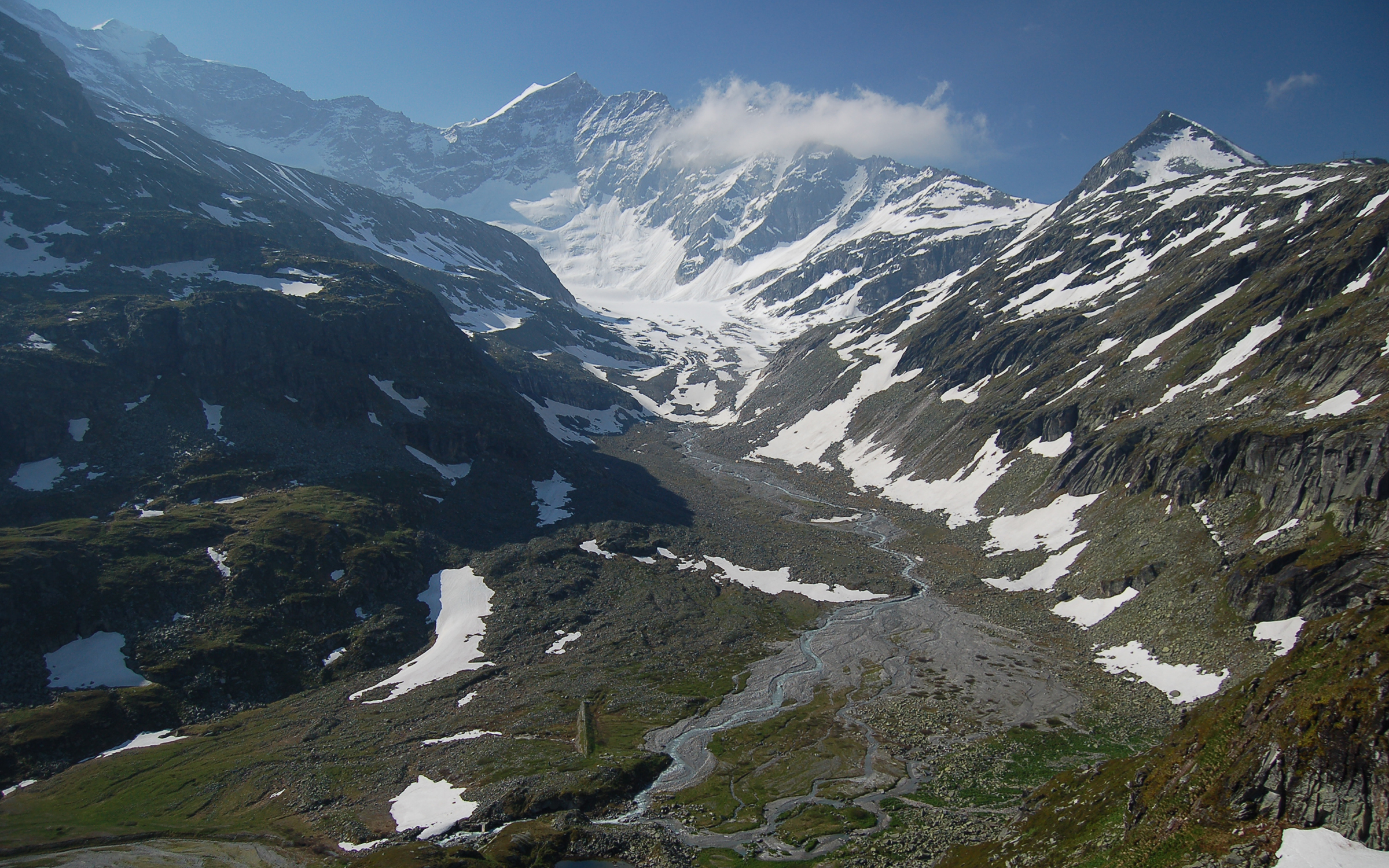
A glacial stream meanders through the fields of Odenwinkelkees, Hohe Tauern, Austria. The further the glacier retreats, the warmer the water in the lower part of the river becomes.
(Photo: Lee Brown)
Protected areas must be extended
If the glaciers melt, not only will new areas be opened up that were previously under a thick layer of ice, but new watercourses and glacial lakes will also form as a result. Accordingly, the organisms accustomed to cold glacial water will migrate upwards with the glacier and move into the newly formed river courses.
Since it is often not easy for the alpine river inhabitants to change their habitat, the researchers are also considering the support of humans who relocate the population to new areas when the time comes – as long as these are protected accordingly. It is therefore urgent to continue monitoring and studying the biodiversity of alpine waters so that modelling techniques can be extended to other aquatic life and actions taken to protect them.
Conflicting goals after glacial retreat
But here the researchers see another risk for biodiversity. Only just 12% of these catchment areas modelled according to their calculations are currently under nature conservation! This means that in 2100, most of the suitable catchment areas for cold-water invertebrates will be in unprotected regions.
The team around Eawag researcher Robinson fears that those regions that are released from the glaciers will be prioritised for recreational activities or hydropower utilisation as soon as they are thus accessible. This can threaten the new life-saving habitats. “Now would be the time to put the future areas emerging from the study under protection,” says Christopher Robinson. This is the only way to ensure retreats for the organisms and their survival.
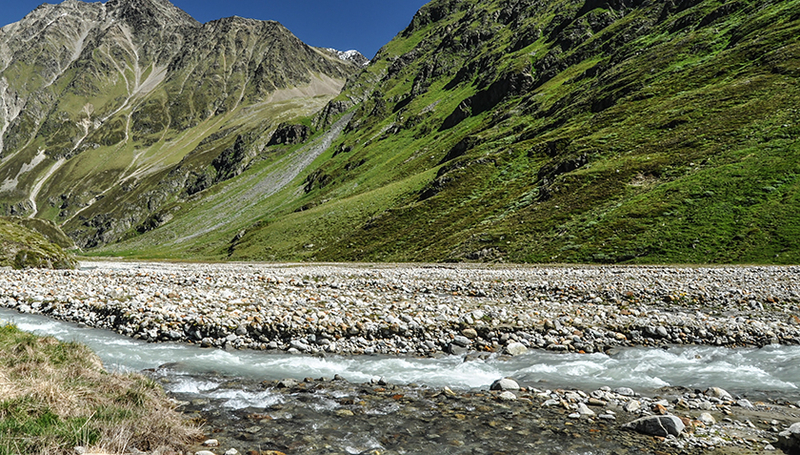
Cover picture: In comparison: at the back, the glacier-fed river with turbid cold water, and at the front, the inflow of warmer, clear water. For many microorganisms, these ice-cold bodies of water are the ideal and only habitat. (Photo: Lee Brown)