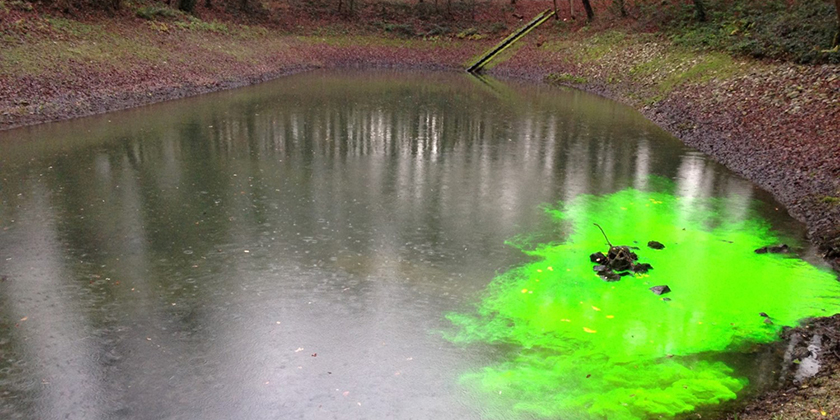
In the canton of Basel-Landschaft, existing pollution situation and hazards to groundwater were determined. The model area Hardwald is characterized by strongly urban and industrially areas. These spatial structures have a great impact on the water supply and on the quality of the groundwater. In the drinking water production area, about 15 million m3 of drinking water are produced per year. The drinking water production area is geologically as well as hydrogeologically very complex. The groundwater circulates in a regional karst aquifer and an overlying unconsolidated aquifer, in which Rhine water is artificially infiltrated. Today, the water supplier recharges twice as much groundwater as is extracted. Since significantly more water infiltrates than groundwater is withdrawn, a "groundwater mound" is created, which protects the area from the surrounding industrial areas and polluted sites.
The area is subject to intensive hydrogeological investigation. In addition to the numerous compounds originating from the Rhine that can be detected in the groundwater, the chlorinated hydrocarbons hexachlorobutadiene and the isomer 1,1,4,4-tetrachlorobutadiene as well as tri- and tetrachloroethene deserve special mention. In the project "Regionale Wasserversorgung Basel-Landschaft 21" and subsequent studies, methods for recording and assessing water quality were developed, further treatment methods for removing trace substances in the Hardwald were identified, and an adaptive (quasi-) real-time online tool for effective groundwater management was developed.
array(12 items)0 => Snowflake\Publications\Domain\Model\Publicationprototypepersistent entity (uid=22025, pid=124)originalId => protected22025 (integer)
authors => protected'Moeck, C.; Popp, A. L.; Brennwald, M. S.; Kipfer,&n bsp;R.; Schirmer, M.' (101 chars)
title => protected'Combined method of <sup>3</sup>H/<sup>3</sup>He apparent age and on-site hel ium analysis to identify groundwater flow processes and transport of perchlo roethylene (PCE) in an urban area' (185 chars)
journal => protected'Journal of Contaminant Hydrology' (32 chars)
year => protected2021 (integer)
volume => protected238 (integer)
issue => protected'' (0 chars)
startpage => protected'103773 (13 pp.)' (15 chars)
otherpage => protected'' (0 chars)
categories => protected'groundwater transport; managed aquifer recharge (MAR); 3H/3He apparent age; environmental gases; perchloroethylene; aquifer connectivity' (136 chars)
description => protected'Urban groundwater management requires a thorough and robust scientific under standing of flow and transport processes. <sup>3</sup>H/<sup>3</sup>He appa rent ages have been shown to efficiently help provide important groundwater- related information. However, this type of analysis is expensive as well as labor- and time-intensive, and hence limits the number of potential sampling locations.<br /> To overcome this limitation, we established an inter-relat
portable gas equilibrium membrane inlet mass spectrometer (GE-MIMS) system, and demonstrated that the results of the simpler GE-MIMS system are an accur ate and reliable alternative to sophisticated laboratory based analyses. The combined use of <sup>3</sup>H/<sup>3</sup>He lab-based ages and predicted ages from the <sup>3</sup>H/<sup>3</sup>He–<sup>4</sup>He age relationshi p opens new opportunities for site characterization, and reveals insights in to the conceptual understanding of groundwater systems.<br /> For our study site, we combined groundwater ages with hydrochemical data, water isotopes ( <sup>18</sup>O and <sup>2</sup>H), and perchloroethylene (PCE) concentratio ns (1) to identify spatial inter-aquifer mixing between artificially infiltr ated groundwater and water originating from regional flow paths and (2) to e xplain the spatial differences in PCE contamination within the observed grou ndwater system. Overall, low PCE concentrations and young ages occur when th e fraction of artificially infiltrated water is high. The results obtained f rom the age distribution analysis are strongly supported by the information gained from the isotopic and hydrochemical data. Moreover, for some wells, f ault-induced aquifer connectivity is identified as a preferential flow path for the transport of older groundwater, leading to elevated PCE concentratio ns.' (1979 chars)
serialnumber => protected'0169-7722' (9 chars)
doi => protected'10.1016/j.jconhyd.2021.103773' (29 chars)
uid => protected22025 (integer)
_localizedUid => protected22025 (integer)modified_languageUid => protectedNULL
_versionedUid => protected22025 (integer)modifiedpid => protected124 (integer)1 => Snowflake\Publications\Domain\Model\Publicationprototypepersistent entity (uid=21418, pid=124)originalId => protected21418 (integer)
authors => protected'Merle, T.; Knappe, D. R. U.; Pronk, W.; Vogler,&nbs p;B.; Hollender, J.; von Gunten, U.' (121 chars)
title => protected'Assessment of the breakthrough of micropollutants in full-scale granular act ivated carbon adsorbers by rapid small-scale column tests and a novel pilot- scale sampling approach' (175 chars)
journal => protected'Environmental Science: Water Research and Technology' (52 chars)
year => protected2020 (integer)
volume => protected6 (integer)
issue => protected'10' (2 chars)
startpage => protected'2742' (4 chars)
otherpage => protected'2751' (4 chars)
categories => protected'' (0 chars)
description => protected'This study aimed to compare three approaches for predicting the service life of full-scale GAC adsorbers for the removal of micropollutants. The approac hes included (i) rapid small-scale column tests (RSSCTs), (ii) two pilot-sca le sampling approaches, and (iii) predictive correlations that consider micr opollutant properties and background water matrix characteristics. The RSSCT could predict full-scale performance only if a micropollutant-specific foul ing index was applied. At the pilot-scale, water samples were collected (1) over time at the top sampling point only (empty bed contact time (EBCT) of 1 minute) to minimize time to breakthrough (method 1) and (2) at different co lumn depths at a single time point (method 2). Breakthrough curves obtained with method 2 more closely matched those obtained at the full-scale. In addi tion, method 2 is more convenient since it requires only one sampling campai gn. Method 2 was used as a prognostic tool to predict breakthrough curves fo r micropollutants without full-scale data and a comparison with an existing prediction model gave satisfactory results for 6 out of 13 compounds.' (1133 chars)
serialnumber => protected'2053-1400' (9 chars)
doi => protected'10.1039/D0EW00405G' (18 chars)
uid => protected21418 (integer)
_localizedUid => protected21418 (integer)modified_languageUid => protectedNULL
_versionedUid => protected21418 (integer)modifiedpid => protected124 (integer)2 => Snowflake\Publications\Domain\Model\Publicationprototypepersistent entity (uid=19850, pid=124)originalId => protected19850 (integer)
authors => protected'Moeck, C.; Molson, J.; Schirmer, M.' (50 chars)
title => protected'Pathline density distributions in a null‐space Monte Carlo approach to ass ess groundwater pathways' (100 chars)
journal => protected'Groundwater' (11 chars)
year => protected2020 (integer)
volume => protected58 (integer)
issue => protected'2' (1 chars)
startpage => protected'189' (3 chars)
otherpage => protected'207' (3 chars)
categories => protected'' (0 chars)
description => protected'A null‐space Monte‐Carlo (NSMC) approach was applied to account for unce rtainty in the calibration of the hydraulic conductivity (<em>K</em>) field for a three‐dimensional groundwater flow model of a major water supply sys tem in Switzerland. The approach generates different parameter realizations of the <em>K</em> field using the pilot point methodology. Subsequently, par ticle tracking (PT) was applied to each calibrated model, and the resulting particles are interpreted as the spatial pathline density distribution of mu ltiple sources. The adopted approach offers advantages over classical PT whi ch does not provide a means for treating uncertainty originating from the in complete description of subsurface heterogeneity. Uncertainty in the <em>K</ em> field is shown to strongly influence the spatial pathline distribution. Pathline spreading is particularly evident in locations where the informatio n content of the head observations does not sufficiently constrain the estim ated parameters. Despite the predictive uncertainty, the pumped drinking wat er at the study site is most likely dominated by artificially‐infiltrated groundwater originating from the local infiltration canals. The model sugges ts that within the well field, the central pumping wells could be extracting regional groundwater, although the probability is relatively low. Neverthel ess, a rigorous uncertainty assessment is still required since only a few re alizations resulted in flow paths that support the field observations. Model results should therefore not be based on only one model realization; rather , an uncertainty analysis should be carried out to provide a sufficiently la rge suite of equally probable simulations that include all potential sources and pathways.' (1762 chars)
serialnumber => protected'0017-467X' (9 chars)
doi => protected'10.1111/gwat.12900' (18 chars)
uid => protected19850 (integer)
_localizedUid => protected19850 (integer)modified_languageUid => protectedNULL
_versionedUid => protected19850 (integer)modifiedpid => protected124 (integer)3 => Snowflake\Publications\Domain\Model\Publicationprototypepersistent entity (uid=19817, pid=124)originalId => protected19817 (integer)
authors => protected'Popp, A. L.; Scheidegger, A.; Moeck, C.; Brennwald,  ;M. S.; Kipfer, R.' (104 chars)
title => protected'Integrating Bayesian groundwater mixing modeling with on‐site helium analy sis to identify unknown water sources' (113 chars)
journal => protected'Water Resources Research' (24 chars)
year => protected2019 (integer)
volume => protected55 (integer)
issue => protected'' (0 chars)
startpage => protected'10602' (5 chars)
otherpage => protected'10615' (5 chars)
categories => protected'' (0 chars)
description => protected'Analyzing groundwater mixing ratios is crucial for many groundwater manageme nt tasks such as assessing sources of groundwater recharge and flow paths. H owever, estimating groundwater mixing ratios is affected by various uncertai nties, which are related to analytical and measurement errors of tracers, th e selection of end‐members, and finding the most suitable set of tracers. Although these uncertainties are well recognized, it is still not common pra ctice to account for them. We address this issue by using a new set of trace rs in combination with a Bayesian modeling approach, which explicitly consid ers the possibility of unknown end‐members while fully accounting for trac er uncertainties. We apply the Bayesian model we developed to a tracer set, which includes helium (<sup>4</sup>He) analyzed on site to determine mixing ratios in groundwater. Thereby, we identify an unknown end‐member that con tributes up to 84 ± 9% to the water mixture observed at our study site. F or the <sup>4</sup>He analysis, we use a newly developed Gas Equilibrium Mem brane Inlet Mass Spectrometer (GE‐MIMS), operated in the field. To test th e reliability of on‐site <sup>4</sup>He analysis, we compare results obtai ned with the GE‐MIMS to the conventional lab‐based method, which is comp aratively expensive and labor intensive. Our work demonstrates that (i) trac er‐aided Bayesian mixing modeling can detect unknown water sources, thereb y revealing valuable insights into the conceptual understanding of the groun dwater system studied, and (ii) on‐site <sup>4</sup>He analysis with the G E‐MIMS system is an accurate and reliable alternative to the lab‐based a nalysis.' (1680 chars)
serialnumber => protected'0043-1397' (9 chars)
doi => protected'10.1029/2019WR025677' (20 chars)
uid => protected19817 (integer)
_localizedUid => protected19817 (integer)modified_languageUid => protectedNULL
_versionedUid => protected19817 (integer)modifiedpid => protected124 (integer)4 => Snowflake\Publications\Domain\Model\Publicationprototypepersistent entity (uid=15322, pid=124)originalId => protected15322 (integer)
authors => protected'Moeck, C.; Affolter, A.; Radny, D.; Dressmann, H.; Aucke nthaler, A.; Huggenberger, P.; Schirmer, M.' (134 chars)
title => protected'Improved water resource management for a highly complex environment using th ree-dimensional groundwater modelling' (113 chars)
journal => protected'Hydrogeology Journal' (20 chars)
year => protected2018 (integer)
volume => protected26 (integer)
issue => protected'' (0 chars)
startpage => protected'133' (3 chars)
otherpage => protected'146' (3 chars)
categories => protected'numerical modelling; urban groundwater; groundwater management; artificial r echarge; Switzerland' (96 chars)
description => protected'A three-dimensional groundwater model was used to improve water resource man agement for a study area in north-west Switzerland, where drinking-water pro duction is close to former landfills and industrial areas. To avoid drinking -water contamination, artificial groundwater recharge with surface water is used to create a hydraulic barrier between the contaminated sites and drinki ng-water extraction wells. The model was used for simulating existing and pr oposed water management strategies as a tool to ensure the utmost security f or drinking water. A systematic evaluation of the flow direction between exi sting observation points using a developed three-point estimation method for a large number of scenarios was carried out. It is demonstrated that system atically applying the developed methodology helps to identify vulnerable loc ations which are sensitive to changing boundary conditions such as those ari sing from changes to artificial groundwater recharge rates. At these locatio ns, additional investigations and protection are required. The presented int egrated approach, using the groundwater flow direction between observation p oints, can be easily transferred to a variety of hydrological settings to sy stematically evaluate groundwater modelling scenarios.' (1270 chars)
serialnumber => protected'1431-2174' (9 chars)
doi => protected'10.1007/s10040-017-1640-y' (25 chars)
uid => protected15322 (integer)
_localizedUid => protected15322 (integer)modified_languageUid => protectedNULL
_versionedUid => protected15322 (integer)modifiedpid => protected124 (integer)5 => Snowflake\Publications\Domain\Model\Publicationprototypepersistent entity (uid=17664, pid=124)originalId => protected17664 (integer)
authors => protected'Moeck, C.; Radny, D.; Huggenberger, P.; Affolter, A.; Au ckenthaler, A.; Hollender, J.; Berg, M.; Schirmer, M.' (149 chars)
title => protected'Verteilung anthropogen eingetragener Stoffe im Grundwasser: ein Fallbeispiel aus der Nordschweiz' (96 chars)
journal => protected'Grundwasser' (11 chars)
year => protected2018 (integer)
volume => protected23 (integer)
issue => protected'4' (1 chars)
startpage => protected'297' (3 chars)
otherpage => protected'309' (3 chars)
categories => protected'stable water isotopes; organic micropollutants; chlorinated solvents; artifi cial groundwater recharge; urban hydrogeology; Switzerland' (134 chars)
description => protected'Im Wassergewinnungsgebiet Hardwald werden rund 15 Mio. m<small><sup>3</s up></small>/a Trinkwasser produziert. Es finden sich jedoch Spuren von chlor ierten organischen Verbindungen im Grundwasser. Als Fallstudie werden hier d ie Ergebnisse von Feld- und Laborarbeiten zur Bestimmung der räumlichen Ver teilung der chlorierten organischen Verbindungen, der stabilen Wasserisotope (δ<small><sup>18</sup></small>O und δ<small><sup>2</sup></small>D), der H auptkationen- und -anionen und ausgewählter Spurenstoffe, welche über ein Rheininfiltrat eingetragen werden, vorgestellt. Als Ergebnis der Untersuchun gen zeigte sich, dass die künstliche Rheinwasserinfiltration ganz entscheid end zur Trinkwassersicherheit beiträgt und das entnommene Grundwasser vorwi egend der chemischen Signatur des infiltrierten Rheinwassers entspricht. Jed och zeigt sich auch, dass durch die über die Fläche ungleichmäßig vertei lte Infiltration vor allem eine Beimischung von Muschelkalkwasser in süd-we stlichen Bereichen des Untersuchungsgebiets wahrscheinlich ist. Diese Interp retation wird durch die Verteilung der chlorierten organischen Verbindungen, Hauptkationen- und -anionen, stabilen Wasserisotopen und Spurenstoffen gest ützt. Trotz der hier vorhandenen komplexen Randbedingungen wird durch das Z usammenspiel von künstlicher Infiltration und Entnahme eine sichere Trinkwa sserversorgung ermöglicht.<br/><br/> At the Hardwald study site, Switzerlan d, 15 million cubic metres per year of drinking water is being pumped. Chlor inated compounds, however, have been detected in the groundwater. We present results from field sampling and lab analyses to determine the spatial distr ibution of chlorinated organic compounds, stable water isotopes (δ<small><s up>18</sup></small>O und δ<small><sup>2</sup></small>D), major ions as well as selected micropollutants, which enter the groundwater by artificial rech arge. We demonstrate that artificial groundwater recharge is essential for w ater security and that t...' (2549 chars)
serialnumber => protected'1430-483X' (9 chars)
doi => protected'10.1007/s00767-018-0403-6' (25 chars)
uid => protected17664 (integer)
_localizedUid => protected17664 (integer)modified_languageUid => protectedNULL
_versionedUid => protected17664 (integer)modifiedpid => protected124 (integer)6 => Snowflake\Publications\Domain\Model\Publicationprototypepersistent entity (uid=15140, pid=124)originalId => protected15140 (integer)
authors => protected'Moeck, C.; Radny, D.; Popp, A.; Brennwald, M.; Stoll,&nb sp;S.; Auckenthaler, A.; Berg, M.; Schirmer, M.' (138 chars)
title => protected'Characterization of a managed aquifer recharge system using multiple tracers' (76 chars)
journal => protected'Science of the Total Environment' (32 chars)
year => protected2017 (integer)
volume => protected609 (integer)
issue => protected'' (0 chars)
startpage => protected'701' (3 chars)
otherpage => protected'714' (3 chars)
categories => protected'managed aquifer recharge; groundwater residence time; acesulfame; time serie s; noble gases; urban hydrogeology' (110 chars)
description => protected'Knowledge about the residence times of artificially infiltrated water into a n aquifer and the resulting flow paths is essential to developing groundwate r-management schemes. To obtain this knowledge, a variety of tracers can be used to study residence times and gain information about subsurface processe s. Although a variety of tracers exists, their interpretation can differ con siderably due to subsurface heterogeneity, underlying assumptions, and sampl ing and analysis limitations. The current study systematically assesses info rmation gained from seven different tracers during a pumping experiment at a site where drinking water is extracted from an aquifer close to contaminate d areas and where groundwater is artificially recharged by infiltrating surf ace water.<br/> We demonstrate that the groundwater residence times estimate d using dye and heat tracers are comparable when the thermal retardation for the heat tracer is considered. Furthermore, major ions, acesulfame, and sta ble isotopes (δ<sup>2</sup>H and δ<sup>18</sup>O) show that mixing of infi ltrated water and groundwater coming from the regional flow path occurred an d a vertical stratification of the flow system exist. Based on the concentra tion patterns of dissolved gases (He, Ar, Kr, N<sub>2</sub>, and O<sub>2</su b>) and chlorinated solvents (e.g., tetrachloroethene), three temporal phase s are observed in the ratio between infiltrated water and regional groundwat er during the pumping experiment. Variability in this ratio is significantly related to changes in the pumping and infiltration rates. During constant p umping rates, more infiltrated water was extracted, which led to a higher di lution of the regional groundwater. An infiltration interruption caused howe ver, the ratio to change and more regional groundwater is extracted, which l ed to an increase in all concentrations. The obtained results are discussed for each tracer considered and its strengths and limitations are illustrated . Overall, it is demonst...' (2166 chars)
serialnumber => protected'0048-9697' (9 chars)
doi => protected'10.1016/j.scitotenv.2017.07.211' (31 chars)
uid => protected15140 (integer)
_localizedUid => protected15140 (integer)modified_languageUid => protectedNULL
_versionedUid => protected15140 (integer)modifiedpid => protected124 (integer)7 => Snowflake\Publications\Domain\Model\Publicationprototypepersistent entity (uid=14298, pid=124)originalId => protected14298 (integer)
authors => protected'Merle, T.; Pronk, W.; von Gunten, U.' (51 chars)
title => protected'MEMBRO<SUB>3</SUB>X, a novel combination of a membrane contactor with advanc ed oxidation (O<SUB>3</SUB>/H<SUB>2</SUB>O<SUB>2</SUB>) for simultaneous mic ropollutant abatement and bromate minimization' (198 chars)
journal => protected'Environmental Science and Technology Letters' (44 chars)
year => protected2017 (integer)
volume => protected4 (integer)
issue => protected'5' (1 chars)
startpage => protected'180' (3 chars)
otherpage => protected'185' (3 chars)
categories => protected'' (0 chars)
description => protected'Ozonation is a water treatment process for disinfection and/or micropollutan t abatement. However, ozonation of bromide-containing water leads to bromate (BrO<SUB>3</SUB><SUP>–</SUP>) formation, a potential human carcinogen. A solution for mitigating BrO<SUB>3</SUB><SUP>–</SUP> formation during abate ment of micropollutants is to minimize the ozone (O<SUB>3</SUB>) concentrati on. This can be achieved by dosing ozone in numerous small portions througho ut a reactor in the presence of H<SUB>2</SUB>O<SUB>2</SUB>. Under these cond itions, O<SUB>3</SUB> is rapidly consumed to form hydroxyl radical (<sup><B> ·</B></sup>OH), which will oxidize micropollutants. To achieve this goal, a novel process (“MEMBRO<SUB>3</SUB>X”) was developed in which ozone is t ransferred to the water through the pores of polytetrafluoroethylene (PTFE) hollow fiber membranes. When compared to the conventional peroxone process ( O<SUB>3</SUB>/H<SUB>2</SUB>O<SUB>2</SUB>), the MEMBRO<SUB>3</SUB>X process s hows better performance in terms of micropollutant abatement and bromate min imization for groundwater and surface water treatment. For a groundwater con taining 180 μg/L bromide, a 95% abatement of the ozone-resistant probe comp ound p-chlorobenzoic acid yielded <0.5 μg/L BrO<SUB>3</SUB><SUP>–</SUP>,
cess was demonstrated with river water and lake water.' (1498 chars)
serialnumber => protected'' (0 chars)
doi => protected'10.1021/acs.estlett.7b00061' (27 chars)
uid => protected14298 (integer)
_localizedUid => protected14298 (integer)modified_languageUid => protectedNULL
_versionedUid => protected14298 (integer)modifiedpid => protected124 (integer)8 => Snowflake\Publications\Domain\Model\Publicationprototypepersistent entity (uid=15035, pid=124)originalId => protected15035 (integer)
authors => protected'Moeck, C.; Radny, D.; Auckenthaler, A.; Berg, M.; Hollen der, J.; Schirmer, M.' (107 chars)
title => protected'Estimating the spatial distribution of artificial groundwater recharge using multiple tracers' (93 chars)
journal => protected'Isotopes in Environmental and Health Studies' (44 chars)
year => protected2017 (integer)
volume => protected53 (integer)
issue => protected'5' (1 chars)
startpage => protected'484' (3 chars)
otherpage => protected'499' (3 chars)
categories => protected'groundwater mixing; hydrochemistry; hydrogen-2; isotope hydrology; managed a quifer recharge; organic micropollutants; oxygen-18; urban hydrogeology' (147 chars)
description => protected'Stable isotopes of water, organic micropollutants and hydrochemistry data ar e powerful tools for identifying different water types in areas where knowle dge of the spatial distribution of different groundwater is critical for wat er resource management. An important question is how the assessments change if only one or a subset of these tracers is used. In this study, we estimate spatial artificial infiltration along an infiltration system with stage–d ischarge relationships and classify different water types based on the menti oned hydrochemistry data for a drinking water production area in Switzerland . Managed aquifer recharge via surface water that feeds into the aquifer cre ates a hydraulic barrier between contaminated groundwater and drinking water wells. We systematically compare the information from the aforementioned tr acers and illustrate differences in distribution and mixing ratios. Despite uncertainties in the mixing ratios, we found that the overall spatial distri bution of artificial infiltration is very similar for all the tracers. The h ighest infiltration occurred in the eastern part of the infiltration system, whereas infiltration in the western part was the lowest. More balanced infi ltration within the infiltration system could cause the elevated groundwater mound to be distributed more evenly, preventing the natural inflow of conta minated groundwater.' (1388 chars)
serialnumber => protected'1025-6016' (9 chars)
doi => protected'10.1080/10256016.2017.1334651' (29 chars)
uid => protected15035 (integer)
_localizedUid => protected15035 (integer)modified_languageUid => protectedNULL
_versionedUid => protected15035 (integer)modifiedpid => protected124 (integer)9 => Snowflake\Publications\Domain\Model\Publicationprototypepersistent entity (uid=14108, pid=124)originalId => protected14108 (integer)
authors => protected'von Gunten, U.; Merle, T.; Lee, M.; Pronk, W.; Hollender , J.; Vogler, B.; Gabriel, T.; Meier, T.' (136 chars)
title => protected'Aufbereitung von Trinkwasser im Hardwald. Einschätzung der jetzigen Situati on und möglicher zusätzlicher Aufbereitungsstufen' (127 chars)
journal => protected'Aqua & Gas' (10 chars)
year => protected2017 (integer)
volume => protected97 (integer)
issue => protected'2' (1 chars)
startpage => protected'21' (2 chars)
otherpage => protected'28' (2 chars)
categories => protected'' (0 chars)
description => protected'Im Hardwald bei Muttenz wird zur Trinkwasseraufbereitung Rheinwasser versick ert. Während der Bodenpassage wird rund die Hälfte der vorhandenen Spurens toffe im Rheinwasser entfernt. Ein Grossteil der restlichen Substanzen wird durch die Aktivkohlefiltration des angereicherten Grundwassers entfernt. Wie gut die Spurenstoffe im Aktivkohlefilter zurückgehalten werden und ob eine vor- oder nachgeschaltete Oxidation zu einer besseren Entfernung führen ka nn, wird in der nachfolgend vorgestellten Studie aufgezeigt. Die Studie wurd e im Rahmen des Projekts "Regionale Wasserversorgung Basel-Landschaft 21" re alisiert.' (617 chars)
serialnumber => protected'2235-5197' (9 chars)
doi => protected'' (0 chars)
uid => protected14108 (integer)
_localizedUid => protected14108 (integer)modified_languageUid => protectedNULL
_versionedUid => protected14108 (integer)modifiedpid => protected124 (integer)10 => Snowflake\Publications\Domain\Model\Publicationprototypepersistent entity (uid=14109, pid=124)originalId => protected14109 (integer)
authors => protected'Möck, C.; Radny, D.; Stoll, S.; Borer, P.; Rothardt,&nb sp;J.; Affolter, A.; Huggenberger, P.; Auckenthaler, A.; Holl ender, J.; Berg, M.; Schirmer, M.' (200 chars)
title => protected'Multivariate Statistik. Zur Optimierung des Wasserressourcen-Managements im Hardwald' (84 chars)
journal => protected'Aqua & Gas' (10 chars)
year => protected2017 (integer)
volume => protected97 (integer)
issue => protected'2' (1 chars)
startpage => protected'14' (2 chars)
otherpage => protected'20' (2 chars)
categories => protected'' (0 chars)
description => protected'Das Trinkwassergewinnungsgebiet Hardwald ist geologisch und hydrogeologisch komplex, zudem existieren zahlreiche Randeinflüsse sowie diverse historisch e Belastungen. Um eine gute Trinkwasserqualität zu gewährleisten, ist es d eshalb von grosser Bedeutung, mögliche Mischungsprozesse verschiedener Wäs ser zu identifizieren. Hierfür wurde im Rahmen des Projekts «Regionale Was serversorgung Basel-Landschaft 21» die zur Verfügung stehende Datenmenge z ur Hydrochemie ausgewertet.' (483 chars)
serialnumber => protected'2235-5197' (9 chars)
doi => protected'' (0 chars)
uid => protected14109 (integer)
_localizedUid => protected14109 (integer)modified_languageUid => protectedNULL
_versionedUid => protected14109 (integer)modifiedpid => protected124 (integer)11 => Snowflake\Publications\Domain\Model\Publicationprototypepersistent entity (uid=14045, pid=124)originalId => protected14045 (integer)
authors => protected'Moeck, C.; Radny, D.; Borer, P.; Rothardt, J.; Auckentha ler, A.; Berg, M.; Schirmer, M.' (122 chars)
title => protected'Multicomponent statistical analysis to identify flow and transport processes in a highly-complex environment' (108 chars)
journal => protected'Journal of Hydrology' (20 chars)
year => protected2016 (integer)
volume => protected542 (integer)
issue => protected'' (0 chars)
startpage => protected'437' (3 chars)
otherpage => protected'449' (3 chars)
categories => protected'hydrochemistry; groundwater; multicomponent statistical analysis; stable wat er isotopes; organic micropollutants; artificial infiltration' (137 chars)
description => protected'A combined approach of multivariate statistical analysis, namely factor anal ysis (FA) and hierarchical cluster analysis (HCA), interpretation of geochem ical processes, stable water isotope data and organic micropollutants enabli ng to assess spatial patterns of water types was performed for a study area in Switzerland, where drinking water production is close to different potent ial input pathways for contamination. To avoid drinking water contamination, artificial groundwater recharge with surface water into an aquifer is used to create a hydraulic barrier between potential intake pathways for contamin ation and drinking water extraction wells. Inter-aquifer mixing in the subsu rface is identified, where a high amount of artificial infiltrated surface w ater is mixed with a lesser amount of water originating from the regional fl ow pathway in the vicinity of drinking water extraction wells. The spatial d istribution of different water types can be estimated and a conceptual syste m understanding is developed. Results of the multivariate statistical analys is are comparable with gained information from isotopic data and organic mic ropollutants analyses. The integrated approach using different kinds of obse rvations can be easily transferred to a variety of hydrological settings to synthesise and evaluate large hydrochemical datasets. The combination of add itional data with different information content is conceivable and enabled e ffective interpretation of hydrological processes. Using the applied approac h leads to more sound conceptual system understanding acting as the very bas is to develop improved water resources management practices in a sustainable way.' (1677 chars)
serialnumber => protected'0022-1694' (9 chars)
doi => protected'10.1016/j.jhydrol.2016.09.023' (29 chars)
uid => protected14045 (integer)
_localizedUid => protected14045 (integer)modified_languageUid => protectedNULL
_versionedUid => protected14045 (integer)modifiedpid => protected124 (integer)
Combined method of 3H/3He apparent age and on-site helium analysis to identify groundwater flow processes and transport of perchloroethylene (PCE) in an urban area
Urban groundwater management requires a thorough and robust scientific understanding of flow and transport processes. 3H/3He apparent ages have been shown to efficiently help provide important groundwater-related information. However, this type of analysis is expensive as well as labor- and time-intensive, and hence limits the number of potential sampling locations. To overcome this limitation, we established an inter-relationship between 3H/3He apparent groundwater ages and 4He concentrations analyzed in the field with a newly developed portable gas equilibrium membrane inlet mass spectrometer (GE-MIMS) system, and demonstrated that the results of the simpler GE-MIMS system are an accurate and reliable alternative to sophisticated laboratory based analyses. The combined use of 3H/3He lab-based ages and predicted ages from the 3H/3He–4He age relationship opens new opportunities for site characterization, and reveals insights into the conceptual understanding of groundwater systems. For our study site, we combined groundwater ages with hydrochemical data, water isotopes (18O and 2H), and perchloroethylene (PCE) concentrations (1) to identify spatial inter-aquifer mixing between artificially infiltrated groundwater and water originating from regional flow paths and (2) to explain the spatial differences in PCE contamination within the observed groundwater system. Overall, low PCE concentrations and young ages occur when the fraction of artificially infiltrated water is high. The results obtained from the age distribution analysis are strongly supported by the information gained from the isotopic and hydrochemical data. Moreover, for some wells, fault-induced aquifer connectivity is identified as a preferential flow path for the transport of older groundwater, leading to elevated PCE concentrations.
Moeck, C.; Popp, A. L.; Brennwald, M. S.; Kipfer, R.; Schirmer, M. (2021) Combined method of 3H/3He apparent age and on-site helium analysis to identify groundwater flow processes and transport of perchloroethylene (PCE) in an urban area, Journal of Contaminant Hydrology, 238, 103773 (13 pp.), doi:10.1016/j.jconhyd.2021.103773, Institutional Repository
Assessment of the breakthrough of micropollutants in full-scale granular activated carbon adsorbers by rapid small-scale column tests and a novel pilot-scale sampling approach
This study aimed to compare three approaches for predicting the service life of full-scale GAC adsorbers for the removal of micropollutants. The approaches included (i) rapid small-scale column tests (RSSCTs), (ii) two pilot-scale sampling approaches, and (iii) predictive correlations that consider micropollutant properties and background water matrix characteristics. The RSSCT could predict full-scale performance only if a micropollutant-specific fouling index was applied. At the pilot-scale, water samples were collected (1) over time at the top sampling point only (empty bed contact time (EBCT) of 1 minute) to minimize time to breakthrough (method 1) and (2) at different column depths at a single time point (method 2). Breakthrough curves obtained with method 2 more closely matched those obtained at the full-scale. In addition, method 2 is more convenient since it requires only one sampling campaign. Method 2 was used as a prognostic tool to predict breakthrough curves for micropollutants without full-scale data and a comparison with an existing prediction model gave satisfactory results for 6 out of 13 compounds.
Merle, T.; Knappe, D. R. U.; Pronk, W.; Vogler, B.; Hollender, J.; von Gunten, U. (2020) Assessment of the breakthrough of micropollutants in full-scale granular activated carbon adsorbers by rapid small-scale column tests and a novel pilot-scale sampling approach, Environmental Science: Water Research and Technology, 6(10), 2742-2751, doi:10.1039/D0EW00405G, Institutional Repository
Pathline density distributions in a null‐space Monte Carlo approach to assess groundwater pathways
A null‐space Monte‐Carlo (NSMC) approach was applied to account for uncertainty in the calibration of the hydraulic conductivity (K) field for a three‐dimensional groundwater flow model of a major water supply system in Switzerland. The approach generates different parameter realizations of the K field using the pilot point methodology. Subsequently, particle tracking (PT) was applied to each calibrated model, and the resulting particles are interpreted as the spatial pathline density distribution of multiple sources. The adopted approach offers advantages over classical PT which does not provide a means for treating uncertainty originating from the incomplete description of subsurface heterogeneity. Uncertainty in the K field is shown to strongly influence the spatial pathline distribution. Pathline spreading is particularly evident in locations where the information content of the head observations does not sufficiently constrain the estimated parameters. Despite the predictive uncertainty, the pumped drinking water at the study site is most likely dominated by artificially‐infiltrated groundwater originating from the local infiltration canals. The model suggests that within the well field, the central pumping wells could be extracting regional groundwater, although the probability is relatively low. Nevertheless, a rigorous uncertainty assessment is still required since only a few realizations resulted in flow paths that support the field observations. Model results should therefore not be based on only one model realization; rather, an uncertainty analysis should be carried out to provide a sufficiently large suite of equally probable simulations that include all potential sources and pathways.
Moeck, C.; Molson, J.; Schirmer, M. (2020) Pathline density distributions in a null‐space Monte Carlo approach to assess groundwater pathways, Groundwater, 58(2), 189-207, doi:10.1111/gwat.12900, Institutional Repository
Integrating Bayesian groundwater mixing modeling with on‐site helium analysis to identify unknown water sources
Analyzing groundwater mixing ratios is crucial for many groundwater management tasks such as assessing sources of groundwater recharge and flow paths. However, estimating groundwater mixing ratios is affected by various uncertainties, which are related to analytical and measurement errors of tracers, the selection of end‐members, and finding the most suitable set of tracers. Although these uncertainties are well recognized, it is still not common practice to account for them. We address this issue by using a new set of tracers in combination with a Bayesian modeling approach, which explicitly considers the possibility of unknown end‐members while fully accounting for tracer uncertainties. We apply the Bayesian model we developed to a tracer set, which includes helium (4He) analyzed on site to determine mixing ratios in groundwater. Thereby, we identify an unknown end‐member that contributes up to 84 ± 9% to the water mixture observed at our study site. For the 4He analysis, we use a newly developed Gas Equilibrium Membrane Inlet Mass Spectrometer (GE‐MIMS), operated in the field. To test the reliability of on‐site 4He analysis, we compare results obtained with the GE‐MIMS to the conventional lab‐based method, which is comparatively expensive and labor intensive. Our work demonstrates that (i) tracer‐aided Bayesian mixing modeling can detect unknown water sources, thereby revealing valuable insights into the conceptual understanding of the groundwater system studied, and (ii) on‐site 4He analysis with the GE‐MIMS system is an accurate and reliable alternative to the lab‐based analysis.
Popp, A. L.; Scheidegger, A.; Moeck, C.; Brennwald, M. S.; Kipfer, R. (2019) Integrating Bayesian groundwater mixing modeling with on‐site helium analysis to identify unknown water sources, Water Resources Research, 55, 10602-10615, doi:10.1029/2019WR025677, Institutional Repository
Improved water resource management for a highly complex environment using three-dimensional groundwater modelling
A three-dimensional groundwater model was used to improve water resource management for a study area in north-west Switzerland, where drinking-water production is close to former landfills and industrial areas. To avoid drinking-water contamination, artificial groundwater recharge with surface water is used to create a hydraulic barrier between the contaminated sites and drinking-water extraction wells. The model was used for simulating existing and proposed water management strategies as a tool to ensure the utmost security for drinking water. A systematic evaluation of the flow direction between existing observation points using a developed three-point estimation method for a large number of scenarios was carried out. It is demonstrated that systematically applying the developed methodology helps to identify vulnerable locations which are sensitive to changing boundary conditions such as those arising from changes to artificial groundwater recharge rates. At these locations, additional investigations and protection are required. The presented integrated approach, using the groundwater flow direction between observation points, can be easily transferred to a variety of hydrological settings to systematically evaluate groundwater modelling scenarios.
Moeck, C.; Affolter, A.; Radny, D.; Dressmann, H.; Auckenthaler, A.; Huggenberger, P.; Schirmer, M. (2018) Improved water resource management for a highly complex environment using three-dimensional groundwater modelling, Hydrogeology Journal, 26, 133-146, doi:10.1007/s10040-017-1640-y, Institutional Repository
Verteilung anthropogen eingetragener Stoffe im Grundwasser: ein Fallbeispiel aus der Nordschweiz
Im Wassergewinnungsgebiet Hardwald werden rund 15 Mio. m3/a Trinkwasser produziert. Es finden sich jedoch Spuren von chlorierten organischen Verbindungen im Grundwasser. Als Fallstudie werden hier die Ergebnisse von Feld- und Laborarbeiten zur Bestimmung der räumlichen Verteilung der chlorierten organischen Verbindungen, der stabilen Wasserisotope (δ18O und δ2D), der Hauptkationen- und -anionen und ausgewählter Spurenstoffe, welche über ein Rheininfiltrat eingetragen werden, vorgestellt. Als Ergebnis der Untersuchungen zeigte sich, dass die künstliche Rheinwasserinfiltration ganz entscheidend zur Trinkwassersicherheit beiträgt und das entnommene Grundwasser vorwiegend der chemischen Signatur des infiltrierten Rheinwassers entspricht. Jedoch zeigt sich auch, dass durch die über die Fläche ungleichmäßig verteilte Infiltration vor allem eine Beimischung von Muschelkalkwasser in süd-westlichen Bereichen des Untersuchungsgebiets wahrscheinlich ist. Diese Interpretation wird durch die Verteilung der chlorierten organischen Verbindungen, Hauptkationen- und -anionen, stabilen Wasserisotopen und Spurenstoffen gestützt. Trotz der hier vorhandenen komplexen Randbedingungen wird durch das Zusammenspiel von künstlicher Infiltration und Entnahme eine sichere Trinkwasserversorgung ermöglicht.
At the Hardwald study site, Switzerland, 15 million cubic metres per year of drinking water is being pumped. Chlorinated compounds, however, have been detected in the groundwater. We present results from field sampling and lab analyses to determine the spatial distribution of chlorinated organic compounds, stable water isotopes (δ18O und δ2D), major ions as well as selected micropollutants, which enter the groundwater by artificial recharge. We demonstrate that artificial groundwater recharge is essential for water security and that the pumped groundwater has a close chemical signature to that of the recharged river water. However, due to the heterogeneous infiltration, Muschelkalk water from the regional flow system is mixed with the recently infiltrated water in the south-west.This interpretation is based on the spatial distribution of chlorinated organic compounds, stable water isotopes, major ions as well as selected micropollutants. Despite the complex boundary conditions, the interaction between artificial recharge and pumping provides a secure drinking water supply.
Moeck, C.; Radny, D.; Huggenberger, P.; Affolter, A.; Auckenthaler, A.; Hollender, J.; Berg, M.; Schirmer, M. (2018) Verteilung anthropogen eingetragener Stoffe im Grundwasser: ein Fallbeispiel aus der Nordschweiz, Grundwasser, 23(4), 297-309, doi:10.1007/s00767-018-0403-6, Institutional Repository
Characterization of a managed aquifer recharge system using multiple tracers
Knowledge about the residence times of artificially infiltrated water into an aquifer and the resulting flow paths is essential to developing groundwater-management schemes. To obtain this knowledge, a variety of tracers can be used to study residence times and gain information about subsurface processes. Although a variety of tracers exists, their interpretation can differ considerably due to subsurface heterogeneity, underlying assumptions, and sampling and analysis limitations. The current study systematically assesses information gained from seven different tracers during a pumping experiment at a site where drinking water is extracted from an aquifer close to contaminated areas and where groundwater is artificially recharged by infiltrating surface water. We demonstrate that the groundwater residence times estimated using dye and heat tracers are comparable when the thermal retardation for the heat tracer is considered. Furthermore, major ions, acesulfame, and stable isotopes (δ2H and δ18O) show that mixing of infiltrated water and groundwater coming from the regional flow path occurred and a vertical stratification of the flow system exist. Based on the concentration patterns of dissolved gases (He, Ar, Kr, N2, and O2) and chlorinated solvents (e.g., tetrachloroethene), three temporal phases are observed in the ratio between infiltrated water and regional groundwater during the pumping experiment. Variability in this ratio is significantly related to changes in the pumping and infiltration rates. During constant pumping rates, more infiltrated water was extracted, which led to a higher dilution of the regional groundwater. An infiltration interruption caused however, the ratio to change and more regional groundwater is extracted, which led to an increase in all concentrations. The obtained results are discussed for each tracer considered and its strengths and limitations are illustrated. Overall, it is demonstrated that aquifer heterogeneity and various subsurface processes necessitate application of multiple tracers to quantify uncertainty when identifying flow processes.
Moeck, C.; Radny, D.; Popp, A.; Brennwald, M.; Stoll, S.; Auckenthaler, A.; Berg, M.; Schirmer, M. (2017) Characterization of a managed aquifer recharge system using multiple tracers, Science of the Total Environment, 609, 701-714, doi:10.1016/j.scitotenv.2017.07.211, Institutional Repository
MEMBRO3X, a novel combination of a membrane contactor with advanced oxidation (O3/H2O2) for simultaneous micropollutant abatement and bromate minimization
Ozonation is a water treatment process for disinfection and/or micropollutant abatement. However, ozonation of bromide-containing water leads to bromate (BrO3–) formation, a potential human carcinogen. A solution for mitigating BrO3– formation during abatement of micropollutants is to minimize the ozone (O3) concentration. This can be achieved by dosing ozone in numerous small portions throughout a reactor in the presence of H2O2. Under these conditions, O3 is rapidly consumed to form hydroxyl radical (·OH), which will oxidize micropollutants. To achieve this goal, a novel process (“MEMBRO3X”) was developed in which ozone is transferred to the water through the pores of polytetrafluoroethylene (PTFE) hollow fiber membranes. When compared to the conventional peroxone process (O3/H2O2), the MEMBRO3X process shows better performance in terms of micropollutant abatement and bromate minimization for groundwater and surface water treatment. For a groundwater containing 180 μg/L bromide, a 95% abatement of the ozone-resistant probe compound p-chlorobenzoic acid yielded <0.5 μg/L BrO3–, whereas in the conventional peroxone process, 8 μg/L BrO3– was formed. In addition, the efficacy of the MEMBRO3X process was demonstrated with river water and lake water.
Merle, T.; Pronk, W.; von Gunten, U. (2017) MEMBRO3X, a novel combination of a membrane contactor with advanced oxidation (O3/H2O2) for simultaneous micropollutant abatement and bromate minimization, Environmental Science and Technology Letters, 4(5), 180-185, doi:10.1021/acs.estlett.7b00061, Institutional Repository
Estimating the spatial distribution of artificial groundwater recharge using multiple tracers
Stable isotopes of water, organic micropollutants and hydrochemistry data are powerful tools for identifying different water types in areas where knowledge of the spatial distribution of different groundwater is critical for water resource management. An important question is how the assessments change if only one or a subset of these tracers is used. In this study, we estimate spatial artificial infiltration along an infiltration system with stage–discharge relationships and classify different water types based on the mentioned hydrochemistry data for a drinking water production area in Switzerland. Managed aquifer recharge via surface water that feeds into the aquifer creates a hydraulic barrier between contaminated groundwater and drinking water wells. We systematically compare the information from the aforementioned tracers and illustrate differences in distribution and mixing ratios. Despite uncertainties in the mixing ratios, we found that the overall spatial distribution of artificial infiltration is very similar for all the tracers. The highest infiltration occurred in the eastern part of the infiltration system, whereas infiltration in the western part was the lowest. More balanced infiltration within the infiltration system could cause the elevated groundwater mound to be distributed more evenly, preventing the natural inflow of contaminated groundwater.
Moeck, C.; Radny, D.; Auckenthaler, A.; Berg, M.; Hollender, J.; Schirmer, M. (2017) Estimating the spatial distribution of artificial groundwater recharge using multiple tracers, Isotopes in Environmental and Health Studies, 53(5), 484-499, doi:10.1080/10256016.2017.1334651, Institutional Repository
Aufbereitung von Trinkwasser im Hardwald. Einschätzung der jetzigen Situation und möglicher zusätzlicher Aufbereitungsstufen
Im Hardwald bei Muttenz wird zur Trinkwasseraufbereitung Rheinwasser versickert. Während der Bodenpassage wird rund die Hälfte der vorhandenen Spurenstoffe im Rheinwasser entfernt. Ein Grossteil der restlichen Substanzen wird durch die Aktivkohlefiltration des angereicherten Grundwassers entfernt. Wie gut die Spurenstoffe im Aktivkohlefilter zurückgehalten werden und ob eine vor- oder nachgeschaltete Oxidation zu einer besseren Entfernung führen kann, wird in der nachfolgend vorgestellten Studie aufgezeigt. Die Studie wurde im Rahmen des Projekts "Regionale Wasserversorgung Basel-Landschaft 21" realisiert.
von Gunten, U.; Merle, T.; Lee, M.; Pronk, W.; Hollender, J.; Vogler, B.; Gabriel, T.; Meier, T. (2017) Aufbereitung von Trinkwasser im Hardwald. Einschätzung der jetzigen Situation und möglicher zusätzlicher Aufbereitungsstufen, Aqua & Gas, 97(2), 21-28, Institutional Repository
Multivariate Statistik. Zur Optimierung des Wasserressourcen-Managements im Hardwald
Das Trinkwassergewinnungsgebiet Hardwald ist geologisch und hydrogeologisch komplex, zudem existieren zahlreiche Randeinflüsse sowie diverse historische Belastungen. Um eine gute Trinkwasserqualität zu gewährleisten, ist es deshalb von grosser Bedeutung, mögliche Mischungsprozesse verschiedener Wässer zu identifizieren. Hierfür wurde im Rahmen des Projekts «Regionale Wasserversorgung Basel-Landschaft 21» die zur Verfügung stehende Datenmenge zur Hydrochemie ausgewertet.
Möck, C.; Radny, D.; Stoll, S.; Borer, P.; Rothardt, J.; Affolter, A.; Huggenberger, P.; Auckenthaler, A.; Hollender, J.; Berg, M.; Schirmer, M. (2017) Multivariate Statistik. Zur Optimierung des Wasserressourcen-Managements im Hardwald, Aqua & Gas, 97(2), 14-20, Institutional Repository
Multicomponent statistical analysis to identify flow and transport processes in a highly-complex environment
A combined approach of multivariate statistical analysis, namely factor analysis (FA) and hierarchical cluster analysis (HCA), interpretation of geochemical processes, stable water isotope data and organic micropollutants enabling to assess spatial patterns of water types was performed for a study area in Switzerland, where drinking water production is close to different potential input pathways for contamination. To avoid drinking water contamination, artificial groundwater recharge with surface water into an aquifer is used to create a hydraulic barrier between potential intake pathways for contamination and drinking water extraction wells. Inter-aquifer mixing in the subsurface is identified, where a high amount of artificial infiltrated surface water is mixed with a lesser amount of water originating from the regional flow pathway in the vicinity of drinking water extraction wells. The spatial distribution of different water types can be estimated and a conceptual system understanding is developed. Results of the multivariate statistical analysis are comparable with gained information from isotopic data and organic micropollutants analyses. The integrated approach using different kinds of observations can be easily transferred to a variety of hydrological settings to synthesise and evaluate large hydrochemical datasets. The combination of additional data with different information content is conceivable and enabled effective interpretation of hydrological processes. Using the applied approach leads to more sound conceptual system understanding acting as the very basis to develop improved water resources management practices in a sustainable way.
Moeck, C.; Radny, D.; Borer, P.; Rothardt, J.; Auckenthaler, A.; Berg, M.; Schirmer, M. (2016) Multicomponent statistical analysis to identify flow and transport processes in a highly-complex environment, Journal of Hydrology, 542, 437-449, doi:10.1016/j.jhydrol.2016.09.023, Institutional Repository