
Practice-oriented courses at Eawag (PEAK)
The practice-oriented Eawag courses (PEAK) are designed for specialists from engineering or environmental consultancies, industry, administration, and non-governmental organisations. They provide up-to-date knowledge and promote exchanges among participants and between science and practice.
-
PEAK Program 2025 (german) [2 MB]
Programme Swiss Centre of Applied Ecotoxicology
The courses offered by the Schweizerischen Zentrums für angewandte Ökotoxikologie operated by Eawag and EPF Lausanne, share expert knowledge and teach professional competencies.
MOOCs Online
MOOC series - Sanitation, Water and Solid Waste for Development.
Free and continuously running online courses of the Department Sandec and EPFL.
Our partners
 | Federal Office for the Environment FOEN |
 | Institute of Natural Resource Sciences |
 | Wasser-Agenda 21 |
 | Verband Schweizer Abwasser- und Gewässerschutzfachleute (VSA) |
 | Ecole polytechnique fédérale de Lausanne (EPFL) |
 | VaLoo |
 | Ecotox Center |
General information
- Foundation-level courses PEAK B teach the basics and provide an up-to-date overview of a specific topic.
- Consolidation-level courses PEAK V are aimed at experts and provide an overall view of the topic using concrete examples and case studies.
- Practical application courses PEAK A teach the participants practical methods of determining and evaluating environmental indicators.
The courses are generally one to two days long and include lectures, practical exercises or group work. Each course is a stand-alone unit that can be taken irrespective of other courses. Participants will receive course documentation and a certificate of attendance. The fees include VAT and course material. The registration forms for the courses are published online together with the annual programme. An invitation is sent along to potential participants three months before the start of a course. Most of the courses take place at the Eawag premises in Dübendorf or Kastanienbaum or are sometimes offered online. Monolingual courses are held in the specified language (without translations).
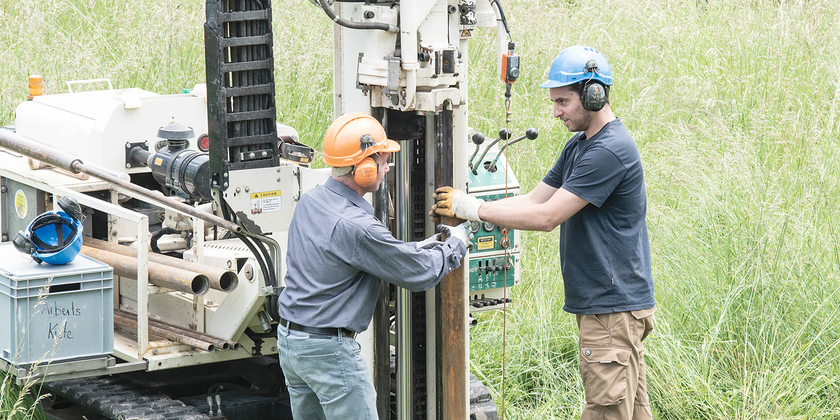
Cover picture: As part of the 2024 PEAK course ‘Field measurement and exploration techniques for groundwater’, course instructor Mario Schirmer and technician Reto Britt (both Eawag) demonstrate direct-push groundwater sampling (Picture: Eawag, Peter Penicka).