Département Assainissement, Eau et Déchets pour le Développement
Assainissement, Eau et Déchets pour le Développement

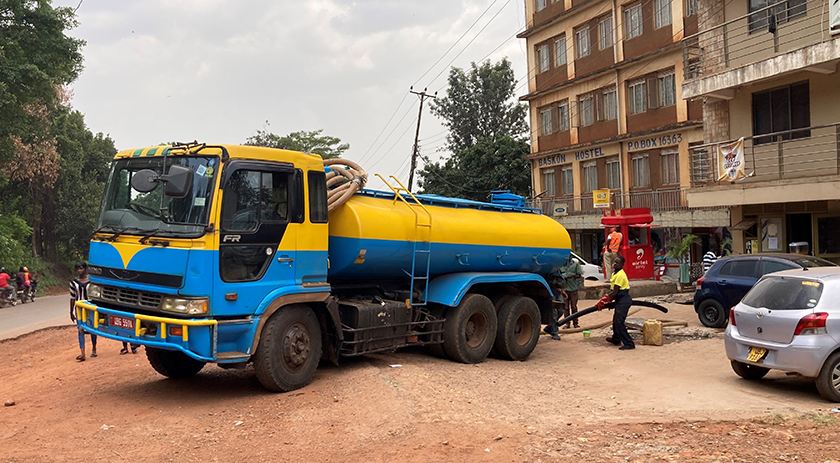
Notre mandat a pour objet de développer et de tester des concepts et technologies qui puissent aider les plus pauvres de la planète à avoir accès à un approvisionnement durable en eau, gestion des déchets et à des systèmes d’assainissement.

En savoir plus

Nouvelles Publications

Extbase Variable Dump
array(2 items)
   publications => '36208,36048,36222' (17 chars)
   libraryUrl => '' (0 chars)
Extbase Variable Dump
array(3 items)
   0 => Snowflake\Publications\Domain\Model\Publicationprototypepersistent entity (uid=36208, pid=124)
      originalId => protected36208 (integer)
      authors => protected'Coppens, K.; Stoll, S.; Strande, L.' (50 chars)
      title => protected'Des lombrics en Ville' (21 chars)
      journal => protected'Aqua & Gas' (10 chars)
      year => protected2026 (integer)
      volume => protected106 (integer)
      issue => protected'2' (1 chars)
      startpage => protected'66' (2 chars)
      otherpage => protected'71' (2 chars)
      categories => protected'' (0 chars)
      description => protected'
         
         ain de Genève a été évaluée. En plus de l'abattement de la matière org
         anique, de l'azote, des pathogènes et des micropolluants, l'étude montre q
         
         
' (417 chars) serialnumber => protected'2235-5197' (9 chars) doi => protected'' (0 chars) uid => protected36208 (integer) _localizedUid => protected36208 (integer)modified _languageUid => protectedNULL _versionedUid => protected36208 (integer)modified pid => protected124 (integer)
1 => Snowflake\Publications\Domain\Model\Publicationprototypepersistent entity (uid=36048, pid=124) originalId => protected36048 (integer) authors => protected'Kanyesigye, C.; Ferrero, G.; Marks, S. J.; Niwagaba,&nbs
         p;C. B.; Kulabako, R. N.; Kansiime, F.
' (134 chars) title => protected'Evaluation of water safety plan outcomes and impacts in Bushenyi-Ishaka Muni
         cipality, Uganda
' (92 chars) journal => protected'Utilities Policy' (16 chars) year => protected2026 (integer) volume => protected98 (integer) issue => protected'' (0 chars) startpage => protected'102106 (9 pp.)' (14 chars) otherpage => protected'' (0 chars) categories => protected'compliance; evaluation; monitoring; performance indicators; water safety pla
         n
' (77 chars) description => protected'The World Health Organization recommends Water Safety Plans (WSP) as the mos
         t effective means of ensuring safe drinking-water supply. WSP performance ev
         aluation is necessary for improving water service delivery, scaling up, and
         motivating the roll out of WSP. In this study, the evaluation of WSP develop
         ment and implementation was done in Bushenyi-Ishaka Municipality, a mid-size
         d semi-rural town in southwestern Uganda. Training of operations staff and t
         he WSP team was done. Performance indicator data were collected before, duri
         ng, and after 18 months of WSP implementation to determine the changes attri
         butable to this intervention. Structured semi-quantitative questionnaires we
         re used for data collection, which consisted of 11 progressive outcome indic
         ators categorized under operational and institutional changes, and 14 short-
         term impact indicators categorized under water supply change. Results showed
          that WSP implementation enabled improvement in infrastructure, operational
         monitoring, customer engagement meetings, and training. Implementation of WS
         P did not result in improved catchment management, development and review of
          standard operating procedures and holding of internal meetings. Regarding s
         hort-term impacts, there was a significant improvement in compliance levels
         with drinking water quality standards, continuity of water supply, and custo
         mer satisfaction, as assessed by the frequency of complaints. There was, how
         ever, a significant reduction in the revenue-cost ratio (<em>p</em> = 0.001)
         , likely due to an inadequate budget for implementing service expansion.
' (1592 chars) serialnumber => protected'0957-1787' (9 chars) doi => protected'10.1016/j.jup.2025.102106' (25 chars) uid => protected36048 (integer) _localizedUid => protected36048 (integer)modified _languageUid => protectedNULL _versionedUid => protected36048 (integer)modified pid => protected124 (integer)
2 => Snowflake\Publications\Domain\Model\Publicationprototypepersistent entity (uid=36222, pid=124) originalId => protected36222 (integer) authors => protected'Mnthambala,&nbsp;F.; Tembo,&nbsp;K.; Chitete,&nbsp;M.&nbsp;M.&nbsp;N.; Moyo,
         &nbsp;N.; Phiri,&nbsp;A.&nbsp;T.; Peguero,&nbsp;D.&nbsp;A.; Zurbrügg,&nbsp;
         C.
' (154 chars) title => protected'Farmers' willingness to pay for organic fertilisers from Black Soldiers Fly
         Larvae frass in Malawi
' (98 chars) journal => protected'Discover Sustainability' (23 chars) year => protected2026 (integer) volume => protected7 (integer) issue => protected'' (0 chars) startpage => protected'402 (17 pp.)' (12 chars) otherpage => protected'' (0 chars) categories => protected'circular economy; organic fertilizer; willingness to pay; sustainable agricu
         lture; Malawi; frass
' (96 chars) description => protected'The rising cost of chemical fertilizers and the environmental degradation wo
         rsened by climate change threaten food security and the sustainability of fo
         od production systems. In response, organic fertilizers are gaining increase
         d attention for their dual role in supplying essential plant nutrients and s
         erving as a climate change adaptation strategy. Among these, Black Soldier F
         ly Larvae (BSFL) frass has emerged as a promising organic alternative, offer
         ing a more affordable and environmentally friendly option than conventional
         fertilizers. However, its adoption remains uncertain, particularly among sma
         llholder farmers in developing countries. This study assessed the market pot
         ential for BSFL frass in Malawi, where over 80% of farmers are smallholders.
          Using a mixed-methods approach, the research evaluated farmers’ knowledge
         , acceptance, and willingness to pay (WTP) for BSFL frass. A double-bounded
         dichotomous choice model was used to elicit WTP, while the Market Driven App
         roach (MDA) quantified potential market demand. Findings revealed a consider
         able knowledge gap, yet strong willingness to adopt BSFL frass if priced aff
         ordably. On average, farmers were willing to pay 0.51 USD per kilogram, whic
         h is lower than the prevailing chemical fertilizer price of approximately 0.
         95 USD per kilogram. MDA analysis indicated significant market potential, wi
         th agro-dealers expressing unanimous willingness to stock BSFL frass given s
         ufficient demand. The estimated market value stood at 474,587 USD per month
         for potential chemical fertilizer substitutes, and 11,993 USD for organic al
         ternatives. The study recommends strengthening supply systems and raising fa
         rmer awareness, with government support in quality assurance and education c
         ritical for widespread adoption.
' (1780 chars) serialnumber => protected'' (0 chars) doi => protected'10.1007/s43621-026-02762-4' (26 chars) uid => protected36222 (integer) _localizedUid => protected36222 (integer)modified _languageUid => protectedNULL _versionedUid => protected36222 (integer)modified pid => protected124 (integer)
Coppens, K.; Stoll, S.; Strande, L. (2026) Des lombrics en Ville, Aqua & Gas, 106(2), 66-71, Institutional Repository
Kanyesigye, C.; Ferrero, G.; Marks, S. J.; Niwagaba, C. B.; Kulabako, R. N.; Kansiime, F. (2026) Evaluation of water safety plan outcomes and impacts in Bushenyi-Ishaka Municipality, Uganda, Utilities Policy, 98, 102106 (9 pp.), doi:10.1016/j.jup.2025.102106, Institutional Repository
Mnthambala, F.; Tembo, K.; Chitete, M. M. N.; Moyo, N.; Phiri, A. T.; Peguero, D. A.; Zurbrügg, C. (2026) Farmers' willingness to pay for organic fertilisers from Black Soldiers Fly Larvae frass in Malawi, Discover Sustainability, 7, 402 (17 pp.), doi:10.1007/s43621-026-02762-4, Institutional Repository
Sandec News

30 mars 2026

La cible 6 des Objectifs de développement durable, l'assainissement pour tous, n'est pas sur les rails et est loin d'être atteinte d'ici 2030. La vermifiltration pourrait contribuer à réduire cet écart : ce système de gestion des eaux usées basé sur la nature se révèle de plus en plus prometteur dans le monde entier en raison de son faible coût. Des chercheurs du département Sandec de l'Eawag ont visité des installations de vermifiltration en Inde et en Suisse afin d'étudier comment les différences locales influencent leur conception optimale.

En savoir plus
More news

Série de MOOCs «Sanitation, Water and Solid Waste for Development»
Notre MOOCs sont donnés continuellement sur Coursera. Vous trouverez plus d'information sur ce lien.

Suivez Nous

Projets de recherche

Our humanitarian work includes backstopping and applied research that support the humanitarian WASH sector in acute and protracted crises.
WABES explores opportunities for integrated planning, implementation and sustainability of water, solid waste and fecal sludge service provision in urban settings.
Improving Electro-chlorination Accuracy and Reliability
An applied project to reduce greenhouse gas emissions, improve food security, and create livelihoods in Côte d'Ivoire, Ethiopia, and Uganda by BSF biowaste conversion.