Détail de l'archive

Analyses et biotests combinés et optimisés pour un meilleur diagnostic

9 août 2018 | Mirella Wepf

Pour venir à bout du problème des micropolluants dans le milieu aquatique, il est notamment essentiel de développer des méthodes d'analyse novatrices et peu coûteuses. C'était l'un des principaux objectifs du programme européen EDA-EMERGE auquel l'Eawag a participé.

Alors que le nombre de composés chimiques présents dans le milieu aquatique ne cesse de croître, les analyses de routine effectuées en Suisse et dans l'Union européenne portent sur un petit nombre de substances prioritaires sélectionnées en raison de leur impact environnemental. Or de nouvelles études montrent que des risques importants pour la vie aquatique et la santé humaine peuvent émaner de composés non prioritaires voire même inconnus. C'est notamment ce qu'a montré un projet de recherche européen auquel l'Eawag a participé. Le but du programme EDA-EMERGE était de développer l'approche EDA (effect-directed analysis) et de la tester dans un programme de démonstration international.

Combiner analyse chimique et bioessais

L'approche EDA combine analyse chimique et bioessais en partant de l'idée suivante : les biotests permettent de démontrer la toxicité d'un échantillon (sur des cellules humaines ou des embryons de poisson par exemple) mais il est souvent difficile de connaître les substances responsables de cette toxicité. C'est là que l'analyse chimique intervient.

Cette méthode a été optimisée et simplifiée dans le cadre d'EDA-EMERGE en s'appuyant sur une sélection de bioessais et un nouveau système permettant de concentrer les polluants présents dans de grandes quantités d'eau.

Des effets inexplicables sur la vie aquatique

Avec la nouvelle méthode, 37 chercheuses et chercheurs de 15 instituts ont étudié la qualité de l'eau de quatre cours d'eau européens aux environs des stations d'épuration. La rivière Urtenen, qui s'écoule dans le Plateau bernois, était concernée au niveau de la station de Moossee-Urtenenbach.

Avec les biotests, les scientifiques ont observé dans les quatre cours d'eau des effets toxiques sur les algues et les embryons de poisson et des perturbations endocriniennes qui ne pouvaient pas s'expliquer par la seule présence de polluants de la liste habituelle. Ces effets étaient particulièrement perceptibles en aval des points de rejet des stations d'épuration.

Les analyses chimiques ont révélé que les échantillons contenaient de nombreux composés ne figurant pas sur la liste. Parmi les substances fréquemment détectées se trouvaient par exemple la gabapentine (une substance active de médicament), le TMDD (un agent tensio-actif) et des phthalimides (notamment employés dans les produits phytosanitaires).
(Pour en savoir plus : Tousova Zouzana, et al, 2017 / https://doi.org/10.1016/j.scitotenv.2017.06.032 )
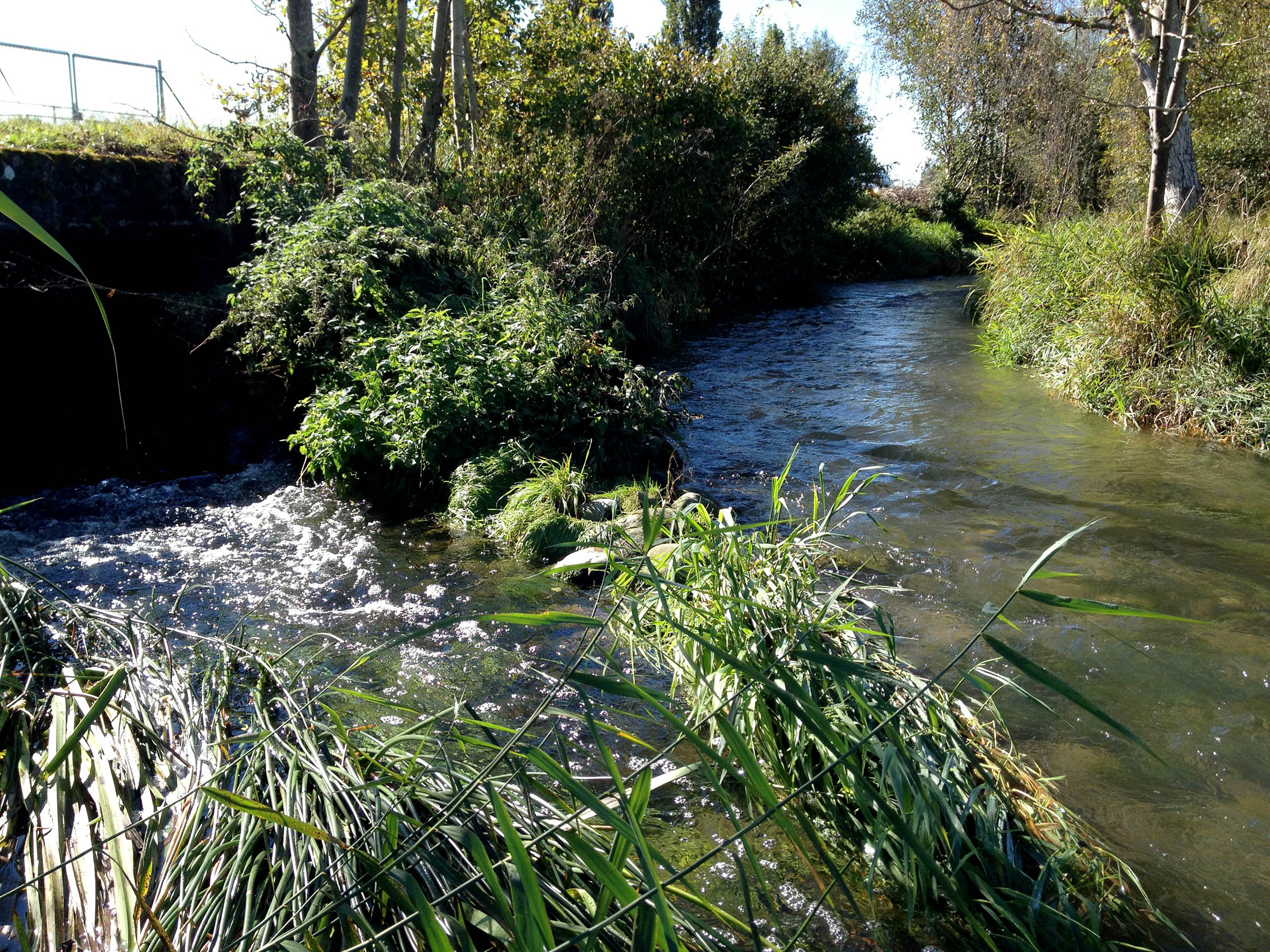
Rejets de la station d'épuration Moossee-Urtenenbach
(Photo : Jennifer Schollée, Eawag)

Examen minutieux de l'Urtenen

Après la première phase d'essai, un petit groupe composé de huit scientifiques de l'Eawag et de l'institut de recherche français INERIS a réexaminé l'Urtenen plus en détail.

Marc Suter, chef du groupe Bioanalytique du département de Toxicologie de l'environnement de l'Eawag explique les raisons de cette démarche : « Dans la première phase du projet, l'équipe a effectué des tests standard sur les quatre cours d'eau et réparti les échantillons en quatre groupes. » Dans la deuxième phase, de nouveaux biotests ont été utilisés pour mieux caractériser les modes d'action des composés et des mélanges présents. « Nous avons prélevé beaucoup plus d'échantillons et les avons ensuite séparés en 40 fractions en fonction de leurs propriétés physicochimiques, obtenant ainsi une très forte résolution. » Plus un échantillon est fractionné, plus il est facile de relier l'activité biologique observée à un polluant donné.

Un diagnostic plus exact grâce au fractionnement des échantillons

Par cette démarche, les scientifiques souhaitaient valider les premiers résultats et exclure l'effet biaisant d'éventuels antagonistes. Suter cite un exemple : « Dans la deuxième série d'essais, des effets œstrogéniques ont été détectés dans 20 fractions. Dans la répartition grossière de la première série, il aurait été possible que, dans une même fraction, des anti-œstrogènes répriment l'action d'œstrogènes. Le résultat aurait alors été faussement négatif. » Le fractionnement à haute résolution livre ainsi une meilleure image de la réalité.

Davantage de glucocorticoïdes détectés

D'après Suter, toutefois, les résultats de la première et de la seconde série d'essais différaient généralement moins que prévu. Mais certaines différences étaient néanmoins notables : « Grâce au fractionnement fin, nous avons par exemple mis en évidence une activité beaucoup plus forte des composés de type glucocorticoïde. » Comme la doctorante de l'Eawag Anita Hidasi l'a démontré sur des poissons zèbres dans le cadre du programme EDA-EMERGE, les glucocorticoïdes peuvent perturber le système immunitaire humain et animal (Hidasi et al, 2017 / https://doi.org/10.1016/j.ecoenv.2016.11.024 ).

La deuxième phase du projet a demandé beaucoup de travail mais elle a été riche d'enseignements : d'après Suter, le fait de combiner les méthodes classiques d'EDA avec de nouveaux bioessais a permis de mieux comprendre les raisons d'effets négatifs observés au laboratoire. De son point de vue, il s'agit d'une étape importante dans l'amélioration de l'analyse du risque dû à la pollution chimique des eaux, en particulier au niveau des stations d'épuration. Dans leurs conclusions, les chercheuses et chercheurs soulignent par ailleurs la nécessité d'approfondir les connaissances sur l'action des polluants de type glucocorticoïde.

Financement

EDA-EMERGE a été financé par la Commission européenne. C'est un projet ITN des Actions Marie Sklodowska-Curie qui, sur quatre ans, visait à encourager la relève scientifique.

Publications

Extbase Variable Dump
array(2 items)
   publications => '16830,14458,14084' (17 chars)
   libraryUrl => '' (0 chars)
Extbase Variable Dump
array(3 items)
   0 => Snowflake\Publications\Domain\Model\Publicationprototypepersistent entity (uid=16830, pid=124)
      originalId => protected16830 (integer)
      authors => protected'Sonavane, M.; Schollée, J. E.; Hidasi, A. O.; Creu
         sot, N.; Brion, F.; Suter, M. J. -F.; Hollender,&nb
         sp;J.; Aït-Aïssa, S.
' (179 chars) title => protected'An integrative approach combining passive sampling, bioassays and effect-dir
         ected analysis to assess the impact of wastewater effluent
' (134 chars) journal => protected'Environmental Toxicology and Chemistry' (38 chars) year => protected2018 (integer) volume => protected37 (integer) issue => protected'8' (1 chars) startpage => protected'2079' (4 chars) otherpage => protected'2088' (4 chars) categories => protected'WWTP effluent; passive sampling; endocrine disrupting chemicals (EDCs); embr
         yo toxicity; effect-directed analysis (EDA); LC-MS/MS analysis
' (138 chars) description => protected'Wastewater treatment plant (WWTP) effluents are major sources of endocrine d
         isrupting chemicals (EDCs) and of other chemicals of toxicological concern f
         or the aquatic environment. In this study, we used an integrated strategy co
         mbining passive sampling (Chemcatcher<sup>®</sup>), developmental toxicity
         and mechanism‐based in vitro and in vivo bioassays to monitor the impacts
         of a WWTP on a river. In vitro screening revealed the WWTP effluent as a sou
         rce of estrogen (ER), glucocorticoid (GR), aryl hydrocarbon (AhR) receptor m
         ediated activities, impacting the downstream river site where significant ac
         tivities were also measured, albeit to a lesser extent than in the effluent.
          Effect‐directed analysis (EDA) of the effluent successfully identified th
         e presence of potent estrogens (estrone, 17α‐ethinylestradiol and 17β‐
         estradiol) and glucocorticoids (clobetasol propionate and fluticasone propio
         nate) as the major contributors to the observed in vitro activities, even th
         ough other unidentified active chemicals were likely present. The impact of
         the WWTP was also assessed using zebrafish embryo assays, highlighting its a
         bility to induce estrogenic response through up‐regulation of aromatase pr
         omoter‐dependent reporter gene in the transgenic (cyp19a1b–GFP) zebrafis
         h assay and to generate teratogenic effects at non‐lethal concentrations i
         n the zebrafish embryo toxicity test. This study argues for the use of such
         an integrated approach, combining passive sampling, bioassays and EDA, to co
         mprehensively identify endocrine active compounds and associated hazards of
         WTTP effluents.
' (1611 chars) serialnumber => protected'0730-7268' (9 chars) doi => protected'10.1002/etc.4155' (16 chars) uid => protected16830 (integer) _localizedUid => protected16830 (integer)modified _languageUid => protectedNULL _versionedUid => protected16830 (integer)modified pid => protected124 (integer)
1 => Snowflake\Publications\Domain\Model\Publicationprototypepersistent entity (uid=14458, pid=124) originalId => protected14458 (integer) authors => protected'Tousova,&nbsp;Z.; Oswald,&nbsp;P.; Slobodnik,&nbsp;J.; Blaha,&nbsp;L.; Muz,&
         nbsp;M.; Hu,&nbsp;M.; Brack,&nbsp;W.; Krauss,&nbsp;M.; Di Paolo,&nbsp;C.; Ta
         rcai,&nbsp;Z.; Seiler,&nbsp;T.-B.; Hollert,&nbsp;H.; Koprivica,&nbsp;S.; Ahe
         l,&nbsp;M.; Schollée,&nbsp;J.&nbsp;E.; Hollender,&nbsp;J.; Suter,&nbsp;M.&n
         bsp;J.&nbsp;-F.; Hidasi,&nbsp;A.&nbsp;O.; Schirmer,&nbsp;K.; Sonavane,&nbsp;
         M.; Ait-Aissa,&nbsp;S.; Creusot,&nbsp;N.; Brion,&nbsp;F.; Froment,&nbsp;J.;
         Almeida,&nbsp;A.&nbsp;C.; Thomas,&nbsp;K.; Tollefsen,&nbsp;K.&nbsp;E.; Tufi,
         &nbsp;S.; Ouyang,&nbsp;X.; Leonards,&nbsp;P.; Lamoree,&nbsp;M.; Torrens,&nbs
         p;V.&nbsp;O.; Kolkman,&nbsp;A.; Schriks,&nbsp;M.; Spirhanzlova,&nbsp;P.; Tin
         dall,&nbsp;A.; Schulze,&nbsp;T.
' (715 chars) title => protected'European demonstration program on the effect-based and chemical identificati
         on and monitoring of organic pollutants in European surface waters
' (142 chars) journal => protected'Science of the Total Environment' (32 chars) year => protected2017 (integer) volume => protected601 (integer) issue => protected'' (0 chars) startpage => protected'1849' (4 chars) otherpage => protected'1868' (4 chars) categories => protected'adverse effects; large volume solid phase extraction; EDA-EMERGE; simplified
          effect-directed analysis protocol; environmental health; human health
' (146 chars) description => protected'Growing concern about the adverse environmental and human health effects of
         a wide range of micropollutants requires the development of novel tools and
         approaches to enable holistic monitoring of their occurrence, fate and effec
         ts in the aquatic environment. A European-wide demonstration program (EDP) f
         or effect-based monitoring of micropollutants in surface waters was carried
         out within the Marie Curie Initial Training Network EDA-EMERGE. The main obj
         ectives of the EDP were to apply a simplified protocol for effect-directed a
         nalysis, to link biological effects to target compounds and to estimate thei
         r risk to aquatic biota. <i>Onsite</i> large volume solid phase extraction o
         f 50 L of surface water was performed at 18 sampling sites in four European
         river basins. Extracts were subjected to effect-based analysis (toxicity to
         algae, fish embryo toxicity, neurotoxicity, (anti-)estrogenicity, (anti-)and
         rogenicity, glucocorticoid activity and thyroid activity), to target analysi
         s (151 organic micropollutants) and to nontarget screening. The most pronoun
         ced effects were estrogenicity, toxicity to algae and fish embryo toxicity.
         In most bioassays, major portions of the observed effects could not be expla
         ined by target compounds, especially in case of androgenicity, glucocorticoi
         d activity and fish embryo toxicity. Estrone and nonylphenoxyacetic acid wer
         e identified as the strongest contributors to estrogenicity, while herbicide
         s, with a minor contribution from other micropollutants, were linked to the
         observed toxicity to algae. Fipronil and nonylphenol were partially responsi
         ble for the fish embryo toxicity. Within the EDP, 21 target compounds were p
         rioritized on the basis of their frequency and extent of exceedance of predi
         cted no effect concentrations. The EDP priority list included 6 compounds, w
         hich are already addressed by European legislation, and 15 micropollutants t
         hat may be important for future monitoring of surface waters. The study pres
         ents a novel simplified ...
' (2113 chars) serialnumber => protected'0048-9697' (9 chars) doi => protected'10.1016/j.scitotenv.2017.06.032' (31 chars) uid => protected14458 (integer) _localizedUid => protected14458 (integer)modified _languageUid => protectedNULL _versionedUid => protected14458 (integer)modified pid => protected124 (integer)
2 => Snowflake\Publications\Domain\Model\Publicationprototypepersistent entity (uid=14084, pid=124) originalId => protected14084 (integer) authors => protected'Hidasi,&nbsp;A.&nbsp;O.; Groh,&nbsp;K.&nbsp;J.; Suter,&nbsp;M.&nbsp;J.&nbsp;
         -F.; Schirmer,&nbsp;K.
' (98 chars) title => protected'Clobetasol propionate causes immunosuppression in zebrafish (Danio rerio) at
          environmentally relevant concentrations
' (116 chars) journal => protected'Ecotoxicology and Environmental Safety' (38 chars) year => protected2017 (integer) volume => protected138 (integer) issue => protected'' (0 chars) startpage => protected'16' (2 chars) otherpage => protected'24' (2 chars) categories => protected'endocrine disrupting chemicals; pharmaceuticals; inflammation; bacterial lip
         opolysaccharide
' (91 chars) description => protected'Synthetic glucocorticoids (GCs) are potential endocrine disrupting compounds
          that have been detected in the aquatic environment around the world in the
         low ng/L (nanomolar) range. GCs are used as immunosuppressants in medicine.
         It is of high interest whether clobetasol propionate (CP), a highly potent G
         C, suppresses the inflammatory response in fish after exposure to environmen
         tally relevant concentrations. Bacterial lipopolysaccharide (LPS) challenge
         was used to induce inflammation and thus mimic pathogen infection. Zebrafish
          embryos were exposed to ≤1000 nM CP from ~1 h post fertilization (hpf) to
          96 hpf, and CP uptake, survival after LPS challenge, and expression of infl
         ammation-related genes were examined. Our initial experiments were carried o
         ut using 0.001% DMSO as a solvent vehicle, but we observed that DMSO interfe
         red with the LPS challenge assay, and thus masked the effects of CP. Therefo
         re, DMSO was not used in the subsequent experiments. The internal CP concent
         ration was quantifiable after exposure to ≥10 nM CP for 96 h. The bioconce
         ntration factor (BCF) of CP was determined to be between 16 and 33 in zebraf
         ish embryos. CP-exposed embryos showed a significantly higher survival rate
         in the LPS challenge assay after exposure to ≥0.1 nM in a dose dependent m
         anner. This effect is an indication of immunosuppression. Furthermore, the r
         egulation pattern of several genes related to LPS challenge in mammals suppo
         rted our results, providing evidence that LPS-mediated inflammatory pathways
          are conserved from mammals to teleost fish. <I>Anxa1b</I>, a GC-action rela
         ted anti-inflammatory gene, was significantly down-regulated after exposure
         to ≥0.05 nM CP. Our results show for the first time that synthetic GCs can
          suppress the innate immune system of fish at environmentally relevant conce
         ntrations. This may reduce the chances of fish to survive in the environment
         , as their defense against pathogens is weakened.
' (1949 chars) serialnumber => protected'0147-6513' (9 chars) doi => protected'10.1016/j.ecoenv.2016.11.024' (28 chars) uid => protected14084 (integer) _localizedUid => protected14084 (integer)modified _languageUid => protectedNULL _versionedUid => protected14084 (integer)modified pid => protected124 (integer)
Sonavane, M.; Schollée, J. E.; Hidasi, A. O.; Creusot, N.; Brion, F.; Suter, M. J. -F.; Hollender, J.; Aït-Aïssa, S. (2018) An integrative approach combining passive sampling, bioassays and effect-directed analysis to assess the impact of wastewater effluent, Environmental Toxicology and Chemistry, 37(8), 2079-2088, doi:10.1002/etc.4155, Institutional Repository
Tousova, Z.; Oswald, P.; Slobodnik, J.; Blaha, L.; Muz, M.; Hu, M.; Brack, W.; Krauss, M.; Di Paolo, C.; Tarcai, Z.; Seiler, T.-B.; Hollert, H.; Koprivica, S.; Ahel, M.; Schollée, J. E.; Hollender, J.; Suter, M. J. -F.; Hidasi, A. O.; Schirmer, K.; Sonavane, M.; Ait-Aissa, S.; Creusot, N.; Brion, F.; Froment, J.; Almeida, A. C.; Thomas, K.; Tollefsen, K. E.; Tufi, S.; Ouyang, X.; Leonards, P.; Lamoree, M.; Torrens, V. O.; Kolkman, A.; Schriks, M.; Spirhanzlova, P.; Tindall, A.; Schulze, T. (2017) European demonstration program on the effect-based and chemical identification and monitoring of organic pollutants in European surface waters, Science of the Total Environment, 601, 1849-1868, doi:10.1016/j.scitotenv.2017.06.032, Institutional Repository
Hidasi, A. O.; Groh, K. J.; Suter, M. J. -F.; Schirmer, K. (2017) Clobetasol propionate causes immunosuppression in zebrafish (Danio rerio) at environmentally relevant concentrations, Ecotoxicology and Environmental Safety, 138, 16-24, doi:10.1016/j.ecoenv.2016.11.024, Institutional Repository

Photos

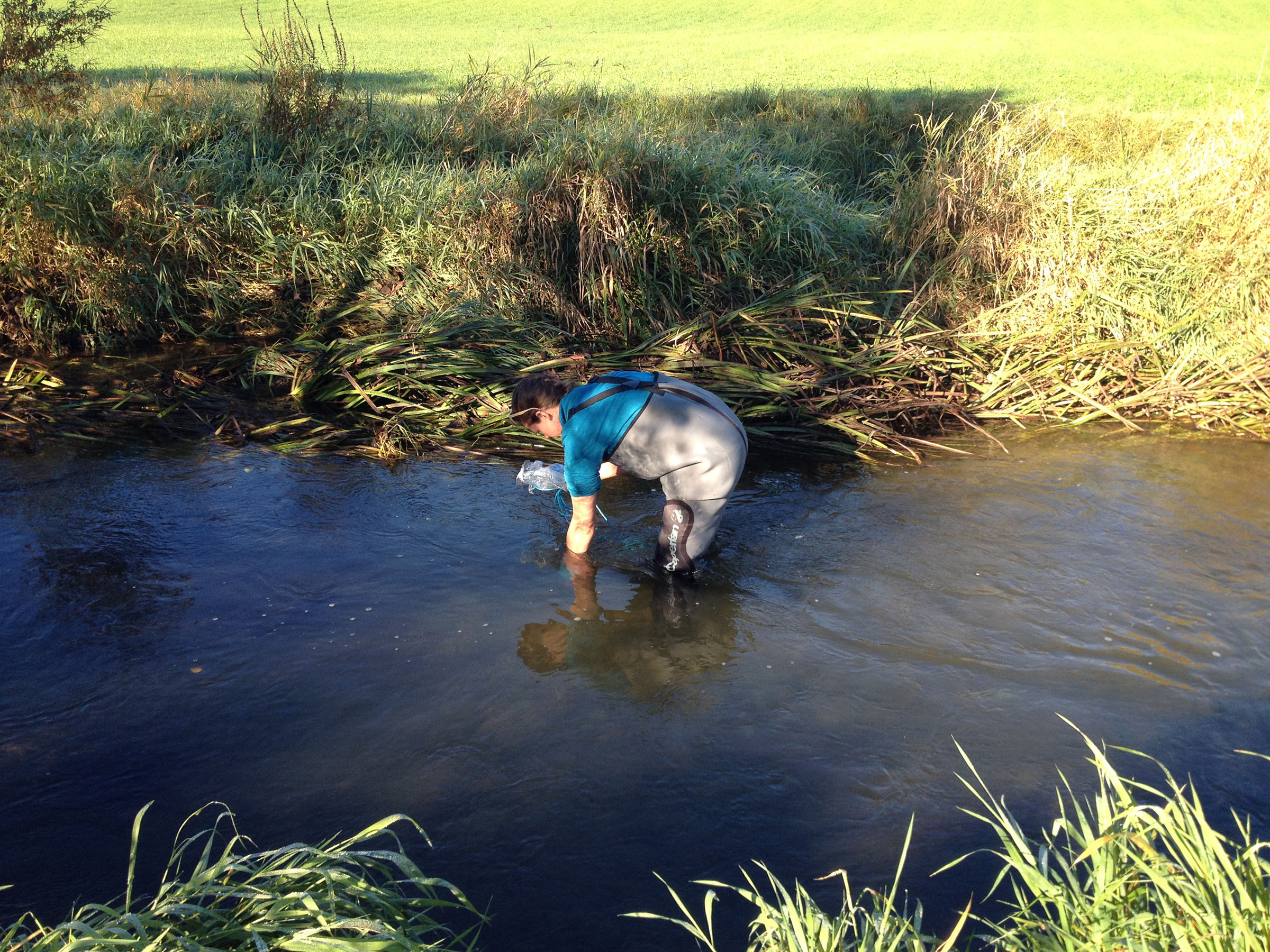
Jennifer Schollée installant le Chemcatcher au niveau de l'arrivée des effluents de la station d'épuration de Moossee-Urtenenbach. En tant que doctorante, Schollée faisait partie de l'équipe de sept personnes de l'Eawag ayant contribué au projet EDA-EMERGE. Ce projet visait notamment un encouragement spécifique de la relève scientifique et Jennifer Schollée et Anita Hidasi de l'Eawag ont été admises dans son programme de promotion. (Photo : Anita Hidasi, Eawag)
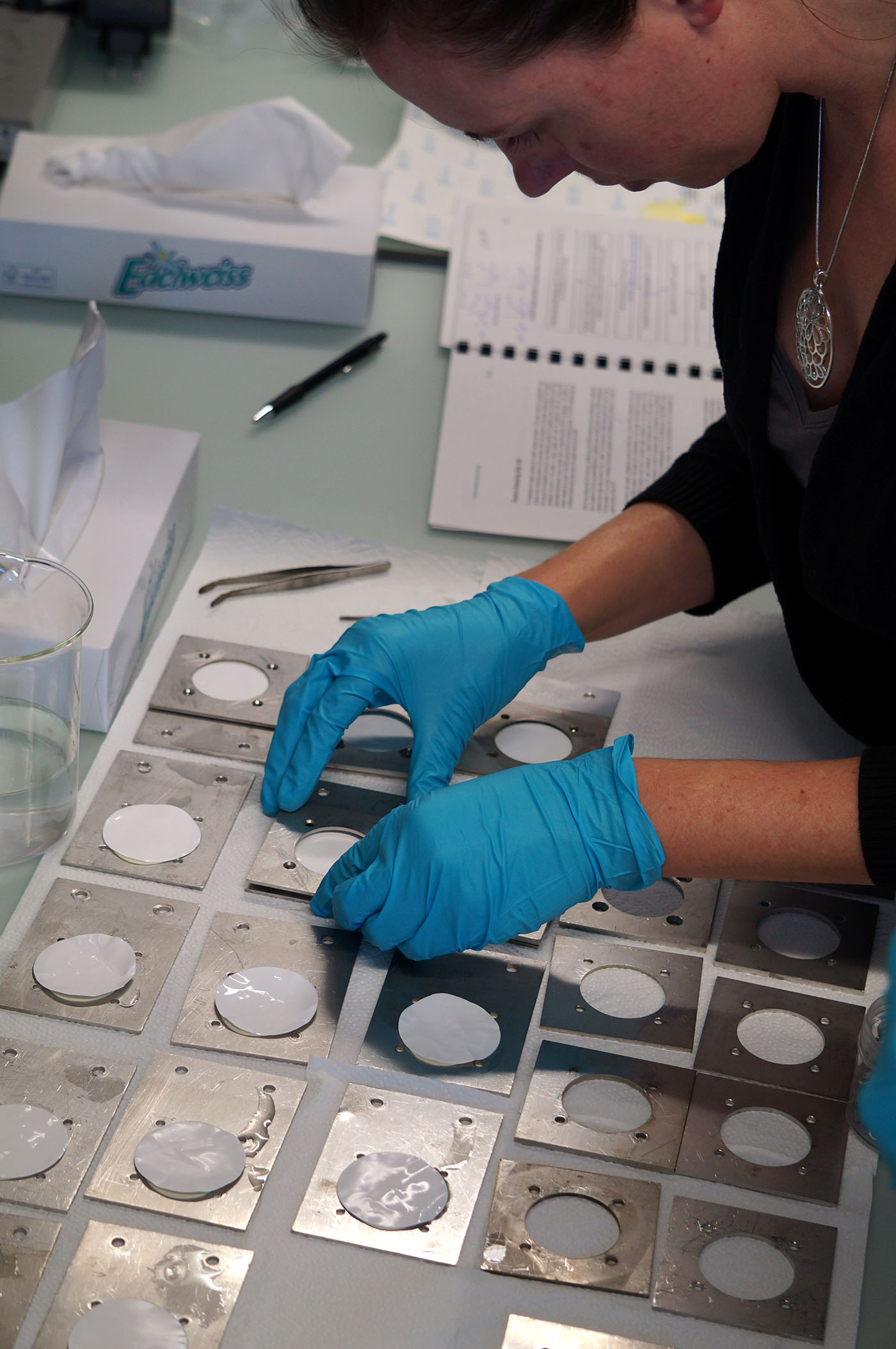
La doctorante de l'Eawag Jennifer Schollée préparant des capteurs passifs au laboratoire pour la deuxième phase de prélèvements dans l'Urtenen. Les capteurs passifs permettent de détecter les polluants présents dans l'eau.
(Photo : Birgit Beck, Eawag)