Détail de l'archive

Médaille de l'ETH pour Lisa Deutsch

26 janvier 2026 | Bärbel Zierl

Remarque: ce texte a été traduit automatiquement en français avec DeepL Pro. Pour l'article original, veuillez sélectionner l'allemand ou l'anglais (changement de langue en haut de la page).


La sociologue et politologue Lisa Deutsch a reçu la médaille de l'ETH pour sa thèse de doctorat rédigée à l'Eawag et à l'ETH Zurich. Avec sa recherche, elle a montré comment la recherche inter- et transdisciplinaire peut réussir et comment la théorie et la pratique peuvent être combinées dans la recherche.

L'ETH Zurich récompense chaque année d'excellents travaux de master et de doctorat en leur décernant la médaille de l'ETH. Cette année, l'une des médailles a été décernée à Lisa Deutsch pour sa thèse de doctorat "Practicing integration in inter- and transdisciplinary research : The role of enabling conditions and integrative leadership". La remise de la médaille de l'ETH a eu lieu dans le cadre de la cérémonie de remise des doctorats le 23 janvier.

La recherche inter- et transdisciplinaire dans la pratique

Les défis sociaux tels que le changement climatique, la durabilité ou les pandémies sont complexes et ne se laissent pas facilement maîtriser. Dans sa thèse de doctorat, Lisa Deutsch montre que ce ne sont pas tant les experts qui font défaut, mais surtout une collaboration efficace au-delà des frontières disciplinaires (interdisciplinaire) et entre la science, la politique et la pratique (transdisciplinaire). Pour que l'intégration inter- et transdisciplinaire (DTI) réussisse, elle doit être encouragée et dirigée de manière proactive.

Des conditions-cadres appropriées, une direction intégrative et des méthodes de soutien

Sur la base d'une recherche qualitative d'accompagnement dans trois grands programmes et réseaux de recherche sur les DTI en Suisse entre 2020 et 2023, Lisa Deutsch a analysé comment les processus d'intégration peuvent être concrètement organisés, ce qui les favorise ou les entrave. Ses résultats montrent que l'interdépendance de trois facteurs est décisive : des conditions-cadres appropriées, une direction intégrative et des méthodes de soutien. "On se concentre souvent sur un seul de ces facteurs. Il était important pour moi d'étudier leur interaction et d'en déduire des pistes d'action concrètes à différents niveaux", explique Lisa Deutsch.
 

Son travail montre clairement que des conditions cadres favorables doivent être mises en place à plusieurs niveaux - des membres individuels de l'équipe, des responsables de programme et des directions, en passant par la conception du programme et les structures d'incitation dans les institutions, jusqu'aux bailleurs de fonds et aux décideurs de la politique scientifique. Lisa Deutsch a également souligné le rôle clé de la direction inclusive, qui nécessite des ressources humaines suffisantes et une expertise en matière d'intégration. Une gestion réussie des programmes de DTI va au-delà de la coordination et de l'animation : elle comprend non seulement des contributions de soutien, mais aussi des contributions créatives et de contenu, ainsi qu'une gestion active des multiples défis de gestion. En outre, le travail présente des aperçus de l'application de méthodes intégratives telles que la "théorie du changement" aux programmes de recherche en DTI et discute de la manière dont elles peuvent aider à faciliter et à mettre en pratique l'intégration au-delà des frontières inter- et transdisciplinaires.

Des dessins animés et un court-métrage sélectionné illustrent les résultats.

Lisa Deutsch a également illustré ses conclusions avec le dessinateur et caricaturiste Christof Stückelberger et la directrice du groupe de recherche de l'Eawag Sabine Hoffmann dans une série de dessins animés intitulée "Comment l'échec de la recherche inter- et transdisciplinaire est garanti". Les scènes représentées donnent des pistes de réflexion transdisciplinaires sur un mode humoristique. Elles invitent à repenser son propre comportement en matière de recherche et à discuter avec les membres de l'équipe de la manière dont une bonne recherche en DTI peut être menée à bien.
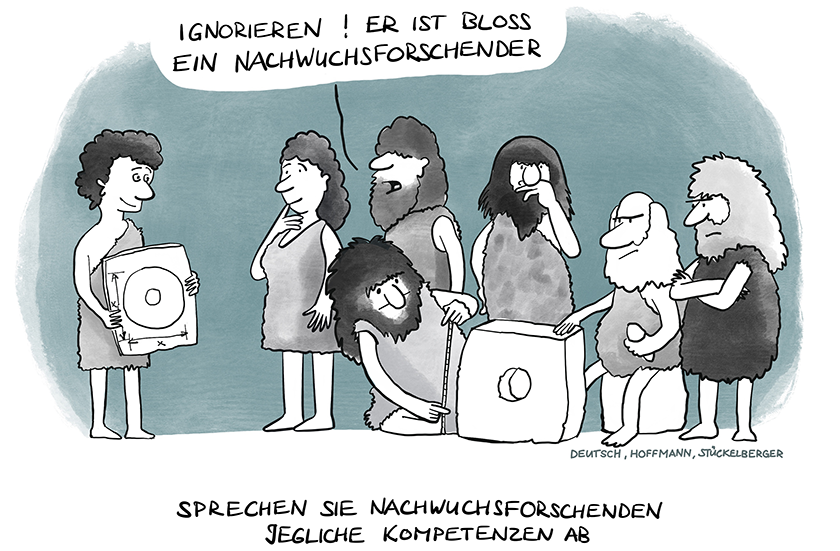
Dessins animés : comment la recherche inter- et transdisciplinaire est garantie d'échouer. Scènes de la recherche inter- et transdisciplinaire. Vers les dessins animés (dessins animés : Lisa Deutsch, Sabine Hoffmann, Christof Stückelberger)

De plus, en collaboration avec d'autres jeunes chercheurs du programme de recherche Wings, le court-métrage d'animation "Verhebets ? Un apéro orienté sur les ressources", qui a été nominé par le Global Science Film Festival dans la catégorie "Best Short Film 2023". Il explique le potentiel de la gestion de l'eau urbaine axée sur les ressources et répond aux questions et inquiétudes fréquentes des principales parties prenantes.

Court-métrage d'animation "Verhebets ? Un apéritif axé sur les ressources"

Dans l'ensemble, la thèse de doctorat de Lisa Deutsch allie théorie et pratique et fournit des connaissances concrètes et orientées vers l'action pour tous ceux qui souhaitent renforcer la recherche inter- et transdisciplinaire et organiser efficacement leur contribution à la résolution des questions sociales d'avenir. "J'ai été particulièrement enthousiasmée par l'enthousiasme et l'engagement avec lesquels les responsables du programme ont participé aux groupes de discussion réguliers. Cet espace de réflexion a permis d'intégrer très tôt les connaissances issues de la recherche d'accompagnement dans les programmes en cours - au lieu d'attendre la fin du projet, où elles pourraient potentiellement disparaître dans les tiroirs."

Le travail a été réalisé dans le cadre du programme Wings de l'Eawag au sein du groupe de recherche Inter- et Transdisciplinarity Research de l'Eawag (Dr. Sabine Hoffmann) ainsi que du Transdisciplinarity Lab (Prof. Christian Pohl) et du groupe de recherche sur les risques météorologiques et climatiques (Prof. David N. Bresch) de l'EPF de Zurich. Actuellement, Lisa Deutsch travaille pour le département de la santé et de l'environnement de la ville de Zurich en tant que collaboratrice d'état-major et chef de projet.


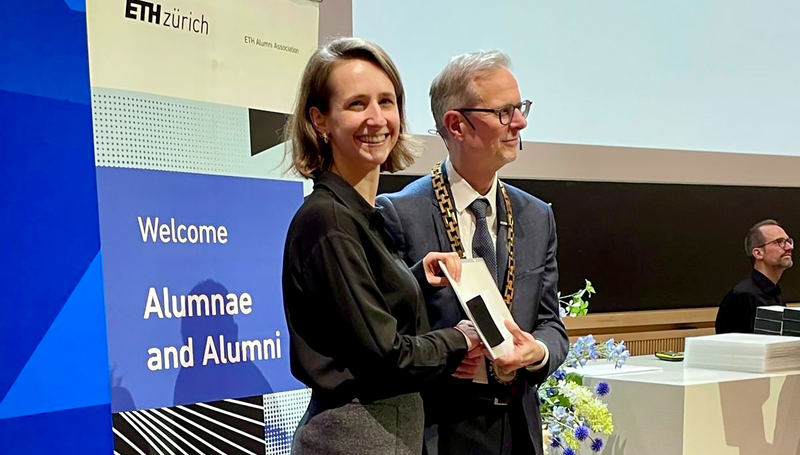
Photo de couverture : L'ETH Zurich remet à Lisa Deutsch la médaille de l'ETH pour sa thèse de doctorat, qu'elle a rédigée à l'Eawag et à l'ETH Zurich. (Photo : Sabine Hoffmann)
 

Publications

Extbase Variable Dump
array(3 items)
   publications => '33599,33843,33548,22292' (23 chars)
   libraryUrl => '' (0 chars)
   layout => '0' (1 chars)
Extbase Variable Dump
array(4 items)
   0 => Snowflake\Publications\Domain\Model\Publicationprototypepersistent entity (uid=33599, pid=124)
      originalId => protected33599 (integer)
      authors => protected'Deutsch, L.' (16 chars)
      title => protected'Practicing integration in inter- and transdisciplinary research: the role of
          enabling conditions and integrative leadership
' (123 chars) journal => protected'' (0 chars) year => protected2024 (integer) volume => protected0 (integer) issue => protected'' (0 chars) startpage => protected'145 p' (10 chars) otherpage => protected'' (0 chars) categories => protected'' (0 chars) description => protected'Given the complexity of contemporary societal challenges such as climate cha
         nge, sustainability transformations and pandemics, the question of how these
          challenges can be adequately addressed has become increasingly urgent in re
         cent years. In the highly differentiated societies of the 21st century, ther
         e is generally no shortage of experts who can make a valuable contribution t
         o addressing these problems. However, what tends to be lacking is a meaningf
         ul integration of these individual perspectives across disciplinary boundari
         es (interdisciplinarity) as well as the integration of knowledge from scienc
         e, policy and practice (transdisciplinarity) in order to avoid a one-sided u
         nderstanding of and solution to the aforementioned challenges. For this reas
         on, more and more inter- and transdisciplinary research programs are being s
         et up to address societally relevant issues by bundling several projects und
         er one roof and involving a large number of different disciplines and stakeh
         olders. However, this integration does not take place automatically, but mus
         t be proactively encouraged, fostered and led. This dissertation aims to con
         tribute to the theoretical understanding as well as the practical implementa
         tion of inter- and transdisciplinary (ITD) integration in research programs
         and projects by embracing three research foci: (a) the role of conditions un
         der which ITD integration takes place (<em>structures</em>), (b) the role of
          integrative leadership to advance ITD integration processes (<em>agency</em
         >), and (c) the role of integrative methods to facilitate ITD integration (<
         em>means</em>). [...]
' (1617 chars) serialnumber => protected'' (0 chars) doi => protected'10.3929/ethz-b-000698963' (24 chars) uid => protected33599 (integer) _localizedUid => protected33599 (integer)modified _languageUid => protectedNULL _versionedUid => protected33599 (integer)modified pid => protected124 (integer)
1 => Snowflake\Publications\Domain\Model\Publicationprototypepersistent entity (uid=33843, pid=124) originalId => protected33843 (integer) authors => protected'Deutsch,&nbsp;L.; Pohl,&nbsp;C.; Bresch,&nbsp;D.&nbsp;N.; Hoffmann,&nbsp;S.' (75 chars) title => protected'
         
' (125 chars) journal => protected'Global Environmental Change' (27 chars) year => protected2025 (integer) volume => protected91 (integer) issue => protected'' (0 chars) startpage => protected'102963 (15 pp.)' (15 chars) otherpage => protected'' (0 chars) categories => protected'interdisciplinary; transdisciplinary; integration; environmental change; sus
         tainability; science to action; critical realism
' (124 chars) description => protected'Complex global social-ecological challenges of our time such as climate chan
         ge, biodiversity loss or, more recently, the Covid-19 pandemic can neither b
         e comprehensively understood nor properly addressed by employing a single di
         sciplinary or sectoral perspective. For this reason, more and more large int
         er- and transdisciplinary (ITD) initiatives are on the rise, intending to op
         en up the silo-like production of knowledge and to advance the integration o
         f different fields of expertise within academia, but also across science, po
         licy and practice. While the need for ITD initiatives in order to both under
         stand and address the complexity of such global socio-ecological challenges
         has increasingly been acknowledged by research institutions, funders and pub
         lic authorities, a question remains concerning the extent to which prevailin
         g conditions suffice for conducting ITD research, particularly in terms of w
         hether the envisioned integration of perspectives and actors really happen i
         n practice. This paper embraces a holistic view on ITD integration by presen
         ting both an analytical framework and empirical insights from three ITD init
         iatives based in Switzerland dealing with sustainable urban water management
         , (future) extreme events and cross-sectoral climate impacts and climate ser
         vices in different socio-economic contexts. The framework is based on critic
         al realist reasoning and employs a structure-agency lens by distinguishing c
         onditions of integration at different structural levels, while also acknowle
         dging the power of actors to shape integration and the respective structures
         . The paper thereby illustrates and helps diagnose the source of challenges
         experienced in living up to ITD integration endeavors and how these differen
         t structural levels are interrelated and impact ITD integration. We conclude
          by discussing entry points for action aimed at transforming currently unfav
         orable structures into favorable ones. We thereby intend to provide, in part
         icular, insights for a w...
' (2196 chars) serialnumber => protected'0959-3780' (9 chars) doi => protected'10.1016/j.gloenvcha.2024.102963' (31 chars) uid => protected33843 (integer) _localizedUid => protected33843 (integer)modified _languageUid => protectedNULL _versionedUid => protected33843 (integer)modified pid => protected124 (integer)
2 => Snowflake\Publications\Domain\Model\Publicationprototypepersistent entity (uid=33548, pid=124) originalId => protected33548 (integer) authors => protected'Deutsch,&nbsp;L.; Björnsen,&nbsp;A.; Fischer,&nbsp;A.&nbsp;M.; Hama,&nbsp;A
         .&nbsp;M.; Zimmermann,&nbsp;N.&nbsp;E.; Zurbrügg,&nbsp;C.; Hoffmann,&nbsp;S
         .
' (153 chars) title => protected'Herding cats: integrative leadership strategies in inter- and transdisciplin
         ary research programs
' (97 chars) journal => protected'Sustainability Science' (22 chars) year => protected2025 (integer) volume => protected20 (integer) issue => protected'' (0 chars) startpage => protected'95' (2 chars) otherpage => protected'115' (3 chars) categories => protected'leadership; interdisciplinary; transdisciplinary; integration; research prog
         rams; actionable knowledge
' (102 chars) description => protected'This paper focuses on the critical role of integrative leadership in inter-
         and transdisciplinary (ITD) research programs. ITD programs have become one
         of academia's responses to address contemporary sustainability challenges. F
         ulfilling the promise of such programs is extraordinarily challenging for al
         l involved participants, but especially for program leaders who have to ensu
         re that the perspectives of the involved program participants become truly i
         ntegrated and that final and useful synthesis outputs are created. We presen
         t six core leadership challenges and respective strategies to address them t
         o advance integration within ITD programs. These challenges include (1) mast
         ering complexity and ambiguity, (2) advancing decision-making with lateral l
         eadership, (3) ensuring responsibility and accountability, (4) setting progr
         am boundaries, (5) selecting suitable projects, and (6) dealing with misconc
         eptions. We derived these challenges and respective strategies from both lea
         ding and studying in-depth three ITD programs focusing on sustainability iss
         ues in Switzerland. With this paper, we intend to promote awareness about th
         e range of leadership challenges in ITD programs and provide actionable know
         ledge, which can support in particular fellow and future leaders, but also f
         unders and heads of research institutions in their efforts to realize the in
         tegrative potential of such programs.
' (1405 chars) serialnumber => protected'1862-4065' (9 chars) doi => protected'10.1007/s11625-024-01585-4' (26 chars) uid => protected33548 (integer) _localizedUid => protected33548 (integer)modified _languageUid => protectedNULL _versionedUid => protected33548 (integer)modified pid => protected124 (integer)
3 => Snowflake\Publications\Domain\Model\Publicationprototypepersistent entity (uid=22292, pid=124) originalId => protected22292 (integer) authors => protected'Deutsch,&nbsp;L.; Belcher,&nbsp;B.; Claus,&nbsp;R.; Hoffmann,&nbsp;S.' (69 chars) title => protected'Leading inter- and transdisciplinary research: lessons from applying theorie
         s of change to a strategic research program
' (119 chars) journal => protected'Environmental Science and Policy' (32 chars) year => protected2021 (integer) volume => protected120 (integer) issue => protected'' (0 chars) startpage => protected'29' (2 chars) otherpage => protected'41' (2 chars) categories => protected'interdisciplinary; transdisciplinary; theory of change; leadership; urban wa
         ter management; research programs
' (109 chars) description => protected'Theory of Change (ToC) has been promoted as a useful tool in sustainability
         research for visioning, planning, communication, monitoring, evaluation and
         learning. It involves a mapping of steps towards a desired long-term goal su
         pplemented with continuous reflection on how and why change is expected to h
         appen in a particular context. However, there is limited reported experience
          with the development and application of ToCs in inter- and transdisciplinar
         y research contexts. While some previous publications have focused on ex-pos
         t application, there has been little discussion about the process of develop
         ing and using ToCs in strategic planning and monitoring in large inter- and
         transdisciplinary research programs. This article reports challenges and les
         sons learned from the experience of developing and using ToCs in the inter-
         and transdisciplinary research program <em>Wings</em> (<em>W</em>ater and sa
         nitation <strong>i</strong>nnovations for <em>n</em>on-<em>g</em>rid <em>s</
         em>olutions). Challenges include (1) managing time constraints, (2) balancin
         g between concrete and abstract discussions, (3) ensuring diversity in group
          composition, (4) fluctuating between reservations and appreciation, and (5)
          fulfilling both service and science roles while leading the ToC process. Th
         e experience highlights the importance of alternating formal and informal in
         teraction formats throughout the process, ensuring heterogenous group format
         ion, involving early career scientists, being responsive to emergent needs a
         nd making the added value of developing and using ToCs explicit and tangible
          for all participants. Although these lessons are mainly derived from develo
         ping ToCs within the interdisciplinary program team, they can support other
         programs in both their inter- and transdisciplinary research endeavors.
' (1819 chars) serialnumber => protected'1462-9011' (9 chars) doi => protected'10.1016/j.envsci.2021.02.009' (28 chars) uid => protected22292 (integer) _localizedUid => protected22292 (integer)modified _languageUid => protectedNULL _versionedUid => protected22292 (integer)modified pid => protected124 (integer)
Deutsch, L. (2024) Practicing integration in inter- and transdisciplinary research: the role of enabling conditions and integrative leadership, 145 p, doi:10.3929/ethz-b-000698963, Institutional Repository
Deutsch, L.; Pohl, C.; Bresch, D. N.; Hoffmann, S. (2025) Creating favorable conditions for inter- and transdisciplinary integration – an analytical framework and empirical insights, Global Environmental Change, 91, 102963 (15 pp.), doi:10.1016/j.gloenvcha.2024.102963, Institutional Repository
Deutsch, L.; Björnsen, A.; Fischer, A. M.; Hama, A. M.; Zimmermann, N. E.; Zurbrügg, C.; Hoffmann, S. (2025) Herding cats: integrative leadership strategies in inter- and transdisciplinary research programs, Sustainability Science, 20, 95-115, doi:10.1007/s11625-024-01585-4, Institutional Repository
Deutsch, L.; Belcher, B.; Claus, R.; Hoffmann, S. (2021) Leading inter- and transdisciplinary research: lessons from applying theories of change to a strategic research program, Environmental Science and Policy, 120, 29-41, doi:10.1016/j.envsci.2021.02.009, Institutional Repository