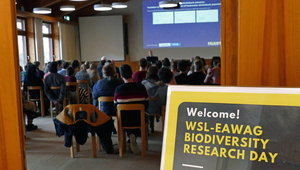
Eine Zusammenarbeit zwischen Eawag und WSL mit dem Ziel, die Biodiversität an der Schnittstelle von aquatischen und terrestrischen Ökosystemen zu erforschen.
Grafik: Blau-grüne Lebensräume – Hotspots der Biodiversität
Aquatische und terrestrische Ökosysteme sind eng miteinander vernetzt und bereichern sich gegenseitig. Diese Hotspots der Biodiversität sind aber durch menschengemachte Veränderungen wie den Klimawandel, die Urbanisierung oder die intensive Landwirtschaft bedroht. Die Grafik illustriert, wie die beiden Lebensräume Wasser und Land ineinandergreifen und sich gegenseitig beeinflussen und welchen Fragen die Forschungsinitiative BGB nachgeht.
Wie verändert sich die Biodiversität?
Weltweit nimmt die Biodiversität dramatisch ab. BGB untersucht, wie sich die biologische Vielfalt in Raum und Zeit verändert – sowohl lokal, etwa an der Thur in der Schweiz, aber auch weltweit mithilfe von Datenarchiven und Satellitendaten. Die untersuchten Zeiträume erstrecken sich dabei von wenigen Jahrzehnten bis hin zu Millionen von Jahren.
Was beeinflusst die Artenvielfalt?
Landnutzungsänderungen wie intensivierte Landwirtschaft oder Urbanisierung, der Klimawandel, die Übernutzung der natürlichen Ressourcen oder invasive Arten verändern Lebensräume und bedrohen die Artenvielfalt. BGB untersucht, wie diese Faktoren die Artenvielfalt beeinflussen.
Wie sind terrestrische und aquatische Ökosysteme miteinander verbunden?
Ökosysteme im Wasser und an Land sind eng miteinander verknüpft. Ein Beispiel: Laub, das von Bäumen ins Wasser fällt, dient dort als Nahrung für Kleinstlebewesen. Diese werden von räuberischen Insektenlarven gefressen, die das Wasser nach ihrem letzten Larvenstadium verlassen. An Land dienen diese besonders nahrhaften Insekten Vögeln als Nahrung. BGB hat zum Ziel, diese vernetzte Biodiversität ganzheitlich zu untersuchen.
Wie lässt sich die Biodiversität fördern und schützen?
BGB will praktische Empfehlungen für Praxis und Politik entwickeln, um den Verlust der biologischen Vielfalt so rasch als möglich zu stoppen oder zumindest zu verringern. Wie können in Siedlungen Lebensräume durch blau-grüne Infrastruktur vernetzt werden? Oder wie sieht erfolgreiche Biodiversitätspolitik aus?
Die biologische Vielfalt ist für das menschliche Leben und Wohlergehen unverzichtbar. Neben dem Klimawandel ist der Verlust an Biodiversität und den damit verbundenen Ökosystemfunktionen und -dienstleistungen eine der grössten Herausforderungen für die Menschheit. Um diesen Verlust einzudämmen oder gar umzukehren, sind weitere Forschung und Massnahmen von entscheidender Bedeutung. Der ETH-Rat finanziert darum die Forschungsinitiative Blue-Green Biodiversity (BGB) an der Schnittstelle von Wasser und Land, um dieses drängende wissenschaftliche und gesellschaftliche Problem anzugehen. Er will damit die interdisziplinäre Biodiversitätsforschung zwischen WSL und Eawag stärken, aber auch innerhalb des ETH-Bereichs und darüber hinaus. Ziel ist es, die Herausforderungen im Zusammenhang mit dem Artenverlust und den Veränderungen der Biodiversität so schnell wie möglich zu verstehen und darauf zu reagieren.
Phase 2: BGB 2021–2025
Im Jahr 2021 starteten längerfristige Forschungsprojekte mit neuen Experimenten, Feldstudien und Datenerhebungen. Fünf Forschungs- und drei Umsetzungsprojekte zielen darauf ab, Themen aus BGB 2020 weiterzuentwickeln sowie neue zukunftsweisende Forschungs- und Anwendungsfragen zu bearbeiten, für die noch keine Daten vorliegen. Die geplanten Forschungsfragen werden wissenschaftlich herausfordernd und für die Anwendung und/oder die Öffentlichkeitsarbeit unmittelbar relevant sein.
Hauptziele 2021-2025
Eine Gruppe von Nachwuchsforschenden in BGB-Themen ausbilden
Modelle zum Wandel der Biodiversität entwickeln und prüfen
Kapazitäten aufbauen für die Planung, Umsetzung und das Management von Massnahmen, um die biologische Vielfalt zu erhalten und wiederherzustellen
Öffentlichkeitsarbeit und Übersetzen der Ergebnisse für Fachpersonen aus der Praxis und die breitere Öffentlichkeit
Finanzierte BGB-Projekte 2023 - 2025
Blau: Forschungs- und Ausbildungsprojekte mit einem Doktorat Grau: Umsetzungsprojekte
The land-water-scape: Capacity building across the blue-green interface Projektleitung: Florian Altermatt (Eawag) und Prof. Dr. Rolf Holderegger (WSL) Postdoc: Sabine Güsewell Zusammenarbeit: verschiedene Wissenschaftler des BGB-Programms
BGB 2020 identifizierte die wichtigsten Forschungsfragen und umfasste 13 Forschungsprojekte, mit denen Post-Doktoranden für ein Jahr finanziert wurden. Ziel war es, Fragen aus der Grundlagen- und der angewandten Biodiversitätsforschung an der Schnittstelle von aquatischer und terrestrischer Biodiversität zu beantworten. Die Projekte lieferten rasch Ergebnisse, indem sie sich auf die Analyse vorhandener Daten konzentrierten.
Hauptziele 2020
Aufbau einer Forschungscommunity, die Beobachtung von aktuellen Entwicklungen (horizon scanning) und das Setzen von Prioritäten, um neue Kollaborationen zu etablieren und rechtzeitig auf Probleme zu reagieren.
Analyse von vorhandenen Daten und Modellierung, um einen besseren Einblick in die Ähnlichkeiten und das Zusammenspiel von aquatischen und terrestrischen Systemen zu gewinnen.
Öffentlichkeitsarbeit und Wissenstransfer, um die Ergebnisse an die Praxis und die breite Öffentlichkeit zu vermitteln.
The architecture of community structure, functional traits and trophic networks across blue-green ecosystems Projektleitung: Prof. Dr. Florian Altermatt (Eawag) und Prof. Dr. Loïc Pellissier (WSL) Postdoc: Hsi-Cheng Ho Zusammenarbeit: Jakob Brodersen (Eawag), Martin Gossner (WSL), Catherine Graham (WSL), Ole Seehausen (Eawag), Niklaus Zimmermann (WSL)
Biodiversity change in a warming world Projektleitung: Anita Narwani (Eawag), Co-Pl: Christian Rixen (WSL) Postdoc: Imran Khaliq (Eawag) Dauer: 01.01.2022 - 31.05.2022 Förderorganisation: Eawag's Academic Transition Grant
Rezente Entwicklungen in der Vielfalt und Abundanz aquatischer Insekten in der Schweiz (Recent developments in richness and abundance of aquatic insects in Switzerland) Projektleitung: Kurt Bollmann (WSL) Co-Pl: Nele Schuwirth (Eawag) Postdoc: Friederike Gebert Dauer: 01.10.2021 - 30.06.2022 Förderorganisation: FOEN (Yael Schindler)
Global analysis of the phenology of supply and demand for n-3 long-chain polyunsaturated fatty acids in consumer diets and its relationship to consumer fitness Projektleitung: Blake Matthews, Daniel Odermatt, and J. Ryan Shipley (Eawag) Dauer: 01.09.2021 - 30.08.2022 Zusammenarbeit: Luis J. Gilarranz (Eawag), Cornelia Twining (Eawag), Jelle Lever (WSL), Catherine Graham (WSL) and Yann Vitasse (WSL) Förderorganisation: Eawag
Living Lab Bern: Establishing a pre-urbanisation baseline Projektleitung: Max Maurer (Eawag) Co-Projektleiter: Lauren Cook, Peter M Bach, João Leitão (Eawag) Dauer: 09.2021 - 09.2022 Zusammenarbeit: Marco Moretti, Janine Bolliger, Anna Hersperger, Matthias Buchecker (WSL), Nadja Contzen, Manuel Fischer (Eawag), Stephanos Anderski, Frank Marti, Judith Dobmann (Stadt Bern) Förderorganisation: Eawag
Biodiversity assembly in blue and green ecosystems: speciation versus immigration Projektleitung: Ole Seehausen (Eawag) Co-Projektleiter: Niklaus Zimmermann (WSL) Postdoc: Luiz Jardim de Queiroz Dauer: 01.09.2021 – 31.06.2022 Zusammenarbeit: Carmela Dönz, Soraya Villalba, Roman Alther, Špela Borko, Ian R. McFadden, Thomas Schmitt, Florian Altermatt, Jakob Brodersen, Martin Gossner, Catherine Graham, Blake Matthews, Loïc Pellissier, Lukas Rüber Förderorganisation: Eawag
BIOMONDO - Towards Earth Observation supported monitoring of freshwater biodiversity Projektleitung: Petra Philipson, coordinator (Brockmann Geomatics) Postdoc: Jelle Lever Dauer: 2021-2023 Zusammenarbeit: Daniel Odermatt (Eawag), Consortium of Brockmann Geomatics, Brockmann Consult, Eawag, PBL, and Deltares Förderorganisation: European Space Agency
Seasonal changes and recovery from extreme climatic events as indicators of ecosystem stability and impending regime shifts Projektleitung: Jelle Lever (WSL) Co-Projektleiter: Yann Vitasse & Arthur Gessler (WSL) Dauer: 2021-2022 Förderorganisation: SwissForestLab
GreenCityNet-Social-ecological networks to enhance biodiversity in urban green spaces Projektleitung: Janine Bolliger (WSL) Co-Projektleiter: Manuel Fischer (Eawag) Dauer: 2022-2025 Förderorganisation: SNF
array(11 items)0 => Snowflake\Publications\Domain\Model\Publicationprototypepersistent entity (uid=25875, pid=124)originalId => protected25875 (integer)
authors => protected'Gebert, F.; Bollmann, K.; Siber, R.; Schuwirth, N.' (70 chars)
title => protected'Zeitliche Trends von Makroinvertebraten. Kantonale und nationale Monitoringd aten im Vergleich' (93 chars)
journal => protected'Aqua & Gas' (10 chars)
year => protected2022 (integer)
volume => protected102 (integer)
issue => protected'10' (2 chars)
startpage => protected'76' (2 chars)
otherpage => protected'82' (2 chars)
categories => protected'' (0 chars)
description => protected'Daten zur zeitlichen Entwicklung der Vielfalt wirbelloser Kleinlebewesen in Fliessgewässern verschiedener Kantone werden den nationalen Datensätzen BD M und NAWA gegenübergestellt. Bis auf wenige Ausnahmen zeigt sich eine auf kantonaler und nationaler Ebene einheitliche Entwicklung: Vor allem die Anza hl pestizidtoleranter Familien und wärmeliebender Arten pro Probenahmestand ort nimmt in den letzten Jahrzehnten zu. Mögliche Ursachen dieses Trends si nd der Klimawandel sowie eine verbesserte Gewässerqualität.' (517 chars)
serialnumber => protected'2235-5197' (9 chars)
doi => protected'' (0 chars)
uid => protected25875 (integer)
_localizedUid => protected25875 (integer)modified_languageUid => protectedNULL
_versionedUid => protected25875 (integer)modifiedpid => protected124 (integer)1 => Snowflake\Publications\Domain\Model\Publicationprototypepersistent entity (uid=26170, pid=124)originalId => protected26170 (integer)
authors => protected'Schnorf, H.; Bergamini, A.; Cook, L.; Moretti, M.' (69 chars)
title => protected'Revitalisierte Bäche leisten einen Beitrag zur städtischen Pflanzenvielfal t. Les ruisseaux revitalisés favorisent la diversité spécifique de la flo re urbaine' (162 chars)
journal => protected'Nature et Paysage. Natur und Landschaft: Inside' (47 chars)
year => protected2022 (integer)
volume => protected0 (integer)
issue => protected'4' (1 chars)
startpage => protected'35' (2 chars)
otherpage => protected'39' (2 chars)
categories => protected'' (0 chars)
description => protected'Bevor sie grösstenteils in den Untergrund verlegt wurden, prägten Bäche d as Bild der Schweiz, auch in der Stadt Zürich. Im Rahmen des naturnahen Was serbaus werden in Zürich diese Bäche seit 35 Jahren wieder an die Oberflä che gebracht. In dieser Studie untersuchten wir die Vielfalt der Gefässpfla
présents du paysage en Suisse, y compris dans l’espace urbain. Depuis 35 ans, les petits cours d’eau de la ville de Zurich sont progressivement rem is à ciel ouvert dans le cadre d’un plan de réaménagement tendant vers l’état naturel. Une étude s’est intéressée à la diversité des plan tes vasculaires présentes dans le courant et au bord des ruisseaux ainsi re vitalisés.' (847 chars)
serialnumber => protected'' (0 chars)
doi => protected'' (0 chars)
uid => protected26170 (integer)
_localizedUid => protected26170 (integer)modified_languageUid => protectedNULL
_versionedUid => protected26170 (integer)modifiedpid => protected124 (integer)2 => Snowflake\Publications\Domain\Model\Publicationprototypepersistent entity (uid=30289, pid=124)originalId => protected30289 (integer)
authors => protected'Ho, H.-C.; Pellissier, L.; Altermatt, F.' (55 chars)
title => protected'Die Klimaerwärmung bedroht die biologische Vielfalt und intensive landwirts chaftliche Nutzung kann dies zusätzlich verschärfen. Le réchauffement cli matique menace la biodiversité et l'agriculture intensive risque d'aggraver la situation' (241 chars)
journal => protected'Nature et Paysage. Natur und Landschaft: Inside' (47 chars)
year => protected2023 (integer)
volume => protected0 (integer)
issue => protected'1' (1 chars)
startpage => protected'20' (2 chars)
otherpage => protected'23' (2 chars)
categories => protected'' (0 chars)
description => protected'' (0 chars)
serialnumber => protected'' (0 chars)
doi => protected'' (0 chars)
uid => protected30289 (integer)
_localizedUid => protected30289 (integer)modified_languageUid => protectedNULL
_versionedUid => protected30289 (integer)modifiedpid => protected124 (integer)3 => Snowflake\Publications\Domain\Model\Publicationprototypepersistent entity (uid=32092, pid=124)originalId => protected32092 (integer)
authors => protected'Moor, H.; Holderegger, R.; Bergamini, A.; Schmidt, B.; V orburger, C.' (93 chars)
title => protected'Weiherbau stoppt Abwärtstrend bei Amphibien' (44 chars)
journal => protected'Aqua Viva' (9 chars)
year => protected2023 (integer)
volume => protected65 (integer)
issue => protected'3' (1 chars)
startpage => protected'8' (1 chars)
otherpage => protected'11' (2 chars)
categories => protected'' (0 chars)
description => protected'Im «Wasserschloss» Schweiz fühlten sich Amphibien wohl. In unseren heutig en trockengelegten Landschaen haben sie jedoch einen schweren Stand. Viele A rten sind gefährdet. Der Kanton Aargau hat vorgemacht, was im Amphibienschu tz möglich ist. In den letzten 20 Jahren hat er grossflächig neue Weiher g ebaut und das mit Erfolg: Die Anzahl der Populationen fast aller Amphibienar ten hat sich stabilisiert oder in einer Trendwende sogar zugenommen.' (448 chars)
serialnumber => protected'2296-2506' (9 chars)
doi => protected'' (0 chars)
uid => protected32092 (integer)
_localizedUid => protected32092 (integer)modified_languageUid => protectedNULL
_versionedUid => protected32092 (integer)modifiedpid => protected124 (integer)4 => Snowflake\Publications\Domain\Model\Publicationprototypepersistent entity (uid=32325, pid=124)originalId => protected32325 (integer)
authors => protected'Perrelet, K.; Moretti, M.; Dietzel, A.; Maurer, M.; Cook , L.' (85 chars)
title => protected'Villes éponges: pour et avec la biodiversité' (46 chars)
journal => protected'Hotspot' (7 chars)
year => protected2023 (integer)
volume => protected48 (integer)
issue => protected'' (0 chars)
startpage => protected'22' (2 chars)
otherpage => protected'23' (2 chars)
categories => protected'' (0 chars)
description => protected'
surtout les villes, à la fois biodiverses et résistantes aux aléas clima tiques. La condition préalable est la collaboration entre l’ingénierie e t les sciences naturelles.' (330 chars)
serialnumber => protected'2235-2538' (9 chars)
doi => protected'' (0 chars)
uid => protected32325 (integer)
_localizedUid => protected32325 (integer)modified_languageUid => protectedNULL
_versionedUid => protected32325 (integer)modifiedpid => protected124 (integer)5 => Snowflake\Publications\Domain\Model\Publicationprototypepersistent entity (uid=29854, pid=124)originalId => protected29854 (integer)
authors => protected'Fischer, M.; Reber, U.' (32 chars)
title => protected'Im Schatten des politischen Fokus' (33 chars)
journal => protected'Aqua Viva' (9 chars)
year => protected2022 (integer)
volume => protected64 (integer)
issue => protected'4' (1 chars)
startpage => protected'30' (2 chars)
otherpage => protected'31' (2 chars)
categories => protected'' (0 chars)
description => protected'Biodiversität betrifft viele verschiedene Aspekte von Politik - Energieprod uktion, invasive Arten, Pestizide oder die Rückkehr des Wolfes sind nur wen ige davon. Dementsprechend sollte eine effektive Biodiversitätspolitik auch in vielen verschiedenen Bereichen präsent sein. Ein Forschungsprojekt der WSL und der Eawag zeigt, dass dies kaum der Fall ist.' (357 chars)
serialnumber => protected'2296-2506' (9 chars)
doi => protected'' (0 chars)
uid => protected29854 (integer)
_localizedUid => protected29854 (integer)modified_languageUid => protectedNULL
_versionedUid => protected29854 (integer)modifiedpid => protected124 (integer)6 => Snowflake\Publications\Domain\Model\Publicationprototypepersistent entity (uid=23750, pid=124)originalId => protected23750 (integer)
authors => protected'Bach, P. M.; Probst, N.; Maurer, M.' (55 chars)
title => protected'Urbane Strategien zur Hitzeminderung. Wie wirksam sind blau-grüne Infrastru kturen?' (83 chars)
journal => protected'Aqua & Gas' (10 chars)
year => protected2021 (integer)
volume => protected101 (integer)
issue => protected'10' (2 chars)
startpage => protected'20' (2 chars)
otherpage => protected'25' (2 chars)
categories => protected'' (0 chars)
description => protected'Schwammstadt, grüne Infrastruktur, WSUD, LID, SuDS – für das Konzept, de n Wasserhaushalt in der Stadt naturnaher zu gestalten, gibt es viele Namen. All diese Ansätze versprechen verschiedenste naturnahe Servicefunktionen, d ie für die Adaptation unserer Städte an den Klimawandel eine zentrale Roll e spielen. Dieser Artikel geht der Frage nach, was wir über die Wirkung fü r die Hitzereduktion solcher «blau-grüner Infrastrukturen» wissen, wie wi r diese quantifizieren und effektiv planen können.' (507 chars)
serialnumber => protected'2235-5197' (9 chars)
doi => protected'' (0 chars)
uid => protected23750 (integer)
_localizedUid => protected23750 (integer)modified_languageUid => protectedNULL
_versionedUid => protected23750 (integer)modifiedpid => protected124 (integer)7 => Snowflake\Publications\Domain\Model\Publicationprototypepersistent entity (uid=24658, pid=124)originalId => protected24658 (integer)
authors => protected'Moor, H.; Gossner, M. M.; Graham, C.; Hobi, M.  ;L.; Logar, I.; Matthews, B.; Narwani, A.; Seehausen, O. ; Holderegger, R.; Altermatt, F.' (194 chars)
title => protected'Blau-grüne Biodiversität ist ein wichtiger Teil des Waldes' (60 chars)
journal => protected'Wald und Holz' (13 chars)
year => protected2022 (integer)
volume => protected103 (integer)
issue => protected'4' (1 chars)
startpage => protected'30' (2 chars)
otherpage => protected'33' (2 chars)
categories => protected'' (0 chars)
description => protected'Im Wald gibt es eine Vielfalt von Lebensräumen und Arten, die von Wechselwi rkungen zwischen Wasser und Land beeinflusst sind. Ein grösseres Bewusstsei n für diese gegenseitige Abhängigkeit ermöglicht effektiveren Biodiversit ätsschutz.' (239 chars)
serialnumber => protected'1423-2456' (9 chars)
doi => protected'' (0 chars)
uid => protected24658 (integer)
_localizedUid => protected24658 (integer)modified_languageUid => protectedNULL
_versionedUid => protected24658 (integer)modifiedpid => protected124 (integer)8 => Snowflake\Publications\Domain\Model\Publicationprototypepersistent entity (uid=24491, pid=124)originalId => protected24491 (integer)
authors => protected'Moor, H.; Gossner, M. M.; Graham, C.; Hobi, M.  ;L.; Logar, I.; Narwani, A.; Reber, U.; Seehausen, O.; H oldereger, R.; Altermatt, F.' (190 chars)
title => protected'Besserer Biodiversitätsschutz in Blau-Grünen Ökosystemen. Des écosystèm es bleus-verts pour mieux protéger la biodiversité' (128 chars)
journal => protected'Nature et Paysage. Natur und Landschaft: Inside' (47 chars)
year => protected2022 (integer)
volume => protected0 (integer)
issue => protected'1' (1 chars)
startpage => protected'25' (2 chars)
otherpage => protected'29' (2 chars)
categories => protected'' (0 chars)
description => protected'Obwohl aquatische (blaue) und terrestrische (grüne) Ökosysteme eng miteina nder verwoben sind, werden sie oft getrennt voneinander betrachtet und verwa ltet. Um Biodiversität Ökosystem-übergreifend besser zu schützen, brauch t es integrative Ansätze in Forschung, Praxis und Gesetzgebung.<br /><br /> Bien qu’ils soient interdépendants, les écosystèmes aquatiques (bleus) et terrestres (verts) sont trop souvent appréhendés isolément les uns des autres. Pour que la conservation de la biodiversité soit plus efficace, la recherche, la pratique et la législation doivent dépasser cette approche cloisonnée au profit d’une vision inter-écosystémique.' (667 chars)
serialnumber => protected'' (0 chars)
doi => protected'' (0 chars)
uid => protected24491 (integer)
_localizedUid => protected24491 (integer)modified_languageUid => protectedNULL
_versionedUid => protected24491 (integer)modifiedpid => protected124 (integer)9 => Snowflake\Publications\Domain\Model\Publicationprototypepersistent entity (uid=23997, pid=124)originalId => protected23997 (integer)
authors => protected'Moor, H.; Gossner, M. M.; Graham, C.; Hobi, M.  ;L.; Holderegger, R.; Reber, U.; Altermatt, F.; Logar, I .; Matthews, B.; Narwani, A.; Seehausen, O.; Shipley, R.' (228 chars)
title => protected'Biodiversitätsschutz dank Ökosystem-übergreifendem Denken. Forschungsinit iative Blau-Grüne Biodiversität (BGB)' (115 chars)
journal => protected'Aqua & Gas' (10 chars)
year => protected2021 (integer)
volume => protected101 (integer)
issue => protected'12' (2 chars)
startpage => protected'44' (2 chars)
otherpage => protected'49' (2 chars)
categories => protected'' (0 chars)
description => protected'Aquatische und terrestrische Ökosysteme sind eng miteinander verknüpft - s owohl durch die Bewegungen von Organismen wie auch durch den Austausch von N ährstoffen oder Schadstoffen. Dennoch werden in der Regel Wasser- und Land- Ökosysteme isoliert voneinander betrachtet und verwaltet. Diese Silo-Mental ität in Forschung, Praxis und Gesetzgebung behindert integrative Ansätze f ür den effektiveren Schutz der Biodiversität.' (427 chars)
serialnumber => protected'2235-5197' (9 chars)
doi => protected'' (0 chars)
uid => protected23997 (integer)
_localizedUid => protected23997 (integer)modified_languageUid => protectedNULL
_versionedUid => protected23997 (integer)modifiedpid => protected124 (integer)10 => Snowflake\Publications\Domain\Model\Publicationprototypepersistent entity (uid=24979, pid=124)originalId => protected24979 (integer)
authors => protected'Twining, C. W.; Weber, C.; Kowarik, C.; Gossner, M. M.; Graham, C. H.; Matthews, B.; Shipley, J. R.' (154 chars)
title => protected'Zum Fressen gern: unsere Gewässer aus der Vogelperspektive' (59 chars)
journal => protected'Wasser, Energie, Luft' (21 chars)
year => protected2022 (integer)
volume => protected114 (integer)
issue => protected'2' (1 chars)
startpage => protected'68' (2 chars)
otherpage => protected'74' (2 chars)
categories => protected'' (0 chars)
description => protected'Fische, Invertebraten oder Makrophyten – im Gewässermanagement stehen tra ditionellerweise die aquatischen Lebewesen im Vordergrund. Im vorliegenden A rtikel betrachten wir unsere Flüsse und Seen aus der Vogelperspektive – m it speziellem Fokus auf die insektenfressenden Vögel. Wir zeigen, dass aqua tische Insekten eine besonders wichtige Nahrungsquelle sind aufgrund der spe zifischen Fettsäuren, die sie enthalten. Für insektenfressende Vögel ist es deshalb entscheidend, dass in kritischen Lebensphasen, wie z. B. während der Aufzucht der Jungen, genügend aquatische Insekten vorhanden sind. Mens chliche Eingriffe in die Umwelt, wie z. B. die Intensivierung der Landwirtsc haft oder der Klimawandel, haben die Menge, Qualität und zeitliche Verfügb arkeit von Insekten verändert und damit auch die Nahrungsgrundlage für ins ektenfressende Vögel. Wir schliessen mit Überlegungen, wie das Gewässerma nagement (z. B. Revitalisierung, Gewässerschutz, Einzugsgebietsmanagement) zum Schutz der Vogelvielfalt und zur Förderung des grün-blauen Nahrungsnet zes beitragen kann.<br /><br />Poissons, invertébrés ou macrophytes – da ns la gestion des cours d'eau, les organismes aquatiques sont traditionnelle ment au premier plan. Dans le présent article, nous considérons nos riviè res et nos lacs du point de vue des oiseaux – avec un accent particulier s ur les oiseaux insectivores. Nous montrons que les insectes aquatiques sont une source de nourriture particulièrement importante en raison des acides g ras spécifiques qu'ils contiennent. Pour les oiseaux insectivores, il est d onc crucial de disposer de suffisamment d'insectes aquatiques durant les pha ses critiques de leur vie, comme pendant l'élevage des jeunes. Les interven tions humaines dans l'environnement, telles que l'intensification de l'agric ulture ou le changement climatique, ont modifié la quantité, la qualité e t la disponibilité temporelle des insectes, et donc la base alimentaire des oiseaux insectivores. N...' (2274 chars)
serialnumber => protected'0377-905X' (9 chars)
doi => protected'' (0 chars)
uid => protected24979 (integer)
_localizedUid => protected24979 (integer)modified_languageUid => protectedNULL
_versionedUid => protected24979 (integer)modifiedpid => protected124 (integer)
Zeitliche Trends von Makroinvertebraten. Kantonale und nationale Monitoringdaten im Vergleich
Daten zur zeitlichen Entwicklung der Vielfalt wirbelloser Kleinlebewesen in Fliessgewässern verschiedener Kantone werden den nationalen Datensätzen BDM und NAWA gegenübergestellt. Bis auf wenige Ausnahmen zeigt sich eine auf kantonaler und nationaler Ebene einheitliche Entwicklung: Vor allem die Anzahl pestizidtoleranter Familien und wärmeliebender Arten pro Probenahmestandort nimmt in den letzten Jahrzehnten zu. Mögliche Ursachen dieses Trends sind der Klimawandel sowie eine verbesserte Gewässerqualität.
Gebert, F.; Bollmann, K.; Siber, R.; Schuwirth, N. (2022) Zeitliche Trends von Makroinvertebraten. Kantonale und nationale Monitoringdaten im Vergleich, Aqua & Gas, 102(10), 76-82, Institutional Repository
Revitalisierte Bäche leisten einen Beitrag zur städtischen Pflanzenvielfalt. Les ruisseaux revitalisés favorisent la diversité spécifique de la flore urbaine
Bevor sie grösstenteils in den Untergrund verlegt wurden, prägten Bäche das Bild der Schweiz, auch in der Stadt Zürich. Im Rahmen des naturnahen Wasserbaus werden in Zürich diese Bäche seit 35 Jahren wieder an die Oberfläche gebracht. In dieser Studie untersuchten wir die Vielfalt der Gefässpflanzen an wieder geöffneten Bächen in der Stadt Zürich.
Avant d’être en majeure partie enfouis, les ruisseaux étaient des marqueurs omniprésents du paysage en Suisse, y compris dans l’espace urbain. Depuis 35 ans, les petits cours d’eau de la ville de Zurich sont progressivement remis à ciel ouvert dans le cadre d’un plan de réaménagement tendant vers l’état naturel. Une étude s’est intéressée à la diversité des plantes vasculaires présentes dans le courant et au bord des ruisseaux ainsi revitalisés.
Schnorf, H.; Bergamini, A.; Cook, L.; Moretti, M. (2022) Revitalisierte Bäche leisten einen Beitrag zur städtischen Pflanzenvielfalt. Les ruisseaux revitalisés favorisent la diversité spécifique de la flore urbaine, Nature et Paysage. Natur und Landschaft: Inside, 35-39, Institutional Repository
Ho, H.-C.; Pellissier, L.; Altermatt, F. (2023) Die Klimaerwärmung bedroht die biologische Vielfalt und intensive landwirtschaftliche Nutzung kann dies zusätzlich verschärfen. Le réchauffement climatique menace la biodiversité et l'agriculture intensive risque d'aggraver la situation, Nature et Paysage. Natur und Landschaft: Inside, 20-23, Institutional Repository
Weiherbau stoppt Abwärtstrend bei Amphibien
Im «Wasserschloss» Schweiz fühlten sich Amphibien wohl. In unseren heutigen trockengelegten Landschaen haben sie jedoch einen schweren Stand. Viele Arten sind gefährdet. Der Kanton Aargau hat vorgemacht, was im Amphibienschutz möglich ist. In den letzten 20 Jahren hat er grossflächig neue Weiher gebaut und das mit Erfolg: Die Anzahl der Populationen fast aller Amphibienarten hat sich stabilisiert oder in einer Trendwende sogar zugenommen.
Moor, H.; Holderegger, R.; Bergamini, A.; Schmidt, B.; Vorburger, C. (2023) Weiherbau stoppt Abwärtstrend bei Amphibien, Aqua Viva, 65(3), 8-11, Institutional Repository
Villes éponges: pour et avec la biodiversité
Une infrastructure bleue et verte composée de cours d’eau, de stations d’épuration végétales ou de toits verts peut rendre l’espace urbain, et surtout les villes, à la fois biodiverses et résistantes aux aléas climatiques. La condition préalable est la collaboration entre l’ingénierie et les sciences naturelles.
Perrelet, K.; Moretti, M.; Dietzel, A.; Maurer, M.; Cook, L. (2023) Villes éponges: pour et avec la biodiversité, Hotspot, 48, 22-23, Institutional Repository
Im Schatten des politischen Fokus
Biodiversität betrifft viele verschiedene Aspekte von Politik - Energieproduktion, invasive Arten, Pestizide oder die Rückkehr des Wolfes sind nur wenige davon. Dementsprechend sollte eine effektive Biodiversitätspolitik auch in vielen verschiedenen Bereichen präsent sein. Ein Forschungsprojekt der WSL und der Eawag zeigt, dass dies kaum der Fall ist.
Fischer, M.; Reber, U. (2022) Im Schatten des politischen Fokus, Aqua Viva, 64(4), 30-31, Institutional Repository
Urbane Strategien zur Hitzeminderung. Wie wirksam sind blau-grüne Infrastrukturen?
Schwammstadt, grüne Infrastruktur, WSUD, LID, SuDS – für das Konzept, den Wasserhaushalt in der Stadt naturnaher zu gestalten, gibt es viele Namen. All diese Ansätze versprechen verschiedenste naturnahe Servicefunktionen, die für die Adaptation unserer Städte an den Klimawandel eine zentrale Rolle spielen. Dieser Artikel geht der Frage nach, was wir über die Wirkung für die Hitzereduktion solcher «blau-grüner Infrastrukturen» wissen, wie wir diese quantifizieren und effektiv planen können.
Bach, P. M.; Probst, N.; Maurer, M. (2021) Urbane Strategien zur Hitzeminderung. Wie wirksam sind blau-grüne Infrastrukturen?, Aqua & Gas, 101(10), 20-25, Institutional Repository
Blau-grüne Biodiversität ist ein wichtiger Teil des Waldes
Im Wald gibt es eine Vielfalt von Lebensräumen und Arten, die von Wechselwirkungen zwischen Wasser und Land beeinflusst sind. Ein grösseres Bewusstsein für diese gegenseitige Abhängigkeit ermöglicht effektiveren Biodiversitätsschutz.
Moor, H.; Gossner, M. M.; Graham, C.; Hobi, M. L.; Logar, I.; Matthews, B.; Narwani, A.; Seehausen, O.; Holderegger, R.; Altermatt, F. (2022) Blau-grüne Biodiversität ist ein wichtiger Teil des Waldes, Wald und Holz, 103(4), 30-33, Institutional Repository
Besserer Biodiversitätsschutz in Blau-Grünen Ökosystemen. Des écosystèmes bleus-verts pour mieux protéger la biodiversité
Obwohl aquatische (blaue) und terrestrische (grüne) Ökosysteme eng miteinander verwoben sind, werden sie oft getrennt voneinander betrachtet und verwaltet. Um Biodiversität Ökosystem-übergreifend besser zu schützen, braucht es integrative Ansätze in Forschung, Praxis und Gesetzgebung.
Bien qu’ils soient interdépendants, les écosystèmes aquatiques (bleus) et terrestres (verts) sont trop souvent appréhendés isolément les uns des autres. Pour que la conservation de la biodiversité soit plus efficace, la recherche, la pratique et la législation doivent dépasser cette approche cloisonnée au profit d’une vision inter-écosystémique.
Moor, H.; Gossner, M. M.; Graham, C.; Hobi, M. L.; Logar, I.; Narwani, A.; Reber, U.; Seehausen, O.; Holdereger, R.; Altermatt, F. (2022) Besserer Biodiversitätsschutz in Blau-Grünen Ökosystemen. Des écosystèmes bleus-verts pour mieux protéger la biodiversité, Nature et Paysage. Natur und Landschaft: Inside, 25-29, Institutional Repository
Aquatische und terrestrische Ökosysteme sind eng miteinander verknüpft - sowohl durch die Bewegungen von Organismen wie auch durch den Austausch von Nährstoffen oder Schadstoffen. Dennoch werden in der Regel Wasser- und Land-Ökosysteme isoliert voneinander betrachtet und verwaltet. Diese Silo-Mentalität in Forschung, Praxis und Gesetzgebung behindert integrative Ansätze für den effektiveren Schutz der Biodiversität.
Moor, H.; Gossner, M. M.; Graham, C.; Hobi, M. L.; Holderegger, R.; Reber, U.; Altermatt, F.; Logar, I.; Matthews, B.; Narwani, A.; Seehausen, O.; Shipley, R. (2021) Biodiversitätsschutz dank Ökosystem-übergreifendem Denken. Forschungsinitiative Blau-Grüne Biodiversität (BGB), Aqua & Gas, 101(12), 44-49, Institutional Repository
Zum Fressen gern: unsere Gewässer aus der Vogelperspektive
Fische, Invertebraten oder Makrophyten – im Gewässermanagement stehen traditionellerweise die aquatischen Lebewesen im Vordergrund. Im vorliegenden Artikel betrachten wir unsere Flüsse und Seen aus der Vogelperspektive – mit speziellem Fokus auf die insektenfressenden Vögel. Wir zeigen, dass aquatische Insekten eine besonders wichtige Nahrungsquelle sind aufgrund der spezifischen Fettsäuren, die sie enthalten. Für insektenfressende Vögel ist es deshalb entscheidend, dass in kritischen Lebensphasen, wie z. B. während der Aufzucht der Jungen, genügend aquatische Insekten vorhanden sind. Menschliche Eingriffe in die Umwelt, wie z. B. die Intensivierung der Landwirtschaft oder der Klimawandel, haben die Menge, Qualität und zeitliche Verfügbarkeit von Insekten verändert und damit auch die Nahrungsgrundlage für insektenfressende Vögel. Wir schliessen mit Überlegungen, wie das Gewässermanagement (z. B. Revitalisierung, Gewässerschutz, Einzugsgebietsmanagement) zum Schutz der Vogelvielfalt und zur Förderung des grün-blauen Nahrungsnetzes beitragen kann.
Poissons, invertébrés ou macrophytes – dans la gestion des cours d'eau, les organismes aquatiques sont traditionnellement au premier plan. Dans le présent article, nous considérons nos rivières et nos lacs du point de vue des oiseaux – avec un accent particulier sur les oiseaux insectivores. Nous montrons que les insectes aquatiques sont une source de nourriture particulièrement importante en raison des acides gras spécifiques qu'ils contiennent. Pour les oiseaux insectivores, il est donc crucial de disposer de suffisamment d'insectes aquatiques durant les phases critiques de leur vie, comme pendant l'élevage des jeunes. Les interventions humaines dans l'environnement, telles que l'intensification de l'agriculture ou le changement climatique, ont modifié la quantité, la qualité et la disponibilité temporelle des insectes, et donc la base alimentaire des oiseaux insectivores. Nous concluons par des réflexions sur la manière dont la gestion des cours d'eau (p. ex. revitalisation, protection des eaux, gestion des bassins versants) peut contribuer à la protection de la diversité des oiseaux et à la promotion du réseau alimentaire vert et bleu.
Twining, C. W.; Weber, C.; Kowarik, C.; Gossner, M. M.; Graham, C. H.; Matthews, B.; Shipley, J. R. (2022) Zum Fressen gern: unsere Gewässer aus der Vogelperspektive, Wasser, Energie, Luft, 114(2), 68-74, Institutional Repository
array(23 items)0 => Snowflake\Publications\Domain\Model\Publicationprototypepersistent entity (uid=32287, pid=124)originalId => protected32287 (integer)
authors => protected'Gebert, F.; Bollmann, K.; Schuwirth, N.; Duelli, P.; Web er, D.; Obrist, M. K.' (112 chars)
title => protected'Similar temporal patterns in insect richness, abundance and biomass across m ajor habitat types' (94 chars)
journal => protected'Insect Conservation and Diversity' (33 chars)
year => protected2024 (integer)
volume => protected17 (integer)
issue => protected'1' (1 chars)
startpage => protected'139' (3 chars)
otherpage => protected'154' (3 chars)
categories => protected'agricultural habitat; climate change; forest habitat; insect decline; insect orders; NDVI; precipitation; temperature; temporal trends; unmanaged habita t' (153 chars)
description => protected'1. While many studies on insect diversity report declines, others show stabl e, fluctuating or increasing trends. For a thorough understanding of insect trends and their effects on ecosystem functioning, it is important to simult aneously assess insect richness, abundance and biomass, and to report trends for multiple taxa.<br />2. We analysed insect richness, abundance and bioma ss data for all insects and for eight insect taxa (Buprestidae, Cerambycidae , Carabidae, other Coleoptera, Aculeata, other Hymenoptera, Heteroptera and Lepidoptera) from 42 sites across Switzerland from 2000 to 2007, representin g three major habitat types in Switzerland (agricultural, unmanaged [open an d forested] and managed forest habitats). As potential drivers of temporal p atterns, we evaluated weather- and land-use-related factors. As predictors, we included temperature and precipitation as well as the vegetation index an d the habitat type, respectively.<br />3. We found a consistent pattern of s table or increasing trends for richness, abundance and biomass of insects in total and the eight taxa over 8 years. Both overall patterns and six out of eight taxa (except for Cerambycidae and Lepidotpera) showed the highest val ues in agricultural habitats. However, when accounting for elevation, there was no difference in open habitats regardless of whether they were used agri culturally.<br />4. Habitat types were the most important predictors, follow ed by weather- and vegetation-related factors. Modelled responses to mean te mperature were unimodal, whereas the standard deviation of temperature showe d positive and precipitation negative effects. Longer time series are needed to draw robust inferences and to investigate potential negative effects of future warming.' (1763 chars)
serialnumber => protected'1752-458X' (9 chars)
doi => protected'10.1111/icad.12700' (18 chars)
uid => protected32287 (integer)
_localizedUid => protected32287 (integer)modified_languageUid => protectedNULL
_versionedUid => protected32287 (integer)modifiedpid => protected124 (integer)1 => Snowflake\Publications\Domain\Model\Publicationprototypepersistent entity (uid=32599, pid=124)originalId => protected32599 (integer)
authors => protected'Khaliq, I.; Rixen, C.; Zellweger, F.; Graham, C. H. ; Gossner, M. M.; McFadden, I. R.; Antão, L.; Brod ersen, J.; Ghosh, S.; Pomati, F.; Seehausen, O.; Roth,&n bsp;T.; Sattler, T.; Supp, S. R.; Riaz, M.; Zimmermann,& nbsp;N. E.; Matthews, B.; Narwani, A.' (356 chars)
title => protected'Warming underpins community turnover in temperate freshwater and terrestrial communities' (88 chars)
journal => protected'Nature Communications' (21 chars)
year => protected2024 (integer)
volume => protected15 (integer)
issue => protected'' (0 chars)
startpage => protected'1921 (9 pp.)' (12 chars)
otherpage => protected'' (0 chars)
categories => protected'' (0 chars)
description => protected'Rising temperatures are leading to increased prevalence of warm-affinity spe cies in ecosystems, known as thermophilisation. However, factors influencing variation in thermophilisation rates among taxa and ecosystems, particularl y freshwater communities with high diversity and high population decline, re main unclear. We analysed compositional change over time in 7123 freshwater and 6201 terrestrial, mostly temperate communities from multiple taxonomic g roups. Overall, temperature change was positively linked to thermophilisatio n in both realms. Extirpated species had lower thermal affinities in terrest rial communities but higher affinities in freshwater communities compared to those persisting over time. Temperature change’s impact on thermophilisat ion varied with community body size, thermal niche breadth, species richness and baseline temperature; these interactive effects were idiosyncratic in t he direction and magnitude of their impacts on thermophilisation, both acros s realms and taxonomic groups. While our findings emphasise the challenges i n predicting the consequences of temperature change across communities, cons ervation strategies should consider these variable responses when attempting to mitigate climate-induced biodiversity loss.' (1263 chars)
serialnumber => protected'' (0 chars)
doi => protected'10.1038/s41467-024-46282-z' (26 chars)
uid => protected32599 (integer)
_localizedUid => protected32599 (integer)modified_languageUid => protectedNULL
_versionedUid => protected32599 (integer)modifiedpid => protected124 (integer)2 => Snowflake\Publications\Domain\Model\Publicationprototypepersistent entity (uid=32825, pid=124)originalId => protected32825 (integer)
authors => protected'Perrelet, K.; Moretti, M.; Dietzel, A.; Altermatt, F.; C ook, L. M.' (96 chars)
title => protected'Engineering blue-green infrastructure for and with biodiversity in cities' (73 chars)
journal => protected'npj Urban Sustainability' (24 chars)
year => protected2024 (integer)
volume => protected4 (integer)
issue => protected'1' (1 chars)
startpage => protected'27 (11 pp.)' (11 chars)
otherpage => protected'' (0 chars)
categories => protected'' (0 chars)
description => protected'Blue-green infrastructure (BGI), combining semi-natural and engineered eleme nts, offers multifaceted benefits like stormwater management, water purifica tion, heat mitigation, and habitat provision. However, current BGI designs p rioritize engineering goals, overlooking its ecological potential. Here we a dvocate for integrating engineering and ecological objectives into BGI desig n to enhance performance and biodiversity. Through an interdisciplinary lite rature review, we emphasize the importance of species diversity, abundance, and ecological processes, to improve engineering performance and resilience, and lower management costs. We emphasize the importance of interdisciplinar y collaboration to navigate trade-offs between engineering and ecological ob jectives, ultimately enabling us to engineer both for and with biodiversity.' (836 chars)
serialnumber => protected'' (0 chars)
doi => protected'10.1038/s42949-024-00163-y' (26 chars)
uid => protected32825 (integer)
_localizedUid => protected32825 (integer)modified_languageUid => protectedNULL
_versionedUid => protected32825 (integer)modifiedpid => protected124 (integer)3 => Snowflake\Publications\Domain\Model\Publicationprototypepersistent entity (uid=32739, pid=124)originalId => protected32739 (integer)
authors => protected'Dietzel, A.; Moretti, M.; Cook, L. M.' (57 chars)
title => protected'Shrinkage-based Bayesian variable selection for species distribution modelli ng in complex environments: an application to urban biodiversity' (140 chars)
journal => protected'Ecological Informatics' (22 chars)
year => protected2024 (integer)
volume => protected81 (integer)
issue => protected'' (0 chars)
startpage => protected'102561 (9 pp.)' (14 chars)
otherpage => protected'' (0 chars)
categories => protected'species distribution model; Bayesian projection predictive variable selectio n; blue-green infrastructure; shrinkage prior; nature-based solutions; urban biodiversity' (165 chars)
description => protected'Robust, quantitative understanding of the diverse ecological needs of specie s is needed to inform effective biodiversity conservation, now and in the fu ture, but is lacking for most species. The advent of "big data" in ecology p resents unprecedented opportunities to fill this gap and to disentangle the diverse drivers of biodiversity. Variable and model selection in sparse (sma ll sample sizes for most species), high-dimensional (large pool of candidate predictors) problems is, however, non-trivial. Here, we employ cross-valida ted Bayesian projection predictive variable selection and shrinkage priors t o identify, from a list of 70 ecological and biophysical candidate predictor variables, the minimal subset that best predicts the habitat preferences an d distributions of 103 species of amphibians, birds, butterflies, dragonflie s, and grasshoppers using the city of Zurich, Switzerland, as a case study. We contrast the predictive performance and ecological inference of models fi t with the full set of predictors using shrinkage priors (exhaustive models) to models fit with a limited number of predictors obtained by compiling pre dictors from the full list of predictors using weakly informative priors (se lective models). We show that exhaustive models excel in predictive performa nce, albeit at the cost of greater model complexity compared to selective mo dels. Results from the selective models reveal the importance of access to a quatic habitat for a wide range of taxa, relative to other drivers such as u rbanisation, vegetation and environmental hazards. These results are complem ented by more nuanced insights from the exhaustive models into the importanc e of specific types of aquatic habitat (ponds, lakes, streams) and vegetatio n (herb, shrub, canopy cover) for the distribution of urban biodiversity, as well as the different spatial scales at which drivers are of predictive rel evance. Our findings demonstrate the potential of shrinkage-based Bayesian v ariable selection to lev...' (2207 chars)
serialnumber => protected'1574-9541' (9 chars)
doi => protected'10.1016/j.ecoinf.2024.102561' (28 chars)
uid => protected32739 (integer)
_localizedUid => protected32739 (integer)modified_languageUid => protectedNULL
_versionedUid => protected32739 (integer)modifiedpid => protected124 (integer)4 => Snowflake\Publications\Domain\Model\Publicationprototypepersistent entity (uid=33076, pid=124)originalId => protected33076 (integer)
authors => protected'Saboret, G.; Drost, B. J. W.; Kowarik, C.; Schubert , C. J.; Gossner, M. M.; Ilić, M.' (135 chars)
title => protected'Quantifying the utilisation of blue, green and brown resources by riparian p redators: a combined use of amino acid isotopes and fatty acids' (139 chars)
journal => protected'Methods in Ecology and Evolution' (32 chars)
year => protected2024 (integer)
volume => protected15 (integer)
issue => protected'8' (1 chars)
startpage => protected'1450' (4 chars)
otherpage => protected'1462' (4 chars)
categories => protected'amino acids; CSIA; food webs; MixSIAR; nutrient fluxes; polyunsaturated fatt y acids; spiders; stable isotopes' (109 chars)
description => protected'1. Global change drives multiple facets of biodiversity including interactio n diversity, which is fundamental for ecosystem functioning. However, studyi ng trophic interactions is challenging in meta-ecosystems, that is ecosystem s connected by spatial flows of energy, materials and organisms across ecosy stem boundaries. While analytical methods based on abundances of polyunsatur ated fatty acids (PUFAs) and stable isotopes of amino acids (AAs) are being increasingly used, it has never been explored if both approaches could be: ( i) combined in mixing models to enhance precision in dietary inference (ii) compared to disentangle transfers of various PUFAs and proteins in food webs in the wild.<br />2. We explore the utility of analytical approaches based on PUFA abundances and AA isotopes to resolve resource transfers in a natura l riparian food web. We focus on spiders and their potential prey from blue, green and brown sources to address three important and persisting methodolo gical issues in food-web ecology, namely whether (i) essential AA carbon iso topes can resolve protein origin from blue, green and brown resources, (ii) PUFA relative abundance and AA isotopes can be combined in a mixing model to provide higher precision estimates (i.e. narrower intervals) and (iii) comb ining the two approaches can unveil the coupling of protein and PUFA transfe rs in food webs. 3. Our research demonstrates the power of AA isotopes and P UFAs to distinguish blue, green, and brown sources and their transfer up to consumers. We show that combining PUFA relative abundance and AA isotopes in a mixing model provides overall estimates similar to the individual estimat es but significantly increases precision. In addition, we showcase how combi ning approaches unveil the coupling of protein and PUFA transfers. For insta nce, we show that most PUFAs are less concentrated from prey to predators, r elative to proteins, highlighting uncoupling of PUFAs and protein transfer a long food chains.<br />4...' (2301 chars)
serialnumber => protected'2041-210X' (9 chars)
doi => protected'10.1111/2041-210X.14371' (23 chars)
uid => protected33076 (integer)
_localizedUid => protected33076 (integer)modified_languageUid => protectedNULL
_versionedUid => protected33076 (integer)modifiedpid => protected124 (integer)5 => Snowflake\Publications\Domain\Model\Publicationprototypepersistent entity (uid=32834, pid=124)originalId => protected32834 (integer)
authors => protected'Moor, H.; Bergamini, A.; Vorburger, C.; Holderegger, R.; Bühler, C.; Bircher, N.; Schmidt, B. R.' (137 chars)
title => protected'Building pondscapes for amphibian metapopulations' (49 chars)
journal => protected'Conservation Biology' (20 chars)
year => protected2024 (integer)
volume => protected38 (integer)
issue => protected'' (0 chars)
startpage => protected'e14165 (16 pp.)' (15 chars)
otherpage => protected'' (0 chars)
categories => protected'amphibian; blue–green ecological infrastructure; connectivity; evidence-ba sed conservation; habitat quality; metapopulation' (125 chars)
description => protected'The success of ponds constructed to restore ecological infrastructure for po nd-breeding amphibians and benefit aquatic biodiversity depends on where and how they are built. We studied effects of pond and landscape characteristic s, including connectivity, on metapopulation dynamics of 12 amphibian specie s in Switzerland. To understand the determinants of long-term occupancy (her e summarized as incidence), environmental effects on both colonization and p ersistence should be considered. We fitted dynamic occupancy models to 20 y ears of monitoring data on a pond construction program to quantify effects o f pond and landscape characteristics and different connectivity metrics on c olonization and persistence probabilities in constructed ponds. Connectivity to existing populations explained dynamics better than structural connectiv ity metrics, and simple metrics (distance to the nearest neighbor population , population density) were useful surrogates for dispersal kernel-weighted m etrics commonly used in metapopulation theory. Population connectivity media ted the persistence of conservation target species in new ponds, suggesting source–sink dynamics in newly established populations. Population density captured this effect well and could be used by practitioners for site select ion. Ponds created where there were 2–4 occupied ponds within a radius of ∼0.5 km had >3.5 times higher incidence of target species (median) tha n isolated ponds. Species had individual preferences regarding pond characte ristics, but breeding sites with larger (≥100 m<sup>2</sup>) total water surface area, that temporarily dried, and that were in surroundings with max imally 50% forest benefitted multiple target species. Pond diversity will fo ster amphibian diversity at the landscape scale.' (1796 chars)
serialnumber => protected'0888-8892' (9 chars)
doi => protected'10.1111/cobi.14281' (18 chars)
uid => protected32834 (integer)
_localizedUid => protected32834 (integer)modified_languageUid => protectedNULL
_versionedUid => protected32834 (integer)modifiedpid => protected124 (integer)6 => Snowflake\Publications\Domain\Model\Publicationprototypepersistent entity (uid=29852, pid=124)originalId => protected29852 (integer)
authors => protected'Reber, U.; Ingold, K.; Fischer, M.' (49 chars)
title => protected'The role of actors' issue and sector specialization for policy integration i n the parliamentary arena: an analysis of Swiss biodiversity policy using te xt as data' (162 chars)
journal => protected'Policy Sciences' (15 chars)
year => protected2023 (integer)
volume => protected56 (integer)
issue => protected'' (0 chars)
startpage => protected'95' (2 chars)
otherpage => protected'114' (3 chars)
categories => protected'policy integration; cross-sectoral integration; mainstreaming; issue attenti on; biodiversity; parliament; quantitative text analysis' (132 chars)
description => protected'The role of the parliamentary arena and members of parliament (MPs) therein for both mainstreaming and cross-sectoral policy integration is largely unkn own. Studying the case of Switzerland, this paper analyzes the integration o f the biodiversity issue into policies of 20 different policy sectors over a period of 19 years to assess how two specific actor attributes - issue and sector specialization - increase the chances of MPs of engaging in both bio diversity mainstreaming and its cross-sectoral integration. The results base d on a comprehensive collection of political documents from the parliamentar y arena, and multilevel regression models show that an increase in MPs' sect or specialization is associated with both a decrease in mainstreaming and a decrease in cross-sectoral integration activities. By contrast, an increase in issue specialization typically translates into biodiversity-related activ ity in a larger number of sectors. In the parliamentary arena, therefore, it is primarily a small group of "issue specialists" who take responsibility f or the integration of crosscutting issues, such as biodiversity, into critic al sectoral policies.' (1161 chars)
serialnumber => protected'0032-2687' (9 chars)
doi => protected'10.1007/s11077-022-09490-2' (26 chars)
uid => protected29852 (integer)
_localizedUid => protected29852 (integer)modified_languageUid => protectedNULL
_versionedUid => protected29852 (integer)modifiedpid => protected124 (integer)7 => Snowflake\Publications\Domain\Model\Publicationprototypepersistent entity (uid=26259, pid=124)originalId => protected26259 (integer)
authors => protected'McFadden, I. R.; Sendek, A.; Brosse, M.; Bach, P.&n bsp;M.; Baity‐Jesi, M.; Bolliger, J.; Bollmann, K.; Brocker hoff, E. G.; Donati, G.; Gebert, F.; Ghosh, S.; Ho, H.‐C.; Khaliq, I.; Lever, J. J.; Logar, I.; Moor , H.; Odermatt, D.; Pellissier, L.; de Queiroz, L. J.; Rixen, C.; Schuwirth, N.; Shipley, J. R.; Twining,&n bsp;C. W.; Vitasse, Y.; Vorburger, C.; Wong, M. K.& nbsp;L.; Zimmermann, N. E.; Seehausen, O.; Gossner, M.&n bsp;M.; Matthews, B.; Graham, C. H.; Altermatt, F.; Narw ani, A.' (696 chars)
title => protected'Linking human impacts to community processes in terrestrial and freshwater e cosystems' (85 chars)
journal => protected'Ecology Letters' (15 chars)
year => protected2023 (integer)
volume => protected26 (integer)
issue => protected'2' (1 chars)
startpage => protected'203' (3 chars)
otherpage => protected'218' (3 chars)
categories => protected'' (0 chars)
description => protected'Human impacts such as habitat loss, climate change and biological invasions are radically altering biodiversity, with greater effects projected into the future. Evidence suggests human impacts may differ substantially between te rrestrial and freshwater ecosystems, but the reasons for these differences a re poorly understood. We propose an integrative approach to explain these di fferences by linking impacts to four fundamental processes that structure co mmunities: dispersal, speciation, species-level selection and ecological dri ft. Our goal is to provide process-based insights into why human impacts, an d responses to impacts, may differ across ecosystem types using a mechanisti c, eco-evolutionary comparative framework. To enable these insights, we revi ew and synthesise (i) how the four processes influence diversity and dynamic s in terrestrial versus freshwater communities, specifically whether the rel ative importance of each process differs among ecosystems, and (ii) the path ways by which human impacts can produce divergent responses across ecosystem s, due to differences in the strength of processes among ecosystems we ident ify. Finally, we highlight research gaps and next steps, and discuss how thi s approach can provide new insights for conservation. By focusing on the pro cesses that shape diversity in communities, we aim to mechanistically link h uman impacts to ongoing and future changes in ecosystems.' (1425 chars)
serialnumber => protected'1461-023X' (9 chars)
doi => protected'10.1111/ele.14153' (17 chars)
uid => protected26259 (integer)
_localizedUid => protected26259 (integer)modified_languageUid => protectedNULL
_versionedUid => protected26259 (integer)modifiedpid => protected124 (integer)8 => Snowflake\Publications\Domain\Model\Publicationprototypepersistent entity (uid=26097, pid=124)originalId => protected26097 (integer)
authors => protected'Pittino, F.; Oliveira, J.; De Almeida Torres, M.; Fink, S.; Janssen, E. M. L.; Scheidegger, C.' (134 chars)
title => protected'Cyanobacteria: extreme environments and toxic metabolites' (57 chars)
journal => protected'Chimia' (6 chars)
year => protected2022 (integer)
volume => protected76 (integer)
issue => protected'11' (2 chars)
startpage => protected'967' (3 chars)
otherpage => protected'969' (3 chars)
categories => protected'bioaccumulation; cyanobacteria; cyanotoxins; lichen; water quality' (66 chars)
description => protected'Cyanobacteria, also known as blue-green algae, are photosynthetic bacteria t hat can colonize different habitats, including extreme ones. They are of gre at interest to the scientific community, especially because of their ability to produce cyanotoxins: toxic secondary metabolites potentially harmful to organisms especially when released to surface waters.' (357 chars)
serialnumber => protected'0009-4293' (9 chars)
doi => protected'10.2533/chimia.2022.967' (23 chars)
uid => protected26097 (integer)
_localizedUid => protected26097 (integer)modified_languageUid => protectedNULL
_versionedUid => protected26097 (integer)modifiedpid => protected124 (integer)9 => Snowflake\Publications\Domain\Model\Publicationprototypepersistent entity (uid=25163, pid=124)originalId => protected25163 (integer)
authors => protected'Twining, C. W.; Shipley, J. R.; Matthews, B.' (69 chars)
title => protected'Climate change creates nutritional phenological mismatches' (58 chars)
journal => protected'Trends in Ecology and Evolution' (31 chars)
year => protected2022 (integer)
volume => protected37 (integer)
issue => protected'9' (1 chars)
startpage => protected'736' (3 chars)
otherpage => protected'739' (3 chars)
categories => protected'animals; climate change; mismatch; nutrition; phenology' (55 chars)
description => protected'Climate change is creating phenological mismatches between consumers and the ir resources. However, while the importance of nutritional quality in ecolog ical interactions is widely appreciated, most studies of phenological mismat ch focus on energy content alone. We argue that mismatches in terms of pheno logy and nutrition will increase with climate change.' (357 chars)
serialnumber => protected'0169-5347' (9 chars)
doi => protected'10.1016/j.tree.2022.06.009' (26 chars)
uid => protected25163 (integer)
_localizedUid => protected25163 (integer)modified_languageUid => protectedNULL
_versionedUid => protected25163 (integer)modifiedpid => protected124 (integer)10 => Snowflake\Publications\Domain\Model\Publicationprototypepersistent entity (uid=25968, pid=124)originalId => protected25968 (integer)
authors => protected'Ho, H.-C.; Brodersen, J.; Gossner, M. M.; Graham, C . H.; Kaeser, S.; Reji Chacko, M.; Seehausen, O.; Zimmer mann, N. E.; Pellissier, L.; Altermatt, F.' (214 chars)
title => protected'Blue and green food webs respond differently to elevation and land use' (70 chars)
journal => protected'Nature Communications' (21 chars)
year => protected2022 (integer)
volume => protected13 (integer)
issue => protected'1' (1 chars)
startpage => protected'6415 (12 pp.)' (13 chars)
otherpage => protected'' (0 chars)
categories => protected'' (0 chars)
description => protected'While aquatic (blue) and terrestrial (green) food webs are parts of the same landscape, it remains unclear whether they respond similarly to shared envi ronmental gradients. We use empirical community data from hundreds of sites across Switzerland and a synthesis of interaction information in the form of a metaweb to show that inferred blue and green food webs have different str uctural and ecological properties along elevation and among various land-use types. Specifically, in green food webs, their modular structure increases with elevation and the overlap of consumers’ diet niche decreases, while t he opposite pattern is observed in blue food webs. Such differences between blue and green food webs are particularly pronounced in farmland-dominated h abitats, indicating that anthropogenic habitat modification modulates the cl imatic effects on food webs but differently in blue versus green systems. Th ese findings indicate general structural differences between blue and green food webs and suggest their potential divergent future alterations through l and-use or climatic changes.' (1092 chars)
serialnumber => protected'' (0 chars)
doi => protected'10.1038/s41467-022-34132-9' (26 chars)
uid => protected25968 (integer)
_localizedUid => protected25968 (integer)modified_languageUid => protectedNULL
_versionedUid => protected25968 (integer)modifiedpid => protected124 (integer)11 => Snowflake\Publications\Domain\Model\Publicationprototypepersistent entity (uid=24504, pid=124)originalId => protected24504 (integer)
authors => protected'Shipley, J. R.; Twining, C. W.; Mathieu-Resuge, M.; Parmar, T. P.; Kainz, M.; Martin-Creuzburg, D.; Weber,& nbsp;C.; Winkler, D. W.; Graham, C. H.; Matthews, B .' (229 chars)
title => protected'Climate change shifts the timing of nutritional flux from aquatic insects' (73 chars)
journal => protected'Current Biology' (15 chars)
year => protected2022 (integer)
volume => protected32 (integer)
issue => protected'6' (1 chars)
startpage => protected'1342' (4 chars)
otherpage => protected'1349' (4 chars)
categories => protected'' (0 chars)
description => protected'Climate change can decouple resource supply from consumer demand, with the p otential to create phenological mismatches driving negative consequences on fitness. However, the underlying ecological mechanisms of phenological misma tches between consumers and their resources have not been fully explored. He re, we use long-term records of aquatic and terrestrial insect biomass and e gg-hatching times of several co-occurring insectivorous species to investiga te temporal mismatches between the availability of and demand for nutrients that are essential for offspring development. We found that insects with aqu atic larvae reach peak biomass earlier in the season than those with terrest rial larvae and that the relative availability of omega-3 long-chain polyuns aturated fatty acids (n-3 LCPUFAs) to consumers is almost entirely dependent on the phenology of aquatic insect emergence. This is due to the 4- to 34-f old greater n-3 LCPUFA concentration difference in insects emerging from aqu atic as opposed to terrestrial habitats. From a long-sampled site (25 years) undergoing minimal land use conversion, we found that both aquatic and terr estrial insect phenologies have advanced substantially faster than those of insectivorous birds, shifting the timing of peak availability of n-3 LCPUFAs for birds during reproduction. For species that require n-3 LCPUFAs directl y from diet, highly nutritious aquatic insects cannot simply be replaced by terrestrial insects, creating nutritional phenological mismatches. Our resea rch findings reveal and highlight the increasing necessity of specifically i nvestigating how nutritional phenology, rather than only overall resource av ailability, is changing for consumers in response to climate change.' (1740 chars)
serialnumber => protected'0960-9822' (9 chars)
doi => protected'10.1016/j.cub.2022.01.057' (25 chars)
uid => protected24504 (integer)
_localizedUid => protected24504 (integer)modified_languageUid => protectedNULL
_versionedUid => protected24504 (integer)modifiedpid => protected124 (integer)12 => Snowflake\Publications\Domain\Model\Publicationprototypepersistent entity (uid=24612, pid=124)originalId => protected24612 (integer)
authors => protected'Gebert, F.; Obrist, M. K.; Siber, R.; Altermatt, F. ; Bollmann, K.; Schuwirth, N.' (115 chars)
title => protected'Recent trends in stream macroinvertebrates: warm-adapted and pesticide-toler ant taxa increase in richness' (105 chars)
journal => protected'Biology Letters' (15 chars)
year => protected2022 (integer)
volume => protected18 (integer)
issue => protected'3' (1 chars)
startpage => protected'20210513 (7 pp.)' (16 chars)
otherpage => protected'' (0 chars)
categories => protected'aquatic insects; climate change; land-use; SPEARPesticide index; temperature niche; temporal trends' (99 chars)
description => protected'Recently, a plethora of studies reporting insect declines has been published . Even though the common theme is decreasing insect richness, positive trend s have also been documented. Here, we analysed nationwide, systematic monito ring data on aquatic insect richness collected at 438 sites in Switzerland f rom 2010 to 2019. In addition to taxonomic richness, we grouped taxa in acco rdance with their ecological preferences and functional traits to gain a bet ter understanding of trends and possible underlying mechanisms. We found tha t in general, richness of aquatic insects remained stable or increased with time. Warm-adapted taxa, common feeding guilds and pesticide-tolerant taxa s howed increasing patterns while cold-adapted, rarer feeding guilds and pesti cide-sensitive taxa displayed stable trends. Both climate and land-use-relat ed factors were the most important explanatory variables for the patterns of aquatic insect richness. Although our data cover the last decade only, our results suggest that recent developments in insect richness are context-depe ndent and affect functional groups differently. However, longer investigatio ns and a good understanding of the baseline are important to reveal if the i ncrease in temperature- and pesticide-tolerant species will lead to a decrea se in specialized species and a homogenization of biotic communities in the long term.' (1378 chars)
serialnumber => protected'1744-9561' (9 chars)
doi => protected'10.1098/rsbl.2021.0513' (22 chars)
uid => protected24612 (integer)
_localizedUid => protected24612 (integer)modified_languageUid => protectedNULL
_versionedUid => protected24612 (integer)modifiedpid => protected124 (integer)13 => Snowflake\Publications\Domain\Model\Publicationprototypepersistent entity (uid=24718, pid=124)originalId => protected24718 (integer)
authors => protected'Reber, U.; Fischer, M.; Ingold, K.; Kienast, F.; Hersper ger, A. M.; Grütter, R.; Benz, R.' (130 chars)
title => protected'Integrating biodiversity: a longitudinal and cross-sectoral analysis of Swis s politics' (86 chars)
journal => protected'Policy Sciences' (15 chars)
year => protected2022 (integer)
volume => protected55 (integer)
issue => protected'' (0 chars)
startpage => protected'311' (3 chars)
otherpage => protected'335' (3 chars)
categories => protected'policy integration; mainstreaming; biodiversity; issue attention; quantitati ve text analysis' (92 chars)
description => protected'The effective conservation and promotion of biodiversity requires its integr ation into a wide range of sectoral policies. For this to happen, the issue must receive attention across policy sectors. Yet, we know little about how attention to the issue evolves over time and across sectors. Drawing from th e literature on environmental policy integration/mainstreaming and policy pr ocess theories, we develop competing hypotheses, expecting either increasing or fluctuating attention to the biodiversity issue. We tested the hypothese s using the case of Swiss politics between 1999 and 2018. Applying a combina tion of computational methods, we analyze the content of a comprehensive col lection of policy documents (<em>n</em> ≈ 440,000) attributed to 20 poli cy sectors. Comparing the sectors, we find that (1) a persistent increase in attention is the exception, (2) if there is an increase in attention, it is likely to be temporary, and (3) the most common pattern is that of invarian t attention over time. Biodiversity integration - if it does happen at all - tends to occur in cycles rather than in steady long-term shifts. This impli es that the conservation of biodiversity does not follow the cross-sectoral nature of the problem, but is subject to the dynamics of "politics," where a ctors, because of limited resources, engage with (aspects of) an issue only for a certain amount of time.' (1397 chars)
serialnumber => protected'0032-2687' (9 chars)
doi => protected'10.1007/s11077-022-09456-4' (26 chars)
uid => protected24718 (integer)
_localizedUid => protected24718 (integer)modified_languageUid => protectedNULL
_versionedUid => protected24718 (integer)modifiedpid => protected124 (integer)14 => Snowflake\Publications\Domain\Model\Publicationprototypepersistent entity (uid=24929, pid=124)originalId => protected24929 (integer)
authors => protected'Donati, G. F. A.; Bolliger, J.; Psomas, A.; Maurer, M.; Bach, P. M.' (107 chars)
title => protected'Reconciling cities with nature: Identifying local Blue-Green Infrastructure interventions for regional biodiversity enhancement' (127 chars)
journal => protected'Journal of Environmental Management' (35 chars)
year => protected2022 (integer)
volume => protected316 (integer)
issue => protected'' (0 chars)
startpage => protected'115254 (14 pp.)' (15 chars)
otherpage => protected'' (0 chars)
categories => protected'biodiversity; circuit theory; ecological corridors; human dominated landscap es; integrated modelling; urban spatial planning' (124 chars)
description => protected'Increasing urbanization degrades quantity, quality, and the functionality of spatial cohesion of natural areas essential to biodiversity and ecosystem f unctioning worldwide. The uncontrolled pace of building activity and the ero sion of blue (i.e., aquatic) and green (i.e., terrestrial) landscape element s threaten existing habitat ranges and movability of wildlife. Local scale m easures, such as nature-inspired engineered Blue-Green Infrastructure (BGI) are emerging mitigation solutions. Originally planned to promote sustainable stormwater management, adaptation to climate change and improved human liva bility in cities, such instruments offer interesting synergies for biodivers ity in support of existing ecological infrastructure. BGI are especially app ealing for globally declining amphibians, a rich and diverse vertebrate asse mblage sensitive to urbanization. We integrated biological and highly resolv ed urban-rural land-cover data, ensemble models of habitat suitability, and connectivity models based on circuit theory to improve multi-scale and multi -species protection of core habitats and ecological corridors in the Swiss l owlands. Considering a broad spectrum of amphibian biodiversity, we identifi ed distributions of amphibian biodiversity hotspots and four landscape eleme nts essential to amphibian movability at the regional scale, namely i) fores t edges, ii) wet-forest habitats, iii) soils with variable moisture and iv) riparian zones. Our work shows that cities can make a substantial contributi on (e.g., up to 15% of urban space in the study area) to wider landscape hab itat connectivity. We highlight the importance of planning BGI locally in st rategic locations across urban and peri-urban areas to promote the permeabil ity and availability of ‘stepping stone’ habitats in densely populated l andscapes, essential to the maintenance of regional habitat connectivity and thereby enhancing biodiversity and ecosystem functioning.' (1958 chars)
serialnumber => protected'0301-4797' (9 chars)
doi => protected'10.1016/j.jenvman.2022.115254' (29 chars)
uid => protected24929 (integer)
_localizedUid => protected24929 (integer)modified_languageUid => protectedNULL
_versionedUid => protected24929 (integer)modifiedpid => protected124 (integer)15 => Snowflake\Publications\Domain\Model\Publicationprototypepersistent entity (uid=25593, pid=124)originalId => protected25593 (integer)
authors => protected'Jardim de Queiroz, L.; Doenz, C. J.; Altermatt, F.; Alth er, R.; Borko, Š.; Brodersen, J.; Gossner, M. M.; Graham, C.; Matthews, B.; McFadden, I. R.; Pellissier,&n bsp;L.; Schmitt, T.; Selz, O. M.; Villalba, S.; Rüber,& nbsp;L.; Zimmermann, N. E.; Seehausen, O.' (360 chars)
title => protected'Climate, immigration and speciation shape terrestrial and aquatic biodiversi ty in the European Alps' (99 chars)
journal => protected'Proceedings of the Royal Society B: Biological Sciences' (55 chars)
year => protected2022 (integer)
volume => protected289 (integer)
issue => protected'1980' (4 chars)
startpage => protected'20221020 (10 pp.)' (17 chars)
otherpage => protected'' (0 chars)
categories => protected'time for speciation; allopatric speciation; adaptive radiation; Pleistocene refugia; glacial species pump; European Alps' (120 chars)
description => protected'Quaternary climate fluctuations can affect speciation in regional biodiversi ty assembly in two non-mutually exclusive ways: a glacial species pump, wher e isolation in glacial refugia accelerates allopatric speciation, and adapti ve radiation in underused adaptive zones during ice-free periods. We detecte d biogeographic and genetic signatures associated with both mechanisms in th e assembly of the biota of the European Alps. Age distributions of endemic a nd widespread species within aquatic and terrestrial taxa (amphipods, fishes , amphibians, butterflies and flowering plants) revealed that endemic fish e volved only in lakes, are highly sympatric, and mainly of Holocene age, cons istent with adaptive radiation. Endemic amphipods are ancient, suggesting pr eglacial radiation with limited range expansion and local Pleistocene surviv al, perhaps facilitated by a groundwater-dwelling lifestyle. Terrestrial end emics are mostly of Pleistocene age and are thus more consistent with the gl acial species pump. The lack of evidence for Holocene adaptive radiation in the terrestrial biome is consistent with faster recolonization through range expansion of these taxa after glacial retreats. More stable and less season al ecological conditions in lakes during the Holocene may also have contribu ted to Holocene speciation in lakes. The high proportion of young, endemic s pecies makes the Alpine biota vulnerable to climate change, but the mechanis ms and consequences of species loss will likely differ between biomes becaus e of their distinct evolutionary histories.' (1563 chars)
serialnumber => protected'0962-8452' (9 chars)
doi => protected'10.1098/rspb.2022.1020' (22 chars)
uid => protected25593 (integer)
_localizedUid => protected25593 (integer)modified_languageUid => protectedNULL
_versionedUid => protected25593 (integer)modifiedpid => protected124 (integer)16 => Snowflake\Publications\Domain\Model\Publicationprototypepersistent entity (uid=25896, pid=124)originalId => protected25896 (integer)
authors => protected'Moor, H.; Bergamini, A.; Vorburger, C.; Holderegger, R.; Bühler, C.; Egger, S.; Schmidt, B. R.' (135 chars)
title => protected'Bending the curve: simple but massive conservation action leads to landscape -scale recovery of amphibians' (105 chars)
journal => protected'Proceedings of the National Academy of Sciences of the United States of Amer ica PNAS' (84 chars)
year => protected2022 (integer)
volume => protected119 (integer)
issue => protected'42' (2 chars)
startpage => protected'e2123070119 (8 pp.)' (19 chars)
otherpage => protected'' (0 chars)
categories => protected'amphibian decline; evidence-based conservation; freshwater biodiversity; rec overy; conservation management' (106 chars)
description => protected'Success stories are rare in conservation science, hindered also by the resea rch-implementation gap, where scientific insights rarely inform practice and practical implementation is rarely evaluated scientifically. Amphibian popu lation declines, driven by multiple stressors, are emblematic of the freshwa ter biodiversity crisis. Habitat creation is a straightforward conservation action that has been shown to locally benefit amphibians, as well as other t axa, but does it benefit entire amphibian communities at large spatial scale s? Here, we evaluate a landscape-scale pond-construction program by fitting dynamic occupancy models to 20 y of monitoring data for 12 pond-breeding amp hibian species in the Swiss state Aargau, a densely populated area of the Sw iss lowlands with intensive land use. After decades of population declines, the number of occupied ponds increased statewide for 10 out of 12 species, w hile one species remained stable and one species further declined between 19 99 and 2019. Despite regional differences, in 77% of all 43 regional metapop ulations, the colonization and subsequent occupation of new ponds stabilized (14%) or increased (63%) metapopulation size. Likely mechanisms include inc reased habitat availability, restoration of habitat dynamics, and increased connectivity between ponds. Colonization probabilities reflected species-spe cific preferences for characteristics of ponds and their surroundings, which provides evidence-based information for future pond construction targeting specific species. The relatively simple but landscape-scale and persistent c onservation action of constructing hundreds of new ponds halted declines and stabilized or increased the state-wide population size of all but one speci es, despite ongoing pressures from other stressors in a human-dominated land scape.' (1830 chars)
serialnumber => protected'0027-8424' (9 chars)
doi => protected'10.1073/pnas.2123070119' (23 chars)
uid => protected25896 (integer)
_localizedUid => protected25896 (integer)modified_languageUid => protectedNULL
_versionedUid => protected25896 (integer)modifiedpid => protected124 (integer)17 => Snowflake\Publications\Domain\Model\Publicationprototypepersistent entity (uid=25765, pid=124)originalId => protected25765 (integer)
authors => protected'Sendek, A.; Baity-Jesi, M.; Altermatt, F.; Bader, M.&nbs p;K. F.; Liebhold, A. M.; Turner, R. M.; Roques,&nb sp;A.; Seebens, H.; Spaak, P.; Vorburger, C.; Brockerhoff,&nb sp;E. G.' (241 chars)
title => protected'Fewer non-native insects in freshwater than in terrestrial habitats across c ontinents' (85 chars)
journal => protected'Diversity and Distributions' (27 chars)
year => protected2022 (integer)
volume => protected28 (integer)
issue => protected'11' (2 chars)
startpage => protected'2303' (4 chars)
otherpage => protected'2315' (4 chars)
categories => protected'aquatic insects; biological invasions; established species; freshwater; inse ct invasions; life history traits; pathways; species richness; terrestrial i nsects' (158 chars)
description => protected'<em>Aim:</em> Biological invasions are a major threat to biodiversity in aqu atic and terrestrial habitats. Insects represent an important group of speci es in freshwater and terrestrial habitats, and they constitute a large propo rtion of non-native species. However, while many non-native insects are know n from terrestrial ecosystems, they appear to be less represented in freshwa ter habitats. Comparisons between freshwater and terrestrial habitats of inv ader richness relative to native species richness are scarce, which hinders syntheses of invasion processes. Here, we used data from three regions on di fferent continents to determine whether non-native insects are indeed under- represented in freshwater compared with terrestrial assemblages.<br /><em>Lo cation:</em> Europe, North America, New Zealand.<br /><em>Methods:</em> We c ompiled a comprehensive inventory of native and non-native insect species es tablished in freshwater and terrestrial habitats of the three study regions. We then contrasted the richness of non-native and native species among fres hwater and terrestrial insects for all insect orders in each region. Using b inomial regression, we analysed the proportions of non-native species in fre shwater and terrestrial habitats. Marine insect species were excluded from o ur analysis, and insects in low-salinity brackish water were considered as f reshwater insects.<br /><em>Results:</em> In most insect orders living in fr eshwater, non-native species were under-represented, while they were over-re presented in a number of terrestrial orders. This pattern occurred in purely aquatic orders and in orders with both freshwater and terrestrial species. Overall, the proportion of non-native species was significantly lower in fre shwater than in terrestrial species.<br /><em>Main conclusions:</em> Despite the numerical and ecological importance of insects among all non-native spe cies, non-native insect species are surprisingly rare in freshwater habitats . This is consistent acr...' (2250 chars)
serialnumber => protected'1366-9516' (9 chars)
doi => protected'10.1111/ddi.13622' (17 chars)
uid => protected25765 (integer)
_localizedUid => protected25765 (integer)modified_languageUid => protectedNULL
_versionedUid => protected25765 (integer)modifiedpid => protected124 (integer)18 => Snowflake\Publications\Domain\Model\Publicationprototypepersistent entity (uid=24979, pid=124)originalId => protected24979 (integer)
authors => protected'Twining, C. W.; Weber, C.; Kowarik, C.; Gossner, M. M.; Graham, C. H.; Matthews, B.; Shipley, J. R.' (154 chars)
title => protected'Zum Fressen gern: unsere Gewässer aus der Vogelperspektive' (59 chars)
journal => protected'Wasser, Energie, Luft' (21 chars)
year => protected2022 (integer)
volume => protected114 (integer)
issue => protected'2' (1 chars)
startpage => protected'68' (2 chars)
otherpage => protected'74' (2 chars)
categories => protected'' (0 chars)
description => protected'Fische, Invertebraten oder Makrophyten – im Gewässermanagement stehen tra ditionellerweise die aquatischen Lebewesen im Vordergrund. Im vorliegenden A rtikel betrachten wir unsere Flüsse und Seen aus der Vogelperspektive – m it speziellem Fokus auf die insektenfressenden Vögel. Wir zeigen, dass aqua tische Insekten eine besonders wichtige Nahrungsquelle sind aufgrund der spe zifischen Fettsäuren, die sie enthalten. Für insektenfressende Vögel ist es deshalb entscheidend, dass in kritischen Lebensphasen, wie z. B. während der Aufzucht der Jungen, genügend aquatische Insekten vorhanden sind. Mens chliche Eingriffe in die Umwelt, wie z. B. die Intensivierung der Landwirtsc haft oder der Klimawandel, haben die Menge, Qualität und zeitliche Verfügb arkeit von Insekten verändert und damit auch die Nahrungsgrundlage für ins ektenfressende Vögel. Wir schliessen mit Überlegungen, wie das Gewässerma nagement (z. B. Revitalisierung, Gewässerschutz, Einzugsgebietsmanagement) zum Schutz der Vogelvielfalt und zur Förderung des grün-blauen Nahrungsnet zes beitragen kann.<br /><br />Poissons, invertébrés ou macrophytes – da ns la gestion des cours d'eau, les organismes aquatiques sont traditionnelle ment au premier plan. Dans le présent article, nous considérons nos riviè res et nos lacs du point de vue des oiseaux – avec un accent particulier s ur les oiseaux insectivores. Nous montrons que les insectes aquatiques sont une source de nourriture particulièrement importante en raison des acides g ras spécifiques qu'ils contiennent. Pour les oiseaux insectivores, il est d onc crucial de disposer de suffisamment d'insectes aquatiques durant les pha ses critiques de leur vie, comme pendant l'élevage des jeunes. Les interven tions humaines dans l'environnement, telles que l'intensification de l'agric ulture ou le changement climatique, ont modifié la quantité, la qualité e t la disponibilité temporelle des insectes, et donc la base alimentaire des oiseaux insectivores. N...' (2274 chars)
serialnumber => protected'0377-905X' (9 chars)
doi => protected'' (0 chars)
uid => protected24979 (integer)
_localizedUid => protected24979 (integer)modified_languageUid => protectedNULL
_versionedUid => protected24979 (integer)modifiedpid => protected124 (integer)19 => Snowflake\Publications\Domain\Model\Publicationprototypepersistent entity (uid=23750, pid=124)originalId => protected23750 (integer)
authors => protected'Bach, P. M.; Probst, N.; Maurer, M.' (55 chars)
title => protected'Urbane Strategien zur Hitzeminderung. Wie wirksam sind blau-grüne Infrastru kturen?' (83 chars)
journal => protected'Aqua & Gas' (10 chars)
year => protected2021 (integer)
volume => protected101 (integer)
issue => protected'10' (2 chars)
startpage => protected'20' (2 chars)
otherpage => protected'25' (2 chars)
categories => protected'' (0 chars)
description => protected'Schwammstadt, grüne Infrastruktur, WSUD, LID, SuDS – für das Konzept, de n Wasserhaushalt in der Stadt naturnaher zu gestalten, gibt es viele Namen. All diese Ansätze versprechen verschiedenste naturnahe Servicefunktionen, d ie für die Adaptation unserer Städte an den Klimawandel eine zentrale Roll e spielen. Dieser Artikel geht der Frage nach, was wir über die Wirkung fü r die Hitzereduktion solcher «blau-grüner Infrastrukturen» wissen, wie wi r diese quantifizieren und effektiv planen können.' (507 chars)
serialnumber => protected'2235-5197' (9 chars)
doi => protected'' (0 chars)
uid => protected23750 (integer)
_localizedUid => protected23750 (integer)modified_languageUid => protectedNULL
_versionedUid => protected23750 (integer)modifiedpid => protected124 (integer)20 => Snowflake\Publications\Domain\Model\Publicationprototypepersistent entity (uid=24491, pid=124)originalId => protected24491 (integer)
authors => protected'Moor, H.; Gossner, M. M.; Graham, C.; Hobi, M.  ;L.; Logar, I.; Narwani, A.; Reber, U.; Seehausen, O.; H oldereger, R.; Altermatt, F.' (190 chars)
title => protected'Besserer Biodiversitätsschutz in Blau-Grünen Ökosystemen. Des écosystèm es bleus-verts pour mieux protéger la biodiversité' (128 chars)
journal => protected'Nature et Paysage. Natur und Landschaft: Inside' (47 chars)
year => protected2022 (integer)
volume => protected0 (integer)
issue => protected'1' (1 chars)
startpage => protected'25' (2 chars)
otherpage => protected'29' (2 chars)
categories => protected'' (0 chars)
description => protected'Obwohl aquatische (blaue) und terrestrische (grüne) Ökosysteme eng miteina nder verwoben sind, werden sie oft getrennt voneinander betrachtet und verwa ltet. Um Biodiversität Ökosystem-übergreifend besser zu schützen, brauch t es integrative Ansätze in Forschung, Praxis und Gesetzgebung.<br /><br /> Bien qu’ils soient interdépendants, les écosystèmes aquatiques (bleus) et terrestres (verts) sont trop souvent appréhendés isolément les uns des autres. Pour que la conservation de la biodiversité soit plus efficace, la recherche, la pratique et la législation doivent dépasser cette approche cloisonnée au profit d’une vision inter-écosystémique.' (667 chars)
serialnumber => protected'' (0 chars)
doi => protected'' (0 chars)
uid => protected24491 (integer)
_localizedUid => protected24491 (integer)modified_languageUid => protectedNULL
_versionedUid => protected24491 (integer)modifiedpid => protected124 (integer)21 => Snowflake\Publications\Domain\Model\Publicationprototypepersistent entity (uid=23998, pid=124)originalId => protected23998 (integer)
authors => protected'Donati, G. F. A.; Bolliger, J.; Psomas, A.; Maurer, M.; Bach, P. M.' (107 chars)
title => protected'Blau-grüne Infrastuktur: eine Möglichkeit zur Förderung der biologischen Vielfalt in vom Menschen geprägten Landschaften? Les infrastructures bleues -vertes: une opportunité pour améliorer la biodiversité dans les paysages dominés par l'homme?' (250 chars)
journal => protected'Nature et Paysage. Natur und Landschaft: Inside' (47 chars)
year => protected2021 (integer)
volume => protected0 (integer)
issue => protected'4' (1 chars)
startpage => protected'41' (2 chars)
otherpage => protected'44' (2 chars)
categories => protected'' (0 chars)
description => protected'Intensiv genutzte Landschaften und Lebensraumfragmentierung sind mitverantwo rtlich für den Rückgang der Biodiversität, weil Lebensraumqualität und g rundlegende biologische Prozesse wie z.B. die Ausbreitung gestört werden. S tetig wachsende Städte als überregionale Barrieren für die Vernetzung nat ürlicher Lebensräume stellen eine besondere Herausforderung dar (Abb. 1). Wir zeigen am Beispiel von Amphibien auf, wie eine gezielte Platzierung blau grüner Infrastrukturen die Durchlässigkeit von Städten verbessern könnte und dadurch Lebensräume und Laichgebiete von regionaler Bedeutung besser v ernetzt werden. Die Einrichtung blaugrüner Infrastrukturen ist eine vielver sprechende Massnahme, um die Anpassung an den Klimawandel zu fördern und di e Lebensqualität zu verbessern. Synergien zur Vernetzung der Biodiversität bieten sich auf lokaler und regionaler Ebene an.<br /><br />L'utilisation i ntensive des paysages et la fragmentation des habitats sont en partie co-res ponsables du déclin de la biodiversité, dans la mesure où la qualité des habitats et des processus biologiques fondamentaux tels que la dispersion s ont perturbés. L'urbanisation croissante constitue un défi particulier dan s ce contexte, notamment en tant qu'obstacle transrégional à la connectivi té des habitats naturels. En prenant l'exemple des amphibiens, nous montron s comment la planification ciblée d'infrastructures bleuesvertes pourrait a méliorer la perméabilité des villes en reliant mieux les habitats naturel s et les sites de reproduction d'importance régionale. L'installation d'inf rastructures bleues-vertes est une mesure prometteuse qui est actuellement p lanifiée dans de nombreuses villes surtout pour promouvoir l'adaptation au changement climatique ainsi que pour l'amélioration de la qualité de vie. Cependant, des synergies pour la mise en réseau de la biodiversité sont au ssi disponibles non seulement à niveaux local mais aussi régional.' (1968 chars)
serialnumber => protected'' (0 chars)
doi => protected'' (0 chars)
uid => protected23998 (integer)
_localizedUid => protected23998 (integer)modified_languageUid => protectedNULL
_versionedUid => protected23998 (integer)modifiedpid => protected124 (integer)22 => Snowflake\Publications\Domain\Model\Publicationprototypepersistent entity (uid=23997, pid=124)originalId => protected23997 (integer)
authors => protected'Moor, H.; Gossner, M. M.; Graham, C.; Hobi, M.  ;L.; Holderegger, R.; Reber, U.; Altermatt, F.; Logar, I .; Matthews, B.; Narwani, A.; Seehausen, O.; Shipley, R.' (228 chars)
title => protected'Biodiversitätsschutz dank Ökosystem-übergreifendem Denken. Forschungsinit iative Blau-Grüne Biodiversität (BGB)' (115 chars)
journal => protected'Aqua & Gas' (10 chars)
year => protected2021 (integer)
volume => protected101 (integer)
issue => protected'12' (2 chars)
startpage => protected'44' (2 chars)
otherpage => protected'49' (2 chars)
categories => protected'' (0 chars)
description => protected'Aquatische und terrestrische Ökosysteme sind eng miteinander verknüpft - s owohl durch die Bewegungen von Organismen wie auch durch den Austausch von N ährstoffen oder Schadstoffen. Dennoch werden in der Regel Wasser- und Land- Ökosysteme isoliert voneinander betrachtet und verwaltet. Diese Silo-Mental ität in Forschung, Praxis und Gesetzgebung behindert integrative Ansätze f ür den effektiveren Schutz der Biodiversität.' (427 chars)
serialnumber => protected'2235-5197' (9 chars)
doi => protected'' (0 chars)
uid => protected23997 (integer)
_localizedUid => protected23997 (integer)modified_languageUid => protectedNULL
_versionedUid => protected23997 (integer)modifiedpid => protected124 (integer)
Similar temporal patterns in insect richness, abundance and biomass across major habitat types
1. While many studies on insect diversity report declines, others show stable, fluctuating or increasing trends. For a thorough understanding of insect trends and their effects on ecosystem functioning, it is important to simultaneously assess insect richness, abundance and biomass, and to report trends for multiple taxa. 2. We analysed insect richness, abundance and biomass data for all insects and for eight insect taxa (Buprestidae, Cerambycidae, Carabidae, other Coleoptera, Aculeata, other Hymenoptera, Heteroptera and Lepidoptera) from 42 sites across Switzerland from 2000 to 2007, representing three major habitat types in Switzerland (agricultural, unmanaged [open and forested] and managed forest habitats). As potential drivers of temporal patterns, we evaluated weather- and land-use-related factors. As predictors, we included temperature and precipitation as well as the vegetation index and the habitat type, respectively. 3. We found a consistent pattern of stable or increasing trends for richness, abundance and biomass of insects in total and the eight taxa over 8 years. Both overall patterns and six out of eight taxa (except for Cerambycidae and Lepidotpera) showed the highest values in agricultural habitats. However, when accounting for elevation, there was no difference in open habitats regardless of whether they were used agriculturally. 4. Habitat types were the most important predictors, followed by weather- and vegetation-related factors. Modelled responses to mean temperature were unimodal, whereas the standard deviation of temperature showed positive and precipitation negative effects. Longer time series are needed to draw robust inferences and to investigate potential negative effects of future warming.
Gebert, F.; Bollmann, K.; Schuwirth, N.; Duelli, P.; Weber, D.; Obrist, M. K. (2024) Similar temporal patterns in insect richness, abundance and biomass across major habitat types, Insect Conservation and Diversity, 17(1), 139-154, doi:10.1111/icad.12700, Institutional Repository
Warming underpins community turnover in temperate freshwater and terrestrial communities
Rising temperatures are leading to increased prevalence of warm-affinity species in ecosystems, known as thermophilisation. However, factors influencing variation in thermophilisation rates among taxa and ecosystems, particularly freshwater communities with high diversity and high population decline, remain unclear. We analysed compositional change over time in 7123 freshwater and 6201 terrestrial, mostly temperate communities from multiple taxonomic groups. Overall, temperature change was positively linked to thermophilisation in both realms. Extirpated species had lower thermal affinities in terrestrial communities but higher affinities in freshwater communities compared to those persisting over time. Temperature change’s impact on thermophilisation varied with community body size, thermal niche breadth, species richness and baseline temperature; these interactive effects were idiosyncratic in the direction and magnitude of their impacts on thermophilisation, both across realms and taxonomic groups. While our findings emphasise the challenges in predicting the consequences of temperature change across communities, conservation strategies should consider these variable responses when attempting to mitigate climate-induced biodiversity loss.
Khaliq, I.; Rixen, C.; Zellweger, F.; Graham, C. H.; Gossner, M. M.; McFadden, I. R.; Antão, L.; Brodersen, J.; Ghosh, S.; Pomati, F.; Seehausen, O.; Roth, T.; Sattler, T.; Supp, S. R.; Riaz, M.; Zimmermann, N. E.; Matthews, B.; Narwani, A. (2024) Warming underpins community turnover in temperate freshwater and terrestrial communities, Nature Communications, 15, 1921 (9 pp.), doi:10.1038/s41467-024-46282-z, Institutional Repository
Engineering blue-green infrastructure for and with biodiversity in cities
Blue-green infrastructure (BGI), combining semi-natural and engineered elements, offers multifaceted benefits like stormwater management, water purification, heat mitigation, and habitat provision. However, current BGI designs prioritize engineering goals, overlooking its ecological potential. Here we advocate for integrating engineering and ecological objectives into BGI design to enhance performance and biodiversity. Through an interdisciplinary literature review, we emphasize the importance of species diversity, abundance, and ecological processes, to improve engineering performance and resilience, and lower management costs. We emphasize the importance of interdisciplinary collaboration to navigate trade-offs between engineering and ecological objectives, ultimately enabling us to engineer both for and with biodiversity.
Perrelet, K.; Moretti, M.; Dietzel, A.; Altermatt, F.; Cook, L. M. (2024) Engineering blue-green infrastructure for and with biodiversity in cities, npj Urban Sustainability, 4(1), 27 (11 pp.), doi:10.1038/s42949-024-00163-y, Institutional Repository
Shrinkage-based Bayesian variable selection for species distribution modelling in complex environments: an application to urban biodiversity
Robust, quantitative understanding of the diverse ecological needs of species is needed to inform effective biodiversity conservation, now and in the future, but is lacking for most species. The advent of "big data" in ecology presents unprecedented opportunities to fill this gap and to disentangle the diverse drivers of biodiversity. Variable and model selection in sparse (small sample sizes for most species), high-dimensional (large pool of candidate predictors) problems is, however, non-trivial. Here, we employ cross-validated Bayesian projection predictive variable selection and shrinkage priors to identify, from a list of 70 ecological and biophysical candidate predictor variables, the minimal subset that best predicts the habitat preferences and distributions of 103 species of amphibians, birds, butterflies, dragonflies, and grasshoppers using the city of Zurich, Switzerland, as a case study. We contrast the predictive performance and ecological inference of models fit with the full set of predictors using shrinkage priors (exhaustive models) to models fit with a limited number of predictors obtained by compiling predictors from the full list of predictors using weakly informative priors (selective models). We show that exhaustive models excel in predictive performance, albeit at the cost of greater model complexity compared to selective models. Results from the selective models reveal the importance of access to aquatic habitat for a wide range of taxa, relative to other drivers such as urbanisation, vegetation and environmental hazards. These results are complemented by more nuanced insights from the exhaustive models into the importance of specific types of aquatic habitat (ponds, lakes, streams) and vegetation (herb, shrub, canopy cover) for the distribution of urban biodiversity, as well as the different spatial scales at which drivers are of predictive relevance. Our findings demonstrate the potential of shrinkage-based Bayesian variable selection to leverage big ecological data for species distribution modelling, and contribute to the development of concrete guidelines for urban planning and infrastructure design that account for biodiversity conservation.
Dietzel, A.; Moretti, M.; Cook, L. M. (2024) Shrinkage-based Bayesian variable selection for species distribution modelling in complex environments: an application to urban biodiversity, Ecological Informatics, 81, 102561 (9 pp.), doi:10.1016/j.ecoinf.2024.102561, Institutional Repository
Quantifying the utilisation of blue, green and brown resources by riparian predators: a combined use of amino acid isotopes and fatty acids
1. Global change drives multiple facets of biodiversity including interaction diversity, which is fundamental for ecosystem functioning. However, studying trophic interactions is challenging in meta-ecosystems, that is ecosystems connected by spatial flows of energy, materials and organisms across ecosystem boundaries. While analytical methods based on abundances of polyunsaturated fatty acids (PUFAs) and stable isotopes of amino acids (AAs) are being increasingly used, it has never been explored if both approaches could be: (i) combined in mixing models to enhance precision in dietary inference (ii) compared to disentangle transfers of various PUFAs and proteins in food webs in the wild. 2. We explore the utility of analytical approaches based on PUFA abundances and AA isotopes to resolve resource transfers in a natural riparian food web. We focus on spiders and their potential prey from blue, green and brown sources to address three important and persisting methodological issues in food-web ecology, namely whether (i) essential AA carbon isotopes can resolve protein origin from blue, green and brown resources, (ii) PUFA relative abundance and AA isotopes can be combined in a mixing model to provide higher precision estimates (i.e. narrower intervals) and (iii) combining the two approaches can unveil the coupling of protein and PUFA transfers in food webs. 3. Our research demonstrates the power of AA isotopes and PUFAs to distinguish blue, green, and brown sources and their transfer up to consumers. We show that combining PUFA relative abundance and AA isotopes in a mixing model provides overall estimates similar to the individual estimates but significantly increases precision. In addition, we showcase how combining approaches unveil the coupling of protein and PUFA transfers. For instance, we show that most PUFAs are less concentrated from prey to predators, relative to proteins, highlighting uncoupling of PUFAs and protein transfer along food chains. 4. We show for the first time the effectiveness of combining AA isotopes and PUFA abundances, particularly relevant for complex trophic interactions in a meta-ecosystem context. Our study illustrates the trophic uncoupling of proteins and PUFAs, highlighting the necessity in combining both approaches.
Saboret, G.; Drost, B. J. W.; Kowarik, C.; Schubert, C. J.; Gossner, M. M.; Ilić, M. (2024) Quantifying the utilisation of blue, green and brown resources by riparian predators: a combined use of amino acid isotopes and fatty acids, Methods in Ecology and Evolution, 15(8), 1450-1462, doi:10.1111/2041-210X.14371, Institutional Repository
Building pondscapes for amphibian metapopulations
The success of ponds constructed to restore ecological infrastructure for pond-breeding amphibians and benefit aquatic biodiversity depends on where and how they are built. We studied effects of pond and landscape characteristics, including connectivity, on metapopulation dynamics of 12 amphibian species in Switzerland. To understand the determinants of long-term occupancy (here summarized as incidence), environmental effects on both colonization and persistence should be considered. We fitted dynamic occupancy models to 20 years of monitoring data on a pond construction program to quantify effects of pond and landscape characteristics and different connectivity metrics on colonization and persistence probabilities in constructed ponds. Connectivity to existing populations explained dynamics better than structural connectivity metrics, and simple metrics (distance to the nearest neighbor population, population density) were useful surrogates for dispersal kernel-weighted metrics commonly used in metapopulation theory. Population connectivity mediated the persistence of conservation target species in new ponds, suggesting source–sink dynamics in newly established populations. Population density captured this effect well and could be used by practitioners for site selection. Ponds created where there were 2–4 occupied ponds within a radius of ∼0.5 km had >3.5 times higher incidence of target species (median) than isolated ponds. Species had individual preferences regarding pond characteristics, but breeding sites with larger (≥100 m2) total water surface area, that temporarily dried, and that were in surroundings with maximally 50% forest benefitted multiple target species. Pond diversity will foster amphibian diversity at the landscape scale.
Moor, H.; Bergamini, A.; Vorburger, C.; Holderegger, R.; Bühler, C.; Bircher, N.; Schmidt, B. R. (2024) Building pondscapes for amphibian metapopulations, Conservation Biology, 38, e14165 (16 pp.), doi:10.1111/cobi.14281, Institutional Repository
The role of actors' issue and sector specialization for policy integration in the parliamentary arena: an analysis of Swiss biodiversity policy using text as data
The role of the parliamentary arena and members of parliament (MPs) therein for both mainstreaming and cross-sectoral policy integration is largely unknown. Studying the case of Switzerland, this paper analyzes the integration of the biodiversity issue into policies of 20 different policy sectors over a period of 19 years to assess how two specific actor attributes - issue and sector specialization - increase the chances of MPs of engaging in both biodiversity mainstreaming and its cross-sectoral integration. The results based on a comprehensive collection of political documents from the parliamentary arena, and multilevel regression models show that an increase in MPs' sector specialization is associated with both a decrease in mainstreaming and a decrease in cross-sectoral integration activities. By contrast, an increase in issue specialization typically translates into biodiversity-related activity in a larger number of sectors. In the parliamentary arena, therefore, it is primarily a small group of "issue specialists" who take responsibility for the integration of crosscutting issues, such as biodiversity, into critical sectoral policies.
Reber, U.; Ingold, K.; Fischer, M. (2023) The role of actors' issue and sector specialization for policy integration in the parliamentary arena: an analysis of Swiss biodiversity policy using text as data, Policy Sciences, 56, 95-114, doi:10.1007/s11077-022-09490-2, Institutional Repository
Linking human impacts to community processes in terrestrial and freshwater ecosystems
Human impacts such as habitat loss, climate change and biological invasions are radically altering biodiversity, with greater effects projected into the future. Evidence suggests human impacts may differ substantially between terrestrial and freshwater ecosystems, but the reasons for these differences are poorly understood. We propose an integrative approach to explain these differences by linking impacts to four fundamental processes that structure communities: dispersal, speciation, species-level selection and ecological drift. Our goal is to provide process-based insights into why human impacts, and responses to impacts, may differ across ecosystem types using a mechanistic, eco-evolutionary comparative framework. To enable these insights, we review and synthesise (i) how the four processes influence diversity and dynamics in terrestrial versus freshwater communities, specifically whether the relative importance of each process differs among ecosystems, and (ii) the pathways by which human impacts can produce divergent responses across ecosystems, due to differences in the strength of processes among ecosystems we identify. Finally, we highlight research gaps and next steps, and discuss how this approach can provide new insights for conservation. By focusing on the processes that shape diversity in communities, we aim to mechanistically link human impacts to ongoing and future changes in ecosystems.
McFadden, I. R.; Sendek, A.; Brosse, M.; Bach, P. M.; Baity‐Jesi, M.; Bolliger, J.; Bollmann, K.; Brockerhoff, E. G.; Donati, G.; Gebert, F.; Ghosh, S.; Ho, H.‐C.; Khaliq, I.; Lever, J. J.; Logar, I.; Moor, H.; Odermatt, D.; Pellissier, L.; de Queiroz, L. J.; Rixen, C.; Schuwirth, N.; Shipley, J. R.; Twining, C. W.; Vitasse, Y.; Vorburger, C.; Wong, M. K. L.; Zimmermann, N. E.; Seehausen, O.; Gossner, M. M.; Matthews, B.; Graham, C. H.; Altermatt, F.; Narwani, A. (2023) Linking human impacts to community processes in terrestrial and freshwater ecosystems, Ecology Letters, 26(2), 203-218, doi:10.1111/ele.14153, Institutional Repository
Cyanobacteria: extreme environments and toxic metabolites
Cyanobacteria, also known as blue-green algae, are photosynthetic bacteria that can colonize different habitats, including extreme ones. They are of great interest to the scientific community, especially because of their ability to produce cyanotoxins: toxic secondary metabolites potentially harmful to organisms especially when released to surface waters.
Pittino, F.; Oliveira, J.; De Almeida Torres, M.; Fink, S.; Janssen, E. M. L.; Scheidegger, C. (2022) Cyanobacteria: extreme environments and toxic metabolites, Chimia, 76(11), 967-969, doi:10.2533/chimia.2022.967, Institutional Repository
Climate change is creating phenological mismatches between consumers and their resources. However, while the importance of nutritional quality in ecological interactions is widely appreciated, most studies of phenological mismatch focus on energy content alone. We argue that mismatches in terms of phenology and nutrition will increase with climate change.
Twining, C. W.; Shipley, J. R.; Matthews, B. (2022) Climate change creates nutritional phenological mismatches, Trends in Ecology and Evolution, 37(9), 736-739, doi:10.1016/j.tree.2022.06.009, Institutional Repository
Blue and green food webs respond differently to elevation and land use
While aquatic (blue) and terrestrial (green) food webs are parts of the same landscape, it remains unclear whether they respond similarly to shared environmental gradients. We use empirical community data from hundreds of sites across Switzerland and a synthesis of interaction information in the form of a metaweb to show that inferred blue and green food webs have different structural and ecological properties along elevation and among various land-use types. Specifically, in green food webs, their modular structure increases with elevation and the overlap of consumers’ diet niche decreases, while the opposite pattern is observed in blue food webs. Such differences between blue and green food webs are particularly pronounced in farmland-dominated habitats, indicating that anthropogenic habitat modification modulates the climatic effects on food webs but differently in blue versus green systems. These findings indicate general structural differences between blue and green food webs and suggest their potential divergent future alterations through land-use or climatic changes.
Ho, H.-C.; Brodersen, J.; Gossner, M. M.; Graham, C. H.; Kaeser, S.; Reji Chacko, M.; Seehausen, O.; Zimmermann, N. E.; Pellissier, L.; Altermatt, F. (2022) Blue and green food webs respond differently to elevation and land use, Nature Communications, 13(1), 6415 (12 pp.), doi:10.1038/s41467-022-34132-9, Institutional Repository
Climate change shifts the timing of nutritional flux from aquatic insects
Climate change can decouple resource supply from consumer demand, with the potential to create phenological mismatches driving negative consequences on fitness. However, the underlying ecological mechanisms of phenological mismatches between consumers and their resources have not been fully explored. Here, we use long-term records of aquatic and terrestrial insect biomass and egg-hatching times of several co-occurring insectivorous species to investigate temporal mismatches between the availability of and demand for nutrients that are essential for offspring development. We found that insects with aquatic larvae reach peak biomass earlier in the season than those with terrestrial larvae and that the relative availability of omega-3 long-chain polyunsaturated fatty acids (n-3 LCPUFAs) to consumers is almost entirely dependent on the phenology of aquatic insect emergence. This is due to the 4- to 34-fold greater n-3 LCPUFA concentration difference in insects emerging from aquatic as opposed to terrestrial habitats. From a long-sampled site (25 years) undergoing minimal land use conversion, we found that both aquatic and terrestrial insect phenologies have advanced substantially faster than those of insectivorous birds, shifting the timing of peak availability of n-3 LCPUFAs for birds during reproduction. For species that require n-3 LCPUFAs directly from diet, highly nutritious aquatic insects cannot simply be replaced by terrestrial insects, creating nutritional phenological mismatches. Our research findings reveal and highlight the increasing necessity of specifically investigating how nutritional phenology, rather than only overall resource availability, is changing for consumers in response to climate change.
Shipley, J. R.; Twining, C. W.; Mathieu-Resuge, M.; Parmar, T. P.; Kainz, M.; Martin-Creuzburg, D.; Weber, C.; Winkler, D. W.; Graham, C. H.; Matthews, B. (2022) Climate change shifts the timing of nutritional flux from aquatic insects, Current Biology, 32(6), 1342-1349, doi:10.1016/j.cub.2022.01.057, Institutional Repository
Recent trends in stream macroinvertebrates: warm-adapted and pesticide-tolerant taxa increase in richness
Recently, a plethora of studies reporting insect declines has been published. Even though the common theme is decreasing insect richness, positive trends have also been documented. Here, we analysed nationwide, systematic monitoring data on aquatic insect richness collected at 438 sites in Switzerland from 2010 to 2019. In addition to taxonomic richness, we grouped taxa in accordance with their ecological preferences and functional traits to gain a better understanding of trends and possible underlying mechanisms. We found that in general, richness of aquatic insects remained stable or increased with time. Warm-adapted taxa, common feeding guilds and pesticide-tolerant taxa showed increasing patterns while cold-adapted, rarer feeding guilds and pesticide-sensitive taxa displayed stable trends. Both climate and land-use-related factors were the most important explanatory variables for the patterns of aquatic insect richness. Although our data cover the last decade only, our results suggest that recent developments in insect richness are context-dependent and affect functional groups differently. However, longer investigations and a good understanding of the baseline are important to reveal if the increase in temperature- and pesticide-tolerant species will lead to a decrease in specialized species and a homogenization of biotic communities in the long term.
Gebert, F.; Obrist, M. K.; Siber, R.; Altermatt, F.; Bollmann, K.; Schuwirth, N. (2022) Recent trends in stream macroinvertebrates: warm-adapted and pesticide-tolerant taxa increase in richness, Biology Letters, 18(3), 20210513 (7 pp.), doi:10.1098/rsbl.2021.0513, Institutional Repository
Integrating biodiversity: a longitudinal and cross-sectoral analysis of Swiss politics
The effective conservation and promotion of biodiversity requires its integration into a wide range of sectoral policies. For this to happen, the issue must receive attention across policy sectors. Yet, we know little about how attention to the issue evolves over time and across sectors. Drawing from the literature on environmental policy integration/mainstreaming and policy process theories, we develop competing hypotheses, expecting either increasing or fluctuating attention to the biodiversity issue. We tested the hypotheses using the case of Swiss politics between 1999 and 2018. Applying a combination of computational methods, we analyze the content of a comprehensive collection of policy documents (n ≈ 440,000) attributed to 20 policy sectors. Comparing the sectors, we find that (1) a persistent increase in attention is the exception, (2) if there is an increase in attention, it is likely to be temporary, and (3) the most common pattern is that of invariant attention over time. Biodiversity integration - if it does happen at all - tends to occur in cycles rather than in steady long-term shifts. This implies that the conservation of biodiversity does not follow the cross-sectoral nature of the problem, but is subject to the dynamics of "politics," where actors, because of limited resources, engage with (aspects of) an issue only for a certain amount of time.
Reber, U.; Fischer, M.; Ingold, K.; Kienast, F.; Hersperger, A. M.; Grütter, R.; Benz, R. (2022) Integrating biodiversity: a longitudinal and cross-sectoral analysis of Swiss politics, Policy Sciences, 55, 311-335, doi:10.1007/s11077-022-09456-4, Institutional Repository
Reconciling cities with nature: Identifying local Blue-Green Infrastructure interventions for regional biodiversity enhancement
Increasing urbanization degrades quantity, quality, and the functionality of spatial cohesion of natural areas essential to biodiversity and ecosystem functioning worldwide. The uncontrolled pace of building activity and the erosion of blue (i.e., aquatic) and green (i.e., terrestrial) landscape elements threaten existing habitat ranges and movability of wildlife. Local scale measures, such as nature-inspired engineered Blue-Green Infrastructure (BGI) are emerging mitigation solutions. Originally planned to promote sustainable stormwater management, adaptation to climate change and improved human livability in cities, such instruments offer interesting synergies for biodiversity in support of existing ecological infrastructure. BGI are especially appealing for globally declining amphibians, a rich and diverse vertebrate assemblage sensitive to urbanization. We integrated biological and highly resolved urban-rural land-cover data, ensemble models of habitat suitability, and connectivity models based on circuit theory to improve multi-scale and multi-species protection of core habitats and ecological corridors in the Swiss lowlands. Considering a broad spectrum of amphibian biodiversity, we identified distributions of amphibian biodiversity hotspots and four landscape elements essential to amphibian movability at the regional scale, namely i) forest edges, ii) wet-forest habitats, iii) soils with variable moisture and iv) riparian zones. Our work shows that cities can make a substantial contribution (e.g., up to 15% of urban space in the study area) to wider landscape habitat connectivity. We highlight the importance of planning BGI locally in strategic locations across urban and peri-urban areas to promote the permeability and availability of ‘stepping stone’ habitats in densely populated landscapes, essential to the maintenance of regional habitat connectivity and thereby enhancing biodiversity and ecosystem functioning.
Donati, G. F. A.; Bolliger, J.; Psomas, A.; Maurer, M.; Bach, P. M. (2022) Reconciling cities with nature: Identifying local Blue-Green Infrastructure interventions for regional biodiversity enhancement, Journal of Environmental Management, 316, 115254 (14 pp.), doi:10.1016/j.jenvman.2022.115254, Institutional Repository
Climate, immigration and speciation shape terrestrial and aquatic biodiversity in the European Alps
Quaternary climate fluctuations can affect speciation in regional biodiversity assembly in two non-mutually exclusive ways: a glacial species pump, where isolation in glacial refugia accelerates allopatric speciation, and adaptive radiation in underused adaptive zones during ice-free periods. We detected biogeographic and genetic signatures associated with both mechanisms in the assembly of the biota of the European Alps. Age distributions of endemic and widespread species within aquatic and terrestrial taxa (amphipods, fishes, amphibians, butterflies and flowering plants) revealed that endemic fish evolved only in lakes, are highly sympatric, and mainly of Holocene age, consistent with adaptive radiation. Endemic amphipods are ancient, suggesting preglacial radiation with limited range expansion and local Pleistocene survival, perhaps facilitated by a groundwater-dwelling lifestyle. Terrestrial endemics are mostly of Pleistocene age and are thus more consistent with the glacial species pump. The lack of evidence for Holocene adaptive radiation in the terrestrial biome is consistent with faster recolonization through range expansion of these taxa after glacial retreats. More stable and less seasonal ecological conditions in lakes during the Holocene may also have contributed to Holocene speciation in lakes. The high proportion of young, endemic species makes the Alpine biota vulnerable to climate change, but the mechanisms and consequences of species loss will likely differ between biomes because of their distinct evolutionary histories.
Jardim de Queiroz, L.; Doenz, C. J.; Altermatt, F.; Alther, R.; Borko, Š.; Brodersen, J.; Gossner, M. M.; Graham, C.; Matthews, B.; McFadden, I. R.; Pellissier, L.; Schmitt, T.; Selz, O. M.; Villalba, S.; Rüber, L.; Zimmermann, N. E.; Seehausen, O. (2022) Climate, immigration and speciation shape terrestrial and aquatic biodiversity in the European Alps, Proceedings of the Royal Society B: Biological Sciences, 289(1980), 20221020 (10 pp.), doi:10.1098/rspb.2022.1020, Institutional Repository
Bending the curve: simple but massive conservation action leads to landscape-scale recovery of amphibians
Success stories are rare in conservation science, hindered also by the research-implementation gap, where scientific insights rarely inform practice and practical implementation is rarely evaluated scientifically. Amphibian population declines, driven by multiple stressors, are emblematic of the freshwater biodiversity crisis. Habitat creation is a straightforward conservation action that has been shown to locally benefit amphibians, as well as other taxa, but does it benefit entire amphibian communities at large spatial scales? Here, we evaluate a landscape-scale pond-construction program by fitting dynamic occupancy models to 20 y of monitoring data for 12 pond-breeding amphibian species in the Swiss state Aargau, a densely populated area of the Swiss lowlands with intensive land use. After decades of population declines, the number of occupied ponds increased statewide for 10 out of 12 species, while one species remained stable and one species further declined between 1999 and 2019. Despite regional differences, in 77% of all 43 regional metapopulations, the colonization and subsequent occupation of new ponds stabilized (14%) or increased (63%) metapopulation size. Likely mechanisms include increased habitat availability, restoration of habitat dynamics, and increased connectivity between ponds. Colonization probabilities reflected species-specific preferences for characteristics of ponds and their surroundings, which provides evidence-based information for future pond construction targeting specific species. The relatively simple but landscape-scale and persistent conservation action of constructing hundreds of new ponds halted declines and stabilized or increased the state-wide population size of all but one species, despite ongoing pressures from other stressors in a human-dominated landscape.
Moor, H.; Bergamini, A.; Vorburger, C.; Holderegger, R.; Bühler, C.; Egger, S.; Schmidt, B. R. (2022) Bending the curve: simple but massive conservation action leads to landscape-scale recovery of amphibians, Proceedings of the National Academy of Sciences of the United States of America PNAS, 119(42), e2123070119 (8 pp.), doi:10.1073/pnas.2123070119, Institutional Repository
Fewer non-native insects in freshwater than in terrestrial habitats across continents
Aim: Biological invasions are a major threat to biodiversity in aquatic and terrestrial habitats. Insects represent an important group of species in freshwater and terrestrial habitats, and they constitute a large proportion of non-native species. However, while many non-native insects are known from terrestrial ecosystems, they appear to be less represented in freshwater habitats. Comparisons between freshwater and terrestrial habitats of invader richness relative to native species richness are scarce, which hinders syntheses of invasion processes. Here, we used data from three regions on different continents to determine whether non-native insects are indeed under-represented in freshwater compared with terrestrial assemblages. Location: Europe, North America, New Zealand. Methods: We compiled a comprehensive inventory of native and non-native insect species established in freshwater and terrestrial habitats of the three study regions. We then contrasted the richness of non-native and native species among freshwater and terrestrial insects for all insect orders in each region. Using binomial regression, we analysed the proportions of non-native species in freshwater and terrestrial habitats. Marine insect species were excluded from our analysis, and insects in low-salinity brackish water were considered as freshwater insects. Results: In most insect orders living in freshwater, non-native species were under-represented, while they were over-represented in a number of terrestrial orders. This pattern occurred in purely aquatic orders and in orders with both freshwater and terrestrial species. Overall, the proportion of non-native species was significantly lower in freshwater than in terrestrial species. Main conclusions: Despite the numerical and ecological importance of insects among all non-native species, non-native insect species are surprisingly rare in freshwater habitats. This is consistent across the three investigated regions. We review hypotheses concerning species traits and invasion pathways that are most likely to explain these patterns. Our findings contribute to a growing appreciation of drivers and impacts of biological invasions.
Sendek, A.; Baity-Jesi, M.; Altermatt, F.; Bader, M. K. F.; Liebhold, A. M.; Turner, R. M.; Roques, A.; Seebens, H.; Spaak, P.; Vorburger, C.; Brockerhoff, E. G. (2022) Fewer non-native insects in freshwater than in terrestrial habitats across continents, Diversity and Distributions, 28(11), 2303-2315, doi:10.1111/ddi.13622, Institutional Repository
Zum Fressen gern: unsere Gewässer aus der Vogelperspektive
Fische, Invertebraten oder Makrophyten – im Gewässermanagement stehen traditionellerweise die aquatischen Lebewesen im Vordergrund. Im vorliegenden Artikel betrachten wir unsere Flüsse und Seen aus der Vogelperspektive – mit speziellem Fokus auf die insektenfressenden Vögel. Wir zeigen, dass aquatische Insekten eine besonders wichtige Nahrungsquelle sind aufgrund der spezifischen Fettsäuren, die sie enthalten. Für insektenfressende Vögel ist es deshalb entscheidend, dass in kritischen Lebensphasen, wie z. B. während der Aufzucht der Jungen, genügend aquatische Insekten vorhanden sind. Menschliche Eingriffe in die Umwelt, wie z. B. die Intensivierung der Landwirtschaft oder der Klimawandel, haben die Menge, Qualität und zeitliche Verfügbarkeit von Insekten verändert und damit auch die Nahrungsgrundlage für insektenfressende Vögel. Wir schliessen mit Überlegungen, wie das Gewässermanagement (z. B. Revitalisierung, Gewässerschutz, Einzugsgebietsmanagement) zum Schutz der Vogelvielfalt und zur Förderung des grün-blauen Nahrungsnetzes beitragen kann.
Poissons, invertébrés ou macrophytes – dans la gestion des cours d'eau, les organismes aquatiques sont traditionnellement au premier plan. Dans le présent article, nous considérons nos rivières et nos lacs du point de vue des oiseaux – avec un accent particulier sur les oiseaux insectivores. Nous montrons que les insectes aquatiques sont une source de nourriture particulièrement importante en raison des acides gras spécifiques qu'ils contiennent. Pour les oiseaux insectivores, il est donc crucial de disposer de suffisamment d'insectes aquatiques durant les phases critiques de leur vie, comme pendant l'élevage des jeunes. Les interventions humaines dans l'environnement, telles que l'intensification de l'agriculture ou le changement climatique, ont modifié la quantité, la qualité et la disponibilité temporelle des insectes, et donc la base alimentaire des oiseaux insectivores. Nous concluons par des réflexions sur la manière dont la gestion des cours d'eau (p. ex. revitalisation, protection des eaux, gestion des bassins versants) peut contribuer à la protection de la diversité des oiseaux et à la promotion du réseau alimentaire vert et bleu.
Twining, C. W.; Weber, C.; Kowarik, C.; Gossner, M. M.; Graham, C. H.; Matthews, B.; Shipley, J. R. (2022) Zum Fressen gern: unsere Gewässer aus der Vogelperspektive, Wasser, Energie, Luft, 114(2), 68-74, Institutional Repository
Urbane Strategien zur Hitzeminderung. Wie wirksam sind blau-grüne Infrastrukturen?
Schwammstadt, grüne Infrastruktur, WSUD, LID, SuDS – für das Konzept, den Wasserhaushalt in der Stadt naturnaher zu gestalten, gibt es viele Namen. All diese Ansätze versprechen verschiedenste naturnahe Servicefunktionen, die für die Adaptation unserer Städte an den Klimawandel eine zentrale Rolle spielen. Dieser Artikel geht der Frage nach, was wir über die Wirkung für die Hitzereduktion solcher «blau-grüner Infrastrukturen» wissen, wie wir diese quantifizieren und effektiv planen können.
Bach, P. M.; Probst, N.; Maurer, M. (2021) Urbane Strategien zur Hitzeminderung. Wie wirksam sind blau-grüne Infrastrukturen?, Aqua & Gas, 101(10), 20-25, Institutional Repository
Besserer Biodiversitätsschutz in Blau-Grünen Ökosystemen. Des écosystèmes bleus-verts pour mieux protéger la biodiversité
Obwohl aquatische (blaue) und terrestrische (grüne) Ökosysteme eng miteinander verwoben sind, werden sie oft getrennt voneinander betrachtet und verwaltet. Um Biodiversität Ökosystem-übergreifend besser zu schützen, braucht es integrative Ansätze in Forschung, Praxis und Gesetzgebung.
Bien qu’ils soient interdépendants, les écosystèmes aquatiques (bleus) et terrestres (verts) sont trop souvent appréhendés isolément les uns des autres. Pour que la conservation de la biodiversité soit plus efficace, la recherche, la pratique et la législation doivent dépasser cette approche cloisonnée au profit d’une vision inter-écosystémique.
Moor, H.; Gossner, M. M.; Graham, C.; Hobi, M. L.; Logar, I.; Narwani, A.; Reber, U.; Seehausen, O.; Holdereger, R.; Altermatt, F. (2022) Besserer Biodiversitätsschutz in Blau-Grünen Ökosystemen. Des écosystèmes bleus-verts pour mieux protéger la biodiversité, Nature et Paysage. Natur und Landschaft: Inside, 25-29, Institutional Repository
Blau-grüne Infrastuktur: eine Möglichkeit zur Förderung der biologischen Vielfalt in vom Menschen geprägten Landschaften? Les infrastructures bleues-vertes: une opportunité pour améliorer la biodiversité dans les paysages dominés par l'homme?
Intensiv genutzte Landschaften und Lebensraumfragmentierung sind mitverantwortlich für den Rückgang der Biodiversität, weil Lebensraumqualität und grundlegende biologische Prozesse wie z.B. die Ausbreitung gestört werden. Stetig wachsende Städte als überregionale Barrieren für die Vernetzung natürlicher Lebensräume stellen eine besondere Herausforderung dar (Abb. 1). Wir zeigen am Beispiel von Amphibien auf, wie eine gezielte Platzierung blaugrüner Infrastrukturen die Durchlässigkeit von Städten verbessern könnte und dadurch Lebensräume und Laichgebiete von regionaler Bedeutung besser vernetzt werden. Die Einrichtung blaugrüner Infrastrukturen ist eine vielversprechende Massnahme, um die Anpassung an den Klimawandel zu fördern und die Lebensqualität zu verbessern. Synergien zur Vernetzung der Biodiversität bieten sich auf lokaler und regionaler Ebene an.
L'utilisation intensive des paysages et la fragmentation des habitats sont en partie co-responsables du déclin de la biodiversité, dans la mesure où la qualité des habitats et des processus biologiques fondamentaux tels que la dispersion sont perturbés. L'urbanisation croissante constitue un défi particulier dans ce contexte, notamment en tant qu'obstacle transrégional à la connectivité des habitats naturels. En prenant l'exemple des amphibiens, nous montrons comment la planification ciblée d'infrastructures bleuesvertes pourrait améliorer la perméabilité des villes en reliant mieux les habitats naturels et les sites de reproduction d'importance régionale. L'installation d'infrastructures bleues-vertes est une mesure prometteuse qui est actuellement planifiée dans de nombreuses villes surtout pour promouvoir l'adaptation au changement climatique ainsi que pour l'amélioration de la qualité de vie. Cependant, des synergies pour la mise en réseau de la biodiversité sont aussi disponibles non seulement à niveaux local mais aussi régional.
Donati, G. F. A.; Bolliger, J.; Psomas, A.; Maurer, M.; Bach, P. M. (2021) Blau-grüne Infrastuktur: eine Möglichkeit zur Förderung der biologischen Vielfalt in vom Menschen geprägten Landschaften? Les infrastructures bleues-vertes: une opportunité pour améliorer la biodiversité dans les paysages dominés par l'homme?, Nature et Paysage. Natur und Landschaft: Inside, 41-44, Institutional Repository
Aquatische und terrestrische Ökosysteme sind eng miteinander verknüpft - sowohl durch die Bewegungen von Organismen wie auch durch den Austausch von Nährstoffen oder Schadstoffen. Dennoch werden in der Regel Wasser- und Land-Ökosysteme isoliert voneinander betrachtet und verwaltet. Diese Silo-Mentalität in Forschung, Praxis und Gesetzgebung behindert integrative Ansätze für den effektiveren Schutz der Biodiversität.
Moor, H.; Gossner, M. M.; Graham, C.; Hobi, M. L.; Holderegger, R.; Reber, U.; Altermatt, F.; Logar, I.; Matthews, B.; Narwani, A.; Seehausen, O.; Shipley, R. (2021) Biodiversitätsschutz dank Ökosystem-übergreifendem Denken. Forschungsinitiative Blau-Grüne Biodiversität (BGB), Aqua & Gas, 101(12), 44-49, Institutional Repository