Department Aquatic Ecology

Amphipod.CH

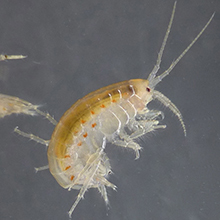
Amphipods are key organisms in freshwater ecosystems and commonly used as indicator taxa for biomonitoring and ecotoxicology. We study the diversity, biogeography and ecology of freshwater amphipods, with a focus on the European Alps/Switzerland. We thereby integrate knowledge on natural history, taxonomy and spatial distribution of amphipods to understand how their contemporary species and genetic diversity have been shaped by macroecological and anthropogenic drivers. As part of the project Amphipod.CH, the first monograph on amphipods of Switzerland was released in 2019. It includes an overview of the amphipod species occurring in Switzerland, as well as an identification key.

A current focus of our work is to better understand the ecology and diversity within the Gammarus fossarum complex. Gammarus fossarum is a common shredder in Swiss surface waters. It is known to be a cryptic species complex that includes several genetically distinct lineages/species. Using molecular and taxonomic approaches, we are working on resolving the taxonomy of this species complex

Key Publications

Extbase Variable Dump
array(3 items)
   publications => '19188,23798' (11 chars)
   libraryUrl => '' (0 chars)
   layout => '0' (1 chars)
Extbase Variable Dump
array(2 items)
   0 => Snowflake\Publications\Domain\Model\Publicationprototypepersistent entity (uid=19188, pid=124)
      originalId => protected19188 (integer)
      authors => protected'Altermatt, F.; Alther, R.; Fišer, C.; Švara, V.' (69 chars)
      title => protected'Amphipoda (Flohkrebse) der Schweiz. Checkliste, Bestimmung und Atlas' (68 chars)
      journal => protected'' (0 chars)
      year => protected2019 (integer)
      volume => protected0 (integer)
      issue => protected'' (0 chars)
      startpage => protected'389 p' (10 chars)
      otherpage => protected'' (0 chars)
      categories => protected'' (0 chars)
      description => protected'Amphipods are a highly diverse group of aquatic invertebrates with >10,00
         0 described species globally. About 20% of these are freshwater species, wit
         h half of them found in the West Palaearctic. Amphipods inhabit almost all f
         reshwater ecosystems, including lakes, rivers, streams, as well as cave and
         groundwater systems, and can be the dominant macroinvertebrates in these hab
         itats. They exhibit essential roles in the functioning of aquatic ecosystems
         , contributing to leaf litter breakdown and serving as important prey for fi
         sh. Furthermore, they are commonly used as indicator taxa for biomonitoring
         and in ecotoxicological studies. Many amphipod communities are currently und
         ergoing rapid changes due to various drivers of global change, and some amph
         ipod species are among the most successful nonnative invasive invertebrates.
         <br />Despite their ecological and economic significance, the knowledge on a
         mphipods in Switzerland was hitherto limited, and until now no checklist, di
         stribution maps, or broadscale estimates on genetic, functional, and morphol
         ogical diversity of all amphipod species in Switzerland existed. All hithert
         o available literature on the ecology, faunistics, and taxonomy of amphipods
          in Central Europe is either outdated by many decades (Chevreux &amp; Fage,
         1925; Schellenberg, 1942), does not cover all species (Ginet, 1995; Eggers &
         amp; Martens, 2001, Piscart &amp; Bollache, 2012), or is only targeting neig
         hboring countries (Vornatscher, 1965; Karaman, 1993; Eggers &amp; Martens, 2
         001; Piscart &amp; Bollache, 2012, Zettler &amp; Zettler, 2017). This lack o
         f appropriate baseline information on the ecology, distribution and faunisti
         cs of amphipods in Switzerland is a serious limitation for fundamental ecolo
         gical research, impedes appropriate conservation strategies, and limits the
         use and application of amphipods as indicator taxa.
' (1875 chars) serialnumber => protected'' (0 chars) doi => protected'' (0 chars) uid => protected19188 (integer) _localizedUid => protected19188 (integer)modified _languageUid => protectedNULL _versionedUid => protected19188 (integer)modified pid => protected124 (integer)
1 => Snowflake\Publications\Domain\Model\Publicationprototypepersistent entity (uid=23798, pid=124) originalId => protected23798 (integer) authors => protected'Alther,&nbsp;R.; Fronhofer,&nbsp;E.&nbsp;A.; Altermatt,&nbsp;F.' (63 chars) title => protected'Dispersal behaviour and riverine network connectivity shape the genetic dive
         rsity of freshwater amphipod metapopulations
' (120 chars) journal => protected'Molecular Ecology' (17 chars) year => protected2021 (integer) volume => protected30 (integer) issue => protected'' (0 chars) startpage => protected'6551' (4 chars) otherpage => protected'6565' (4 chars) categories => protected'connectivity; Gammarus fossarum; landscape genetics; population genetics; st
         ochastic simulation
' (95 chars) description => protected'Theory predicts that the distribution of genetic diversity in a landscape is
          strongly dependent on the connectivity of the metapopulation and the disper
         sal of individuals between patches. However, the influence of explicit spati
         al configurations such as dendritic landscapes on the genetic diversity of m
         etapopulations is still understudied, and theoretical corroborations of empi
         rical patterns are largely lacking. Here, we used microsatellite data and st
         ochastic simulations of two metapopulations of freshwater amphipods in a 28,
         000 km<sup>2</sup> riverine network to study the influence of spatial conne
         ctivity and dispersal strategies on the spatial distribution of their geneti
         c diversity. We found a significant imprint of the effects of riverine netwo
         rk connectivity on the local and global genetic diversity of both amphipod s
         pecies. Data from 95 sites showed that allelic richness significantly incre
         ased towards more central nodes of the network. This was also seen for obser
         ved heterozygosity, yet not for expected heterozygosity. Genetic differentia
         tion increased with instream distance. In simulation models, depending on th
         e mutational model assumed, upstream movement probability and dispersal rate
         , respectively, emerged as key factors explaining the empirically observed d
         istribution of local genetic diversity and genetic differentiation. Surprisi
         ngly, the role of site-specific carrying capacities, for example by assuming
          a direct dependency of population size on local river size, was less clear
         cut: while our best fitting model scenario included this feature, over all s
         imulations, scaling of carrying capacities did not increase data-model fit.
         This highlights the importance of dispersal behaviour along spatial networks
          in shaping population genetic diversity.
' (1789 chars) serialnumber => protected'0962-1083' (9 chars) doi => protected'10.1111/mec.16201' (17 chars) uid => protected23798 (integer) _localizedUid => protected23798 (integer)modified _languageUid => protectedNULL _versionedUid => protected23798 (integer)modified pid => protected124 (integer)
Altermatt, F.; Alther, R.; Fišer, C.; Švara, V. (2019) Amphipoda (Flohkrebse) der Schweiz. Checkliste, Bestimmung und Atlas, 389 p, Institutional Repository
Alther, R.; Fronhofer, E. A.; Altermatt, F. (2021) Dispersal behaviour and riverine network connectivity shape the genetic diversity of freshwater amphipod metapopulations, Molecular Ecology, 30, 6551-6565, doi:10.1111/mec.16201, Institutional Repository