Department Aquatic Ecology

Community ecology and seasonality of leaf litter dynamics of headwater streams
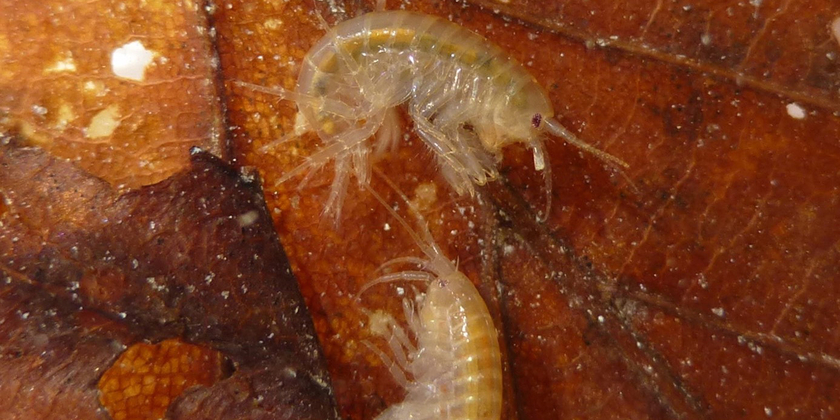
Leaf litter fall forms the foundation of many aquatic ecosystems and represents the dominant pathway of resource transfer from terrestrial to aquatic environments. In headwater streams, a diverse group of organisms known as shredders initiates the breakdown of this material by consuming leaves, thereby releasing nutrients. Through this process, carbon and nitrogen are transferred to higher trophic levels, as shredders are consumed by fish and produce fine particulate organic matter that can be consumed by filter-feeding organisms.

The rate at which shredders consume leaf litter strongly influences the magnitude of nutrient cycling within stream food webs and is governed by both leaf quality and quantity. In temperate regions, climate change is altering the timing of leaf fall, thereby affecting the availability and nutritional quality of leaf litter for aquatic consumers and potentially disrupting these critical nutrient pathways.

Our research focuses on understanding how seasonal shifts in leaf litter dynamics influence nutrient cycling in headwater streams. We employ highly temporally and spatially replicated leaf litter bags and litter traps to quantify patterns of leaf litter decomposition and to construct leaf litter budgets. In addition, we use mesocosm experiments to assess how altered leaf fall timing affects consumption rates by aquatic organisms, with a particular focus on the abundant shredding amphipod Gammarus fossarum. Future work will investigate how changes in leaf fall phenology influence the consumption and growth rates of emerging aquatic insects, allowing us to assess how climate-driven shifts in leaf litter inputs may affect the reciprocal subsidy between aquatic and terrestrial ecosystems.


Key Publications

Extbase Variable Dump
array(2 items)
   publications => '35088,34563' (11 chars)
   libraryUrl => '' (0 chars)
Extbase Variable Dump
array(2 items)
   0 => Snowflake\Publications\Domain\Model\Publicationprototypepersistent entity (uid=35088, pid=124)
      originalId => protected35088 (integer)
      authors => protected'Cereghetti, E.; Altermatt, F.' (39 chars)
      title => protected'The phenology of leaf litter decomposition in aquatic and terrestrial compar
         tments of headwater catchments
' (106 chars) journal => protected'American Naturalist' (19 chars) year => protected2025 (integer) volume => protected206 (integer) issue => protected'2' (1 chars) startpage => protected'89' (2 chars) otherpage => protected'100' (3 chars) categories => protected'ecosystem function and services; detritus cycling; seasonality; metaecosyste
         m
' (77 chars) description => protected'The decomposition of leaf litter is a major ecological process in terrestria
         l and aquatic ecosystems worldwide. Leaf litter generally enters ecosystems
         in annual pulses and is subsequently decomposed across many seasons. Yet inv
         estigations into this process are rarely conducted in parallel in aquatic an
         d terrestrial ecosystems and over the full year, limiting our understanding
         of its phenological context across the blue-green interface. Here, we assess
         ed the decomposition of three litter species by microorganisms and macroinve
         rtebrates in temperate streams and forests across a year using repeated litt
         erbag assays at 6-week intervals. We observed higher decomposition rates in
         summer in most combinations of ecosystem, litter species, and decomposer typ
         e, indicating positive effects of higher temperatures and low standing crops
          of labile litter. Furthermore, forests showed lower decomposition rates tha
         n streams. Last, we found that the relative litter species effects on both m
         icrobial and invertebrate decomposition were consistent across environments,
          suggesting that the fast microbial activity decreased the quality of the re
         maining tissue mass for invertebrates. Overall, our work places known driver
         s of the decomposition of leaf litter into a phenological context, providing
          evidence that changes in the timing or strength of these drivers could driv
         e temporal shifts of this central ecological process.
' (1421 chars) serialnumber => protected'0003-0147' (9 chars) doi => protected'10.1086/736356' (14 chars) uid => protected35088 (integer) _localizedUid => protected35088 (integer)modified _languageUid => protectedNULL _versionedUid => protected35088 (integer)modified pid => protected124 (integer)
1 => Snowflake\Publications\Domain\Model\Publicationprototypepersistent entity (uid=34563, pid=124) originalId => protected34563 (integer) authors => protected'Cereghetti, E.; Peller, T.; Kaeser, S.; Gounand, I.; Alt
         ermatt, F.
' (91 chars) title => protected'Seasonal dynamics of detritus flows and decomposition across ecosystem bound
         aries
' (81 chars) journal => protected'Current Biology' (15 chars) year => protected2025 (integer) volume => protected35 (integer) issue => protected'9' (1 chars) startpage => protected'2139' (4 chars) otherpage => protected'2145' (4 chars) categories => protected'' (0 chars) description => protected'Material fluxes are ubiquitous in nature within and across ecosystems, conne
         cting habitats with vastly different characteristics, like forests to rivers
          and lakes.<sup>1</sup><sup>,</sup><sup>2</sup><sup>,</sup><sup>3</sup> Alth
         ough individual fluxes and their cascading effects are well known,<sup>4</su
         p><sup>,</sup><sup>5</sup><sup>,</sup><sup>6</sup> very few studies address
         the intra-annual phenology of ecosystem processes, despite the pronounced se
         asonality of fluxes. Here, we empirically quantified and resolved fluxes of
         recalcitrant and labile types of leaf litter in temperate riparian forests a
         nd streams across a year, representing one of the most emblematic examples o
         f seasonal systems. We quantified intra-annual variation in litter inputs fr
         om terrestrial plants to forest floors and streams and estimated aquatic and
          terrestrial decomposition rates across the year at 6-week intervals. Our da
         ta show that the autumn pulse of leaf litter is complemented by smaller magn
         itude but more constant-through-the-year lateral flows to the stream ecosyst
         ems. Decomposition of labile litter fluctuated seasonally, on a different ph
         enology, with generally higher rates in summer, but rates of recalcitrant li
         tter decomposition remained largely constant. Microorganisms were the main c
         ontributors to the decomposition process in both forests and streams. Overal
         l, our work highlights the asynchronous and seasonally variable changes in d
         ecomposition rates between recalcitrant and labile detritus despite their in
         itial synchronized availability and suggests that the dominating presence of
          recalcitrant litter buffers ecosystem responses to the concentrated tempora
         l distribution of litter resources.<sup>7</sup><sup>,</sup><sup>8</sup> Inve
         stigating such ecological processes both across ecosystem borders and at fin
         e intra-annual resolutions is imperative to understand complex system respon
         ses in the context of species’ shifts in phenologies and resource quality.
         <sup>9</sup><sup>,</sup>...
' (2038 chars) serialnumber => protected'0960-9822' (9 chars) doi => protected'10.1016/j.cub.2025.03.019' (25 chars) uid => protected34563 (integer) _localizedUid => protected34563 (integer)modified _languageUid => protectedNULL _versionedUid => protected34563 (integer)modified pid => protected124 (integer)
Cereghetti, E.; Altermatt, F. (2025) The phenology of leaf litter decomposition in aquatic and terrestrial compartments of headwater catchments, American Naturalist, 206(2), 89-100, doi:10.1086/736356, Institutional Repository
Cereghetti, E.; Peller, T.; Kaeser, S.; Gounand, I.; Altermatt, F. (2025) Seasonal dynamics of detritus flows and decomposition across ecosystem boundaries, Current Biology, 35(9), 2139-2145, doi:10.1016/j.cub.2025.03.019, Institutional Repository

Contact

Dr. Roman Alther Senior scientist (he/him) Tel. +41 58 765 5638 Send Mail
Luke Ireland Tel. +41 58 765 6747 Send Mail

Further Information