Department Aquatic Ecology
Spatio-temporal dynamics in meta-ecosystem ecology
Temporal fluctuations are ubiquitous in ecological systems, shaping how organisms and ecosystems function across multiple scales. Yet ecological theory has long relied on steady-state assumptions, treating ecosystems as static entities governed by equilibrium dynamics. Emerging evidence suggests that variability in time is not simply background noise but a fundamental driver of ecological characteristics, such as community composition, biomass structure, or functions. While the effects of temporal variability have been studied at local and individual levels, its implications for meta-ecosystem dynamics remain poorly understood.
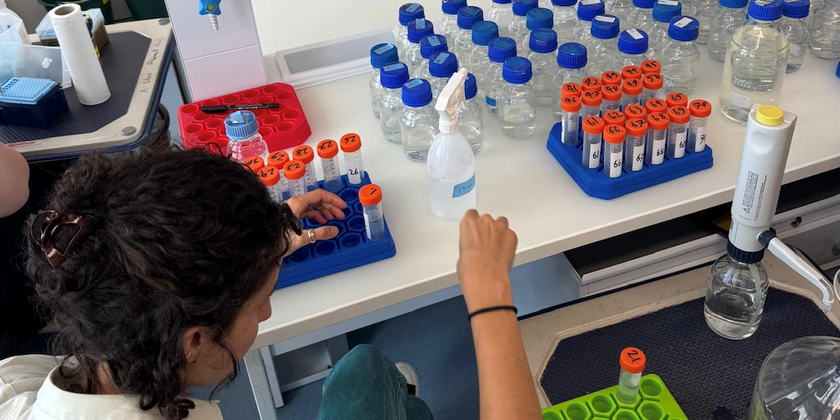
Our group aims to develop our understanding of meta-ecosystem dynamics through a combination of mathematical models and experiments. We develop mathematical models and use protist experiments to make and test predictions on the impacts of temporal and spatial fluctuations on (meta)ecosystems, modifying biodiversity and ecosystem functions in a changing world. Further, we include spatial connections between ecosystems via flows of resources and organisms (such as crustaceans) in these temporally fluctuating ecosystems. We are interested in studying the timing between ecological events.