Department Environmental Social Sciences

Achieving long-term use of solar water disinfection in Zimbabwe
Project description

Household water treatment can guarantee safe drinking water to prevent diarrhea and cholera. However, high compliance and sustainable use is seldom achieved. The present study designed and evaluated several promotion strategies for solar water disinfection (SODIS), based on results from a baseline survey. Visits to inform households about the costs and benefits of SODIS combined with public commitment and memory aids were emerged as the best strategy, resulting in 80-90% of households using SODIS even 14 months after intervention.


Context

The consumption of unsafe water is one of the main causes of diarrhea, which leads to the deaths of an estimated of 760,000 children under the age of five worldwide each year. Households in the peri-urban areas of Harare, Zimbabwe drink unsafe water from wells, surface water, or intermittent piped water supply. Episodes of cholera are frequent in these areas. Household water treatment systems, such as solar water disinfection (SODIS), could prevent a large proportion of diarrhea cases. However they are neither frequently nor consistently used.


Objectives
The main objective of this study was to find out which behavior change strategy would be most effective in securing high compliance and sustained use of SODIS. For that purpose, first, SODIS was introduced in communities in peri-urban areas of Harare. Then, different behavior change strategies were developed and evaluated with regard to the population’s sustainable uptake of SODIS.


Activities
Step 1 + 2: Identify, measure, and determine behavioral factors of SODIS use.

  • A baseline survey was conducted.
  • A doer/non-doer analysis revealed the following behavioral factors to explain SODIS use: Knowledge about the safety of raw water (health knowledge), beliefs about the expensiveness, taste, and how time-consuming or difficult to perform SODIS is, belief about what others think about SODIS (others’ approval), and whether performing SODIS is intended in the future (intention) and perceived as a habit.


Step 3: Select behavior change techniques (BCTs) and design behavior change strategies to enhance SODIS use. The following behavior change strategies were designed:

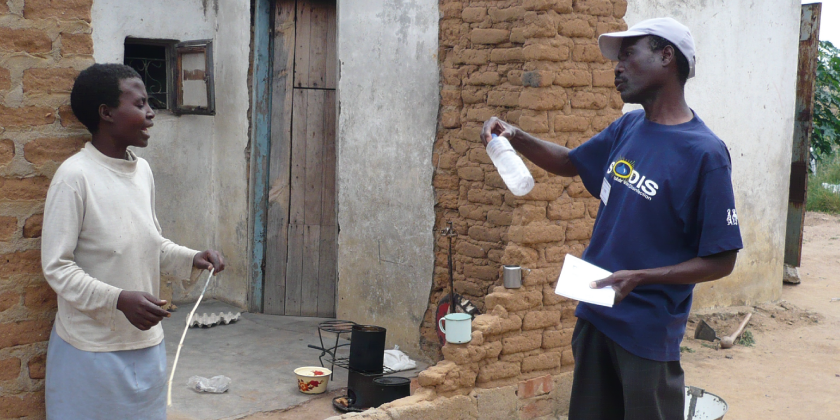
  • Visits using the BCT inform households about and assess costs and benefits were followed by public commitment and the use of memory aids such as a reminder notice.
  • The BCT prompt talk to others was used for a pass-on task for which community members were trained to convince other persons to use SODIS, who in turn should convince more persons, generating a ‘snowball effect’.
  • The pass-on-task in combination with the BCT highlight the discrepancy between set goal and actual behavior contrasted desirable behaviors with actual practices.


Step 4: Implement and evaluate behavior change strategies for SODIS use

  • The behavior change strategies were evaluated through a before-after control trial.
  • The strategies were implemented in four different areas. A fifth area served as control group.
  • Behavioral factors and SODIS use were surveyed several times. The last survey was conducted 14 months after the latest intervention.
  • The effectiveness of the promotion activities was measured by observing whether the households had SODIS bottles exposed to the sun.


Findings
The most effective strategy was the visit to inform households about and assess costs and benefits in combination with public commitment and the use of memory aids such as a reminder notice.
In the areas receiving these strategies, 80-90% of the households were still using SODIS 14 months after the intervention had ended.


Conclusion
This project revealed that systematic behavior change strategies make it possible to achieve highly frequent and sustainable use of household water treatment and thus the safe water consumption levels necessary for improved health.

Publications

Extbase Variable Dump
array(2 items)
   publications => '7169,8846,6685,6608,7084,6288' (29 chars)
   libraryUrl => '' (0 chars)
Extbase Variable Dump
array(6 items)
   0 => Snowflake\Publications\Domain\Model\Publicationprototypepersistent entity (uid=7169, pid=124)
      originalId => protected7169 (integer)
      authors => protected'Mosler, H. J.; Kraemer, S. M.; Johnston, R. B.' (76 chars)
      title => protected'Achieving long-term use of solar water disinfection in Zimbabwe' (63 chars)
      journal => protected'Public Health' (13 chars)
      year => protected2013 (integer)
      volume => protected127 (integer)
      issue => protected'1' (1 chars)
      startpage => protected'92' (2 chars)
      otherpage => protected'98' (2 chars)
      categories => protected'behavioural change; household water treatment and safe storage (HWTS); solar
          disinfection (SODIS); Zimbabwe
' (107 chars) description => protected'<I>Objectives:</I> To use a psychological theory of behavioural change to me
         asure and interpret the effectiveness of different promotional strategies fo
         r achieving long-term usage of a household water treatment and safe storage
         (HWTS) system in peri-urban Zimbabwe.<BR/><I>Study design:</I> Solar disinfe
         ction (SODIS) was introduced into five peri-urban communities near Harare, Z
         imbabwe. Six different interventions were developed and were applied in four
          communities in different combinations, with the fifth remaining as a contro
         l area where no interventions were implemented.<BR/><I>Methods:</I> Througho
         ut the 26 months of the study nine longitudinal panel surveys were conducted
          in which SODIS usage was estimated using three separate metrics: reported,
         calculated, and observed. A total of 1551 people were interviewed.<BR/><I>Re
         sults:</I> The three indicators of SODIS usage broadly agreed with one anoth
         er. By any measure, the most effective intervention was household visits by
         trained promoters in combination with persuasion. Households which received
         household visits maintained SODIS usage rates of 65% or more, even six month
         s after the cessation of all promotional activities. Households receiving ot
         her interventions were significantly less effective. Interventions like prom
         pts or public commitment after the application of household visits were effe
         ctive at maintaining good practices once these were established.<BR/><I>Conc
         lusions:</I> Household promotion in combination with persuasion appears more
          effective than other approaches, especially when followed with intervention
         s targeting the maintenance of the new behaviour. With this intervention it
         is possible that around 65% of the households continue to use solar water di
         sinfection (SODIS) more than two years after the initial promotion, and six
         months after the end of all interventions
' (1865 chars) serialnumber => protected'0033-3506' (9 chars) doi => protected'10.1016/j.puhe.2012.09.001' (26 chars) uid => protected7169 (integer) _localizedUid => protected7169 (integer)modified _languageUid => protectedNULL _versionedUid => protected7169 (integer)modified pid => protected124 (integer)
1 => Snowflake\Publications\Domain\Model\Publicationprototypepersistent entity (uid=8846, pid=124) originalId => protected8846 (integer) authors => protected'Kraemer,&nbsp;S.&nbsp;M.; Mosler,&nbsp;H.-J.' (44 chars) title => protected'Effectiveness and effects of promotion strategies for behaviour change: sola
         r water disinfection in Zimbabwe
' (108 chars) journal => protected'Applied Psychology' (18 chars) year => protected2012 (integer) volume => protected61 (integer) issue => protected'3' (1 chars) startpage => protected'392' (3 chars) otherpage => protected'414' (3 chars) categories => protected'' (0 chars) description => protected'Solar water disinfection (SODIS) is a sustainable method of water treatment.
          Despite the simplicity and many advantages of SODIS, past behaviour change
         campaigns have seen limited success. This study aims to compare intervention
          strategies in their efficiency in changing behaviour and to analyse which b
         ehavioural factors are differentially affected. The following factors were a
         nalysed in this study: intention, subjective norm, behavioural control, beli
         efs, habits, frequency of talking, knowledge and tension. The promotion stra
         tegies used in this intervention study were promoters, a pass-on task, promp
         ts, public commitment and disseminating knowledge with inducing tension. Inh
         abitants of high-density areas near Harare, Zimbabwe, were interviewed at di
         fferent points in time. High SODIS consumption was achieved when the promote
         r intervention was followed by a memory-aiding technique such as prompts or
         public commitment. Consequently, this combined-intervention strategy increas
         ed all behavioural factors and kept them at a high level. A continued pass-o
         n task alone did not change behaviour and had decreasing effects on several
         behavioural factors. When the pass-on task was combined with disseminating k
         nowledge with inducing tension, high SODIS water consumption was also reache
         d, but several behavioural factors stayed at a low level. More effective int
         ervention strategies are identified and discussed.
' (1418 chars) serialnumber => protected'0269-994X' (9 chars) doi => protected'10.1111/j.1464-0597.2011.00475.x' (32 chars) uid => protected8846 (integer) _localizedUid => protected8846 (integer)modified _languageUid => protectedNULL _versionedUid => protected8846 (integer)modified pid => protected124 (integer)
2 => Snowflake\Publications\Domain\Model\Publicationprototypepersistent entity (uid=6685, pid=124) originalId => protected6685 (integer) authors => protected'Mosler,&nbsp;H.-J.; Kraemer,&nbsp;S.' (36 chars) title => protected'Which psychological factors change when habitual water treatment practices a
         lter?
' (81 chars) journal => protected'Journal of Public Health (Berlin, Heidelberg)' (45 chars) year => protected2012 (integer) volume => protected20 (integer) issue => protected'1' (1 chars) startpage => protected'71' (2 chars) otherpage => protected'79' (2 chars) categories => protected'household water treatment; adoption; behavior change; habits' (60 chars) description => protected'<I>Aim</I>. Household water treatment systems (HWTS) and safe storage system
         s are an effective measure to ensure safe water supply. The adoption of HWTS
          requires long-term changes in behavior. During campaigns for health related
          behavior change, many people appear to have fixed behavioral patterns that
         are difficult to change. Since behavior change originates in the altering of
          inner psychological factors, it is necessary to investigate the transformat
         ion of these factors. Five categories of psychological factors are identifie
         d as responsible for the formation of habitual behavior: risk beliefs, attit
         udinal beliefs, normative beliefs, ability beliefs, and maintenance beliefs.
          This study analyzes which factors change when long-term users of HWTS, non-
         users, or 'tryers' (using HWTS occasionally), transform their behavior type
         or remain in their current behavior type.<BR/> <I>Subjects and methods</I>.
         Data were obtained by conducting six panel interviews about the use of solar
          water disinfection (SODIS) over a period of 14 months, with 694 households,
          in the slum areas of Harare, Zimbabwe.<BR/> <I>Results</I>. The results rev
         eal that progressing to a higher level of user type (one who increases their
          use of SODIS), or staying at a high level of use (maintaining their level o
         f use) is associated with the user’s ability to avoid being hindered by ot
         her habits, to remember the behavior in respective situations, and to notice
          that other people are also using SODIS.<BR/> <I>Conclusion</I>. Suggested s
         trategies which may foster these factors include the control of distracting
         stimuli, forming implementation intentions, daily routine planning, applying
          reminders, and using public commitments.
' (1713 chars) serialnumber => protected'2198-1833' (9 chars) doi => protected'10.1007/s10389-011-0435-1' (25 chars) uid => protected6685 (integer) _localizedUid => protected6685 (integer)modified _languageUid => protectedNULL _versionedUid => protected6685 (integer)modified pid => protected124 (integer)
3 => Snowflake\Publications\Domain\Model\Publicationprototypepersistent entity (uid=6608, pid=124) originalId => protected6608 (integer) authors => protected'Kraemer,&nbsp;S.&nbsp;M.; Mosler,&nbsp;H.-J.' (44 chars) title => protected'Factors from the transtheoretical model differentiating between solar water
         disinfection (SODIS) user groups
' (108 chars) journal => protected'Journal of Health Psychology' (28 chars) year => protected2011 (integer) volume => protected16 (integer) issue => protected'1' (1 chars) startpage => protected'126' (3 chars) otherpage => protected'136' (3 chars) categories => protected'adoption; attitude; habit; longitudinal study; solar water disinfection; Tra
         nstheoretical Model of Change; user groups
' (118 chars) description => protected'Solar water disinfection (SODIS) is a sustainable household water treatment
         technique that could prevent millions of deaths caused by diarrhoea. The beh
         aviour change process necessary to move from drinking raw water to drinking
         SODIS is analysed with the Transtheoretical Model of Change (TTM). User grou
         ps and psychological factors that differentiate between types of users are i
         dentified. Results of a 1.5 year longitudinal study in Zimbabwe reveal disti
         nguishing factors between groups, from which it can be deduced that they dri
         ve the development of user groups. Implications are drawn for campaigns with
          the aim of bringing all user types to a regular use.
' (661 chars) serialnumber => protected'1359-1053' (9 chars) doi => protected'10.1177/1359105310370630' (24 chars) uid => protected6608 (integer) _localizedUid => protected6608 (integer)modified _languageUid => protectedNULL _versionedUid => protected6608 (integer)modified pid => protected124 (integer)
4 => Snowflake\Publications\Domain\Model\Publicationprototypepersistent entity (uid=7084, pid=124) originalId => protected7084 (integer) authors => protected'McGuigan,&nbsp;K.&nbsp;G.; Conroy,&nbsp;R.&nbsp;M.; Mosler,&nbsp;H.-J.; du P
         reez,&nbsp;M.; Ubomba-Jaswa,&nbsp;E.; Fernandez-Ibañez,&nbsp;P.
' (140 chars) title => protected'Solar water disinfection (SODIS): a review from bench-top to roof-top' (69 chars) journal => protected'Journal of Hazardous Materials' (30 chars) year => protected2012 (integer) volume => protected235 (integer) issue => protected'' (0 chars) startpage => protected'29' (2 chars) otherpage => protected'46' (2 chars) categories => protected'solar disinfection; SODIS; drinking water; waterborne disease; developing wo
         rld
' (79 chars) description => protected'Solar water disinfection (SODIS) has been known for more than 30 years. The
         technique consists of placing water into transparent plastic or glass contai
         ners (normally 2 L PET beverage bottles) which are then exposed to the sun.
         Exposure times vary from 6 to 48 h depending on the intensity of sunlight an
         d sensitivity of the pathogens. Its germicidal effect is based on the combin
         ed effect of thermal heating of solar light and UV radiation. It has been re
         peatedly shown to be effective for eliminating microbial pathogens and reduc
         e diarrhoeal morbidity including cholera. Since 1980 much research has been
         carried out to investigate the mechanisms of solar radiation induced cell de
         ath in water and possible enhancement technologies to make it faster and saf
         er. Since SODIS is simple to use and inexpensive, the method has spread thro
         ughout the developing world and is in daily use in more than 50 countries in
          Asia, Latin America, and Africa. More than 5 million people disinfect their
          drinking water with the solar disinfection (SODIS) technique. This review a
         ttempts to revise all relevant knowledge about solar disinfection from micro
         biological issues, laboratory research, solar testing, up to and including r
         eal application studies, limitations, factors influencing adoption of the te
         chnique and health impact.
' (1318 chars) serialnumber => protected'0304-3894' (9 chars) doi => protected'10.1016/j.jhazmat.2012.07.053' (29 chars) uid => protected7084 (integer) _localizedUid => protected7084 (integer)modified _languageUid => protectedNULL _versionedUid => protected7084 (integer)modified pid => protected124 (integer)
5 => Snowflake\Publications\Domain\Model\Publicationprototypepersistent entity (uid=6288, pid=124) originalId => protected6288 (integer) authors => protected'Kraemer,&nbsp;S.&nbsp;M.; Mosler,&nbsp;H.-J.' (44 chars) title => protected'Persuasion factors influencing the decision to use sustainable household wat
         er treatment
' (88 chars) journal => protected'International Journal of Environmental Health Research' (54 chars) year => protected2010 (integer) volume => protected20 (integer) issue => protected'1' (1 chars) startpage => protected'61' (2 chars) otherpage => protected'79' (2 chars) categories => protected'intervention; solar water disinfection (SODIS); behaviour change; campaign;
         persuasion; convictions
' (99 chars) description => protected'Solar water disinfection (SODIS) is a sustainable water treatment method. Wi
         th the help of the sun and plastic bottles, water is treated and illnesses p
         revented. This paper aims to identify the factors influencing SODIS uptake,
         that is, why someone may become a SODIS user. This uptake decision can be in
         fluenced by persuasion. From behaviour theory, variables are recognised whic
         h have been proven to influence intention and behaviour and simultaneously c
         an be influenced by persuasion. A total of (<I>n</I> = 878) structured inter
         views were conducted in a field study in Zimbabwe. Linear and binary logisti
         c regressions showed that several of the initially proposed persuasion varia
         bles have significant influence. Persuasion factors have a stronger influenc
         e on the uptake of SODIS use and on intention to use SODIS in the future tha
         n on the amount of SODIS water consumed. Ideas are presented for using the e
         ffective variables in future SODIS campaigns and campaigns in other fields.
' (987 chars) serialnumber => protected'0960-3123' (9 chars) doi => protected'10.1080/09603120903398301' (25 chars) uid => protected6288 (integer) _localizedUid => protected6288 (integer)modified _languageUid => protectedNULL _versionedUid => protected6288 (integer)modified pid => protected124 (integer)
Mosler, H. J.; Kraemer, S. M.; Johnston, R. B. (2013) Achieving long-term use of solar water disinfection in Zimbabwe, Public Health, 127(1), 92-98, doi:10.1016/j.puhe.2012.09.001, Institutional Repository
Kraemer, S. M.; Mosler, H.-J. (2012) Effectiveness and effects of promotion strategies for behaviour change: solar water disinfection in Zimbabwe, Applied Psychology, 61(3), 392-414, doi:10.1111/j.1464-0597.2011.00475.x, Institutional Repository
Mosler, H.-J.; Kraemer, S. (2012) Which psychological factors change when habitual water treatment practices alter?, Journal of Public Health (Berlin, Heidelberg), 20(1), 71-79, doi:10.1007/s10389-011-0435-1, Institutional Repository
Kraemer, S. M.; Mosler, H.-J. (2011) Factors from the transtheoretical model differentiating between solar water disinfection (SODIS) user groups, Journal of Health Psychology, 16(1), 126-136, doi:10.1177/1359105310370630, Institutional Repository
McGuigan, K. G.; Conroy, R. M.; Mosler, H.-J.; du Preez, M.; Ubomba-Jaswa, E.; Fernandez-Ibañez, P. (2012) Solar water disinfection (SODIS): a review from bench-top to roof-top, Journal of Hazardous Materials, 235, 29-46, doi:10.1016/j.jhazmat.2012.07.053, Institutional Repository
Kraemer, S. M.; Mosler, H.-J. (2010) Persuasion factors influencing the decision to use sustainable household water treatment, International Journal of Environmental Health Research, 20(1), 61-79, doi:10.1080/09603120903398301, Institutional Repository