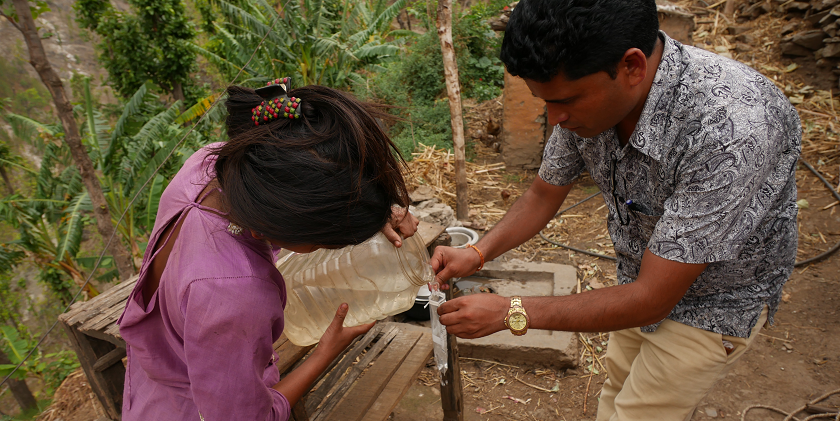
REACH: Strengthening Monitoring & Management of Small Water Supplies
Monitoring the quality of rural water supplies is necessary to identify contamination risks and motivate proactive management. Yet establishing a consistent monitoring program is challenged by many issues, including inconsistent supply chains, high costs of material and equipment, challenging terrain, lack of technical capacity, and low political commitment. Inadequate water quality information hampers service providers’ ability to effectively manage and treat water supplies, presenting a public health risk to consumers.
SANDEC’s Water Supply and Treatment (WS+T) Group is collaborating with REACH: Improving Water Security for the Poor to improve access to safe drinking water in remote rural areas of Nepal, Bangladesh and Kenya. This multidisciplinary project aims to establish and support fit-for-purpose laboratories, defined as local labs designed to meet the operational and management needs of rural water supplies, can effectively address these challenges in Nepal, Kenya and Bangladesh. Fit-for-purpose labs are highly contextual, often with adapted monitoring methods and close integration with local institutions. A unifying feature of these labs is their focus on supporting water service providers to respond to risks in an informed and timely manner.
array(12 items)0 => Snowflake\Publications\Domain\Model\Publicationprototypepersistent entity (uid=30083, pid=124)originalId => protected30083 (integer)
authors => protected'Shrestha, A.; Bhattarai, T. N.; Acharya, G.; Timalsina,& nbsp;H.; Marks, S. J.; Uprety, S.; Paudel, S. R.' (149 chars)
title => protected'Water, sanitation, and hygiene of Nepal: status, challenges, and opportuniti es' (78 chars)
journal => protected'ACS ES&T Water' (14 chars)
year => protected2023 (integer)
volume => protected3 (integer)
issue => protected'6' (1 chars)
startpage => protected'1429' (4 chars)
otherpage => protected'1453' (4 chars)
categories => protected'' (0 chars)
description => protected'Access to water, sanitation, and hygiene (WASH) has been a challenge to sout h Asia’s rapidly growing and climate change-sensitive region. Nepal, a wat er-abundant country, faces obstacles to fulfilling the highly prioritized WA SH Sustainable Development Goal 6 (SDG 6). This review offers details about Nepal’s WASH status from 2000 to 2020 with regard to the challenges Nepal had in delivering reliable WASH services to the people, as well as opportuni ties for a sustainable way forward, and provides insights that can be applie d to other developing countries. From analysis of national-level assessments , estimates point toward healthy progress in extending WASH access to the po pulation. However, large inequalities persist at the subnational level betwe en urban and rural residents, between poor and rich residents, and between g enders. Many local constraints such as a lack of long-term infrastructural c apacity to provide and maintain WASH services, financial issues, and institu tional and policy incompatibilities are some of the key factors that technic al considerations and private sector involvement could address. We also prop ose roles for Nepal’s central, provincial, and local governments for ident ification and adaptation to the undeniable risks of climate change. Furtherm ore, there is a need to capitalize on the potential opportunities for develo ping a much-needed robust and climate-resilient WASH sector in Nepal, safegu arding the rights of future generations to safe and clean water.' (1508 chars)
serialnumber => protected'' (0 chars)
doi => protected'10.1021/acsestwater.2c00303' (27 chars)
uid => protected30083 (integer)
_localizedUid => protected30083 (integer)modified_languageUid => protectedNULL
_versionedUid => protected30083 (integer)modifiedpid => protected124 (integer)1 => Snowflake\Publications\Domain\Model\Publicationprototypepersistent entity (uid=24953, pid=124)originalId => protected24953 (integer)
authors => protected'Ambuehl, B.; Kunwar, B. M.; Schertenleib, A.; Marks,&nbs p;S. J.; Inauen, J.' (105 chars)
title => protected'Can participation promote psychological ownership of a shared resource? An i ntervention study of community-based safe water infrastructure' (138 chars)
journal => protected'Journal of Environmental Psychology' (35 chars)
year => protected2022 (integer)
volume => protected81 (integer)
issue => protected'' (0 chars)
startpage => protected'101818 (11 pp.)' (15 chars)
otherpage => protected'' (0 chars)
categories => protected'psychological ownership; participation; water; sustainable development; envi ronmental contamination; resource management; longitudinal intervention stud y; dilemma of the commons' (177 chars)
description => protected'Previous research suggests that community-based participation, a process thr ough which beneficiaries can actively influence and define the direction and execution of development programs, can promote long-term uptake, use, and m anagement of shared resources, such as community-based safe water infrastruc ture. However, results are heterogeneous. Psychological ownership theory and initial evidence suggests that participation promotes positive outcomes for shared resources by fostering sense of ownership through three routes: havi ng control, intimate knowledge, and investing the self. This study used comm unity-based safe water infrastructure as an example to investigate how vario us forms of participation affect acceptance, use, and functionality of a sha red resource and whether this effect is mediated by psychological ownership. We conducted a nonrandomized cluster-based controlled trial with pre–post intervention assessment (N = 369) in 33 villages in rural Nepal, where safe water infrastructure is shared. Participatory intervention activities (e.g. , influence in decision-making, contributing materials and labour) favourabl y affected self-reported outcomes and use of the water supply infrastructure but not observed functionality or drinking water quality. In conclusion, th is study supports the assumption that participation can foster psychological ownership, which in turn can support successful management of a shared reso urce.' (1449 chars)
serialnumber => protected'0272-4944' (9 chars)
doi => protected'10.1016/j.jenvp.2022.101818' (27 chars)
uid => protected24953 (integer)
_localizedUid => protected24953 (integer)modified_languageUid => protectedNULL
_versionedUid => protected24953 (integer)modifiedpid => protected124 (integer)2 => Snowflake\Publications\Domain\Model\Publicationprototypepersistent entity (uid=24466, pid=124)originalId => protected24466 (integer)
authors => protected'Bänziger, C.; Schertenleib, A.; Kunwar, B. M.; Bhatta,& nbsp;M. R.; Marks, S. J.' (115 chars)
title => protected'Assessing microbial water quality, users' perceptions and system functionali ty following a combined water safety intervention in rural Nepal' (140 chars)
journal => protected'Frontiers in Water' (18 chars)
year => protected2022 (integer)
volume => protected3 (integer)
issue => protected'' (0 chars)
startpage => protected'750802 (14 pp.)' (15 chars)
otherpage => protected'' (0 chars)
categories => protected'drinking water; water safety planning; microbial quality; piped systems; rur al communities; Nepal' (97 chars)
description => protected'Risk-based water safety interventions are one approach to improve drinking w ater quality and consequently reduce the number of people consuming faecally contaminated water. Despite broad acceptance of water safety planning appro aches globally, there is a lack of evidence of their effectiveness for commu nity-managed piped water supplies in rural areas of developing countries. Ou r research, in the form of a cluster-based controlled pre-post intervention analysis, investigated the impact of a combined water safety intervention on outcomes of microbial water quality, users' perceptions and piped system fu nctionality in rural Nepal. The study enrolled 21 treatment systems and 12 c ontrol systems across five districts of the Karnali and Sudurpaschim provinc es. Treatment group interventions included field laboratories for microbial analysis, regular monitoring of water quality including sanitary inspections , targeted treatment and infrastructure improvements, household hygiene and water filter promotion, and community training. In certain systems, regular system-level chlorination was implemented. Before and after the intervention s, the microbial water quality was measured at multiple points within the wa ter system. This information was complemented by household interviews and sa nitary inspections. The main result to emerge from this study is that chlori nation is the only identified intervention that led to a significant reducti on in <em>E. coli</em> concentration at the point of consumption. Secondly, the effectiveness of other interventions was presumably reduced due to highe r contamination at endline in general, brought about by the monsoon. All the interventions had a positive impact on users' perceptions about their water system, as measured by expectations for future functionality, satisfaction with the services received, and awareness of the potential health risks of d rinking contaminated water. For future applications we would recommend the m ore broadly applied use ...' (2115 chars)
serialnumber => protected'' (0 chars)
doi => protected'10.3389/frwa.2021.750802' (24 chars)
uid => protected24466 (integer)
_localizedUid => protected24466 (integer)modified_languageUid => protectedNULL
_versionedUid => protected24466 (integer)modifiedpid => protected124 (integer)3 => Snowflake\Publications\Domain\Model\Publicationprototypepersistent entity (uid=25904, pid=124)originalId => protected25904 (integer)
authors => protected'Crider, Y. S.; Sainju, S.; Shrestha, R.; Clair-Caliot,&n bsp;G.; Schertenleib, A.; Kunwar, B. M.; Bhatta, M.  ;R.; Marks, S. J.; Ray, I.' (193 chars)
title => protected'Evaluation of system-level, passive chlorination in gravity-fed piped water systems in rural Nepal' (98 chars)
journal => protected'Environmental Science and Technology' (36 chars)
year => protected2022 (integer)
volume => protected56 (integer)
issue => protected'19' (2 chars)
startpage => protected'13985' (5 chars)
otherpage => protected'13995' (5 chars)
categories => protected'chlorine; safe drinking water; rural water supply; passive chlorination' (71 chars)
description => protected'Over 2 billion people globally lack access to safely managed drinking water. In contrast to the household-level, manually implemented treatment products that have been the dominant strategy for gaining low-cost access to safe dr inking water, passive chlorination technologies have the potential to treat water and reduce reliance on individual behavior change. However, few studie s exist that evaluate the performance and costs of these technologies over t ime, especially in small, rural systems. We conducted a nonrandomized evalua tion of two passive chlorination technologies for system-level water treatme nt in six gravity-fed, piped water systems in small communities in the hilly region of western Nepal. We monitored water quality indicators upstream of the treatment, at shared taps, and at households, as well as user acceptabil ity and maintenance costs, over 1 year. At baseline, over 80% of tap samples were contaminated with <em>Escherichia coli</em>. After 1 year of system-le vel chlorination, only 7% of those same taps had <em>E. coli</em>. However, 29% of household stored water was positive for <em>E. coli</em>. Per cubic m eter of treated water, the cost of chlorine was 0.06-0.09 USD, similar to th e cost of monitoring technology installations. Safe storage, service deliver y models, and reliable supply chains are required, but passive chlorination technologies have the potential to radically improve how rural households ga in access to safely managed water.' (1478 chars)
serialnumber => protected'0013-936X' (9 chars)
doi => protected'10.1021/acs.est.2c03133' (23 chars)
uid => protected25904 (integer)
_localizedUid => protected25904 (integer)modified_languageUid => protectedNULL
_versionedUid => protected25904 (integer)modifiedpid => protected124 (integer)4 => Snowflake\Publications\Domain\Model\Publicationprototypepersistent entity (uid=22343, pid=124)originalId => protected22343 (integer)
authors => protected'Ambuehl, B.; Tomberge, V. M. J.; Kunwar, B. M. ; Schertenleib, A.; Marks, S. J.; Inauen, J.' (140 chars)
title => protected'The role of psychological ownership in safe water management: a mixed-method s study in Nepal' (92 chars)
journal => protected'Water' (5 chars)
year => protected2021 (integer)
volume => protected13 (integer)
issue => protected'5' (1 chars)
startpage => protected'589 (18 pp.)' (12 chars)
otherpage => protected'' (0 chars)
categories => protected'psychological ownership; community-based drinking water management; sustaina bility; participation; convergent mixed-methods design; Nepal' (137 chars)
description => protected'Long-term management and use of community-based safe water systems are essen tial to reduce water-related health risks in rural areas. Water sector profe ssionals frequently cite water users' sense of ownership for the water syste m as essential for its continuity. This study aims to provide the first insi ght into users' understanding of psychological ownership, as well as general izable data, regarding safe water management in rural Nepal. In this converg ent mixed-methods study, we conducted 22 qualitative and 493 quantitative in terviews with community members in five districts of Nepal, where spring-fed piped water supplies were previously implemented through a demand-led, part icipatory planning approach. We analyzed the qualitative data by thematic an alysis and modeled quantitative routes to and consequences of psychological ownership in generalized estimating equations. Findings from qualitative and quantitative analyses converged to show that community members' decision-ma king, investment of labor and money, and knowledge about the water system we re associated with greater psychological ownership. Psychological ownership was related to greater acceptance and responsibility for maintenance and use , as well as greater confidence in functionality of the water system, but no t to its actual functionality. The results highlight the potential of psycho logical ownership and community participation for the longevity of community -based safe water infrastructure.' (1477 chars)
serialnumber => protected'2073-4441' (9 chars)
doi => protected'10.3390/w13050589' (17 chars)
uid => protected22343 (integer)
_localizedUid => protected22343 (integer)modified_languageUid => protectedNULL
_versionedUid => protected22343 (integer)modifiedpid => protected124 (integer)5 => Snowflake\Publications\Domain\Model\Publicationprototypepersistent entity (uid=20506, pid=124)originalId => protected20506 (integer)
authors => protected'Daniel, D.; Diener, A.; van de Vossenberg, J.; Bhatta, M .; Marks, S. J.' (101 chars)
title => protected'Assessing drinking water quality at the point of collection and within house hold storage containers in the hilly rural areas of Mid and Far-Western Nepa l' (153 chars)
journal => protected'International Journal of Environmental Research and Public Health' (65 chars)
year => protected2020 (integer)
volume => protected17 (integer)
issue => protected'7' (1 chars)
startpage => protected'2172 (14 pp.)' (13 chars)
otherpage => protected'' (0 chars)
categories => protected'water quality; E. coli; sanitary inspection; household hygiene; hilly area; rural communities; Nepal' (100 chars)
description => protected'Accurate assessments of drinking water quality, household hygenic practices, and the mindset of the consumers are critical for developing effective wate r intervention strategies. This paper presents a microbial quality assessmen t of 512 samples from household water storage containers and 167 samples fro m points of collection (POC) in remote rural communities in the hilly area o f western Nepal. We found that 81% of the stored drinking water samples (mea n log<sub>10</sub> of all samples = 1.16 colony-forming units (CFU)/100 mL, standard deviation (SD) = 0.84) and 68% of the POC samples (mean log<sub>10< /sub> of all samples = 0.57 CFU/100 mL, SD = 0.86) had detectable <em>E. col i.</em> The quality of stored water was significantly correlated with the qu ality at the POC, with the majority (63%) of paired samples showing a deteri oration in quality post-collection. Locally applied household water treatmen t (HWT) methods did not effectively improve microbial water quality. Among a ll household sanitary inspection questions, only the presence of livestock n ear the water storage container was significantly correlated with its microb ial contamination. Households' perceptions of their drinking water quality w ere mostly influenced by the water's visual appearance, and these perception s in general motivated their use of HWT. Improving water quality within the distribution network and promoting safer water handling practices are propos ed to reduce the health risk due to consumption of contaminated water in thi s setting.' (1530 chars)
serialnumber => protected'1661-7827' (9 chars)
doi => protected'10.3390/ijerph17072172' (22 chars)
uid => protected20506 (integer)
_localizedUid => protected20506 (integer)modified_languageUid => protectedNULL
_versionedUid => protected20506 (integer)modifiedpid => protected124 (integer)6 => Snowflake\Publications\Domain\Model\Publicationprototypepersistent entity (uid=21963, pid=124)originalId => protected21963 (integer)
authors => protected'Daniel, D.; Gaicugi, J.; King, R.; Marks, S. J.; Fe rrero, G.' (90 chars)
title => protected'Combining sanitary inspection and water quality data in western Uganda: less ons learned from a field trial of original and revised sanitary inspection f orms' (156 chars)
journal => protected'Resources' (9 chars)
year => protected2020 (integer)
volume => protected9 (integer)
issue => protected'12' (2 chars)
startpage => protected'1' (1 chars)
otherpage => protected'19' (2 chars)
categories => protected'sanitary inspection; water quality; water safety; risk assessment; Uganda; s mall town' (85 chars)
description => protected'Risk assessment for drinking water systems combines sanitary inspections (SI ) and water quality testing and is critical for effectively managing the saf ety of these systems. SI forms consist of question sets relating to the pres ence of potential sources and pathways of contamination specific to differen t types of water points, piped distribution systems, and household collectio n and storage practices. As part of the revision to the Guidelines for Drink ing-water Quality (GDWQ), the World Health Organization (WHO) is updating th e suite of SI forms to reflect and include the most recent technical and sci entific information available. This paper reports the results from a field p ilot of a selection of published and revised SI forms and water quality test ing in the municipality of Bushenyi-Ishaka, Uganda. We collected data from 4 5 springs, 61 taps from piped distribution systems, and 129 household storag e containers filled with water from those springs and taps. The median total risk scores, according to the revised forms, for spring, tap, and household practices were 36, 53, and 33%, respectively, with higher percentages indic ating greater risk. The median<em> Escherichia coli </em>concentrations of s pring, tap, and household storage systems were 17, <1, and 7 CFU/100 mL, respectively. We found that increased questioning in the revised SI forms do not necessarily translate to a higher total risk. There is potential for mi sinterpretation of terminology in the revised SI forms and occasional redund ancy of concepts. For the revised SI form for springs, we suggest specific t ext changes to reduce potential bias. We recommend that users of SI forms re ceive training in their use and be familiar with their locale. Furthermore, the revised SI forms may need to be adapted in accordance with the local con text.' (1829 chars)
serialnumber => protected'' (0 chars)
doi => protected'10.3390/resources9120150' (24 chars)
uid => protected21963 (integer)
_localizedUid => protected21963 (integer)modified_languageUid => protectedNULL
_versionedUid => protected21963 (integer)modifiedpid => protected124 (integer)7 => Snowflake\Publications\Domain\Model\Publicationprototypepersistent entity (uid=19248, pid=124)originalId => protected19248 (integer)
authors => protected'Marks, S.; Shrestha, R.' (33 chars)
title => protected'Improving drinking water quality in rural communities in Mid-Western Nepal' (74 chars)
journal => protected'In: O’Bannon, D. J. (Eds.), Women in water quality. Investigatio ns by prominent female engineers' (108 chars)
year => protected2020 (integer)
volume => protected0 (integer)
issue => protected'' (0 chars)
startpage => protected'47' (2 chars)
otherpage => protected'59' (2 chars)
categories => protected'' (0 chars)
description => protected'Achieving universal access to safe drinking water is a global challenge, esp ecially in rural areas of low-income countries. In Nepal, most rural househ olds have access to a protected drinking water source. However, for 75% of t he rural population, these sources are impacted by fecal and chemical contam inants. This chapter describes 4 years of applied research on drinking wate r quality in Mid-Western Nepal, in collaboration with Helvetas Swiss Interco operation and the REACH: Improving Water Security for the Poor program. The aim of this project was to improve access to safe drinking water for rural h ouseholds served by the Helvetas Water Resources Management Programme. The f ield activities were organized into three phases: a baseline characterizatio n of microbial quality at water collection points and household water storag e containers for 505 households; an investigation of households' perceptions and practices regarding household water treatment; and controlled evaluatio n of a combined water safety intervention's impact on <em>E. coli</em> conc entrations for five piped schemes. The interventions examined included sola r-powered field laboratories, centralized data management, targeted infrastr ucture improvements, household filter promotion, a sanitation and hygiene be havior change campaign, and community-level orientation and training. By the end of the study period the share of taps and storage containers meeting th e WHO guideline for microbial safety increased from 7% to 50% and from 17% t o 53%, respectively. These findings indicate that a combination of tailored interventions can effectively reduce fecal contamination at the points of c ollection and consumption for piped supplies in remote rural communities.' (1745 chars)
serialnumber => protected'' (0 chars)
doi => protected'10.1007/978-3-030-17819-2_3' (27 chars)
uid => protected19248 (integer)
_localizedUid => protected19248 (integer)modified_languageUid => protectedNULL
_versionedUid => protected19248 (integer)modifiedpid => protected124 (integer)8 => Snowflake\Publications\Domain\Model\Publicationprototypepersistent entity (uid=19685, pid=124)originalId => protected19685 (integer)
authors => protected'Daniel, D.; Diener, A.; Pande, S.; Jansen, S.; Marks,&nb sp;S.; Meierhofer, R.; Bhatta, M.; Rietveld, L.' (138 chars)
title => protected'Understanding the effect of socio-economic characteristics and psychosocial factors on household water treatment practices in rural Nepal using Bayesian belief networks' (168 chars)
journal => protected'International Journal of Hygiene and Environmental Health' (57 chars)
year => protected2019 (integer)
volume => protected222 (integer)
issue => protected'5' (1 chars)
startpage => protected'847' (3 chars)
otherpage => protected'855' (3 chars)
categories => protected'Bayesian belief networks; household water treatment; behavioural modelling' (74 chars)
description => protected'About 20 Million (73%) people in Nepal still do not have access to safely ma naged drinking water service and 22 million (79%) do not treat their drinkin g water before consumption. Few studies have addressed the combination of so cio-economic characteristics and psychosocial factors that explain such beha viour in a probabilistic manner. In this paper we present a novel approach t o assess the usage of household water treatment (HWT), using data from 451 h ouseholds in mid and far-western rural Nepal. We developed a Bayesian belief network model that integrates socio-economic characteristics and five psych osocial factors. The socio-economic characteristics of households included p resence of young children, having been exposed to HWT promotion in the past, level of education, type of water source used, access to technology and wea lth level. The five psychosocial factors capture households' perceptions of incidence and severity of water-borne infections, attitudes towards the impa ct of poor water quality on health, water treatment norms and the knowledge level for performing HWT. We found that the adoption of technology was influ enced by the psychosocial factors norms, followed by the knowledge level for operating the technology. Education, wealth level, and being exposed to the promotion of HWT were the most influential socio-economic characteristics. Interestingly, households who were connected to a piped water scheme have a higher probability of HWT adoption compared to other types of water sources. The scenario analysis revealed that interventions that only target single s ocio-economic characteristics do not effectively boost the probability of HW T practice. However, interventions addressing several socio-economic charact eristics increase the probability of HWT adoption among the target groups.' (1822 chars)
serialnumber => protected'1438-4639' (9 chars)
doi => protected'10.1016/j.ijheh.2019.04.005' (27 chars)
uid => protected19685 (integer)
_localizedUid => protected19685 (integer)modified_languageUid => protectedNULL
_versionedUid => protected19685 (integer)modifiedpid => protected124 (integer)9 => Snowflake\Publications\Domain\Model\Publicationprototypepersistent entity (uid=18545, pid=124)originalId => protected18545 (integer)
authors => protected'Schertenleib, A.; Sigrist, J.; Friedrich, M. N. D.; Ebi, C.; Hammes, F.; Marks, S. J.' (130 chars)
title => protected'Construction of a low-cost mobile incubator for field and laboratory use' (72 chars)
journal => protected'Journal of Visualized Experiments' (33 chars)
year => protected2019 (integer)
volume => protected0 (integer)
issue => protected'145' (3 chars)
startpage => protected'e58443 (17 pp.)' (15 chars)
otherpage => protected'' (0 chars)
categories => protected'environmental sciences; issue 145; incubator; field laboratory; microbial te sting; field methods; Escherichia coli; drinking water; water quality testin g' (153 chars)
description => protected'Incubators are essential for a range of culture-based microbial methods, suc h as membrane filtration followed by cultivation for assessing drinking wate r quality. However, commercially available incubators are often costly, diff icult to transport, not flexible in terms of volume, and/or poorly adapted t o local field conditions where access to electricity is unreliable. The purp ose of this study was to develop an adaptable, low-cost and transportable in cubator that can be constructed using readily available components. The elec tronic core of the incubator was first developed. These components were then tested under a range of ambient temperature conditions (3.5 °C - 39 °C) u sing three types of incubator shells (polystyrene foam box, hard cooler box, and cardboard box covered with a survival blanket). The electronic core sho wed comparable performance to a standard laboratory incubator in terms of th e time required to reach the set temperature, inner temperature stability an d spatial dispersion, power consumption, and microbial growth. The incubator set-ups were also effective at moderate and low ambient temperatures (betwe en 3.5 °C and 27 °C), and at high temperatures (39 °C) when the incubator set temperature was higher. This incubator prototype is low-cost (< 300 USD ) and adaptable to a variety of materials and volumes. Its demountable struc ture makes it easy to transport. It can be used in both established laborato ries with grid power or in remote settings powered by solar energy or a car battery. It is particularly useful as an equipment option for field laborato ries in areas with limited access to resources for water quality monitoring.' (1672 chars)
serialnumber => protected'' (0 chars)
doi => protected'10.3791/58443' (13 chars)
uid => protected18545 (integer)
_localizedUid => protected18545 (integer)modified_languageUid => protectedNULL
_versionedUid => protected18545 (integer)modifiedpid => protected124 (integer)10 => Snowflake\Publications\Domain\Model\Publicationprototypepersistent entity (uid=17791, pid=124)originalId => protected17791 (integer)
authors => protected'Tosi Robinson, D.; Schertenleib, A.; Kunwar, B. M.; Shre stha, R.; Bhatta, M.; Marks, S. J.' (130 chars)
title => protected'Assessing the impact of a risk-based intervention on piped water quality in rural communities: the case of mid-western Nepal' (124 chars)
journal => protected'International Journal of Environmental Research and Public Health' (65 chars)
year => protected2018 (integer)
volume => protected15 (integer)
issue => protected'8' (1 chars)
startpage => protected'1616 (23 pp.)' (13 chars)
otherpage => protected'' (0 chars)
categories => protected'E. coli; monitoring; drinking water; water safety plan; sanitary inspection; gravity-fed piped water scheme; risk management' (124 chars)
description => protected'Ensuring universal access to safe drinking water is a global challenge, espe cially in rural areas. This research aimed to assess the effectiveness of a risk-based strategy to improve drinking water safety for five gravity-fed pi ped schemes in rural communities of the Mid-Western Region of Nepal. The str ategy was based on establishing community-led monitoring of the microbial wa ter quality and the sanitary status of the schemes. The interventions examin ed included field-robust laboratories, centralized data management, targeted infrastructure improvements, household hygiene and filter promotion, and co mmunity training. The results indicate a statistically significant improveme nt in the microbial water quality eight months after intervention implementa tion, with the share of taps and household stored water containers meeting t he international guidelines increasing from 7% to 50% and from 17% to 53%, r espectively. At the study endline, all taps had a concentration of <10 CF U <em>Escherichia coli</em>/100 mL. These water quality improvements were dr iven by scheme-level chlorination, improved hygiene behavior, and the univer sal uptake of household water treatment. Sanitary inspection tools did not p redict microbial water quality and, alone, are not sufficient for decision m aking. Implementation of this risk-based water safety strategy in remote rur al communities can support efforts towards achieving universal water safety.' (1444 chars)
serialnumber => protected'1661-7827' (9 chars)
doi => protected'10.3390/ijerph15081616' (22 chars)
uid => protected17791 (integer)
_localizedUid => protected17791 (integer)modified_languageUid => protectedNULL
_versionedUid => protected17791 (integer)modifiedpid => protected124 (integer)11 => Snowflake\Publications\Domain\Model\Publicationprototypepersistent entity (uid=15171, pid=124)originalId => protected15171 (integer)
authors => protected'Diener, A.; Schertenleib, A.; Daniel, D.; Kenea, M.; Pra tama, I.; Bhatta, M.; Bhatta, M.; Marks, S.' (139 chars)
title => protected'Adaptable drinking-water laboratory unit for decentralised testing in remote and alpine regions' (95 chars)
journal => protected'In: WEDC conference 40' (22 chars)
year => protected2017 (integer)
volume => protected0 (integer)
issue => protected'' (0 chars)
startpage => protected'2743 (6 pp.)' (12 chars)
otherpage => protected'' (0 chars)
categories => protected'' (0 chars)
description => protected'Our project introduces an adaptable drinking-water laboratory unit to promot e decentralised drinking-water quality testing in remote and alpine regions. We outline product-design and handling requirements for analyses in remote areas as a basis for the development of do-it-yourself setups that fill the gap between field test-kits and professional laboratory facilities. In a col laborative effort between international researchers and local water experts,
le, suitable for cold climates and easy-to-handle in mobile and stationary a pplication. The setup can support the extension of water safety planning and water quality surveillance to so-far underserved rural or unreached remote regions. Long-term implementation will require a careful look at effective s olutions for training, supervision, supply chains and integration into exist ing structures.' (1003 chars)
serialnumber => protected'' (0 chars)
doi => protected'' (0 chars)
uid => protected15171 (integer)
_localizedUid => protected15171 (integer)modified_languageUid => protectedNULL
_versionedUid => protected15171 (integer)modifiedpid => protected124 (integer)
Water, sanitation, and hygiene of Nepal: status, challenges, and opportunities
Access to water, sanitation, and hygiene (WASH) has been a challenge to south Asia’s rapidly growing and climate change-sensitive region. Nepal, a water-abundant country, faces obstacles to fulfilling the highly prioritized WASH Sustainable Development Goal 6 (SDG 6). This review offers details about Nepal’s WASH status from 2000 to 2020 with regard to the challenges Nepal had in delivering reliable WASH services to the people, as well as opportunities for a sustainable way forward, and provides insights that can be applied to other developing countries. From analysis of national-level assessments, estimates point toward healthy progress in extending WASH access to the population. However, large inequalities persist at the subnational level between urban and rural residents, between poor and rich residents, and between genders. Many local constraints such as a lack of long-term infrastructural capacity to provide and maintain WASH services, financial issues, and institutional and policy incompatibilities are some of the key factors that technical considerations and private sector involvement could address. We also propose roles for Nepal’s central, provincial, and local governments for identification and adaptation to the undeniable risks of climate change. Furthermore, there is a need to capitalize on the potential opportunities for developing a much-needed robust and climate-resilient WASH sector in Nepal, safeguarding the rights of future generations to safe and clean water.
Shrestha, A.; Bhattarai, T. N.; Acharya, G.; Timalsina, H.; Marks, S. J.; Uprety, S.; Paudel, S. R. (2023) Water, sanitation, and hygiene of Nepal: status, challenges, and opportunities, ACS ES&T Water, 3(6), 1429-1453, doi:10.1021/acsestwater.2c00303, Institutional Repository
Can participation promote psychological ownership of a shared resource? An intervention study of community-based safe water infrastructure
Previous research suggests that community-based participation, a process through which beneficiaries can actively influence and define the direction and execution of development programs, can promote long-term uptake, use, and management of shared resources, such as community-based safe water infrastructure. However, results are heterogeneous. Psychological ownership theory and initial evidence suggests that participation promotes positive outcomes for shared resources by fostering sense of ownership through three routes: having control, intimate knowledge, and investing the self. This study used community-based safe water infrastructure as an example to investigate how various forms of participation affect acceptance, use, and functionality of a shared resource and whether this effect is mediated by psychological ownership. We conducted a nonrandomized cluster-based controlled trial with pre–post intervention assessment (N = 369) in 33 villages in rural Nepal, where safe water infrastructure is shared. Participatory intervention activities (e.g., influence in decision-making, contributing materials and labour) favourably affected self-reported outcomes and use of the water supply infrastructure but not observed functionality or drinking water quality. In conclusion, this study supports the assumption that participation can foster psychological ownership, which in turn can support successful management of a shared resource.
Ambuehl, B.; Kunwar, B. M.; Schertenleib, A.; Marks, S. J.; Inauen, J. (2022) Can participation promote psychological ownership of a shared resource? An intervention study of community-based safe water infrastructure, Journal of Environmental Psychology, 81, 101818 (11 pp.), doi:10.1016/j.jenvp.2022.101818, Institutional Repository
Assessing microbial water quality, users' perceptions and system functionality following a combined water safety intervention in rural Nepal
Risk-based water safety interventions are one approach to improve drinking water quality and consequently reduce the number of people consuming faecally contaminated water. Despite broad acceptance of water safety planning approaches globally, there is a lack of evidence of their effectiveness for community-managed piped water supplies in rural areas of developing countries. Our research, in the form of a cluster-based controlled pre-post intervention analysis, investigated the impact of a combined water safety intervention on outcomes of microbial water quality, users' perceptions and piped system functionality in rural Nepal. The study enrolled 21 treatment systems and 12 control systems across five districts of the Karnali and Sudurpaschim provinces. Treatment group interventions included field laboratories for microbial analysis, regular monitoring of water quality including sanitary inspections, targeted treatment and infrastructure improvements, household hygiene and water filter promotion, and community training. In certain systems, regular system-level chlorination was implemented. Before and after the interventions, the microbial water quality was measured at multiple points within the water system. This information was complemented by household interviews and sanitary inspections. The main result to emerge from this study is that chlorination is the only identified intervention that led to a significant reduction in E. coli concentration at the point of consumption. Secondly, the effectiveness of other interventions was presumably reduced due to higher contamination at endline in general, brought about by the monsoon. All the interventions had a positive impact on users' perceptions about their water system, as measured by expectations for future functionality, satisfaction with the services received, and awareness of the potential health risks of drinking contaminated water. For future applications we would recommend the more broadly applied use of chlorination methods at system level as a key component of the package of risk-based water safety interventions.
Bänziger, C.; Schertenleib, A.; Kunwar, B. M.; Bhatta, M. R.; Marks, S. J. (2022) Assessing microbial water quality, users' perceptions and system functionality following a combined water safety intervention in rural Nepal, Frontiers in Water, 3, 750802 (14 pp.), doi:10.3389/frwa.2021.750802, Institutional Repository
Evaluation of system-level, passive chlorination in gravity-fed piped water systems in rural Nepal
Over 2 billion people globally lack access to safely managed drinking water. In contrast to the household-level, manually implemented treatment products that have been the dominant strategy for gaining low-cost access to safe drinking water, passive chlorination technologies have the potential to treat water and reduce reliance on individual behavior change. However, few studies exist that evaluate the performance and costs of these technologies over time, especially in small, rural systems. We conducted a nonrandomized evaluation of two passive chlorination technologies for system-level water treatment in six gravity-fed, piped water systems in small communities in the hilly region of western Nepal. We monitored water quality indicators upstream of the treatment, at shared taps, and at households, as well as user acceptability and maintenance costs, over 1 year. At baseline, over 80% of tap samples were contaminated with Escherichia coli. After 1 year of system-level chlorination, only 7% of those same taps had E. coli. However, 29% of household stored water was positive for E. coli. Per cubic meter of treated water, the cost of chlorine was 0.06-0.09 USD, similar to the cost of monitoring technology installations. Safe storage, service delivery models, and reliable supply chains are required, but passive chlorination technologies have the potential to radically improve how rural households gain access to safely managed water.
Crider, Y. S.; Sainju, S.; Shrestha, R.; Clair-Caliot, G.; Schertenleib, A.; Kunwar, B. M.; Bhatta, M. R.; Marks, S. J.; Ray, I. (2022) Evaluation of system-level, passive chlorination in gravity-fed piped water systems in rural Nepal, Environmental Science and Technology, 56(19), 13985-13995, doi:10.1021/acs.est.2c03133, Institutional Repository
The role of psychological ownership in safe water management: a mixed-methods study in Nepal
Long-term management and use of community-based safe water systems are essential to reduce water-related health risks in rural areas. Water sector professionals frequently cite water users' sense of ownership for the water system as essential for its continuity. This study aims to provide the first insight into users' understanding of psychological ownership, as well as generalizable data, regarding safe water management in rural Nepal. In this convergent mixed-methods study, we conducted 22 qualitative and 493 quantitative interviews with community members in five districts of Nepal, where spring-fed piped water supplies were previously implemented through a demand-led, participatory planning approach. We analyzed the qualitative data by thematic analysis and modeled quantitative routes to and consequences of psychological ownership in generalized estimating equations. Findings from qualitative and quantitative analyses converged to show that community members' decision-making, investment of labor and money, and knowledge about the water system were associated with greater psychological ownership. Psychological ownership was related to greater acceptance and responsibility for maintenance and use, as well as greater confidence in functionality of the water system, but not to its actual functionality. The results highlight the potential of psychological ownership and community participation for the longevity of community-based safe water infrastructure.
Ambuehl, B.; Tomberge, V. M. J.; Kunwar, B. M.; Schertenleib, A.; Marks, S. J.; Inauen, J. (2021) The role of psychological ownership in safe water management: a mixed-methods study in Nepal, Water, 13(5), 589 (18 pp.), doi:10.3390/w13050589, Institutional Repository
Assessing drinking water quality at the point of collection and within household storage containers in the hilly rural areas of Mid and Far-Western Nepal
Accurate assessments of drinking water quality, household hygenic practices, and the mindset of the consumers are critical for developing effective water intervention strategies. This paper presents a microbial quality assessment of 512 samples from household water storage containers and 167 samples from points of collection (POC) in remote rural communities in the hilly area of western Nepal. We found that 81% of the stored drinking water samples (mean log10 of all samples = 1.16 colony-forming units (CFU)/100 mL, standard deviation (SD) = 0.84) and 68% of the POC samples (mean log10 of all samples = 0.57 CFU/100 mL, SD = 0.86) had detectable E. coli. The quality of stored water was significantly correlated with the quality at the POC, with the majority (63%) of paired samples showing a deterioration in quality post-collection. Locally applied household water treatment (HWT) methods did not effectively improve microbial water quality. Among all household sanitary inspection questions, only the presence of livestock near the water storage container was significantly correlated with its microbial contamination. Households' perceptions of their drinking water quality were mostly influenced by the water's visual appearance, and these perceptions in general motivated their use of HWT. Improving water quality within the distribution network and promoting safer water handling practices are proposed to reduce the health risk due to consumption of contaminated water in this setting.
Daniel, D.; Diener, A.; van de Vossenberg, J.; Bhatta, M.; Marks, S. J. (2020) Assessing drinking water quality at the point of collection and within household storage containers in the hilly rural areas of Mid and Far-Western Nepal, International Journal of Environmental Research and Public Health, 17(7), 2172 (14 pp.), doi:10.3390/ijerph17072172, Institutional Repository
Combining sanitary inspection and water quality data in western Uganda: lessons learned from a field trial of original and revised sanitary inspection forms
Risk assessment for drinking water systems combines sanitary inspections (SI) and water quality testing and is critical for effectively managing the safety of these systems. SI forms consist of question sets relating to the presence of potential sources and pathways of contamination specific to different types of water points, piped distribution systems, and household collection and storage practices. As part of the revision to the Guidelines for Drinking-water Quality (GDWQ), the World Health Organization (WHO) is updating the suite of SI forms to reflect and include the most recent technical and scientific information available. This paper reports the results from a field pilot of a selection of published and revised SI forms and water quality testing in the municipality of Bushenyi-Ishaka, Uganda. We collected data from 45 springs, 61 taps from piped distribution systems, and 129 household storage containers filled with water from those springs and taps. The median total risk scores, according to the revised forms, for spring, tap, and household practices were 36, 53, and 33%, respectively, with higher percentages indicating greater risk. The median Escherichia coli concentrations of spring, tap, and household storage systems were 17, <1, and 7 CFU/100 mL, respectively. We found that increased questioning in the revised SI forms do not necessarily translate to a higher total risk. There is potential for misinterpretation of terminology in the revised SI forms and occasional redundancy of concepts. For the revised SI form for springs, we suggest specific text changes to reduce potential bias. We recommend that users of SI forms receive training in their use and be familiar with their locale. Furthermore, the revised SI forms may need to be adapted in accordance with the local context.
Daniel, D.; Gaicugi, J.; King, R.; Marks, S. J.; Ferrero, G. (2020) Combining sanitary inspection and water quality data in western Uganda: lessons learned from a field trial of original and revised sanitary inspection forms, Resources, 9(12), 1-19, doi:10.3390/resources9120150, Institutional Repository
Improving drinking water quality in rural communities in Mid-Western Nepal
Achieving universal access to safe drinking water is a global challenge, especially in rural areas of low-income countries. In Nepal, most rural households have access to a protected drinking water source. However, for 75% of the rural population, these sources are impacted by fecal and chemical contaminants. This chapter describes 4 years of applied research on drinking water quality in Mid-Western Nepal, in collaboration with Helvetas Swiss Intercooperation and the REACH: Improving Water Security for the Poor program. The aim of this project was to improve access to safe drinking water for rural households served by the Helvetas Water Resources Management Programme. The field activities were organized into three phases: a baseline characterization of microbial quality at water collection points and household water storage containers for 505 households; an investigation of households' perceptions and practices regarding household water treatment; and controlled evaluation of a combined water safety intervention's impact on E. coli concentrations for five piped schemes. The interventions examined included solar-powered field laboratories, centralized data management, targeted infrastructure improvements, household filter promotion, a sanitation and hygiene behavior change campaign, and community-level orientation and training. By the end of the study period the share of taps and storage containers meeting the WHO guideline for microbial safety increased from 7% to 50% and from 17% to 53%, respectively. These findings indicate that a combination of tailored interventions can effectively reduce fecal contamination at the points of collection and consumption for piped supplies in remote rural communities.
Marks, S.; Shrestha, R. (2020) Improving drinking water quality in rural communities in Mid-Western Nepal, In: O’Bannon, D. J. (Eds.), Women in water quality. Investigations by prominent female engineers, 47-59, doi:10.1007/978-3-030-17819-2_3, Institutional Repository
Understanding the effect of socio-economic characteristics and psychosocial factors on household water treatment practices in rural Nepal using Bayesian belief networks
About 20 Million (73%) people in Nepal still do not have access to safely managed drinking water service and 22 million (79%) do not treat their drinking water before consumption. Few studies have addressed the combination of socio-economic characteristics and psychosocial factors that explain such behaviour in a probabilistic manner. In this paper we present a novel approach to assess the usage of household water treatment (HWT), using data from 451 households in mid and far-western rural Nepal. We developed a Bayesian belief network model that integrates socio-economic characteristics and five psychosocial factors. The socio-economic characteristics of households included presence of young children, having been exposed to HWT promotion in the past, level of education, type of water source used, access to technology and wealth level. The five psychosocial factors capture households' perceptions of incidence and severity of water-borne infections, attitudes towards the impact of poor water quality on health, water treatment norms and the knowledge level for performing HWT. We found that the adoption of technology was influenced by the psychosocial factors norms, followed by the knowledge level for operating the technology. Education, wealth level, and being exposed to the promotion of HWT were the most influential socio-economic characteristics. Interestingly, households who were connected to a piped water scheme have a higher probability of HWT adoption compared to other types of water sources. The scenario analysis revealed that interventions that only target single socio-economic characteristics do not effectively boost the probability of HWT practice. However, interventions addressing several socio-economic characteristics increase the probability of HWT adoption among the target groups.
Daniel, D.; Diener, A.; Pande, S.; Jansen, S.; Marks, S.; Meierhofer, R.; Bhatta, M.; Rietveld, L. (2019) Understanding the effect of socio-economic characteristics and psychosocial factors on household water treatment practices in rural Nepal using Bayesian belief networks, International Journal of Hygiene and Environmental Health, 222(5), 847-855, doi:10.1016/j.ijheh.2019.04.005, Institutional Repository
Construction of a low-cost mobile incubator for field and laboratory use
Incubators are essential for a range of culture-based microbial methods, such as membrane filtration followed by cultivation for assessing drinking water quality. However, commercially available incubators are often costly, difficult to transport, not flexible in terms of volume, and/or poorly adapted to local field conditions where access to electricity is unreliable. The purpose of this study was to develop an adaptable, low-cost and transportable incubator that can be constructed using readily available components. The electronic core of the incubator was first developed. These components were then tested under a range of ambient temperature conditions (3.5 °C - 39 °C) using three types of incubator shells (polystyrene foam box, hard cooler box, and cardboard box covered with a survival blanket). The electronic core showed comparable performance to a standard laboratory incubator in terms of the time required to reach the set temperature, inner temperature stability and spatial dispersion, power consumption, and microbial growth. The incubator set-ups were also effective at moderate and low ambient temperatures (between 3.5 °C and 27 °C), and at high temperatures (39 °C) when the incubator set temperature was higher. This incubator prototype is low-cost (< 300 USD) and adaptable to a variety of materials and volumes. Its demountable structure makes it easy to transport. It can be used in both established laboratories with grid power or in remote settings powered by solar energy or a car battery. It is particularly useful as an equipment option for field laboratories in areas with limited access to resources for water quality monitoring.
Schertenleib, A.; Sigrist, J.; Friedrich, M. N. D.; Ebi, C.; Hammes, F.; Marks, S. J. (2019) Construction of a low-cost mobile incubator for field and laboratory use, Journal of Visualized Experiments, e58443 (17 pp.), doi:10.3791/58443, Institutional Repository
Assessing the impact of a risk-based intervention on piped water quality in rural communities: the case of mid-western Nepal
Ensuring universal access to safe drinking water is a global challenge, especially in rural areas. This research aimed to assess the effectiveness of a risk-based strategy to improve drinking water safety for five gravity-fed piped schemes in rural communities of the Mid-Western Region of Nepal. The strategy was based on establishing community-led monitoring of the microbial water quality and the sanitary status of the schemes. The interventions examined included field-robust laboratories, centralized data management, targeted infrastructure improvements, household hygiene and filter promotion, and community training. The results indicate a statistically significant improvement in the microbial water quality eight months after intervention implementation, with the share of taps and household stored water containers meeting the international guidelines increasing from 7% to 50% and from 17% to 53%, respectively. At the study endline, all taps had a concentration of <10 CFU Escherichia coli/100 mL. These water quality improvements were driven by scheme-level chlorination, improved hygiene behavior, and the universal uptake of household water treatment. Sanitary inspection tools did not predict microbial water quality and, alone, are not sufficient for decision making. Implementation of this risk-based water safety strategy in remote rural communities can support efforts towards achieving universal water safety.
Tosi Robinson, D.; Schertenleib, A.; Kunwar, B. M.; Shrestha, R.; Bhatta, M.; Marks, S. J. (2018) Assessing the impact of a risk-based intervention on piped water quality in rural communities: the case of mid-western Nepal, International Journal of Environmental Research and Public Health, 15(8), 1616 (23 pp.), doi:10.3390/ijerph15081616, Institutional Repository
Adaptable drinking-water laboratory unit for decentralised testing in remote and alpine regions
Our project introduces an adaptable drinking-water laboratory unit to promote decentralised drinking-water quality testing in remote and alpine regions. We outline product-design and handling requirements for analyses in remote areas as a basis for the development of do-it-yourself setups that fill the gap between field test-kits and professional laboratory facilities. In a collaborative effort between international researchers and local water experts, a setup was developed in the alpine region of Mid-Western Nepal. The unit’s main element, a solar-powered incubation system proved technically reliable, suitable for cold climates and easy-to-handle in mobile and stationary application. The setup can support the extension of water safety planning and water quality surveillance to so-far underserved rural or unreached remote regions. Long-term implementation will require a careful look at effective solutions for training, supervision, supply chains and integration into existing structures.
Diener, A.; Schertenleib, A.; Daniel, D.; Kenea, M.; Pratama, I.; Bhatta, M.; Bhatta, M.; Marks, S. (2017) Adaptable drinking-water laboratory unit for decentralised testing in remote and alpine regions, In: WEDC conference 40, 2743 (6 pp.), Institutional Repository
array(1 item)0 => Snowflake\Publications\Domain\Model\Publicationprototypepersistent entity (uid=15287, pid=124)originalId => protected15287 (integer)
authors => protected'Schertenleib, A.; Bhatta, M. R.; Kunwar, B. M.; Shr estha, R.; Marks, S.' (106 chars)
title => protected'Drinking water safety in mid-western Nepal: insights from project scoping' (73 chars)
journal => protected'Sandec News' (11 chars)
year => protected2017 (integer)
volume => protected18 (integer)
issue => protected'' (0 chars)
startpage => protected'20' (2 chars)
otherpage => protected'' (0 chars)
categories => protected'' (0 chars)
description => protected'Implementing effective and sustainable strategies for drinking water safety in rural communities is a global challenge. An essential prerequisite to est ablishing a viable approach is to assess and understand the country context and unmet needs regarding drinking water quality.' (277 chars)
serialnumber => protected'1420-5572' (9 chars)
doi => protected'' (0 chars)
uid => protected15287 (integer)
_localizedUid => protected15287 (integer)modified_languageUid => protectedNULL
_versionedUid => protected15287 (integer)modifiedpid => protected124 (integer)
Drinking water safety in mid-western Nepal: insights from project scoping
Implementing effective and sustainable strategies for drinking water safety in rural communities is a global challenge. An essential prerequisite to establishing a viable approach is to assess and understand the country context and unmet needs regarding drinking water quality.
Schertenleib, A.; Bhatta, M. R.; Kunwar, B. M.; Shrestha, R.; Marks, S. (2017) Drinking water safety in mid-western Nepal: insights from project scoping, Sandec News, 18, 20, Institutional Repository
REACH-Nepal Catalyst – Baseline to endline household-level water quality data, DOI: 10.5287/ora-0zzvrq4xk
REACH Nepal Catalyst grant – Baseline to endline scheme level water quality data from 8 piped water systems in Western Nepal, DOI: 10.5287/ora-py9n5npp9