Vermifiltration – Understanding treatment mechanisms up for optimization of treatment performance
Context
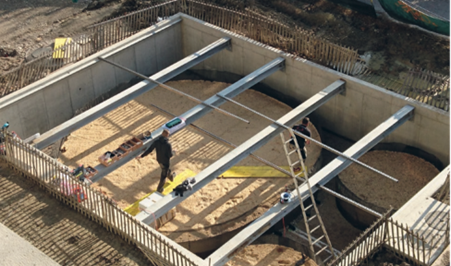
Vermifiltration is a non-sewered, nature-based sanitation technology that harnesses the symbiotic relationship between earthworms and microorganisms to treat wastewater in aerobic conditions. Earthworms break down solids, aerate the compost via tunnelling, and exctrete their own gut microorganisms and enzymes which enhance the overall treatment process. Earthworms and microorganisms biologically transform and degrade organic matter, nutrients, and emerging contaminants of concern found in wastewater. With low installation and maintenance costs, no sludge production and low to null energy needs, vermifiltration has potential to be an economical viable global solution for wastewater management.
Despite full-scale implementations in China, France, India, Rwanda, and the USA, processes in vermifiltration are not clearly defined, and there are many research gaps remaining for reliable and optimized models of treatment performance.
Goal
The objectives of this four-year research project are to gain an understanding of operating parameters on treatment mechanisms and performance, longer-term treatment performance, and the validity of scaling-up laboratory results. To accomplish this, full-scale vermifiltration installations are being monitored, and in parallel laboratory-scale installations are used in controlled studies to gain an understanding of the effect of operational parameters, such as wastewater type and loading rates, on treatment performance. The role of microbial communities in these processes is being evaluated, together with the impact on greenhouse gas emissions. The laboratory- and full-scale results will then be compared to evaluate the effects of scaling-up and long-term performance.
Collaborators
University of Geneva (UniGe), Geneva Switzerland: Prof. Serge Stoll, Prof. John Pote and Prof Laurent Matthey
aneco, Geneva Switzerland
Housing cooperative Equilibre, Geneva Switzerland
Geneva’s Cantonal Water Department (OCEau)
Current funding
Institute for Environmental Sciences, Department F.-A. Forel
Swiss Federal Institute of Aquatic Science and Technology, Eawag
array(2 items)0 => Snowflake\Publications\Domain\Model\Publicationprototypepersistent entity (uid=34994, pid=124)originalId => protected34994 (integer)
authors => protected'Coppens, K.; Strande, L.; Stoll, S.' (50 chars)
title => protected'Performance analysis and impact of operating conditions on the treatment cap acity of two full-scale vermifilters' (112 chars)
journal => protected'Journal of Environmental Management' (35 chars)
year => protected2025 (integer)
volume => protected391 (integer)
issue => protected'' (0 chars)
startpage => protected'126328 (11 pp.)' (15 chars)
otherpage => protected'' (0 chars)
categories => protected'full-scale vermifiltration; nature-based solution; domestic wastewater manag ement; seasonal impacts; optimal design for nitrogen removal; post-treatment requirements' (165 chars)
description => protected'Due to low investment and operational costs, chemical and energy independenc e, and a high potential to contribute to circular wastewater management prac tices, vermifiltration is a globally relevant wastewater treatment solution. Despite its potential, insufficient knowledge of the full-scale performance and the absence of guidelines for optimal design and operation impede vermi filtration from being widely implemented. This study analyzed the performanc e of two full-scale vermifilters treating domestic blackwater and greywater sediments in winter and summer in Switzerland. For the first time, the opera ting conditions of both vermifilters were determined empirically, where the blackwater vermifilter observed 4 times lower hydraulic loading rates, thoug h 10 times larger nitrogen loading rates than the greywater sediments vermif ilter. Both vermifilters demonstrated the ability to maintain high removal e fficiencies for organics and solids (>75 % for BOD<sub>5</sub>, COD, and TSS), though nutrient removal was lacking (<30 % for TN and TP). The desi gn and operation used in the full-scale vermifilters are, in general, recomm endable, as no clogging was observed, and the performance of the vermifilter s did not vary with season. In addition, with post-treatment, the effluent c omplied with discharge standards 100 % of the time. Insights into optimal de sign and operation include separate urine treatment, increased vermifilter d epth, and alternative and intermittent feeding regimes. Such modifications w ould likely decrease the post-treatment requirements, spatial footprint, and investment costs. Overall, the results of this study conclude that when emp loying favorable design and operation conditions, vermifiltration is a relev ant, reliable, and resilient wastewater treatment solution for both urban an d rural areas worldwide.' (1848 chars)
serialnumber => protected'0301-4797' (9 chars)
doi => protected'10.1016/j.jenvman.2025.126328' (29 chars)
uid => protected34994 (integer)
_localizedUid => protected34994 (integer)modified_languageUid => protectedNULL
_versionedUid => protected34994 (integer)modifiedpid => protected124 (integer)1 => Snowflake\Publications\Domain\Model\Publicationprototypepersistent entity (uid=35076, pid=124)originalId => protected35076 (integer)
authors => protected'Coppens, K.; Geyer, T.; Monod, A.; Strande, L.; Stoll,&n bsp;S.' (82 chars)
title => protected'Evaluation of vermifilter-treated domestic wastewater for irrigation and fer tigation: opportunities and challenges for implementation' (133 chars)
journal => protected'Journal of Water Process Engineering' (36 chars)
year => protected2025 (integer)
volume => protected77 (integer)
issue => protected'' (0 chars)
startpage => protected'108295 (11 pp.)' (15 chars)
otherpage => protected'' (0 chars)
categories => protected'nature-based solutions; organic micropollutants; metallic trace elements; mi croplastics; wastewater reclamation' (111 chars)
description => protected'Water reclamation can help meet agricultural irrigation and nutrient demands . Due to high nutrient loads, vermifiltration is often considered a suitable treatment solution for reclamation in agriculture. However, the ability of vermifiltration to meet irrigation standards is understudied. This study exp lores the feasibility of reclamation through irrigation and fertigation from two full-scale vermifilters treating black- and sedimented greywater in par allel and evaluates the removal efficiencies of metallic trace elements (MTE s), E. coli, and 15 organic micropollutants (OMPs). Microplastics in the eff luent were also quantified. The results show that, for reclamation in agricu lture, post-treatment of the vermifilter effluent is necessary to ensure rel iable and sufficient effluent quality. Despite an overall log removal of 3.6 7, E. coli is the most restrictive parameter, conforming to irrigation stand ards only after the second post-treatment step. Various constraints, due to high nitrate concentrations and salinity, would also be necessary to avoid n egative environmental and agronomic impacts. For fertigation, careful planni ng is needed to overcome excessive and variable nitrogen loads. Despite low and variable MTE removal, the effluent quality meets irrigation standards. A verage removal of OMPs is 91 ± 15 %, and the coefficient of variation is &l t;10 % for two-thirds of the OMPs. Suggested optimizations to improve the us ability in agriculture include adding a disinfection step and urine separati on. Future studies should focus on the impacts of vermifilter reclamation in agriculture on soil and crops, as well as the potential for designations su ch as toilet flushing and street cleaning, which are likely more advantageou s in urban settings.' (1768 chars)
serialnumber => protected'2214-7144' (9 chars)
doi => protected'10.1016/j.jwpe.2025.108295' (26 chars)
uid => protected35076 (integer)
_localizedUid => protected35076 (integer)modified_languageUid => protectedNULL
_versionedUid => protected35076 (integer)modifiedpid => protected124 (integer)
Performance analysis and impact of operating conditions on the treatment capacity of two full-scale vermifilters
Due to low investment and operational costs, chemical and energy independence, and a high potential to contribute to circular wastewater management practices, vermifiltration is a globally relevant wastewater treatment solution. Despite its potential, insufficient knowledge of the full-scale performance and the absence of guidelines for optimal design and operation impede vermifiltration from being widely implemented. This study analyzed the performance of two full-scale vermifilters treating domestic blackwater and greywater sediments in winter and summer in Switzerland. For the first time, the operating conditions of both vermifilters were determined empirically, where the blackwater vermifilter observed 4 times lower hydraulic loading rates, though 10 times larger nitrogen loading rates than the greywater sediments vermifilter. Both vermifilters demonstrated the ability to maintain high removal efficiencies for organics and solids (>75 % for BOD5, COD, and TSS), though nutrient removal was lacking (<30 % for TN and TP). The design and operation used in the full-scale vermifilters are, in general, recommendable, as no clogging was observed, and the performance of the vermifilters did not vary with season. In addition, with post-treatment, the effluent complied with discharge standards 100 % of the time. Insights into optimal design and operation include separate urine treatment, increased vermifilter depth, and alternative and intermittent feeding regimes. Such modifications would likely decrease the post-treatment requirements, spatial footprint, and investment costs. Overall, the results of this study conclude that when employing favorable design and operation conditions, vermifiltration is a relevant, reliable, and resilient wastewater treatment solution for both urban and rural areas worldwide.
Coppens, K.; Strande, L.; Stoll, S. (2025) Performance analysis and impact of operating conditions on the treatment capacity of two full-scale vermifilters, Journal of Environmental Management, 391, 126328 (11 pp.), doi:10.1016/j.jenvman.2025.126328, Institutional Repository
Evaluation of vermifilter-treated domestic wastewater for irrigation and fertigation: opportunities and challenges for implementation
Water reclamation can help meet agricultural irrigation and nutrient demands. Due to high nutrient loads, vermifiltration is often considered a suitable treatment solution for reclamation in agriculture. However, the ability of vermifiltration to meet irrigation standards is understudied. This study explores the feasibility of reclamation through irrigation and fertigation from two full-scale vermifilters treating black- and sedimented greywater in parallel and evaluates the removal efficiencies of metallic trace elements (MTEs), E. coli, and 15 organic micropollutants (OMPs). Microplastics in the effluent were also quantified. The results show that, for reclamation in agriculture, post-treatment of the vermifilter effluent is necessary to ensure reliable and sufficient effluent quality. Despite an overall log removal of 3.67, E. coli is the most restrictive parameter, conforming to irrigation standards only after the second post-treatment step. Various constraints, due to high nitrate concentrations and salinity, would also be necessary to avoid negative environmental and agronomic impacts. For fertigation, careful planning is needed to overcome excessive and variable nitrogen loads. Despite low and variable MTE removal, the effluent quality meets irrigation standards. Average removal of OMPs is 91 ± 15 %, and the coefficient of variation is <10 % for two-thirds of the OMPs. Suggested optimizations to improve the usability in agriculture include adding a disinfection step and urine separation. Future studies should focus on the impacts of vermifilter reclamation in agriculture on soil and crops, as well as the potential for designations such as toilet flushing and street cleaning, which are likely more advantageous in urban settings.
Coppens, K.; Geyer, T.; Monod, A.; Strande, L.; Stoll, S. (2025) Evaluation of vermifilter-treated domestic wastewater for irrigation and fertigation: opportunities and challenges for implementation, Journal of Water Process Engineering, 77, 108295 (11 pp.), doi:10.1016/j.jwpe.2025.108295, Institutional Repository
Coppens, K., Strande, L., & Stoll, S. (2026). Des lombrics en ville. Aqua & Gas, 2, 2-7
Coppens, K., & Strande, L. (2025). Optimal Vermifilter Design: Insights From Three Full-scale Installations. Sandec News, 26, 22.
Coppens, K., Stoll, S., & Strande, L. (2024). Nitrogen Removal in a Vermifilter Treating Urban Domestic Wastewater. Sandec News, 25, 26-27