Department Sanitation, Water and Solid Waste for Development

Waste Flow Diagram – Plastic leakage into the environment
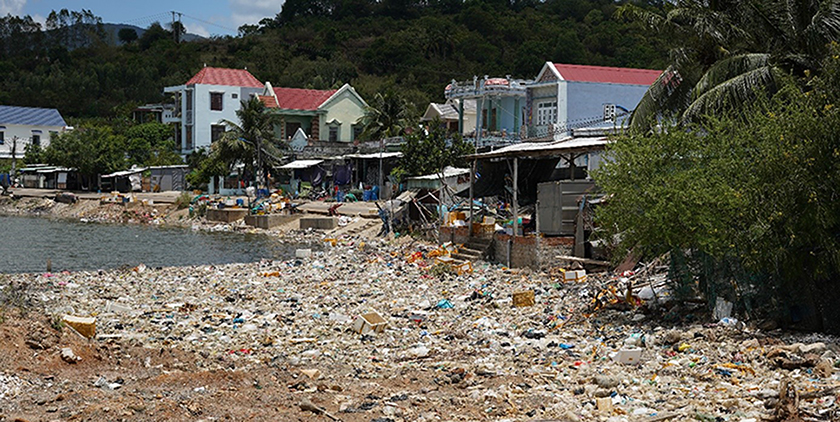
Mismanaged waste leads to plastic leakage into rivers, lakes, and oceans. This is a global and growing problem leading to significant environmental harm, emerging risks to human health, and economic burdens. To tackle the issue, a first step is to understand why these plastics leak into the environment and what their fates in the environment are.

In collaboration with GIZ, the University of Leeds and Wasteaware, Eawag developed the Waste Flow Diagram (WFD). This is a rapid, observation-based assessment tool that maps how municipal solid waste moves through a city and identifies where plastics leak into the environment. Using a Material Flow Analysis (MFA) approach, it visualises waste flows from generation to collection, transport, treatment and disposal, while pinpointing leakage sources and their fate in the environment.

The WFD is especially valuable in cities—particularly in low- and middle-income contexts—to strengthen waste management systems and monitor progress toward SDG 11.6.1. It produces clear numerical estimates (e.g., tonnes per year) and visual diagrams that help authorities and organisations prioritise interventions, compare scenarios, and design actions to reduce pollution and plastic leakage.

Through the AWARE project, in collaboration with Phenikaa University, Hanoi, Vietnam, we rigorously applied the WFD to Tuy Hoa City and explored methodologies to also use the tool regionally, at Phu Yen province level.

Furthermore, we developed training materials for practitioners on how to apply the WFD in their contexts. Training videos can be used alongside the WFD user manual which is also available online.


Further resources:

Latest WFD developments on the online platform

Training videos and user manual

Publications

Tosi Robinson, D.; Zurbrügg, C.; Nguyen, T. H. T. (2025). Applying the Waste Flow Diagram Regionally. Technical Brief. Eawag-Sandec


Extbase Variable Dump
array(2 items)
   publications => '34683,33080' (11 chars)
   libraryUrl => '' (0 chars)
Extbase Variable Dump
array(2 items)
   0 => Snowflake\Publications\Domain\Model\Publicationprototypepersistent entity (uid=34683, pid=124)
      originalId => protected34683 (integer)
      authors => protected'Tosi Robinson, D.; Le, T. T.; Ngo, H. T. T.; H
         oang, T. H. T.; Zurbrügg, C.; Nguyen, T. H.&n
         bsp;T.
' (158 chars) title => protected'Regional land-based plastic leakage into the aquatic environment – Waste F
         low Diagram applied to the Phu Yen province, Vietnam
' (128 chars) journal => protected'Marine Pollution Bulletin' (25 chars) year => protected2025 (integer) volume => protected217 (integer) issue => protected'' (0 chars) startpage => protected'118058 (10 pp.)' (15 chars) otherpage => protected'' (0 chars) categories => protected'macroplastic; solid waste management; regional waste flow diagram' (65 chars) description => protected'Land-based plastic waste is the primary source of ocean plastic pollution, b
         ut data regarding its origins and pathways remain limited. This study adapte
         d the Waste Flow Diagram (WFD) tool, initially developed for city-level plas
         tic leakage assessment, for regional application in Phu Yen province, Vietna
         m. This adaptation aims to capture plastic leakage dynamics across a broader
          spatial scale to account for all significant sources contributing to ocean
         plastic pollution. The results show that, excluding Tuy Hoa City, Phu Yen co
         ntributes 9.4 kg per capita per year to aquatic environments. Most leakage (
         88.6 %) originated from uncollected waste in areas lacking collection servic
         es. Additional leakage arises from waste collection and transport (7.9 %), d
         isposal sites (2.8 %), and informal activities (0.6 %). Leakage varies widel
         y across districts, ranging from 1 to 55.7 kg/cap/year. The findings offer v
         aluable insights for targeted interventions and policies aimed to enhance wa
         ste collection coverage and mitigate regional marine plastic pollution.
' (1059 chars) serialnumber => protected'0025-326X' (9 chars) doi => protected'10.1016/j.marpolbul.2025.118058' (31 chars) uid => protected34683 (integer) _localizedUid => protected34683 (integer)modified _languageUid => protectedNULL _versionedUid => protected34683 (integer)modified pid => protected124 (integer)
1 => Snowflake\Publications\Domain\Model\Publicationprototypepersistent entity (uid=33080, pid=124) originalId => protected33080 (integer) authors => protected'Tosi Robinson, D.; Thao Vu, P.; Le, T. T.; Thi Hoang,&nb
         sp;T. H.; Viet Ly, Q.; Thi Thuy Ngo, H.; Zurbrügg, C.;
         Hanh Tien Nguyen, T.
' (177 chars) title => protected'Land-based plastic leakage into the aquatic environment from municipal solid
          waste – Waste flow diagram applied to Tuy Hoa City, Phu Yen, Vietnam
' (147 chars) journal => protected'Waste Management' (16 chars) year => protected2024 (integer) volume => protected186 (integer) issue => protected'' (0 chars) startpage => protected'226' (3 chars) otherpage => protected'235' (3 chars) categories => protected'macro-plastic; plastic litter; leakage; solid waste management; waste flow d
         iagram
' (82 chars) description => protected'Plastic mismanagement and its subsequent pollution by rapid economic develop
         ment and urbanisation pose significant challenges for modern world society.
         Notwithstanding one of the main sources for macro plastic leakage into the o
         cean from land, precise assessment of plastic pollution origins from Southea
         st Asia is yet to be clearly examined. In order to make informed decisions a
         nd prioritise areas of improvement it is required to better understand the w
         aste leakage dynamics at the local level. In this work, the Waste Flow Diagr
         am (WFD) was applied to understand the sources and fates of plastics leaking
          from the solid waste management system for the case of Tuy Hoa City, Phu Ye
         n, Vietnam. The study shows scenarios of leakage into the aquatic environmen
         t ranging from 0.8 to 2.7 kg/cap/year, which originates mainly from the coll
         ection system. Targeted improvements to this stage of the service could redu
         ce leakages and the overall environmental impacts of mismanaged plastic wast
         e. The results of this study show the necessity and importance of having up
         to date and reliable data to better inform stakeholders and service planning
         , facilitating efficient action against plastic pollution. As the first peer
         -reviewed scientific article critically applying the WFD, this work highligh
         ts the steps and challenges of the methodology and critically analyses diffe
         rent methodological pathways.
' (1397 chars) serialnumber => protected'0956-053X' (9 chars) doi => protected'10.1016/j.wasman.2024.06.014' (28 chars) uid => protected33080 (integer) _localizedUid => protected33080 (integer)modified _languageUid => protectedNULL _versionedUid => protected33080 (integer)modified pid => protected124 (integer)
Tosi Robinson, D.; Le, T. T.; Ngo, H. T. T.; Hoang, T. H. T.; Zurbrügg, C.; Nguyen, T. H. T. (2025) Regional land-based plastic leakage into the aquatic environment – Waste Flow Diagram applied to the Phu Yen province, Vietnam, Marine Pollution Bulletin, 217, 118058 (10 pp.), doi:10.1016/j.marpolbul.2025.118058, Institutional Repository
Tosi Robinson, D.; Thao Vu, P.; Le, T. T.; Thi Hoang, T. H.; Viet Ly, Q.; Thi Thuy Ngo, H.; Zurbrügg, C.; Hanh Tien Nguyen, T. (2024) Land-based plastic leakage into the aquatic environment from municipal solid waste – Waste flow diagram applied to Tuy Hoa City, Phu Yen, Vietnam, Waste Management, 186, 226-235, doi:10.1016/j.wasman.2024.06.014, Institutional Repository