
Department Systems Analysis, Integrated Assessment and Modelling
Development of Surface Water Assessment Procedures
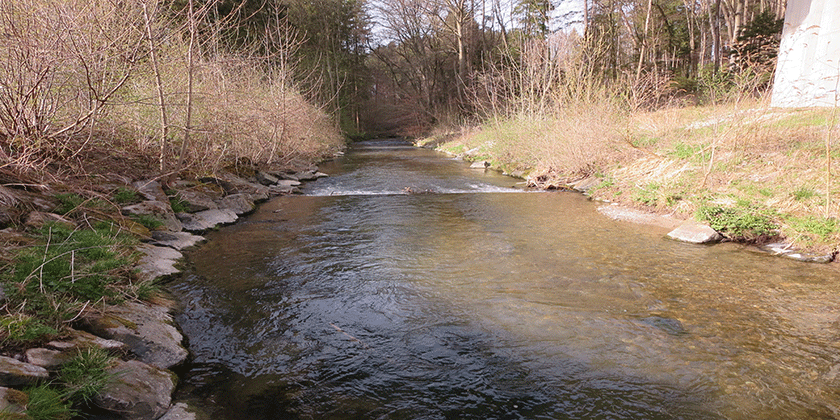
Under the lead of the VSA platform water quality and in collaboration with the Federal Office of the Environment (FOEN), experts from cantonal authorities and consulting companies and other Eawag collaborators, we contribute to the development and improvement of ecological river and lake assessment procedures and their application in surface water management.
Current focus is on the development of assessment procedures for the water quality regarding micropollutants based on chemical analysis and diatoms and a revision of the assessment method for fishes in running waters.
Extbase Variable Dump
array(2 items)
   publications => '21306,19699,19693,17581,19568,14213,9167,7661,7276,7249,10780,6702,6688' (71 chars)
   libraryUrl => '' (0 chars)
Extbase Variable Dump
array(13 items) 0 => Snowflake\Publications\Domain\Model\Publicationprototypepersistent entity (uid=21306, pid=124) originalId => protected21306 (integer) authors => protected'Schuwirth, N.' (18 chars) title => protected'Towards an integrated surface water quality assessment: aggregation over mul
tiple pollutants and time' (101 chars) journal => protected'Water Research' (14 chars) year => protected2020 (integer) volume => protected186 (integer) issue => protected'' (0 chars) startpage => protected'116330 (11 pp.)' (15 chars) otherpage => protected'' (0 chars) categories => protected'uncertainty; surface water quality; integrated assessment; multi-criteria de
cision analysis; river basin management; micropollutants; visualization' (147 chars) description => protected'Surface water quality management requires foresighted decision making regard
ing long-term investments. It should consider multiple objectives (e.g. rela
ted to different pollutants and costs), integrate multiple sources of pollut
ion (point and diffuse sources), and external conditions that change over ti
me (climate, population and land-use changes). Multi-attribute value theory
can support such decisions, especially the development of an assessment meth
od. Integrated surface water quality assessment methods including micropollu
tants are currently lacking or in development in many countries. Important s
teps for the development of such an immission oriented and integrated surfac
e water quality assessment method are discussed in this paper and exemplifie
d for organic micropollutants. The proposed assessment method goes beyond si
mple pass-fail criteria for single substances. It provides a continuous asse
ssment on a scale from zero to one based on five color-coded water quality c
lasses and suggestions for the visualization of assessment results. It takes
into account the toxicity of the micropollutants and their mixture to aquat
ic organisms by comparing measured concentrations to environmental quality s
tandards (EQS). The focus of this paper is on aggregation over multiple subs
tances and time. Advantages and disadvantages of different aggregation metho
ds are discussed as well as their implications for practice. The consequence
s of different aggregation methods are illustrated with didactical examples
and by an application of the proposed water quality assessment method to pes
ticide monitoring data from Switzerland. Recommendations are provided that a
ccount for the purpose of the assessment. Furthermore, the paper illustrates
how the proposed method can facilitate dealing with uncertainty and a trans
parent communication of monitoring results to support water quality manageme
nt decisions.' (1913 chars) serialnumber => protected'0043-1354' (9 chars) doi => protected'10.1016/j.watres.2020.116330' (28 chars) uid => protected21306 (integer) _localizedUid => protected21306 (integer)modified _languageUid => protectedNULL _versionedUid => protected21306 (integer)modified pid => protected124 (integer) 1 => Snowflake\Publications\Domain\Model\Publicationprototypepersistent entity (uid=19699, pid=124) originalId => protected19699 (integer) authors => protected'Küry, D.; Stucki, P.; Martinez, N.; Roth, T.; Schuwirth
, N.; Michel, C.; Schindler Wildhaber, Y.' (132 chars) title => protected'Vom IBCH zum IBCH_2019. Methoden-Update des Moduls "Makrozoobenthos Stufe F"
im Modul-Stufen-Konzept' (100 chars) journal => protected'Aqua & Gas' (10 chars) year => protected2019 (integer) volume => protected99 (integer) issue => protected'12' (2 chars) startpage => protected'47' (2 chars) otherpage => protected'54' (2 chars) categories => protected'' (0 chars) description => protected'Der Schweizer Makrozoobenthos-Index IBCH geniesst für die Zustandsbewertung
von Fliessgewässern bei den Kantonen eine hohe Akzeptanz. In den letzten z
ehn Jahren zeigte sich aber, dass nicht nur anthropogene Faktoren die Bewert
ung beeinflussen, sondern auch natürliche wie die Höhenlage oder die bioge
ografische Region. Basierend auf einer Analyse der bisherigen Ergebnisse wur
de der IBCH_2019 entwickelt, der diese Mängel korrigiert und eine plausible
re Bewertung der Gewässer erlaubt.' (491 chars) serialnumber => protected'2235-5197' (9 chars) doi => protected'' (0 chars) uid => protected19699 (integer) _localizedUid => protected19699 (integer)modified _languageUid => protectedNULL _versionedUid => protected19699 (integer)modified pid => protected124 (integer) 2 => Snowflake\Publications\Domain\Model\Publicationprototypepersistent entity (uid=19693, pid=124) originalId => protected19693 (integer) authors => protected'Schuwirth, N.; Caradima, B.; Schindler Wildhaber, Y.; Sarbach
-Remund, N.' (92 chars) title => protected'Analyse schweizweiter Makrozoobenthosdaten. Erkenntnisse über anthropogene
Einflüsse und Monitoring-Design' (108 chars) journal => protected'Aqua & Gas' (10 chars) year => protected2019 (integer) volume => protected99 (integer) issue => protected'12' (2 chars) startpage => protected'55' (2 chars) otherpage => protected'61' (2 chars) categories => protected'' (0 chars) description => protected'Mit einem statistischen Modell wurden schweizweite Monitoringdaten über die
Zusammensetzung von Makrozoobenthosgemeinschaften in Schweizer Fliessgewäs
sern ausgewertet. Temperatur, Landwirtschaft und Hydromorphologie wurden dab
ei als wichtige Einflussfaktoren im Modell identifiziert. Arten aus der glei
chen Familie reagieren in vielen Fällen unterschiedlich auf natürliche und
menschliche Umwelteinflüsse. Neben der taxonomischen Auflösung wirkt sich
auch die Stellenauswahl auf die Aussagekraft der Resultate aus.' (520 chars) serialnumber => protected'2235-5197' (9 chars) doi => protected'' (0 chars) uid => protected19693 (integer) _localizedUid => protected19693 (integer)modified _languageUid => protectedNULL _versionedUid => protected19693 (integer)modified pid => protected124 (integer) 3 => Snowflake\Publications\Domain\Model\Publicationprototypepersistent entity (uid=17581, pid=124) originalId => protected17581 (integer) authors => protected'Kuemmerlen, M.; Reichert, P.; Siber, R.; Schuwirth, N.' (74 chars) title => protected'Ecological assessment of river networks: from reach to catchment scale' (70 chars) journal => protected'Science of the Total Environment' (32 chars) year => protected2019 (integer) volume => protected650 (integer) issue => protected'' (0 chars) startpage => protected'1613' (4 chars) otherpage => protected'1627' (4 chars) categories => protected'ecological state assessment; morphology; nutrients; micropollutants; restora
tion strategy; environmental management' (115 chars) description => protected'Freshwater ecosystems are increasingly under threat as they are confronted w
ith multiple anthropogenic impairments. This calls for comprehensive managem
ent strategies to counteract, or even prevent, long-term impacts on habitats
and their biodiversity, as well as on their ecological functions and servic
es. The basis for the efficient management and effective conservation of any
ecosystem is sufficient knowledge on the state of the system and its respon
se to external influence factors. In freshwater ecosystems, state informatio
n is currently drawn from ecological assessments at the reach or site scale.
While these assessments are essential, they are not sufficient to assess th
e expected outcome of different river restoration strategies, because they d
o not account for important characteristics of the whole river network, such
as habitat connectivity or headwater reachability. This is of particular im
portance for the spatial prioritization of restoration measures. River resto
ration could be supported best by integrative catchment-scale ecological ass
essments that are sensitive to the spatial arrangement of river reaches and
barriers. Assessments at this scale are of increasing interest to environmen
tal managers and conservation practitioners to prioritize restoration measur
es or to locate areas worth protecting. We present an approach based on deci
sion support methods that integrates abiotic and biotic ecological assessmen
ts at the reach-scale and aggregates them spatially to describe the ecologic
al state of entire catchments. This aggregation is based on spatial criteria
that represent important ecological catchment properties, such as fish migr
ation potential, resilience, fragmentation and habitat diversity in a spatia
lly explicit way.We identify the most promising assessment criteria from dif
ferent alternatives based on theoretical considerations and a comparison wit
h biological indicators. Potential applications are discussed, particularly
for supporting the strat...' (2076 chars) serialnumber => protected'0048-9697' (9 chars) doi => protected'10.1016/j.scitotenv.2018.09.019' (31 chars) uid => protected17581 (integer) _localizedUid => protected17581 (integer)modified _languageUid => protectedNULL _versionedUid => protected17581 (integer)modified pid => protected124 (integer) 4 => Snowflake\Publications\Domain\Model\Publicationprototypepersistent entity (uid=19568, pid=124) originalId => protected19568 (integer) authors => protected'Reichert, P.; Niederberger, K.; Rey, P.; Helg, U.; Haert
el-Borer, S.' (93 chars) title => protected'The need for unconventional value aggregation techniques: experiences from e
liciting stakeholder preferences in environmental management' (136 chars) journal => protected'EURO Journal on Decision Processes' (34 chars) year => protected2019 (integer) volume => protected7 (integer) issue => protected'3-4' (3 chars) startpage => protected'197' (3 chars) otherpage => protected'219' (3 chars) categories => protected'environmental decision support; stakeholder involvement; elicitation; value
function; objectives hierarchy; non-additive aggregation' (132 chars) description => protected'Despite the large literature about non-additive value aggregation techniques
, in the large majority of applied decision support processes, additive valu
e aggregation functions are used. The main reasons for this may be the simpl
icity of the approach, minimum elicitation requirements, software availabili
ty, and the appeal of the underlying preference independence concepts that m
ay be strengthened by an adequate choice of sub-objectives and attributes. H
owever, in an applied decision support process, the decision maker(s) or the
stakeholders decide on the sub-objectives and attributes to characterize th
e state of a system and they have to provide information that allows the dec
ision analyst to express their preferences as a value function of these attr
ibutes. It is the task of the decision analyst to find the parameterization
and parameter values of a value function that fits best the expressed prefer
ences. We describe a value function elicitation process for the ideal morpho
logical state of a lake shore, performed with stakeholders from federal and
cantonal authorities and from environmental consulting companies in Switzerl
and. This process led to the elicitation of strongly non-additive and partly
even non-concave value aggregation functions. The objective of this paper i
s to raise the awareness about the importance of carefully testing the assum
ptions underlying parameterized (often additive) value aggregation technique
s during the preferences elicitation process and to be flexible regarding ev
aluating value functions that deviate from the often used additive aggregati
on scheme. This can lead to a higher confidence that additive aggregation is
suitable for the specific decision problem or to the selection of alternati
ve aggregation techniques that better represent the decision maker’s prefe
rences in case additivity is violated.' (1862 chars) serialnumber => protected'2193-9438' (9 chars) doi => protected'10.1007/s40070-019-00101-9' (26 chars) uid => protected19568 (integer) _localizedUid => protected19568 (integer)modified _languageUid => protectedNULL _versionedUid => protected19568 (integer)modified pid => protected124 (integer) 5 => Snowflake\Publications\Domain\Model\Publicationprototypepersistent entity (uid=14213, pid=124) originalId => protected14213 (integer) authors => protected'Michel, C.; Schindler Wildhaber, Y.; Leib, V.; Remund, N
.; Schuwirth, N.' (97 chars) title => protected'Überarbeitung des Makrozoobenthos-Index. Natürliche Einflussfaktoren, Ursa
che-Wirkungsanalyse und Diskussion des Spear-Index' (126 chars) journal => protected'Aqua & Gas' (10 chars) year => protected2017 (integer) volume => protected97 (integer) issue => protected'4' (1 chars) startpage => protected'70' (2 chars) otherpage => protected'77' (2 chars) categories => protected'' (0 chars) description => protected'Die Makrozoobenthos-Erhebungsmethode des Modul-Stufen-Konzepts (MSK) wird br
eit angewandt. Wie eine Umfrage zeigt, entspricht sie überwiegend den Erwar
tungen der Anwender und Anwenderinnen. Um die Verlässlichkeit zu steigern,
llen auf Schweizer Daten getestet und die Ergebnisse publiziert werden.' (451 chars) serialnumber => protected'2235-5197' (9 chars) doi => protected'' (0 chars) uid => protected14213 (integer) _localizedUid => protected14213 (integer)modified _languageUid => protectedNULL _versionedUid => protected14213 (integer)modified pid => protected124 (integer) 6 => Snowflake\Publications\Domain\Model\Publicationprototypepersistent entity (uid=9167, pid=124) originalId => protected9167 (integer) authors => protected'Reichert, P.; Langhans, S. D.; Lienert, J.; Schuwirth,&n
bsp;N.' (82 chars) title => protected'The conceptual foundation of environmental decision support' (59 chars) journal => protected'Journal of Environmental Management' (35 chars) year => protected2015 (integer) volume => protected154 (integer) issue => protected'' (0 chars) startpage => protected'316' (3 chars) otherpage => protected'332' (3 chars) categories => protected'multi-criteria decision analysis; environmental management; societal decisio
n support; stakeholder involvement; intersubjective probabilities; multi-att
ribute value theory; multi-attribute utility theory; uncertainty; river mana
gement' (234 chars) description => protected'Environmental decision support intends to use the best available scientific
knowledge to help decision makers find and evaluate management alternatives.
The goal of this process is to achieve the best fulfillment of societal obj
ectives. This requires a careful analysis of (i) how scientific knowledge ca
n be represented and quantified, (ii) how societal preferences can be descri
bed and elicited, and (iii) how these concepts can best be used to support c
ommunication with authorities, politicians, and the public in environmental
management. The goal of this paper is to discuss key requirements for a conc
eptual framework to address these issues and to suggest how these can best b
e met. We argue that a combination of probability theory and scenario planni
ng with multi-attribute utility theory fulfills these requirements, and disc
uss adaptations and extensions of these theories to improve their applicatio
n for supporting environmental decision making. With respect to (i) we sugge
st the use of intersubjective probabilities, if required extended to impreci
se probabilities, to describe the current state of scientific knowledge. To
address (ii), we emphasize the importance of value functions, in addition to
utilities, to support decisions under risk. We discuss the need for testing
"non-standard" value aggregation techniques, the usefulness of flexibility
of value functions regarding attribute data availability, the elicitation of
value functions for sub-objectives from experts, and the consideration of u
ncertainty in value and utility elicitation. With respect to (iii), we outli
ne a well-structured procedure for transparent environmental decision suppor
t that is based on a clear separation of scientific prediction and societal
valuation. We illustrate aspects of the suggested methodology by its applica
tion to river management in general and with a small, didactical case study
on spatial river rehabilitation prioritization.' (1947 chars) serialnumber => protected'0301-4797' (9 chars) doi => protected'10.1016/j.jenvman.2015.01.053' (29 chars) uid => protected9167 (integer) _localizedUid => protected9167 (integer)modified _languageUid => protectedNULL _versionedUid => protected9167 (integer)modified pid => protected124 (integer) 7 => Snowflake\Publications\Domain\Model\Publicationprototypepersistent entity (uid=7661, pid=124) originalId => protected7661 (integer) authors => protected'Langhans, S. D.; Reichert, P.; Schuwirth, N.' (64 chars) title => protected'The method matters: a guide for indicator aggregation in ecological assessme
nts' (79 chars) journal => protected'Ecological Indicators' (21 chars) year => protected2014 (integer) volume => protected45 (integer) issue => protected'' (0 chars) startpage => protected'494' (3 chars) otherpage => protected'507' (3 chars) categories => protected'Water Framework Directive; aggregation; multi-criteria decision analysis; mu
lti-attribute value theory; one-out all-out; river assessment' (137 chars) description => protected'Ecological assessment requires the integration of many physical, chemical, a
nd/or biological quality elements. The choice of the aggregation method of s
uch partial assessments into an overall assessment can considerably affect t
he assessment outcome – an issue that has been controversially discussed w
ithin the scientific community for the last decade. Current practice often c
onsiders only two different aggregation methods, the weighted arithmetic mea
n (additive aggregation) and the one-out, all-out method (minimum aggregatio
n). However, both have important drawbacks. Additive aggregation compensates
a bad status of one quality element by a number of elements featuring good
status. Minimum aggregation can lead to overly pessimistic assessment result
s, since only the quality element in the worst status is considered. Here, w
e introduce a toolbox containing current and new aggregation methods, demons
trate and discuss their properties with simple, didactical examples, and sug
gest in which situations best to use them. Then, we illustrate the consequen
ces of selected aggregation schemes for ecological river assessment with the
case study of the Swiss Modular Concept of stream assessment (SMC), which w
e apply to ten river reaches in the Mönchaltdorfer Aa catchment in Switzerl
and. To be able to do so, we used multi-criteria decision analysis, i.e., mu
lti-attribute value theory, to arrange the SMC quality elements into an obje
ctives hierarchy, and to translate their individual assessments into value f
unctions. Our case study revealed that choosing the most appropriate aggrega
tion method particularly matters, if objectives with significantly different
qualities are aggregated. We argue that redundant objectives (i.e., quality
elements), often found at the lower levels of the objectives hierarchy, sho
uld best be aggregated additively allowing for compensation to increase the
statistical significance of the results. Further, we suggest that complement
ary sub-objectives that ...' (2427 chars) serialnumber => protected'1470-160X' (9 chars) doi => protected'10.1016/j.ecolind.2014.05.014' (29 chars) uid => protected7661 (integer) _localizedUid => protected7661 (integer)modified _languageUid => protectedNULL _versionedUid => protected7661 (integer)modified pid => protected124 (integer) 8 => Snowflake\Publications\Domain\Model\Publicationprototypepersistent entity (uid=7276, pid=124) originalId => protected7276 (integer) authors => protected'Langhans, S. D.; Lienert, J.; Schuwirth, N.; Reichert,&n
bsp;P.' (82 chars) title => protected'How to make river assessments comparable: a demonstration for hydromorpholog
y' (77 chars) journal => protected'Ecological Indicators' (21 chars) year => protected2013 (integer) volume => protected32 (integer) issue => protected'' (0 chars) startpage => protected'264' (3 chars) otherpage => protected'275' (3 chars) categories => protected'ecological assessment; comparability; intercalibration; bioassessment; river
management; multi-criteria decision analysis' (121 chars) description => protected'River monitoring and assessment programs are important tools to quantify the
condition of river ecosystems, identify deficits, and provide preliminary i
ndication of how to improve them. But, they are limited in delivering compar
able assessment results across national or transnational borders, aggregatin
g site-specific assessments into broader scale assessments, and supporting r
iver management decisions. We present a multi-criteria decision analysis app
roach for improving the comparability of ecological assessment methods of di
fferent origin and for combining these assessments into a joint procedure. T
he approach consists of seven consecutive steps. The most central ones conce
rn the hierarchical allocation of ecological assessment endpoints, and the h
armonization of the scoring procedure of attributes (ecological indicators o
r assets) to a common scale from 0 to 1. We demonstrate the approach integra
ting three programs developed to assess the hydromorphological river conditi
on in Switzerland, Germany, and the USA. In our example, the integrated asse
ssment produces comparable results for the whole range from natural to impac
ted rivers, while data continuity with original assessments was maintained.
Our approach provides a common assessment standard due to the definition of
the minimum amount of information required, is flexible regarding measuremen
t and assessment endpoints, and bridges the gap between river quality assess
ment and management.' (1464 chars) serialnumber => protected'1470-160X' (9 chars) doi => protected'10.1016/j.ecolind.2013.03.027' (29 chars) uid => protected7276 (integer) _localizedUid => protected7276 (integer)modified _languageUid => protectedNULL _versionedUid => protected7276 (integer)modified pid => protected124 (integer) 9 => Snowflake\Publications\Domain\Model\Publicationprototypepersistent entity (uid=7249, pid=124) originalId => protected7249 (integer) authors => protected'Reichert, P.; Schuwirth, N.; Langhans, S.' (56 chars) title => protected'Constructing, evaluating and visualizing value and utility functions for dec
ision support' (89 chars) journal => protected'Environmental Modelling and Software' (36 chars) year => protected2013 (integer) volume => protected46 (integer) issue => protected'' (0 chars) startpage => protected'283' (3 chars) otherpage => protected'291' (3 chars) categories => protected'decision support; multi-criteria decision analysis; value functions; utility
functions; uncertainty; environmental management; ecological river assessme
nt; river management' (172 chars) description => protected'Formal methods of decision analysis can help to structure a decision making
process and to communicate reasons for decisions transparently. Objectives h
ierarchies and associated value and utility functions are useful instruments
for supporting such decision making processes by structuring and quantifyin
g the preferences of decision makers or stakeholders. Common multi-attribute
decision analysis software products support such decision making processes
but they can often not represent complex preference structures and visualize
uncertainty induced by uncertain predictions of the consequences of decisio
n alternatives. To stimulate strengthening these aspects in decision support
processes, we propose a set of visualization tools and provide a software p
ackage for constructing, evaluating and visualizing value and utility functi
ons. In these tools we emphasize flexibility in value aggregation schemes an
d consideration and communication of prediction uncertainty. The use of thes
e tools is demonstrated with an illustrative example of river management dec
ision support.' (1078 chars) serialnumber => protected'1364-8152' (9 chars) doi => protected'10.1016/j.envsoft.2013.01.017' (29 chars) uid => protected7249 (integer) _localizedUid => protected7249 (integer)modified _languageUid => protectedNULL _versionedUid => protected7249 (integer)modified pid => protected124 (integer) 10 => Snowflake\Publications\Domain\Model\Publicationprototypepersistent entity (uid=10780, pid=124) originalId => protected10780 (integer) authors => protected'Schlosser, J. A.; Haertel-Borer, S.; Liechti, P.; Reiche
rt, P.' (87 chars) title => protected'Konzept für die Untersuchung und Beurteilung der Seen in der Schweiz. <em>A
nleitung zur Entwicklung und Anwendung von Beurteilungsmethoden</em>' (144 chars) journal => protected'' (0 chars) year => protected2013 (integer) volume => protected0 (integer) issue => protected'' (0 chars) startpage => protected'38 p' (9 chars) otherpage => protected'' (0 chars) categories => protected'Lake assessment; concept; decision-making support; module development' (69 chars) description => protected'This publication describes the concept for the ecological assessment of the
condition of Switzerland's lakes. It is published as part of the FOEN «Envi
ronmental studies» series. The concept is an integral part of the modular s
tepwise procedure for studying and assessing surface bodies of water. It des
cribes the use of instruments supporting the decision-making process in the
development and application of modules for assessing the condition of lakes,
and provides an overview of the priorities in the area of module developmen
t.' (534 chars) serialnumber => protected'' (0 chars) doi => protected'' (0 chars) uid => protected10780 (integer) _localizedUid => protected10780 (integer)modified _languageUid => protectedNULL _versionedUid => protected10780 (integer)modified pid => protected124 (integer) 11 => Snowflake\Publications\Domain\Model\Publicationprototypepersistent entity (uid=6702, pid=124) originalId => protected6702 (integer) authors => protected'Langhans, S. D.; Reichert, P.' (44 chars) title => protected'Einbettung von Verfahren zur Fliessgewässerbewertung in ein übergeordnetes
Gewässermanagementkonzept. Vorschläge am Beispiel des Modulstufenkonzepts' (152 chars) journal => protected'Wasser, Energie, Luft' (21 chars) year => protected2011 (integer) volume => protected103 (integer) issue => protected'3' (1 chars) startpage => protected'204' (3 chars) otherpage => protected'214' (3 chars) categories => protected'' (0 chars) description => protected'' (0 chars) serialnumber => protected'0377-905X' (9 chars) doi => protected'' (0 chars) uid => protected6702 (integer) _localizedUid => protected6702 (integer)modified _languageUid => protectedNULL _versionedUid => protected6702 (integer)modified pid => protected124 (integer) 12 => Snowflake\Publications\Domain\Model\Publicationprototypepersistent entity (uid=6688, pid=124) originalId => protected6688 (integer) authors => protected'Reichert, P.; Schuwirth, N.; Langhans, S. D.' (64 chars) title => protected'MCWM – Ein Konzept für multikriterielle Entscheidungsunterstützung im Wa
ssermanagement' (90 chars) journal => protected'Wasser, Energie, Luft' (21 chars) year => protected2011 (integer) volume => protected103 (integer) issue => protected'2' (1 chars) startpage => protected'139' (3 chars) otherpage => protected'148' (3 chars) categories => protected'' (0 chars) description => protected'Das per 1.1.2011 in Kraft getretene revidierte Gewässerschutzgesetz bringt
den Kantonen in der Schweiz zusätzliche Verpflichtungen bezüglich der Revi
talisierung morphologisch beeinträchtigter Gewässer und der Verminderung n
egativer Auswirkungen von Wasserkraftanlagen auf Gewässerökosysteme. Da au
ch neue Finanzierungsquellen erschlossen werden, sind diese neuen oder verst
ärkten Verpflichtungen eine grosse Chance für die ökologische Aufwertung
der schweizerischen Gewässersysteme. Ähnliche Anforderungen an das Gewäss
ermanagement wurden auch im Ausland etabliert, etwa in der Europäischen Uni
on durch die Wasserrahmenrichtlinie (WFD, 2000). Das Ziel des Gewässermanag
' (815 chars) serialnumber => protected'0377-905X' (9 chars) doi => protected'' (0 chars) uid => protected6688 (integer) _localizedUid => protected6688 (integer)modified _languageUid => protectedNULL _versionedUid => protected6688 (integer)modified pid => protected124 (integer)
Towards an integrated surface water quality assessment: aggregation over multiple pollutants and time
Surface water quality management requires foresighted decision making regarding long-term investments. It should consider multiple objectives (e.g. related to different pollutants and costs), integrate multiple sources of pollution (point and diffuse sources), and external conditions that change over time (climate, population and land-use changes). Multi-attribute value theory can support such decisions, especially the development of an assessment method. Integrated surface water quality assessment methods including micropollutants are currently lacking or in development in many countries. Important steps for the development of such an immission oriented and integrated surface water quality assessment method are discussed in this paper and exemplified for organic micropollutants. The proposed assessment method goes beyond simple pass-fail criteria for single substances. It provides a continuous assessment on a scale from zero to one based on five color-coded water quality classes and suggestions for the visualization of assessment results. It takes into account the toxicity of the micropollutants and their mixture to aquatic organisms by comparing measured concentrations to environmental quality standards (EQS). The focus of this paper is on aggregation over multiple substances and time. Advantages and disadvantages of different aggregation methods are discussed as well as their implications for practice. The consequences of different aggregation methods are illustrated with didactical examples and by an application of the proposed water quality assessment method to pesticide monitoring data from Switzerland. Recommendations are provided that account for the purpose of the assessment. Furthermore, the paper illustrates how the proposed method can facilitate dealing with uncertainty and a transparent communication of monitoring results to support water quality management decisions.
Schuwirth, N. (2020) Towards an integrated surface water quality assessment: aggregation over multiple pollutants and time, Water Research, 186, 116330 (11 pp.), doi:10.1016/j.watres.2020.116330, Institutional Repository
Vom IBCH zum IBCH_2019. Methoden-Update des Moduls "Makrozoobenthos Stufe F" im Modul-Stufen-Konzept
Der Schweizer Makrozoobenthos-Index IBCH geniesst für die Zustandsbewertung von Fliessgewässern bei den Kantonen eine hohe Akzeptanz. In den letzten zehn Jahren zeigte sich aber, dass nicht nur anthropogene Faktoren die Bewertung beeinflussen, sondern auch natürliche wie die Höhenlage oder die biogeografische Region. Basierend auf einer Analyse der bisherigen Ergebnisse wurde der IBCH_2019 entwickelt, der diese Mängel korrigiert und eine plausiblere Bewertung der Gewässer erlaubt.
Küry, D.; Stucki, P.; Martinez, N.; Roth, T.; Schuwirth, N.; Michel, C.; Schindler Wildhaber, Y. (2019) Vom IBCH zum IBCH_2019. Methoden-Update des Moduls "Makrozoobenthos Stufe F" im Modul-Stufen-Konzept, Aqua & Gas, 99(12), 47-54, Institutional Repository
Analyse schweizweiter Makrozoobenthosdaten. Erkenntnisse über anthropogene Einflüsse und Monitoring-Design
Mit einem statistischen Modell wurden schweizweite Monitoringdaten über die Zusammensetzung von Makrozoobenthosgemeinschaften in Schweizer Fliessgewässern ausgewertet. Temperatur, Landwirtschaft und Hydromorphologie wurden dabei als wichtige Einflussfaktoren im Modell identifiziert. Arten aus der gleichen Familie reagieren in vielen Fällen unterschiedlich auf natürliche und menschliche Umwelteinflüsse. Neben der taxonomischen Auflösung wirkt sich auch die Stellenauswahl auf die Aussagekraft der Resultate aus.
Schuwirth, N.; Caradima, B.; Schindler Wildhaber, Y.; Sarbach-Remund, N. (2019) Analyse schweizweiter Makrozoobenthosdaten. Erkenntnisse über anthropogene Einflüsse und Monitoring-Design, Aqua & Gas, 99(12), 55-61, Institutional Repository
Ecological assessment of river networks: from reach to catchment scale
Freshwater ecosystems are increasingly under threat as they are confronted with multiple anthropogenic impairments. This calls for comprehensive management strategies to counteract, or even prevent, long-term impacts on habitats and their biodiversity, as well as on their ecological functions and services. The basis for the efficient management and effective conservation of any ecosystem is sufficient knowledge on the state of the system and its response to external influence factors. In freshwater ecosystems, state information is currently drawn from ecological assessments at the reach or site scale. While these assessments are essential, they are not sufficient to assess the expected outcome of different river restoration strategies, because they do not account for important characteristics of the whole river network, such as habitat connectivity or headwater reachability. This is of particular importance for the spatial prioritization of restoration measures. River restoration could be supported best by integrative catchment-scale ecological assessments that are sensitive to the spatial arrangement of river reaches and barriers. Assessments at this scale are of increasing interest to environmental managers and conservation practitioners to prioritize restoration measures or to locate areas worth protecting. We present an approach based on decision support methods that integrates abiotic and biotic ecological assessments at the reach-scale and aggregates them spatially to describe the ecological state of entire catchments. This aggregation is based on spatial criteria that represent important ecological catchment properties, such as fish migration potential, resilience, fragmentation and habitat diversity in a spatially explicit way.We identify the most promising assessment criteria from different alternatives based on theoretical considerations and a comparison with biological indicators. Potential applications are discussed, particularly for supporting the strategic, long-term planning and spatial prioritization of restoration measures.
Kuemmerlen, M.; Reichert, P.; Siber, R.; Schuwirth, N. (2019) Ecological assessment of river networks: from reach to catchment scale, Science of the Total Environment, 650, 1613-1627, doi:10.1016/j.scitotenv.2018.09.019, Institutional Repository
The need for unconventional value aggregation techniques: experiences from eliciting stakeholder preferences in environmental management
Despite the large literature about non-additive value aggregation techniques, in the large majority of applied decision support processes, additive value aggregation functions are used. The main reasons for this may be the simplicity of the approach, minimum elicitation requirements, software availability, and the appeal of the underlying preference independence concepts that may be strengthened by an adequate choice of sub-objectives and attributes. However, in an applied decision support process, the decision maker(s) or the stakeholders decide on the sub-objectives and attributes to characterize the state of a system and they have to provide information that allows the decision analyst to express their preferences as a value function of these attributes. It is the task of the decision analyst to find the parameterization and parameter values of a value function that fits best the expressed preferences. We describe a value function elicitation process for the ideal morphological state of a lake shore, performed with stakeholders from federal and cantonal authorities and from environmental consulting companies in Switzerland. This process led to the elicitation of strongly non-additive and partly even non-concave value aggregation functions. The objective of this paper is to raise the awareness about the importance of carefully testing the assumptions underlying parameterized (often additive) value aggregation techniques during the preferences elicitation process and to be flexible regarding evaluating value functions that deviate from the often used additive aggregation scheme. This can lead to a higher confidence that additive aggregation is suitable for the specific decision problem or to the selection of alternative aggregation techniques that better represent the decision maker’s preferences in case additivity is violated.
Reichert, P.; Niederberger, K.; Rey, P.; Helg, U.; Haertel-Borer, S. (2019) The need for unconventional value aggregation techniques: experiences from eliciting stakeholder preferences in environmental management, EURO Journal on Decision Processes, 7(3-4), 197-219, doi:10.1007/s40070-019-00101-9, Institutional Repository
Überarbeitung des Makrozoobenthos-Index. Natürliche Einflussfaktoren, Ursache-Wirkungsanalyse und Diskussion des Spear-Index
Die Makrozoobenthos-Erhebungsmethode des Modul-Stufen-Konzepts (MSK) wird breit angewandt. Wie eine Umfrage zeigt, entspricht sie überwiegend den Erwartungen der Anwender und Anwenderinnen. Um die Verlässlichkeit zu steigern, bedarf es jedoch einer Weiterentwicklung der Methode. So soll die Methode künftig den natürlichen Hintergrund miteinbeziehen, weitergehende Indices sollen auf Schweizer Daten getestet und die Ergebnisse publiziert werden.
Michel, C.; Schindler Wildhaber, Y.; Leib, V.; Remund, N.; Schuwirth, N. (2017) Überarbeitung des Makrozoobenthos-Index. Natürliche Einflussfaktoren, Ursache-Wirkungsanalyse und Diskussion des Spear-Index, Aqua & Gas, 97(4), 70-77, Institutional Repository
The conceptual foundation of environmental decision support
Environmental decision support intends to use the best available scientific knowledge to help decision makers find and evaluate management alternatives. The goal of this process is to achieve the best fulfillment of societal objectives. This requires a careful analysis of (i) how scientific knowledge can be represented and quantified, (ii) how societal preferences can be described and elicited, and (iii) how these concepts can best be used to support communication with authorities, politicians, and the public in environmental management. The goal of this paper is to discuss key requirements for a conceptual framework to address these issues and to suggest how these can best be met. We argue that a combination of probability theory and scenario planning with multi-attribute utility theory fulfills these requirements, and discuss adaptations and extensions of these theories to improve their application for supporting environmental decision making. With respect to (i) we suggest the use of intersubjective probabilities, if required extended to imprecise probabilities, to describe the current state of scientific knowledge. To address (ii), we emphasize the importance of value functions, in addition to utilities, to support decisions under risk. We discuss the need for testing "non-standard" value aggregation techniques, the usefulness of flexibility of value functions regarding attribute data availability, the elicitation of value functions for sub-objectives from experts, and the consideration of uncertainty in value and utility elicitation. With respect to (iii), we outline a well-structured procedure for transparent environmental decision support that is based on a clear separation of scientific prediction and societal valuation. We illustrate aspects of the suggested methodology by its application to river management in general and with a small, didactical case study on spatial river rehabilitation prioritization.
Reichert, P.; Langhans, S. D.; Lienert, J.; Schuwirth, N. (2015) The conceptual foundation of environmental decision support, Journal of Environmental Management, 154, 316-332, doi:10.1016/j.jenvman.2015.01.053, Institutional Repository
The method matters: a guide for indicator aggregation in ecological assessments
Ecological assessment requires the integration of many physical, chemical, and/or biological quality elements. The choice of the aggregation method of such partial assessments into an overall assessment can considerably affect the assessment outcome – an issue that has been controversially discussed within the scientific community for the last decade. Current practice often considers only two different aggregation methods, the weighted arithmetic mean (additive aggregation) and the one-out, all-out method (minimum aggregation). However, both have important drawbacks. Additive aggregation compensates a bad status of one quality element by a number of elements featuring good status. Minimum aggregation can lead to overly pessimistic assessment results, since only the quality element in the worst status is considered. Here, we introduce a toolbox containing current and new aggregation methods, demonstrate and discuss their properties with simple, didactical examples, and suggest in which situations best to use them. Then, we illustrate the consequences of selected aggregation schemes for ecological river assessment with the case study of the Swiss Modular Concept of stream assessment (SMC), which we apply to ten river reaches in the Mönchaltdorfer Aa catchment in Switzerland. To be able to do so, we used multi-criteria decision analysis, i.e., multi-attribute value theory, to arrange the SMC quality elements into an objectives hierarchy, and to translate their individual assessments into value functions. Our case study revealed that choosing the most appropriate aggregation method particularly matters, if objectives with significantly different qualities are aggregated. We argue that redundant objectives (i.e., quality elements), often found at the lower levels of the objectives hierarchy, should best be aggregated additively allowing for compensation to increase the statistical significance of the results. Further, we suggest that complementary sub-objectives that often occur at higher levels may be optimally aggregated with a mixture of additive and minimum aggregation. Such a mixed method will allow some compensation, but nevertheless penalize for very bad states. Since here we compare commonly used aggregation methods with some which we believe have never been discussed in an assessment context before, our study concurrently informs ecological assessment in theory and in practice.
Langhans, S. D.; Reichert, P.; Schuwirth, N. (2014) The method matters: a guide for indicator aggregation in ecological assessments, Ecological Indicators, 45, 494-507, doi:10.1016/j.ecolind.2014.05.014, Institutional Repository
How to make river assessments comparable: a demonstration for hydromorphology
River monitoring and assessment programs are important tools to quantify the condition of river ecosystems, identify deficits, and provide preliminary indication of how to improve them. But, they are limited in delivering comparable assessment results across national or transnational borders, aggregating site-specific assessments into broader scale assessments, and supporting river management decisions. We present a multi-criteria decision analysis approach for improving the comparability of ecological assessment methods of different origin and for combining these assessments into a joint procedure. The approach consists of seven consecutive steps. The most central ones concern the hierarchical allocation of ecological assessment endpoints, and the harmonization of the scoring procedure of attributes (ecological indicators or assets) to a common scale from 0 to 1. We demonstrate the approach integrating three programs developed to assess the hydromorphological river condition in Switzerland, Germany, and the USA. In our example, the integrated assessment produces comparable results for the whole range from natural to impacted rivers, while data continuity with original assessments was maintained. Our approach provides a common assessment standard due to the definition of the minimum amount of information required, is flexible regarding measurement and assessment endpoints, and bridges the gap between river quality assessment and management.
Langhans, S. D.; Lienert, J.; Schuwirth, N.; Reichert, P. (2013) How to make river assessments comparable: a demonstration for hydromorphology, Ecological Indicators, 32, 264-275, doi:10.1016/j.ecolind.2013.03.027, Institutional Repository
Constructing, evaluating and visualizing value and utility functions for decision support
Formal methods of decision analysis can help to structure a decision making process and to communicate reasons for decisions transparently. Objectives hierarchies and associated value and utility functions are useful instruments for supporting such decision making processes by structuring and quantifying the preferences of decision makers or stakeholders. Common multi-attribute decision analysis software products support such decision making processes but they can often not represent complex preference structures and visualize uncertainty induced by uncertain predictions of the consequences of decision alternatives. To stimulate strengthening these aspects in decision support processes, we propose a set of visualization tools and provide a software package for constructing, evaluating and visualizing value and utility functions. In these tools we emphasize flexibility in value aggregation schemes and consideration and communication of prediction uncertainty. The use of these tools is demonstrated with an illustrative example of river management decision support.
Reichert, P.; Schuwirth, N.; Langhans, S. (2013) Constructing, evaluating and visualizing value and utility functions for decision support, Environmental Modelling and Software, 46, 283-291, doi:10.1016/j.envsoft.2013.01.017, Institutional Repository
Konzept für die Untersuchung und Beurteilung der Seen in der Schweiz. Anleitung zur Entwicklung und Anwendung von Beurteilungsmethoden
This publication describes the concept for the ecological assessment of the condition of Switzerland's lakes. It is published as part of the FOEN «Environmental studies» series. The concept is an integral part of the modular stepwise procedure for studying and assessing surface bodies of water. It describes the use of instruments supporting the decision-making process in the development and application of modules for assessing the condition of lakes, and provides an overview of the priorities in the area of module development.
Schlosser, J. A.; Haertel-Borer, S.; Liechti, P.; Reichert, P. (2013) Konzept für die Untersuchung und Beurteilung der Seen in der Schweiz. Anleitung zur Entwicklung und Anwendung von Beurteilungsmethoden, 38 p, Institutional Repository
Langhans, S. D.; Reichert, P. (2011) Einbettung von Verfahren zur Fliessgewässerbewertung in ein übergeordnetes Gewässermanagementkonzept. Vorschläge am Beispiel des Modulstufenkonzepts, Wasser, Energie, Luft, 103(3), 204-214, Institutional Repository
MCWM – Ein Konzept für multikriterielle Entscheidungsunterstützung im Wassermanagement
Das per 1.1.2011 in Kraft getretene revidierte Gewässerschutzgesetz bringt den Kantonen in der Schweiz zusätzliche Verpflichtungen bezüglich der Revitalisierung morphologisch beeinträchtigter Gewässer und der Verminderung negativer Auswirkungen von Wasserkraftanlagen auf Gewässerökosysteme. Da auch neue Finanzierungsquellen erschlossen werden, sind diese neuen oder verstärkten Verpflichtungen eine grosse Chance für die ökologische Aufwertung der schweizerischen Gewässersysteme. Ähnliche Anforderungen an das Gewässermanagement wurden auch im Ausland etabliert, etwa in der Europäischen Union durch die Wasserrahmenrichtlinie (WFD, 2000). Das Ziel des Gewässermanagements muss es sein, mit den verfügbaren Mitteln einen möglichst grossen ökologischen und gesellschaftlichen Nutzen zu erzielen.
Reichert, P.; Schuwirth, N.; Langhans, S. D. (2011) MCWM – Ein Konzept für multikriterielle Entscheidungsunterstützung im Wassermanagement, Wasser, Energie, Luft, 103(2), 139-148, Institutional Repository