Department Environmental Chemistry

Understanding of the unusual redox buffer behaviour of clay minerals
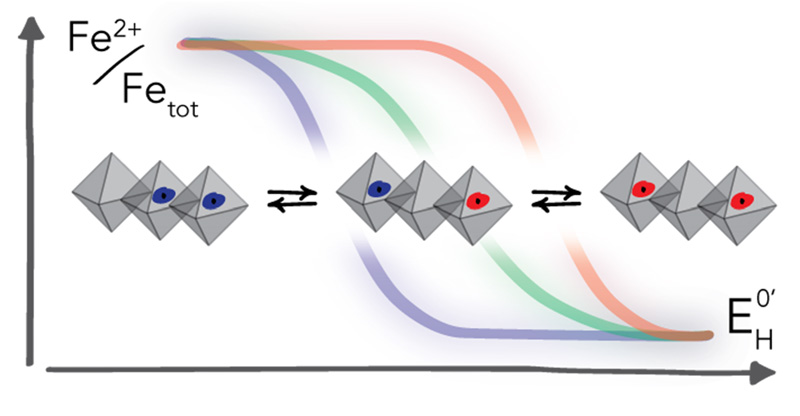

Electron transfer reactions involving Fe(II)/Fe(III) couples associated with iron-bearing clay minerals profoundly impact the environment by influencing organic carbon cycling, microbial activity, rock weathering and diagenesis, and corrosion. These redox reactions are also particularly important for groundwater remediation efforts because they produce Fe(II) that can abiotically reduce several classes of oxidized environmental contaminants to less toxic or less mobile forms, including radionuclides, toxic metals and metalloids, and various organic pollutants. 

Rates and extents of these redox reactions strongly depend on the speciation and coordination of Fe(II)/Fe(III), which has important consequences for interpreting the roles that iron plays in biogeochemical cycles as well as pollutant dynamics. In contrast to iron minerals such as iron (oxyhydr)oxides, changes of Fe oxidation state in clay minerals are not necessarily coupled to reductive dissolution. Instead, electron transfer to and from Fe primarily leads to structural re-arrangements of the mineral structure. 

In our research, we evaluate whether this feature is responsible for observations of the unusually large range of reduction potentials over which Fe in clay minerals can be involved in redox reactions. Our work combines the evaluation of Fe binding and redox state by spectroscopic and microscopic analyses with the electrochemical characterization of Fe redox reaction over the reduction potential range found in subsurface environments. In addition to studying reference clay minerals, our recent work extents to synthetic materials with well-defined iron coordination.

Publications

Extbase Variable Dump
array(2 items)
   publications => '19350,7532' (10 chars)
   libraryUrl => '' (0 chars)
Extbase Variable Dump
array(2 items)
   0 => Snowflake\Publications\Domain\Model\Publicationprototypepersistent entity (uid=19350, pid=124)
      originalId => protected19350 (integer)
      authors => protected'Aeppli, M.; Vranic, S.; Kaegi, R.; Kretzschmar, R.; Brow
         n, A. R.; Voegelin, A.; Hofstetter, T. B.; Sander,&
         nbsp;M.
' (159 chars) title => protected'Decreases in iron oxide reducibility during microbial reductive dissolution
         and transformation of ferrihydrite
' (110 chars) journal => protected'Environmental Science and Technology' (36 chars) year => protected2019 (integer) volume => protected53 (integer) issue => protected'15' (2 chars) startpage => protected'8736' (4 chars) otherpage => protected'8746' (4 chars) categories => protected'' (0 chars) description => protected'Ferrous iron formed during microbial ferric iron reduction induces phase tra
         nsformations of poorly crystalline into more crystalline and thermodynamical
         ly more stable iron (oxyhydr)oxides. Yet, characterizing the resulting decre
         ases in the reactivity of the remaining oxide ferric iron toward reduction (
         i.e., its reducibility) has been challenging. Here, we used the reduction of
          six-line ferrihydrite by <em>Shewanella oneidensis</em> MR-1 as a model sys
         tem to demonstrate that mediated electrochemical reduction (MER) allows dire
         ctly following decreases in oxide ferric iron reducibility during the transf
         ormation of ferrihydrite into goethite and magnetite which we characterized
         by X-ray diffraction analysis and transmission electron microscopy imaging.
         Ferrihydrite was fully reducible in MER at both pH<sub>MER</sub> of 5.0 and
         7.5. Decreases in iron oxide reducibility associated with ferrihydrite trans
         formation into magnetite were accessible at both pH<sub>MER</sub> because th
         e formed magnetite was not reducible under either of these conditions. Conve
         rsely, decreases in iron oxide reducibility associated with goethite formati
         on were apparent only at the highest tested pH<sub>MER</sub> of 7.5 and thus
          the thermodynamically least favorable conditions for iron oxide reductive d
         issolution. The unique capability to adjust the thermodynamic boundary condi
         tions in MER to the specific reducibilities of individual iron (oxyhydr)oxid
         es makes this electrochemical approach broadly applicable for studying chang
         es in iron oxide reducibility in heterogeneous environmental samples such as
          soils and sediments.
' (1617 chars) serialnumber => protected'0013-936X' (9 chars) doi => protected'10.1021/acs.est.9b01299' (23 chars) uid => protected19350 (integer) _localizedUid => protected19350 (integer)modified _languageUid => protectedNULL _versionedUid => protected19350 (integer)modified pid => protected124 (integer)
1 => Snowflake\Publications\Domain\Model\Publicationprototypepersistent entity (uid=7532, pid=124) originalId => protected7532 (integer) authors => protected'Gorski,&nbsp;C.&nbsp;A.; Klüpfel,&nbsp;L.&nbsp;E.; Voegelin,&nbsp;A.; Sande
         r,&nbsp;M.; Hofstetter,&nbsp;T.&nbsp;B.
' (115 chars) title => protected'Redox properties of structural Fe in clay minerals: 3. Relationships between
          smectite redox and structural properties
' (117 chars) journal => protected'Environmental Science and Technology' (36 chars) year => protected2013 (integer) volume => protected47 (integer) issue => protected'23' (2 chars) startpage => protected'13477' (5 chars) otherpage => protected'13485' (5 chars) categories => protected'' (0 chars) description => protected'Structural Fe in clay minerals is an important redox-active species in many
         pristine and contaminated environments as well as in engineered systems. Und
         erstanding the extent and kinetics of redox reactions involving Fe-bearing c
         lay minerals has been challenging due to the inability to relate structural
         Fe<SUP>2+</SUP>/Fe<SUB>total</SUB> fractions to fundamental redox properties
         , such as reduction potentials (<I>E</I><SUB>H</SUB>). Here, we overcame thi
         s challenge by using mediated electrochemical reduction (MER) and oxidation
         (MEO) to characterize the fraction of redox-active structural Fe (Fe<SUP>2+<
         /SUP>/Fe<SUB>total</SUB>) in smectites over a wide range of applied <I>E</I>
         <SUB>H</SUB>-values (−0.6 V to +0.6 V). We examined Fe<SUP>2+</SUP>/Fe<SUB
         >total</SUB> – <I>E</I><SUB>H</SUB> relationships of four natural Fe-beari
         ng smectites (SWy-2, SWa-1, NAu-1, NAu-2) in their native, reduced, and reox
         idized states and compared our measurements with spectroscopic observations
         and a suite of mineralogical properties. All smectites exhibited unique Fe<S
         UP>2+</SUP>/Fe<SUB>total</SUB> – <I>E</I><SUB>H</SUB> relationships, were
         redox active over wide <I>E</I><SUB>H</SUB> ranges, and underwent irreversib
         le electron transfer induced structural changes that were observable with X-
         ray absorption spectroscopy. Variations among the smectite Fe<SUP>2+</SUP>/F
         e<SUB>total</SUB> – <I>E</I><SUB>H</SUB> relationships correlated well wit
         h both bulk and molecular-scale properties, including Fe<SUB>total</SUB> con
         tent, layer charge, and quadrupole splitting values, suggesting that multipl
         e structural parameters determined the redox properties of smectites. The Fe
         <SUP>2+</SUP>/Fe<SUB>total</SUB> – <I>E</I><SUB>H</SUB> relationships deve
         loped for these four commonly studied clay minerals may be applied to future
          studies interested in relating the extent of structural Fe reduction or oxi
         dation to <I>E</I><SUB>H</SUB>-values.
' (1938 chars) serialnumber => protected'0013-936X' (9 chars) doi => protected'10.1021/es403824x' (17 chars) uid => protected7532 (integer) _localizedUid => protected7532 (integer)modified _languageUid => protectedNULL _versionedUid => protected7532 (integer)modified pid => protected124 (integer)
Aeppli, M.; Vranic, S.; Kaegi, R.; Kretzschmar, R.; Brown, A. R.; Voegelin, A.; Hofstetter, T. B.; Sander, M. (2019) Decreases in iron oxide reducibility during microbial reductive dissolution and transformation of ferrihydrite, Environmental Science and Technology, 53(15), 8736-8746, doi:10.1021/acs.est.9b01299, Institutional Repository
Gorski, C. A.; Klüpfel, L. E.; Voegelin, A.; Sander, M.; Hofstetter, T. B. (2013) Redox properties of structural Fe in clay minerals: 3. Relationships between smectite redox and structural properties, Environmental Science and Technology, 47(23), 13477-13485, doi:10.1021/es403824x, Institutional Repository

Project partner