Archive detail

Land use influences organisms living underground

October 22, 2024 | Ori Schipper

Researchers at Eawag have complied and analysed a globally unique data set on the occurrence of various amphipods in groundwater. They were able to show that land use within a radius of up to one kilometre from the groundwater extraction site has an impact on these sensitive creatures. This could indicate that the current groundwater protection zones are not large enough.

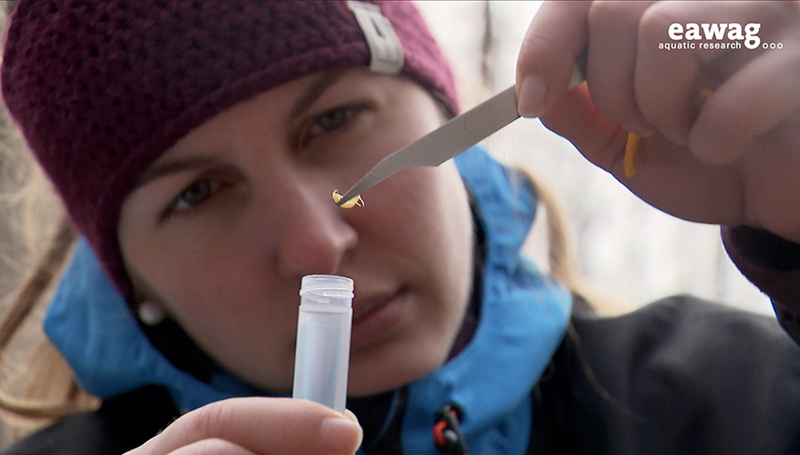
Four fifths of Switzerland’s drinking water comes from hidden underground aquifers. Numerous groundwater extraction sites tap into these reserves. Drinking water supplies are under increasing pressure. “In order to fulfil the quality criteria, some extraction sites have to be taken off the grid or water from impacted sites has to be mixed with less impaired water,” says aquatic ecologist Mara Knüsel, who is currently completing her doctorate in Professor Florian Altermatt’s research group at the aquatic research institute Eawag and the University of Zurich.

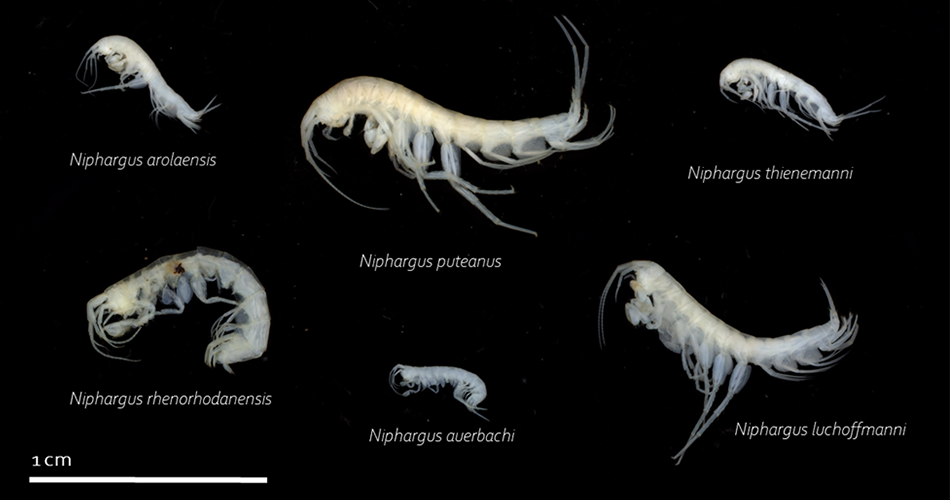
In recent years, Knüsel and her colleagues have been working intensively on researching small creatures that are at home in dark and cold water: groundwater amphipods. They resemble tiny shrimps, but unlike the differently pigmented freshwater amphipods on the surface, they are white and blind. They play an important role in the function of groundwater ecosystems.
 

Less nitrate at groundwater extraction sites surrounded by forests

In their latest article, which has just been published in the journal Ecological Applications, the researchers link the occurrence of amphipods to the type of land use on the Swiss Central Plateau. The researchers often found amphipods at groundwater extraction sites in the middle of a forest, whereas they encountered amphipods much less frequently at groundwater extraction sites near farmland. The groundwater at the extraction sites close to crops also tended to be more contaminated with nitrate than at the sites surrounded by forest, which indicates poorer drinking water quality.

However, Knüsel’s colleague Roman Alther points out that it would be premature to conclude that the water quality is poor because amphipods are absent. “Hydrogeology also plays a role,” he explains. “Factors such as the structure of the local groundwater aquifer, including pore size and water chemistry, can also influence whether or not amphipods are present.” The researchers therefore regard the presence or absence of the small organisms more as a supplementary indicator. “As an indication that the biology at a particular location may be impaired,” says Alther.
 

Influence of farmland still found within a distance of up to a kilometre

The researchers also show that the type of land use has an impact on the occurrence of amphipods in a larger radius. In the data set, farmland located 600 to 1,000 metres away from the groundwater extraction site also leaves a negative signal in the groundwater. In Switzerland, the Water Protection Act stipulates that protection zones must be created around groundwater extraction sites in order to protect valuable drinking water from contamination and other harmful influences. On the Swiss Central Plateau, however, these protection zones cover an area that extends on average only 300 to 400 metres around the extraction site. “We conclude that the currently established protection zones may not be large enough to prevent possible negative effects of land use on groundwater communities,” the researchers state in their article.
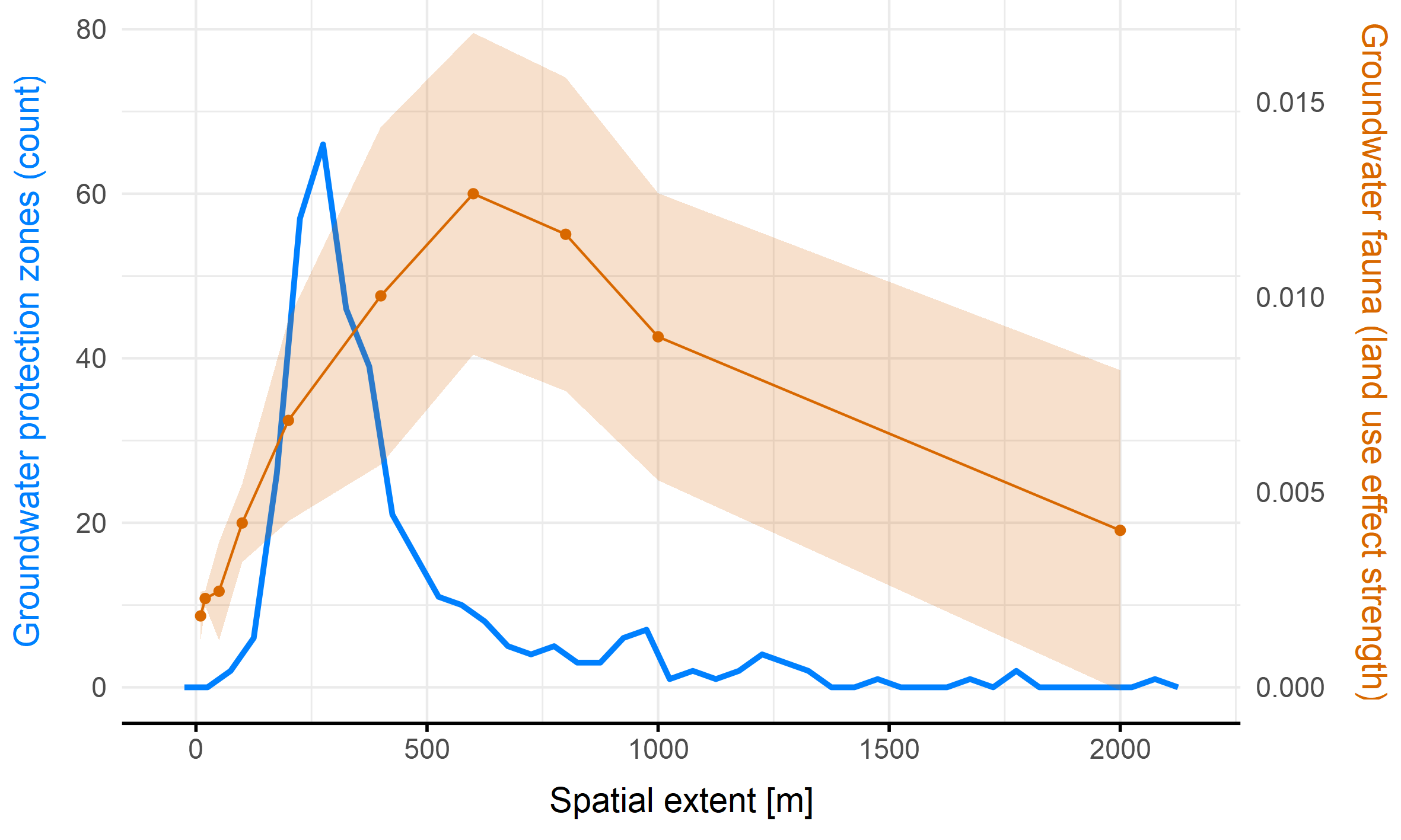
 

The effect of land use on the groundwater fauna (green line) changes with the distance from the groundwater extraction site (x-axis). This also applies at a distance where there is practically no groundwater protection zones (blue line). (Chart: modified according to Knüsel et al. / http://doi.org/10.1002/eap.3040)

A unique habitat

Just like lions in the savannah, amphipods in groundwater are at the top of the food chain. As a result, they also influence all other living organisms at lower trophic levels. “The great diversity of life forms in groundwater is still largely unexplored,” says Knüsel. The researchers have therefore only just laid the foundations with their data set on amphipods: their findings could be an argument in favour of a possible extension of the groundwater protection zones. Beyond this, they are keen to “raise awareness among the general public that groundwater is not only a precious drinking water reserve,” says Alther, “but also a unique habitat that needs to be preserved.”
 

New findings about amphipods

The Eawag researchers worked closely with water supply managers who are responsible for over 900 different groundwater extraction sites throughout Switzerland and “without whose help this work would not have been possible,” as Mara Knüsel emphasises. The collaboration resulted in a systematic collection of amphipods, in which the researchers also discovered several previously unknown species with the help of genetic analyses. The researchers also traced how the last ice age around 20,000 years ago affected the spread and the present occurrence of groundwater amphipods. “We find some species only in places that were not glaciated,” says Knüsel.

Groundwater fauna in Switzerland

The aim of the AmphiWell project is to record and document the occurrence of groundwater organisms at extraction sites throughout Switzerland. In order to collect as much data as possible throughout Switzerland, Eawag researchers work together with water supply managers.


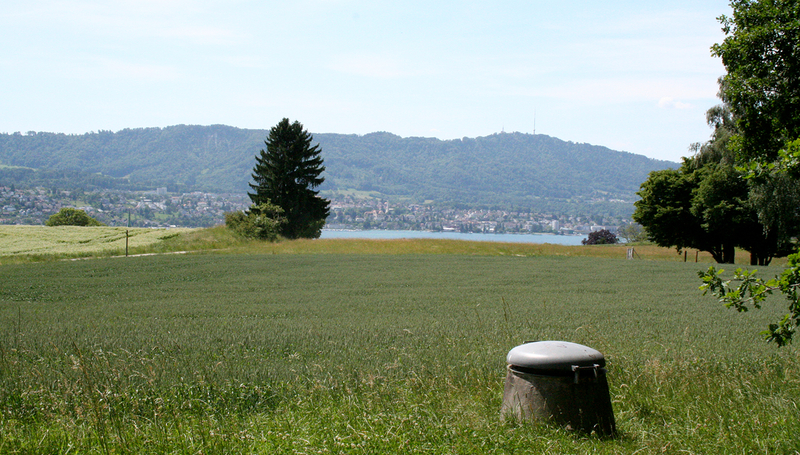
Cover picture: Farmland or forest? Researchers found amphipods less frequently at groundwater extraction sites located near farmland than at those in the middle of a forest (Photo: Wikimedia, Adrian Michael).

Original publications

Knüsel M, Alther R, and Altermatt F. Terrestrial land use signals on groundwater fauna beyond current protection buffers. Ecol Appl. (2024). http://doi.org/10.1002/eap.3040

Extbase Variable Dump
array(3 items)
   publications => '33091,33018' (11 chars)
   libraryUrl => '' (0 chars)
   layout => '0' (1 chars)
Extbase Variable Dump
array(2 items)
   0 => Snowflake\Publications\Domain\Model\Publicationprototypepersistent entity (uid=33091, pid=124)
      originalId => protected33091 (integer)
      authors => protected'Knüsel, M.; Alther, R.; Locher, N.; Ozgul, A.; Fišer,&
         nbsp;C.; Altermatt, F.
' (103 chars) title => protected'Systematic and highly resolved modelling of biodiversity in inherently rare
         groundwater amphipods
' (97 chars) journal => protected'Journal of Biogeography' (23 chars) year => protected2024 (integer) volume => protected51 (integer) issue => protected'11' (2 chars) startpage => protected'2094' (4 chars) otherpage => protected'2108' (4 chars) categories => protected'citizen science; Niphargus; occupancy model; species distribution; stygofaun
         a; subterranean; Switzerland
' (104 chars) description => protected'Aim: groundwater ecosystems harbour a unique biodiversity, but remain poorly
          studied, mainly due to difficulties in accessibility and imperfect species
         detection. Consequently, knowledge on the state and change of groundwater bi
         odiversity remains highly deficient. In the context of global warming and ex
         cessive groundwater extraction, understanding groundwater from an ecosystem-
         perspective, including organism diversity and distribution, is essential. Th
         is study presents the largest ever systematic assessment of groundwater amph
         ipods, which are a key component of European groundwater biodiversity.<br />
         Location: Switzerland (41,285 km<sup>2</sup>), including data from 906 sam
         pling sites.<br />Taxon: groundwater amphipods, genera <em>Niphargus</em> an
         d <em>Crangonyx</em> (Crustacea, Amphipoda).<br />Methods: we applied a high
         ly standardized citizen science approach to collect repeated groundwater fau
         na samples in collaboration with municipal drinking water providers. Using d
         etection–nondetection data of the genetically identified groundwater amphi
         pod species, we assessed the overall species diversity of both rare and comm
         on species. The distribution of commonly found species was predicted using m
         ultispecies occupancy modelling.<br />Results: we retrieved 3882 samples fro
         m 906 sites, yielding 2350 groundwater amphipod individuals. We identified a
          remarkable species diversity, comprising few commonly and many rarely found
          species. Considering commonly found species, we identified distinct distrib
         ution ranges, low local species richness and a predominance of negative co-o
         ccurrences. In contrast, a major portion of species were found rarely (gener
         ally at just one or two sites each), distributed uniformly throughout the st
         udy area and unrelated to common species' recognized hotspots. Many of these
          rarely found species are not yet formally described.<br />Main conclusions:
          Our results give robust emphasis on the rare occurrence and narrow distribu
         tion of many groundwater...
' (2312 chars) serialnumber => protected'0305-0270' (9 chars) doi => protected'10.1111/jbi.14975' (17 chars) uid => protected33091 (integer) _localizedUid => protected33091 (integer)modified _languageUid => protectedNULL _versionedUid => protected33091 (integer)modified pid => protected124 (integer)
1 => Snowflake\Publications\Domain\Model\Publicationprototypepersistent entity (uid=33018, pid=124) originalId => protected33018 (integer) authors => protected'Knüsel,&nbsp;M.; Alther,&nbsp;R.; Altermatt,&nbsp;F.' (53 chars) title => protected'Pronounced changes of subterranean biodiversity patterns along a Late Pleist
         ocene glaciation gradient
' (101 chars) journal => protected'Ecography' (9 chars) year => protected2024 (integer) volume => protected2024 (integer) issue => protected'8' (1 chars) startpage => protected'e07321 (10 pp.)' (15 chars) otherpage => protected'' (0 chars) categories => protected'alps; community dissimilarity; distribution; groundwater; Last Glacial Maxim
         um (LGM); stygofauna
' (96 chars) description => protected'Understanding spatial patterns of biodiversity within the context of long-te
         rm climatic shifts is of high importance, particularly in the face of contem
         porary climate change. In comparison to aboveground taxa, subterranean organ
         isms respond to changing climates with generally much lower dispersal and re
         colonization potential, yet possible persistence in refugial groundwater hab
         itats under ice-shields. However, knowledge on general and geographically la
         rge-scale effects of glaciation on contemporary groundwater biodiversity pat
         terns is still very limited. Here, we tested how Late Pleistocene glaciation
          influenced the diversity and distribution of 36 groundwater amphipod specie
         s in Alpine and peri-Alpine regions, characterized by extensive glaciation c
         ycles, and how its legacy explains contemporary diversity patterns. We based
          our analysis on an unprecedented density of ~ 1000 systematic sampling site
         s across Switzerland. Using presence–absence data, we assessed biodiversit
         y and species' ranges, and calculated for each site within-catchment distanc
         e to the Last Glacial Maximum (LGM) glacier extent. We then applied a slidin
         g window approach along the obtained distance gradient from LGM ice-covered
         to ice-free sites to compute biodiversity indices reflecting local richness,
          regional richness, and differentiation, respectively. We found a strong sig
         nal of the LGM ice extent on the present-day distribution of groundwater amp
         hipods. Our findings revealed pronounced species turnover and spatial envelo
         pes of individual species' occurrences in formerly ice-covered, ice-free, or
          transitional zones, respectively. While local richness remained constant an
         d low along the LGM distance gradient, groundwater communities in LGM ice-co
         vered areas were more similar to each other and had lower gamma diversities
         and decreased occurrence probabilities per sliding window compared to commun
         ities in Pleistocene ice-free areas. These results highlight the significant
          impact of Pleistocene g...
' (2137 chars) serialnumber => protected'0906-7590' (9 chars) doi => protected'10.1111/ecog.07321' (18 chars) uid => protected33018 (integer) _localizedUid => protected33018 (integer)modified _languageUid => protectedNULL _versionedUid => protected33018 (integer)modified pid => protected124 (integer)
Knüsel, M.; Alther, R.; Locher, N.; Ozgul, A.; Fišer, C.; Altermatt, F. (2024) Systematic and highly resolved modelling of biodiversity in inherently rare groundwater amphipods, Journal of Biogeography, 51(11), 2094-2108, doi:10.1111/jbi.14975, Institutional Repository
Knüsel, M.; Alther, R.; Altermatt, F. (2024) Pronounced changes of subterranean biodiversity patterns along a Late Pleistocene glaciation gradient, Ecography, 2024(8), e07321 (10 pp.), doi:10.1111/ecog.07321, Institutional Repository

Funding / Partnerships

  • Eawag
  • University of Zurich
  • University of Ljubljana, Slovenia
  • Federal Office for the Environment (FOEN)
  • Swiss Gas and Water Industry Association (SVGW)
  • Swiss National Fund