
Archive detail

Tracking down the smallest particles

June 19, 2018 | Christine Arnold

Nanomaterials consist of tiny particles of different composition. They are used, for example, in textiles and can enter aquatic systems directly from the factory, while being worn or disposed of. For years, research groups at Eawag have been investigating the effects of artificially manufactured nanoparticles on human beings and the environment. Their preliminary conclusion: nanoparticles have a reputation worse than they deserve.

They can make plastics stronger, block UV rays, reduce sweat odour in t-shirts or ensure better water-droplet formation: artificial nanoparticles are used in a wide range of products. They range from one to a hundred nanometres in size – even a hair has a diameter of c. 10,000 nanometres. They are hard to grasp, which is perhaps the reason for their often-dubious reputation among the general population. But, these tiny particles are not just a human invention. Natural nanoparticles are found in volcanic ash or in the smoke from wood fires, and biological and chemical particles, such as fat droplets in milk or small proteins in the blood, are also on a nanoscale.

Transformation in wastewater treatment plants

Artificially produced nanoparticles can enter the environment during the entire life cycle of a product. How the particles then behave or what effects they have are questions which researchers all over the world grapple with. One of these researchers is Ralf Kägi, an expert on nanoparticles at Eawag. In a study published in 2017, for example, he and his team investigated the transformation of copper oxide nanoparticles in wastewater. These are used in conductors and circuits and in wood impregnation. It is assumed that copper oxide is transformed into copper sulphide in wastewater treatment plants and thereby loses most of its toxicity. Within minutes, in fact, copper particles are converted into covellite, a copper sulphide. This mineral is frequently found in nature as a thin film on rocks. As Kägi states: “In this way, the dissolved copper ions are bound together and the particles lose their nano-specific properties”.

Large quantities land in sewage sludge

Other nanoparticles are also quickly transformed in wastewater treatment plants and 95% to 99% end up in sewage sludge. “These are incinerated and deposited, and, therefore, the artificial nanoparticles are no longer in circulation”, says Kägi. He and his team have investigated the risks of nanomaterials for humans and the environment in a number of studies. “We started with silver, which is used mainly in textiles. We have also looked at copper, zinc, titanium and cerium nanoparticles in pilot plants at Eawag, simulating real-world conditions”, he explains. The latter is used in abrasive powders and glass lenses, while titanium is an ingredient in sunscreens and boats are painted with copper. The results are the same: “Wastewater plants transform the reactive nanoparticles relatively quickly into less harmful particles which can then be efficiently removed from wastewater”.

Ecotoxicology investigates biological reactions

Fundamental processes are the focus in the Environmental Toxicology department, under the leadership of Kristin Schirmer. “We are investigating in particular the influence of frequently used metallic nanoparticles on living organisms at different ecological levels of organisation: from algae to biofilms, cell lines, and embryos up to fish”, explains Ecotoxicologist Ahmed Tlili. These investigations take place in the laboratory. Although a range of effects appear with very low concentrations, as a rule the concentrations are higher than those in the environment.

The Ecotoxicologists have investigated, for example, how well the alga Chlamydomonas reinhardtii takes up cerium and cerium oxide nanoparticles. These are used as additives, for instance, in ceramic tooth fillings, in the coatings of self-cleaning ovens and as opacifying agents in special glass, such as windshields. In their study, the researchers compared how the wild type of the alga and a mutant without a cell wall absorb the cerium and cerium dioxide nanoparticles. In the case of cerium dioxide there is no difference, but the dissolved cerium is better absorbed by the mutant. The researchers, thus, assume that cellular cerium adheres strongly to the cell wall of the wild type, and that less is absorbed.

“Algae often cannot take up nanoparticles”, confirms Ahmed Tlili. “But if metallic components are dissolved in water, these can have an effect on algae and bacteria. These are indirectly affected by the nanoparticles”. Biofilms, on the other hand, do react to nanoparticles. “Groups of microbiological organisms show less growth and the respiration rate sinks. This results in less food being available for higher-level organisms”, explains Tlili.

Differentiating between artificial and natural sources

Thanks to comprehensive research in various areas, it is now better known how common nanoparticles land in the environment and where they finally end up. In addition, a large number of analytical methods are available today, which make it possible, for example, to distinguish between artificial and natural nanoparticles. One example is titanium dioxide, that is used in sunscreen, and that is washed off the skin when bathing. Filters in swimming pools remove nearly all the titanium from water. In natural bathing locations, such as lakes and rivers, however, there are no such filters. But, titanium-containing nanoparticles also occur naturally – in bodies of water at a concentration of c. 5,000 particles per millilitre.

In a recently published study, researchers at the University of Vienna, Eawag and the Swedish University of Agricultural Sciences cooperated in an investigation on whether and how much titanium dioxide in sunscreens ends up in lakes and rivers during bathing and is later deposited in sediment. They drew on the fact that natural titanium particles are often found with iron, manganese, lead or aluminium, while in the case of artificial titanium nanoparticles, no such typical ‘background’ is known. “This is useful for differentiating the sources of the particles”, says Kägi. The researchers determined that in the Danube, the titanium oxide concentration increases during the bathing season. The increase resulting from sunscreen, however, was much less than the naturally occurring material. It is also possible to differentiate artificial cerium oxide from the naturally occurring nanomaterial. Kägi explains: “Natural cerium oxide generally occurs with lanthanum, whereas the artificial cerium oxide does not. This fact makes differentiation possible”.

No acute effects in natural conditions

The progress in nano research over the last 10 years and where it should go were the topics of a meeting of international experts, under the leadership of Empa and Eawag, on Monte Verità in March 2017. They noted that the effects of nanoparticles on diverse organisms can be observed after relatively brief periods in laboratory experiments. However, these occur above all at high concentrations, and cannot be observed in the environment. “Such laboratory experiments are important to understand basic processes. But, they are often far removed from reality”, says Kägi. “Under realistic conditions, we see no acute effects on organisms and ecosystems – provided that the nanomaterials do not consist of toxic materials, such as heavy metals”.

Research focus shifts

In the future, Eawag researchers want to concentrate on the many open questions that remain: What chronic effects can artificial nanoparticles cause? How do living communities and ecosystems react when exposed over the long term to a combination of different nanomaterials? What happens to nanomaterials when they are incinerated? “We want to use the great amount of existing data to improve risk modelling”, adds Tlili. “In addition, we want to do less research on original nanomaterials and rather concentrate on particles that have aged in the environment”. This is also true for the research plans of Kägi’s group, which is planning to investigate the transformation of cerium dioxide nanoparticles during the wastewater treatment process, as well as during the treatment and incineration of sludge. Furthermore, the researchers wish to determine if the nanoparticles from the deposited ashes of sludge become active again.

Publications

Extbase Variable Dump
array(2 items)
   publications => '8024,16584,16550,15475' (22 chars)
   libraryUrl => '' (0 chars)
Extbase Variable Dump
array(4 items)
   0 => Snowflake\Publications\Domain\Model\Publicationprototypepersistent entity (uid=8024, pid=124)
      originalId => protected8024 (integer)
      authors => protected'Gil-Allué, C.; Schirmer, K.; Tlili, A.; Gessner, M.&nbs
         p;O.; Behra, R.
' (96 chars) title => protected'Silver nanoparticle effects on stream periphyton during short-term exposures' (76 chars) journal => protected'Environmental Science and Technology' (36 chars) year => protected2015 (integer) volume => protected49 (integer) issue => protected'2' (1 chars) startpage => protected'1165' (4 chars) otherpage => protected'1172' (4 chars) categories => protected'' (0 chars) description => protected'Silver nanoparticles (AgNP) are increasingly used as antimicrobials in consu
         mer products. Subsequently released into aquatic environments, they are like
         ly to come in contact with microbial communities like periphyton, which play
         s a key role as a primary producer in stream ecosystems. At present, however
         , very little is known about the effects of nanoparticles on processes media
         ted by periphyton communities. We assessed the effects of citrate-coated sil
         ver nanoparticles and silver ions (dosed as AgNO<SUB>3</SUB>) on five functi
         onal end points reflecting community and ecosystem-level processes in periph
         yton: photosynthetic yield, respiration potential, and the activity of three
          extracellular enzymes. After 2 h of exposure in experimental microcosms, Ag
         NP and AgNO<SUB>3</SUB> inhibited respiration and photosynthesis of periphyt
         on and the activities of two of the three extracellular enzymes. Addition of
          a chelating ligand that complexes free silver ions indicated that, in most
         cases, toxicity of AgNP suspensions was caused by Ag(I) dissolved from the p
         articles. However, these suspensions inhibited one of the extracellular enzy
         mes (leucine aminopeptidase), pointing to a specific nanoparticle effect ind
         ependent of the dissolved Ag(I). Thus, our results show that both silver nan
         oparticles and silver ions have potential to disrupt basic metabolic functio
         ns and enzymatic resource acquisition of stream periphyton.
' (1427 chars) serialnumber => protected'0013-936X' (9 chars) doi => protected'10.1021/es5050166' (17 chars) uid => protected8024 (integer) _localizedUid => protected8024 (integer)modified _languageUid => protectedNULL _versionedUid => protected8024 (integer)modified pid => protected124 (integer)
1 => Snowflake\Publications\Domain\Model\Publicationprototypepersistent entity (uid=16584, pid=124) originalId => protected16584 (integer) authors => protected'Gondikas,&nbsp;A.; Von Der Kammer,&nbsp;F.; Kaegi,&nbsp;R.; Borovinskaya,&nb
         sp;O.; Neubauer,&nbsp;E.; Navratilova,&nbsp;J.; Praetorius,&nbsp;A.; Corneli
         s,&nbsp;G.; Hofmann,&nbsp;T.
' (180 chars) title => protected'Where is the nano? Analytical approaches for the detection and quantificatio
         n of TiO<sub>2</sub> engineered nanoparticles in surface waters
' (139 chars) journal => protected'Environmental Science: Nano' (27 chars) year => protected2018 (integer) volume => protected5 (integer) issue => protected'2' (1 chars) startpage => protected'313' (3 chars) otherpage => protected'326' (3 chars) categories => protected'' (0 chars) description => protected'Detecting and quantifying engineered nanoparticles (ENPs) in complex environ
         mental matrices requires the distinction between natural nanoparticles (NNPs
         ) and ENPs. The distinction of NNPs and ENPs for regulatory purposes calls f
         or cost-efficient methods, but is hampered by similarities in intrinsic prop
         erties, such as particle composition, size, density, surface chemistry, etc.
          Titanium dioxide (TiO<sub>2</sub>) ENPs, for instance, are produced in very
          large quantities but Ti also commonly occurs naturally in nano-scale minera
         ls. In this work, we focus on utilizing particle size and composition to ide
         ntify ENPs in a system with a significant background concentration of the ta
         rget metal. We have followed independent approaches involving both conventio
         nal and state-of-the-art analytical techniques to detect and quantify TiO<su
         b>2</sub> ENPs released into surface waters from sunscreen products and to d
         istinguish them from Ti-bearing NNPs. To achieve this, we applied single par
         ticle inductively coupled plasma mass spectrometry with single-element (spIC
         PMS) and multi-element detection (time-of-flight) spICP-TOFMS, together with
          transmission electron microscopy (TEM), automated scanning electron microsc
         opy (autoSEM), and bulk elemental analyses. A background concentration of Ti
         -bearing NPs (approximately 5 × 10<sup>3</sup> particles per ml), possibly
         of natural origin, was consistently observed outside the bathing season. Thi
         s concentration increased by up to 40% during the bathing season. Multi-elem
         ent analysis of individual particles using spICP-TOFMS revealed that Al, Fe,
          Mn, and Pb are often present in natural Ti-bearing NPs, but no specific mul
         ti-element signatures were detected for ENPs. Our data suggests that TiO<sub
         >2</sub> ENPs enter the lake water during bathing activities, eventually agg
         lomerating and sedimenting. We found adhesion of the TiO<sub>2</sub> ENPs to
          the air-water interface for short time periods, depending on wind condition
         s. This study demonstrat...
' (2325 chars) serialnumber => protected'2051-8153' (9 chars) doi => protected'10.1039/c7en00952f' (18 chars) uid => protected16584 (integer) _localizedUid => protected16584 (integer)modified _languageUid => protectedNULL _versionedUid => protected16584 (integer)modified pid => protected124 (integer)
2 => Snowflake\Publications\Domain\Model\Publicationprototypepersistent entity (uid=16550, pid=124) originalId => protected16550 (integer) authors => protected'Kosak née Röhder,&nbsp;L.&nbsp;A.; Brandt,&nbsp;T.; Sigg,&nbsp;L.; Behra,&
         nbsp;R.
' (83 chars) title => protected'Uptake and effects of cerium(III) and cerium oxide nanoparticles to <i>Chlam
         ydomonas reinhardtii</i>
' (100 chars) journal => protected'Aquatic Toxicology' (18 chars) year => protected2018 (integer) volume => protected197 (integer) issue => protected'' (0 chars) startpage => protected'41' (2 chars) otherpage => protected'46' (2 chars) categories => protected'cerium; cerium oxide nanoparticles; calcium; uptake; cell wall free mutant;
         algae
' (81 chars) description => protected'Cerium (Ce) and cerium oxide nanoparticles (CeO<sub>2</sub> NP) are increasi
         ngly used in different applications. Upon their release into the aquatic env
         ironment, the exposure of aquatic organisms becomes likely. In this study, t
         he uptake of CeO<sub>2</sub> NP and Ce<sup>3+</sup> into the wild type and c
         ell wall free mutant of <em>Chlamydomonas reinhardtii</em> was examined upon
          short term exposure. Separation of CeO<sub>2</sub> NP and Ce<sup>3+</sup> n
         ot taken up or loosely bound to the cells was performed by washing algae wit
         h EDTA. <br/> <p id="spar0055">Despite a concentration and time dependent in
         crease of cellular Ce upon exposure to CeO<sub>2</sub> NP with the maximal c
         alculated Ce concentration corresponding to 1.1 CeO<sub>2</sub> NP per cell,
          an internalization of CeO<sub>2</sub> NP with a mean size of 140 nm in <e
         m>C. reinhardtii</em> was excluded. In contrast, dissolved Ce<sup>3+</sup> (
         1 and 10 μM) was taken up both in the wild type and cell wall free mutant
         
         
         ub>cell</sub><sup>−1</sup> (wild type) and 9.0 × 10<sup>−5</sup> 
         mol L<sub>cell</sub><sup>−1</sup> (cell wall free mutant). Based on comp
         etition with Ca<sup>2+</sup> for Ce<sup>3+</sup> uptake, on the comparison o
         f the wild type and the cell wall free mutant and on inhibition of photosynt
         hetic yield, we suggest that no efficient uptake routes for Ce<sup>3+</sup>
         are available in <em>C. reinhardtii</em> and that a fraction of the cellular
          Ce in the wild type strongly sorbs to the algal cell wall.
' (1655 chars) serialnumber => protected'0166-445X' (9 chars) doi => protected'10.1016/j.aquatox.2018.02.004' (29 chars) uid => protected16550 (integer) _localizedUid => protected16550 (integer)modified _languageUid => protectedNULL _versionedUid => protected16550 (integer)modified pid => protected124 (integer)
3 => Snowflake\Publications\Domain\Model\Publicationprototypepersistent entity (uid=15475, pid=124) originalId => protected15475 (integer) authors => protected'Gogos,&nbsp;A.; Thalmann,&nbsp;B.; Voegelin,&nbsp;A.; Kaegi,&nbsp;R.' (68 chars) title => protected'Sulfidation kinetics of copper oxide nanoparticles' (50 chars) journal => protected'Environmental Science: Nano' (27 chars) year => protected2017 (integer) volume => protected4 (integer) issue => protected'8' (1 chars) startpage => protected'1733' (4 chars) otherpage => protected'1741' (4 chars) categories => protected'' (0 chars) description => protected'Sulfidation of copper oxide nanoparticles (CuO NPs) in urban wastewater syst
         ems is expected to influence their impact on the environment. However, the k
         inetics of this reaction has not been studied to date and the reaction mecha
         nism remains largely unexplored. We therefore investigated the sulfidation k
         inetics of CuO NPs reacted with bisulfide (HS<sup>−</sup>) at concentratio
         ns relevant to wastewater systems. Pristine CuO NPs (50 nm, 7.7 μM) were re
         acted with HS<sup>−</sup> (26.4–105.6 μM) in oxic solutions buffered to
          pH 8.0. The reaction progress was monitored using silver nitrate to quench
         the reaction and selectively dissolve the copper sulfides (Cu<i><sub>x</sub>
         </i>) and zincon to spectrophotometrically quantify the released Cu<sup>2+</
         sup>. In addition, the reaction products were characterized at selected time
          points using analytical electron microscopy and X-ray absorption spectrosco
         py (XAS). The sulfidation rate of the CuO NPs was best described by a pseudo
          first order rate law and the corresponding half-life times ranged between 1
          and 6 minutes. XAS results showed that crystalline CuO NPs rapidly transfor
         med into amorphous Cu<i><sub>x</sub></i>S and gradually into crystalline CuS
          (covellite). The comparable size of pristine and transformed primary partic
         les, the similar morphology of their aggregates, and the initial formation o
         f CuO–Cu<i><sub>x</sub></i>S core–shell structures revealed by analytica
         l electron microscopy suggest that the initial sulfidation occurred via a di
         rect conversion reaction mechanism. Our findings suggest that CuO NPs releas
         ed from various sources into wastewater will rapidly transform into amorphou
         s Cu<i><sub>x</sub></i>S and eventually recrystallize into covellite.
' (1741 chars) serialnumber => protected'2051-8153' (9 chars) doi => protected'10.1039/C7EN00309A' (18 chars) uid => protected15475 (integer) _localizedUid => protected15475 (integer)modified _languageUid => protectedNULL _versionedUid => protected15475 (integer)modified pid => protected124 (integer)
Gil-Allué, C.; Schirmer, K.; Tlili, A.; Gessner, M. O.; Behra, R. (2015) Silver nanoparticle effects on stream periphyton during short-term exposures, Environmental Science and Technology, 49(2), 1165-1172, doi:10.1021/es5050166, Institutional Repository
Gondikas, A.; Von Der Kammer, F.; Kaegi, R.; Borovinskaya, O.; Neubauer, E.; Navratilova, J.; Praetorius, A.; Cornelis, G.; Hofmann, T. (2018) Where is the nano? Analytical approaches for the detection and quantification of TiO2 engineered nanoparticles in surface waters, Environmental Science: Nano, 5(2), 313-326, doi:10.1039/c7en00952f, Institutional Repository
Kosak née Röhder, L. A.; Brandt, T.; Sigg, L.; Behra, R. (2018) Uptake and effects of cerium(III) and cerium oxide nanoparticles to Chlamydomonas reinhardtii, Aquatic Toxicology, 197, 41-46, doi:10.1016/j.aquatox.2018.02.004, Institutional Repository
Gogos, A.; Thalmann, B.; Voegelin, A.; Kaegi, R. (2017) Sulfidation kinetics of copper oxide nanoparticles, Environmental Science: Nano, 4(8), 1733-1741, doi:10.1039/C7EN00309A, Institutional Repository

Nowack, B., 2009. The behavior and effects of nanoparticles in the environment. Environ. Pollut. 157, 1063–1064.

Photos

Ecotoxicologist Xiaomei Li points to nanoparticles taken up by cells.
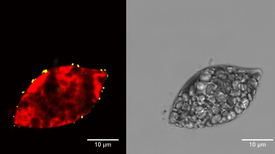
Euglena gracilis, after the alga has been exposed for two hours to fluorescent nanoparticles. Fluorescent particles (left, yellow) are found on the outside of the algae cell, the inside of which fluoresces red (compared to the appearance in transmission microscopy on the right). (Source: Eawag, Xiaomei Li)
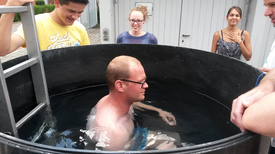
In experiments at Eawag, researchers test methods for analysing artificial titanium dioxide nanoparticles from sunscreens in water.
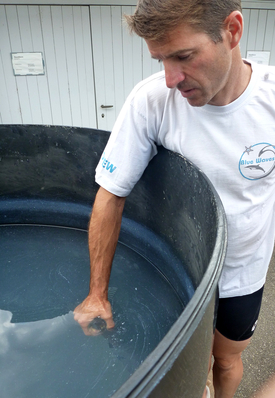
After the bath, researchers take water samples in order to analyse artificial titanium dioxide nanoparticles from sunscreens.