Archive detail

Underestimated diversity of toxins from cyanobacteria

October 17, 2023 | Ori Schipper

The guidelines of the World Health Organization (WHO) list only four substances produced by cyanobacteria. This is a small fraction of all the metabolites that can have ecotoxicological effects such as negatively impacting zebrafish larvae.

They are more than three billion years old. They were also the first organisms on earth to tap sunlight as a source of energy, thereby essentially inventing photosynthesis. “Cyanobacteria can also cope in nutrient-poor waters and are found all over the world,” says Elisabeth Janssen, research group leader at the Environmental Chemistry Department of the aquatic research institute Eawag.

Tragic incident

Science has known for some time that these tiny organisms, often called blue-green algae, produce toxic substances. For about 20 years now, political and social interest in cyanobacteria has been growing. When they suddenly multiply in a body of water and trigger a bloom, like the cyanobacterium Planktothrix rubescens, bathing is strongly discouraged or forbidden. If dogs drink from the murky water containing certain cyanobacteria, they can even die from it.

Until now, toxicology experts have devoted their greatest attention to a specific class of toxins known as microcystins. “This follows from a particularly severe and tragic incident in 1996, which occurred in the Brazilian city of Caruaru,” write a group of researchers including Janssen in a recently published paper. At that time, the local water supply failed and water had to be trucked in from a nearby water reservoir for the hospital. The fact that this water contained microcystins only became clear after 60 dialysis patients had died.

A whole bouquet of metabolites

As a result, the World Health Organization (WHO) issued guidelines on microcystins, which were extended to three other toxins from cyanobacteria in 2021. But this only regulates a tiny fraction of the substances. After all: “Cyanobacteria produce a whole bouquet of secondary metabolites,” says Janssen. The ecotoxicological risks of this variety of substances are still largely unknown. Now the results of experiments with zebrafish larvae conducted by Janssenʼs and vom Bergʼs teams provide a little more clarity.

 

“We used cell extracts from two different cyanobacterial strains of the genus Microcystis from Brazil,” says Mariana de Almeida Torres, first author of the scientific publication and a fellow of the Eawag Partnership Programme (see box). One strain was isolated from a natural reserve in the Amazon rainforest. It produces microcystins – unlike the other strain, which was isolated from a wastewater treatment plant in Rio de Janeiro.

Edema around the heart

In fact, the microcystin-producing strain proved to be twice as toxic. Half a microgram of extracted biomass from cyanobacteria per millilitre was enough to kill half the zebrafish larvae within a day. “Such a concentration can typically be found during a mass reproduction of cyanobacteria, known as blooms,” says Janssen. Although the other strain did not contain any of the toxins listed in the WHO guidelines, the cyanobacteria from the sewage treatment plant were also toxic: at a concentration of one microgram of biomass per millilitre, they led to the death of half the zebrafish larvae. When the researchers divided the extracts into different chemical fractions, they found that numerous substances made their own contribution to toxicity. The researchers also determined that they often did not immediately lead to the death of the larvae, but severely impaired their development, for example through edemas around their hearts.

Just like the microcystins, these other toxin classes also have exotic names. They are called cyanopeptolins, nostoginins, microginins and micropeptins – and all belong to the chemical universe of the metabolic products of cyanobacteria, which is only gradually being revealed. “So far, we have compiled more than 2,400 substances in a publicly accessible database,” says Janssen, who coordinates the CyanoMetDB project. “And about 100 new entries are added every year.”

Problem gains importance with global warming

But why do cyanobacteria produce toxins? “Somehow they must derive an advantage from them, because the production of these substances costs cyanobacteria a lot of metabolic energy,” says Janssen. However, the nature of this advantage has not yet been clarified, even though there are many theories, such as that the tiny organisms use the substances as signal molecules and thus communicate chemically with each other, or that the toxins protect them from predators.

In any case, the topic is likely to gain in importance in the future. Due to the warming climate, it is expected that cyanobacteria will bloom more frequently in Swiss lakes. Thatʼs why Janssen is keen to raise public awareness of the problem. The environmental chemist adds: “Compared to pollutants from industry, the toxins from cyanobacteria are more difficult to grasp, because they are metabolic products of living organisms – and accumulate when they multiply and we cannot turn off the source as easily.”
 

Eawag Partnership Programme

The Eawag Partnership Programme (EPP) aims to strengthen scientific capacity in economically underdeveloped countries. It offers doctoral students working on environmentally relevant topics, such as water scarcity, pollution or biodiversity loss, the opportunity to train and exchange during a short-term research placement at Eawag.

EPP fellow Mariana de Almeida Torres was integrated into the research groups of Elisabeth Janssen and Colette vom Berg from January to July 2021. Also after the fellowship, the researchers continued their collaboration and carried out another 6-month visit in 2022. Regarding her work at the interface between environmental chemistry and environmental toxicology, Torres says: “It was such a rich and valuable experience! My time at Eawag was life-changing, not only from a career development perspective, but also on a personal level.” Her two supervisors also express their enthusiasm. “For us, this collaboration was a huge gain – with a real sense of achievement,” says Janssen.

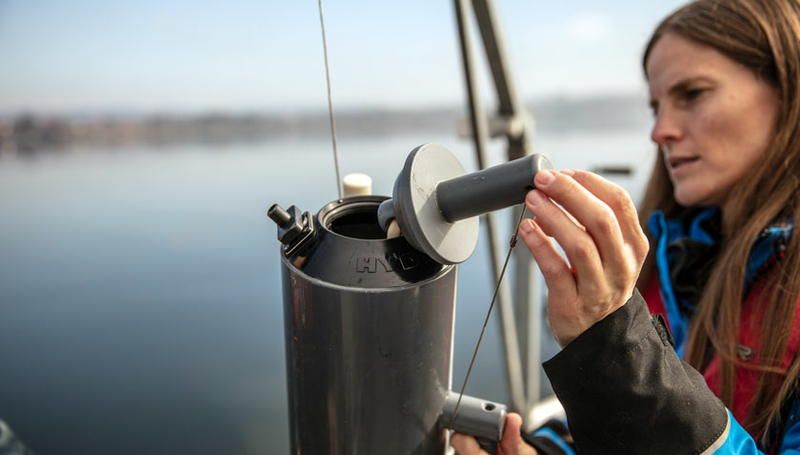
Cover picture: Sampling at a lake. (Photo: ETH Board, Daniel Kellenberger)
 

Original publications

Extbase Variable Dump
array(3 items)
   publications => '31895,22310' (11 chars)
   libraryUrl => '' (0 chars)
   layout => '0' (1 chars)
Extbase Variable Dump
array(2 items)
   0 => Snowflake\Publications\Domain\Model\Publicationprototypepersistent entity (uid=31895, pid=124)
      originalId => protected31895 (integer)
      authors => protected'de Almeida Torres, M.; Jones, M. R.; vom Berg, C.; Pinto
         , E.; Janssen, E. M. -L.
' (120 chars) title => protected'Lethal and sublethal effects towards zebrafish larvae of microcystins and ot
         her cyanopeptides produced by cyanobacteria
' (119 chars) journal => protected'Aquatic Toxicology' (18 chars) year => protected2023 (integer) volume => protected263 (integer) issue => protected'' (0 chars) startpage => protected'106689 (11 pp.)' (15 chars) otherpage => protected'' (0 chars) categories => protected'cyanobacterial metabolites; fish toxicity; cardiotoxicity; locomotor behavio
         ur; cyanopeptolin; microginin
' (105 chars) description => protected'Cyanobacterial blooms affect aquatic ecosystems across the globe and one maj
         or concern relates to their toxins such as microcystins (MC). Yet, the ecoto
         xicological risks, particularly non-lethal effects, associated with other co
         -produced secondary metabolites remain mostly unknown. Here, we assessed sur
         vival, morphological alterations, swimming behaviour and cardiovascular func
         tions of zebrafish (<em>Danio rerio</em>) upon exposure to cyanobacterial ex
         tracts of two Brazilian <em>Microcystis</em> strains. We verified that only
         MIRS-04 produced MCs and identified other co-produced cyanopeptides also for
          the MC non-producer NPCD-01 by LC-HRMS/MS analysis. Both cyanobacterial ext
         racts, from the MC-producer and non-producer, caused acute toxicity in zebra
         fish with LC<sub>50</sub> values of 0.49 and 0.98 mg<sub>dw_biomass</sub>/mL
         , respectively. After exposure to MC-producer extract, additional decreased
         locomotor activity was observed. The cyanopeptolin (micropeptin K139) contri
         buted 52% of the overall mortality and caused oedemas of the pericardial reg
         ion. Oedemas of the pericardial area and prevented hatching were also observ
         ed upon exposure to the fraction with high abundance of a microginin (Nostog
         inin BN741) in the extract of the MC non-producer. Our results further add t
         o the yet sparse understanding of lethal and sublethal effects caused by cya
         nobacterial metabolites other than MCs and the need to better understand the
          underlying mechanisms of the toxicity. We emphasize the importance of consi
         dering mixture toxicity of co-produced metabolites in the ecotoxicological r
         isk assessment of cyanobacterial bloom events, given the importance for pred
         icting adverse outcomes in fish and other organisms.
' (1724 chars) serialnumber => protected'0166-445X' (9 chars) doi => protected'10.1016/j.aquatox.2023.106689' (29 chars) uid => protected31895 (integer) _localizedUid => protected31895 (integer)modified _languageUid => protectedNULL _versionedUid => protected31895 (integer)modified pid => protected124 (integer)
1 => Snowflake\Publications\Domain\Model\Publicationprototypepersistent entity (uid=22310, pid=124) originalId => protected22310 (integer) authors => protected'Jones,&nbsp;M.&nbsp;R.; Pinto,&nbsp;E.; Torres,&nbsp;M.&nbsp;A.; Dörr,&nbsp
         ;F.; Mazur-Marzec,&nbsp;H.; Szubert,&nbsp;K.; Tartaglione,&nbsp;L.; Dell'Ave
         rsano,&nbsp;C.; Miles,&nbsp;C.&nbsp;O.; Beach,&nbsp;D.&nbsp;G.; McCarron,&nb
         sp;P.; Sivonen,&nbsp;K.; Fewer,&nbsp;D.&nbsp;P.; Jokela,&nbsp;J.; Janssen,&n
         bsp;E.&nbsp;M.&nbsp;-L.
' (327 chars) title => protected'CyanoMetDB, a comprehensive public database of secondary metabolites from cy
         anobacteria
' (87 chars) journal => protected'Water Research' (14 chars) year => protected2021 (integer) volume => protected196 (integer) issue => protected'' (0 chars) startpage => protected'117017 (12 pp.)' (15 chars) otherpage => protected'' (0 chars) categories => protected'cyanobacteria; secondary metabolite; database; toxin; cyanopeptide; CyanoMet
         DB
' (78 chars) description => protected'Harmful cyanobacterial blooms, which frequently contain toxic secondary meta
         bolites, are reported in aquatic environments around the world. More than tw
         o thousand cyanobacterial secondary metabolites have been reported from dive
         rse sources over the past fifty years. A comprehensive, publically-accessibl
         e database detailing these secondary metabolites would facilitate research i
         nto their occurrence, functions and toxicological risks. To address this nee
         d we created CyanoMetDB, a highly curated, flat-file, openly-accessible data
         base of cyanobacterial secondary metabolites collated from 850 peer-reviewed
          articles published between 1967 and 2020. CyanoMetDB contains 2010 cyanobac
         terial metabolites and 99 structurally related compounds. This has nearly do
         ubled the number of entries with complete literature metadata and structural
          composition information compared to previously available open access databa
         ses. The dataset includes microcytsins, cyanopeptolins, other depsipeptides,
          anabaenopeptins, microginins, aeruginosins, cyclamides, cryptophycins, saxi
         toxins, spumigins, microviridins, and anatoxins among other metabolite class
         es. A comprehensive database dedicated to cyanobacterial secondary metabolit
         es facilitates: (1) the detection and dereplication of known cyanobacterial
         toxins and secondary metabolites; (2) the identification of novel natural pr
         oducts from cyanobacteria; (3) research on biosynthesis of cyanobacterial se
         condary metabolites, including substructure searches; and (4) the investigat
         ion of their abundance, persistence, and toxicity in natural environments.
' (1594 chars) serialnumber => protected'0043-1354' (9 chars) doi => protected'10.1016/j.watres.2021.117017' (28 chars) uid => protected22310 (integer) _localizedUid => protected22310 (integer)modified _languageUid => protectedNULL _versionedUid => protected22310 (integer)modified pid => protected124 (integer)
de Almeida Torres, M.; Jones, M. R.; vom Berg, C.; Pinto, E.; Janssen, E. M. -L. (2023) Lethal and sublethal effects towards zebrafish larvae of microcystins and other cyanopeptides produced by cyanobacteria, Aquatic Toxicology, 263, 106689 (11 pp.), doi:10.1016/j.aquatox.2023.106689, Institutional Repository
Jones, M. R.; Pinto, E.; Torres, M. A.; Dörr, F.; Mazur-Marzec, H.; Szubert, K.; Tartaglione, L.; Dell'Aversano, C.; Miles, C. O.; Beach, D. G.; McCarron, P.; Sivonen, K.; Fewer, D. P.; Jokela, J.; Janssen, E. M. -L. (2021) CyanoMetDB, a comprehensive public database of secondary metabolites from cyanobacteria, Water Research, 196, 117017 (12 pp.), doi:10.1016/j.watres.2021.117017, Institutional Repository

Funding / Cooperations

  • Eawag
  • School of Pharmaceutical Sciences, Universität São Paulo, Brasilien