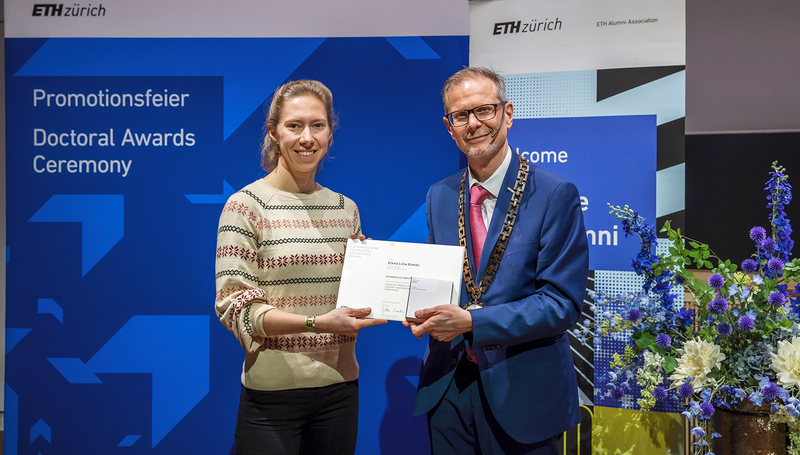
ETH Zurich awards the ETH Medal in recognition of excellent master and doctoral theses. Elena Gimmi was presented with the award on 24 January 2025 for her dissertation. The award acknowledges Gimmi’s findings on the influence of bacterial “bodyguards” on the co-evolution of the black bean aphid, a major pest in the area of food production, and its natural enemy the parasitoid wasp.
As a PhD student at the aquatic research institute Eawag, Elena Gimmi closely studied the tripartite relationship between the black bean aphid (Aphis fabae), a tiny parasitoid wasp (Lysiphlebus fabarum) and the bacterium Hamiltonella defensa. She was supervised by Prof. Christoph Vorburger and Prof. Jukka Jokela. Vorburger’s research group has been following the interplay between the three different organisms for years. Laboratory experiments showed that the bacterium H. defensa lives in the body of the bean aphid as a symbiont. It receives “board and lodging” from the aphid and, in return, protects it against parasitic wasps, the larvae of which devour the aphid. The bacteria presumably produce toxins which kill the eggs of the wasp.
Comprehensive range of data obtained in the field – despite Covid
Elena Gimmi has tested predictions obtained from basic laboratory research in wild populations under natural conditions for the first time. She examined in particular the patterns and seasonal dynamics in the resistance of the aphids. “I found it exciting and challenging to compare known results from laboratory testing with observations obtained from the real world,” says the environmental biologist.
The centrepiece of Gimmi’s work was a large-scale field study conducted over a two-year period. In three different areas around Zurich, Gimmi tracked the abundance of the bacteria in the aphids on a monthly basis. Over the same period of time, she also investigated how the risk of the aphid being parasitised by the wasp changed. “It was clear from the start that a lot of things could essentially go wrong. However, thanks to a combination of persistence and luck, the original plans for my thesis turned out quite well,” says Gimmi in retrospect.
“A tremendous amount of time and effort went into the field work. This was reflected in the high quality of the data collected, which allowed us to ascertain a significant number of new and important findings.”
Christoph Vorburger
Christoph Vorburger emphasises: “A tremendous amount of time and effort went into the field investigations. This was reflected in the high quality of the data collected, which allowed us to ascertain a significant number of new and important findings.” However, the important second year of the field project was put at serious risk by the Covid pandemic. The researcher quickly set up a home laboratory for the study of small insects with the help of her father and engaged her brother as a field assistant. This ensured a continuous flow of data and made it seem as though there had never been any lockdown. Vorburger: “That really was a great effort and I am also very grateful to Elena’s family for their support.”
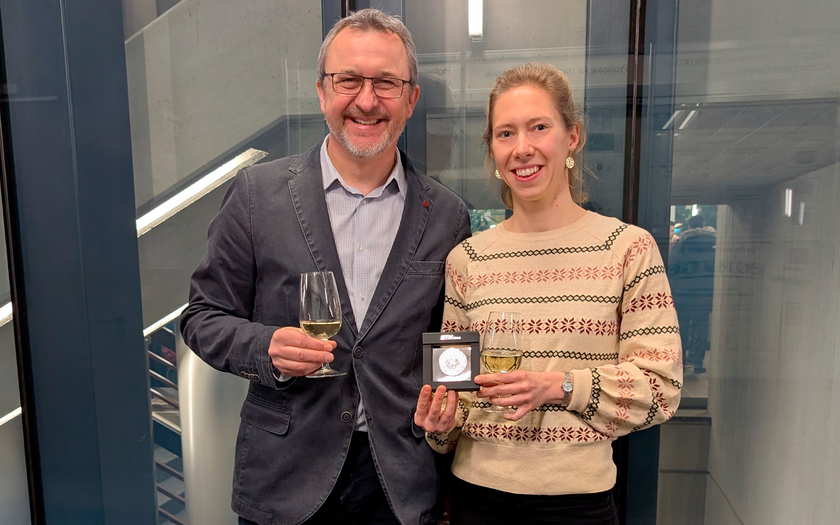
Christoph Vorburger and Elena Gimmi (Photo: Eawag).
Surprising influence of ambient temperature
Gimmi’s data provides new and, in some cases, surprising information on the relationship between the three unequal partners. This enabled the researcher to demonstrate that the frequency of the bacteria in the aphid populations fluctuated during the course of the year – and that the ambient temperature might exert a much greater influence than had been suspected. In other words: the warmer it was, the greater the frequency of bacterial “bodyguards” that were identified and the greater the resistance of the aphids. This could indicate that climate warming is impairing the use of parasitic wasps as a means of biological pest control.
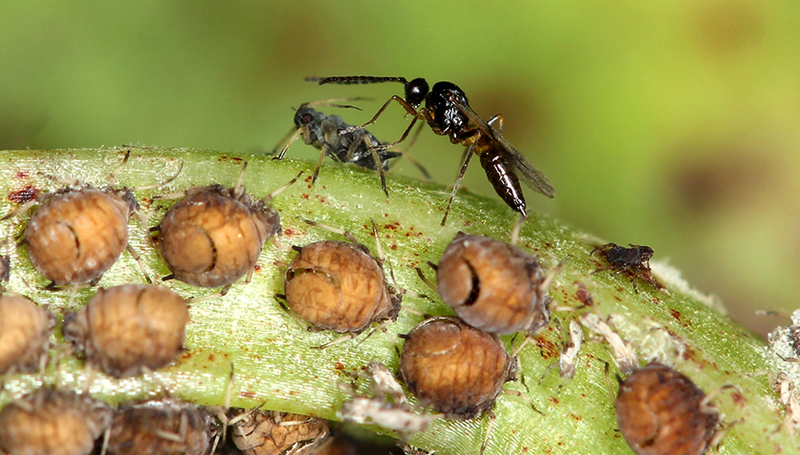
A parasitoid wasp attacking an aphid. The aphids visible in front have already been parasitised by the wasps
(Photo: Christoph Vorburger, Eawag).
Research will be continued at Eawag
Christoph Vorburger has been involved in academic teaching for over 20 years. He describes the award as being very well-deserved: “We were really extremely lucky to have succeeded in gaining Elena for this project. In addition to her talent, she brings a conscientious approach, diligence and a healthy dose of ambition, which helped her purposefully drive the challenging project forward. At the same time, she is an excellent team player. I am also impressed by the fact that just shortly after gaining her doctorate, every chapter of her thesis, without exception, was published in prestigious original publications.”
Gimmi’s findings also form the basis for a follow-up project at Eawag, which will be supported by the Swiss National Science Foundation through to 2027.
Cover picture: Elena Gimmi with ETH Rector Günther Dissertori (Photo: Alessandro della Bella).
array(5 items)0 => Snowflake\Publications\Domain\Model\Publicationprototypepersistent entity (uid=31284, pid=124)originalId => protected31284 (integer)
authors => protected'Gimmi, E. L.' (22 chars)
title => protected'Defensive symbiosis in the wild - patterns and dynamics of symbiont-conferre d resistance in natural host-parasitoid communities' (127 chars)
journal => protected'' (0 chars)
year => protected2023 (integer)
volume => protected0 (integer)
issue => protected'' (0 chars)
startpage => protected'175 p' (10 chars)
otherpage => protected'' (0 chars)
categories => protected'' (0 chars)
description => protected'Defensive symbiosis describes the interaction between two species where one species protects the other from dangers, in exchange for another benefit. Pr otagonist of this thesis is <em>Hamiltonella defensa</em>, a vertically tran smitted bacterial endosymbiont of aphids. <em>H. defensa</em> can defend its aphid host against parasitoid wasps and in return profits from nutrients an d shelter inside the aphid body. In wild aphid populations, <em>H. defensa</ em> often occurs at intermediate prevalence, that is, some aphid individuals carry the bacteria, but others do not. This might be explained by balancing selection, as carrying <em>H. defensa</em> has not only benefits but also c osts for the aphid. The tripartite interaction between aphids, <em>H. defens a</em> and aphid parasitoids is considered a model system for symbiont-drive n hostparasite coevolution and has been studied from various angles during t he past twenty years. However, there is still a lack of data on the role of defensive symbiosis in the ecology and evolution of natural communities. Wit h my PhD work, I sought to improve on that by studying patterns and dynamics of <em>H. defensa</em>-conferred resistance in the field. [...]<br /><br /> Symbiose beschreibt das enge Zusammenleben zweier unterschiedlicher Organism en. In sogenannten defensiven Symbiosen bietet eine Art der anderen Schutz o der Resistenz gegen Feinde oder Gefahren. Protagonist der vorliegenden Arbei t ist <em>Hamiltonella defensa</em>, ein endosymbiotisches Bakterium, das im Körper von Blattläusen lebt und von einer zur nächsten Blattlausgenerati on vererbt wird. <em>H. defensa</em> kann Blattläusen Resistenz gegen paras itische Schlupfwespen verleihen, welche wichtige natürliche Feinde der Läu se sind. <em>H. defensa</em> ist also ein defensiver Symbiont von Blattläus en. Im Gegenzug profitiert <em>H. defensa</em> von 'Kost und Logis' im Inner n der Blattlaus. In natürlichen Blattlauspopulationen leben meist einige In dividuen mit, andere ohn...' (2465 chars)
serialnumber => protected'' (0 chars)
doi => protected'10.3929/ethz-b-000617575' (24 chars)
uid => protected31284 (integer)
_localizedUid => protected31284 (integer)modified_languageUid => protectedNULL
_versionedUid => protected31284 (integer)modifiedpid => protected124 (integer)1 => Snowflake\Publications\Domain\Model\Publicationprototypepersistent entity (uid=32898, pid=124)originalId => protected32898 (integer)
authors => protected'Gimmi, E.; Wallisch, J.; Vorburger, C.' (53 chars)
title => protected'Ecological divergence despite common mating sites: genotypes and symbiotypes shed light on cryptic diversity in the black bean aphid species complex' (148 chars)
journal => protected'Heredity' (8 chars)
year => protected2024 (integer)
volume => protected132 (integer)
issue => protected'' (0 chars)
startpage => protected'320' (3 chars)
otherpage => protected'330' (3 chars)
categories => protected'' (0 chars)
description => protected'Different host plants represent ecologically dissimilar environments for phy tophagous insects. The resulting divergent selection can promote the evoluti on of specialized host races, provided that gene flow is reduced between pop ulations feeding on different plants. In black bean aphids belonging to the <em>Aphis fabae</em> complex, several morphologically cryptic taxa have been described based on their distinct host plant preferences. However, host cho ice and mate choice are largely decoupled in these insects: they are host-al ternating and migrate between specific summer host plants and shared winter hosts, with mating occurring on the shared hosts. This provides a yearly opp ortunity for gene flow among aphids using different summer hosts, and raises the question if and to what extent the ecologically defined taxa are reprod uctively isolated. Here, we analyzed a geographically and temporally structu red dataset of microsatellite genotypes from <em>A. fabae</em> that were mos tly collected from their main winter host <em>Euonymus europaeus</em>, and a dditionally from another winter host and fourteen summer hosts. The data rev eals multiple, strongly differentiated genetic clusters, which differ in the ir association with different summer and winter hosts. The clusters also dif fer in the frequency of infection with two heritable, facultative endosymbio nts, separately hinting at reproductive isolation and divergent ecological s election. Furthermore, we found evidence for occasional hybridization among genetic clusters, with putative hybrids collected more frequently in spring than in autumn. This suggests that similar to host races in other phytophago us insects, both prezygotic and postzygotic barriers including selection aga inst hybrids maintain genetic differentiation among <em>A. fabae</em> taxa, despite a common mating habitat.' (1856 chars)
serialnumber => protected'0018-067X' (9 chars)
doi => protected'10.1038/s41437-024-00687-0' (26 chars)
uid => protected32898 (integer)
_localizedUid => protected32898 (integer)modified_languageUid => protectedNULL
_versionedUid => protected32898 (integer)modifiedpid => protected124 (integer)2 => Snowflake\Publications\Domain\Model\Publicationprototypepersistent entity (uid=32442, pid=124)originalId => protected32442 (integer)
authors => protected'Gimmi, E.; Vorburger, C.' (34 chars)
title => protected'High specificity of symbiont-conferred resistance in an aphid-parasitoid fie ld community' (88 chars)
journal => protected'Journal of Evolutionary Biology' (31 chars)
year => protected2024 (integer)
volume => protected37 (integer)
issue => protected'2' (1 chars)
startpage => protected'162' (3 chars)
otherpage => protected'170' (3 chars)
categories => protected'host–parasite interactions; specificity of resistance; genotype-by-genotyp e interactions; aphids; Hamiltonella defensa; local adaptation' (138 chars)
description => protected'Host–parasite coevolution is mediated by genetic interactions between the antagonists and may lead to reciprocal adaptation. In the black bean aphid, <em>Aphis fabae fabae</em>, resistance to parasitoids can be conferred by th e heritable bacterial endosymbiont <em>Hamiltonella defensa</em>. <em>H. def ensa</em> has been shown to be variably protective against different parasit oid species, and different genotypes of the black bean aphid's main parasito id <em>Lysiphlebus fabarum</em>. However, these results were obtained using haphazard combinations of laboratory-reared insect lines with different orig ins, making it unclear how representative they are of natural, locally (co)a dapted communities. We therefore comprehensively sampled the parasitoids of a natural <em>A. f. fabae</em> population and measured the ability of the fi ve most abundant species to parasitize aphids carrying the locally prevalent <em>H. defensa</em> haplotypes. <em>H. defensa</em> provided resistance onl y against the dominant parasitoid <em>L. fabarum</em> (70% of all parasitoid s), but not against less abundant parasitoids, and resistance to <em>L. faba rum</em> acted in a genotype-specific manner (G × G interactions betwee n <em>H. defensa</em> and <em>L. fabarum</em>). These results confirm that s trong species- and genotype-specificity of symbiont-conferred resistance is indeed a hallmark of wild <em>A. f. fabae</em> populations, and they are con sistent with symbiont-mediated adaptation of aphids to the parasitoids posin g the highest risk.' (1539 chars)
serialnumber => protected'1010-061X' (9 chars)
doi => protected'10.1093/jeb/voad013' (19 chars)
uid => protected32442 (integer)
_localizedUid => protected32442 (integer)modified_languageUid => protectedNULL
_versionedUid => protected32442 (integer)modifiedpid => protected124 (integer)3 => Snowflake\Publications\Domain\Model\Publicationprototypepersistent entity (uid=30906, pid=124)originalId => protected30906 (integer)
authors => protected'Gimmi, E.; Wallisch, J.; Vorburger, C.' (53 chars)
title => protected'Defensive symbiosis in the wild: seasonal dynamics of parasitism risk and sy mbiont‐conferred resistance' (105 chars)
journal => protected'Molecular Ecology' (17 chars)
year => protected2023 (integer)
volume => protected32 (integer)
issue => protected'14' (2 chars)
startpage => protected'4063' (4 chars)
otherpage => protected'4077' (4 chars)
categories => protected'balancing selection; defensive symbiosis; Hamiltonella defensa; host-parasit e interactions; symbiont-conferred resistance; trade-offs' (133 chars)
description => protected'Parasite-mediated selection can rapidly drive up resistance levels in host p opulations, but fixation of resistance traits may be prevented by costs of r esistance. Black bean aphids (<em>Aphis fabae</em>) benefit from increased r esistance to parasitoids when carrying the defensive bacterial endosymbiont <em>Hamiltonella defensa</em>. However, due to fitness costs that come with symbiont infection, symbiont-conferred resistance may result in either a net benefit or a net cost to the aphid host, depending on parasitoid presence a s well as on the general ecological context. Balancing selection may therefo re explain why in natural aphid populations, <em>H. defensa</em> is often found at intermediate frequencies. Here we present a 2-year field study wher e we set out to look for signatures of balancing selection in natural aphid populations. We collected temporally well-resolved data on the prevalence of <em>H. defensa</em> in <em>A. f. fabae</em> and estimated the risk im posed by parasitoids using sentinel hosts. Despite a marked and consistent e arly-summer peak in parasitism risk, and significant changes in symbiont pre valence over time, we found just a weak correlation between parasitism risk and <em>H. defensa</em> frequency dynamics. <em>H. defensa</em> prevalen ce in the populations under study was, in fact, better explained by the numb er of heat days that previous aphid generations were exposed to. Our study g rants an unprecedentedly well-resolved insight into the dynamics of endosymb iont and parasitoid communities of <em>A. f. fabae</em> populations, and it adds to a growing body of empirical evidence suggesting that not only pa rasitism risk, but rather multifarious selection is shaping <em>H. defensa </em> prevalence in the wild.' (1777 chars)
serialnumber => protected'0962-1083' (9 chars)
doi => protected'10.1111/mec.16976' (17 chars)
uid => protected30906 (integer)
_localizedUid => protected30906 (integer)modified_languageUid => protectedNULL
_versionedUid => protected30906 (integer)modifiedpid => protected124 (integer)4 => Snowflake\Publications\Domain\Model\Publicationprototypepersistent entity (uid=23917, pid=124)originalId => protected23917 (integer)
authors => protected'Gimmi, E.; Vorburger, C.' (34 chars)
title => protected'Strong genotype-by-genotype interactions between aphid-defensive symbionts a nd parasitoids persist across different biotic environments' (135 chars)
journal => protected'Journal of Evolutionary Biology' (31 chars)
year => protected2021 (integer)
volume => protected34 (integer)
issue => protected'12' (2 chars)
startpage => protected'1944' (4 chars)
otherpage => protected'1953' (4 chars)
categories => protected'aphids; defensive symbiosis; genotype-by-genotype interactions; host–paras ite coevolution; parasitoids; resistance' (116 chars)
description => protected'The dynamics of coevolution between hosts and parasites are influenced by th eir genetic interactions. Highly specific interactions, where the outcome of an infection depends on the precise combination of host and parasite genoty pes (G × G interactions), have the potential to maintain genetic variatio n by inducing negative frequency-dependent selection. The importance of this effect also rests on whether such interactions are consistent across differ ent environments or modified by environmental variation (G × G × E int eraction). In the black bean aphid, <em>Aphis fabae</em>, resistance to its parasitoid <em>Lysiphlebus fabarum</em> is largely determined by the possess ion of a heritable bacterial endosymbiont, <em>Hamiltonella defensa</em>, wi th strong G × G interactions between <em>H</em>. <em>defensa</em> and <e m>L</em>. <em>fabarum</em>. A key environmental factor in this system is th e host plant on which the aphid feeds. Here, we exposed genetically identica l aphids harbouring three different strains of <em>H</em>. <em>defensa</em> to three asexual genotypes of <em>L</em>. <em>fabarum</em> and measured pa rasitism success on three common host plants of <em>A</em>. <em>fabae</em>, namely <em>Vicia faba</em>, <em>Chenopodium album</em> and <em>Beta vulgari s</em>. As expected, we observed the pervasive G × G interaction between <em>H</em>. <em>defensa</em> and <em>L</em>. <em>fabarum</em>, but despite strong main effects of the host plants on average rates of parasitism, this interaction was not altered significantly by the host plant environment (n o G × G × E interaction). The symbiont-conferred specificity of resist ance is thus likely to mediate the coevolution of <em>A</em>. <em>fabae</em > and <em>L</em>. <em>fabarum</em>, even when played out across diverse hos t plants of the aphid.' (1846 chars)
serialnumber => protected'1010-061X' (9 chars)
doi => protected'10.1111/jeb.13953' (17 chars)
uid => protected23917 (integer)
_localizedUid => protected23917 (integer)modified_languageUid => protectedNULL
_versionedUid => protected23917 (integer)modifiedpid => protected124 (integer)
Defensive symbiosis in the wild - patterns and dynamics of symbiont-conferred resistance in natural host-parasitoid communities
Defensive symbiosis describes the interaction between two species where one species protects the other from dangers, in exchange for another benefit. Protagonist of this thesis is Hamiltonella defensa, a vertically transmitted bacterial endosymbiont of aphids. H. defensa can defend its aphid host against parasitoid wasps and in return profits from nutrients and shelter inside the aphid body. In wild aphid populations, H. defensa often occurs at intermediate prevalence, that is, some aphid individuals carry the bacteria, but others do not. This might be explained by balancing selection, as carrying H. defensa has not only benefits but also costs for the aphid. The tripartite interaction between aphids, H. defensa and aphid parasitoids is considered a model system for symbiont-driven hostparasite coevolution and has been studied from various angles during the past twenty years. However, there is still a lack of data on the role of defensive symbiosis in the ecology and evolution of natural communities. With my PhD work, I sought to improve on that by studying patterns and dynamics of H. defensa-conferred resistance in the field. [...]
Symbiose beschreibt das enge Zusammenleben zweier unterschiedlicher Organismen. In sogenannten defensiven Symbiosen bietet eine Art der anderen Schutz oder Resistenz gegen Feinde oder Gefahren. Protagonist der vorliegenden Arbeit ist Hamiltonella defensa, ein endosymbiotisches Bakterium, das im Körper von Blattläusen lebt und von einer zur nächsten Blattlausgeneration vererbt wird. H. defensa kann Blattläusen Resistenz gegen parasitische Schlupfwespen verleihen, welche wichtige natürliche Feinde der Läuse sind. H. defensa ist also ein defensiver Symbiont von Blattläusen. Im Gegenzug profitiert H. defensa von 'Kost und Logis' im Innern der Blattlaus. In natürlichen Blattlauspopulationen leben meist einige Individuen mit, andere ohne symbiotische H. defensa. Das wird damit erklärt, dass H. defensa für die Läuse nicht nur Vorteile bringt, sondern auch Kosten. Diese Kosten kommen besonders dann zur Geltung, wenn keine Schlupfwespen die Blattläuse bedrohen, weil die Resistenz gegen solche dann nichts bringt, H. defensa aber weiterhin von den Blattlausressourcen zehrt. Je nach Situation sind also Blattläuse mit oder solche ohne H. defensa fitter. [...]
Gimmi, E. L. (2023) Defensive symbiosis in the wild - patterns and dynamics of symbiont-conferred resistance in natural host-parasitoid communities, 175 p, doi:10.3929/ethz-b-000617575, Institutional Repository
Ecological divergence despite common mating sites: genotypes and symbiotypes shed light on cryptic diversity in the black bean aphid species complex
Different host plants represent ecologically dissimilar environments for phytophagous insects. The resulting divergent selection can promote the evolution of specialized host races, provided that gene flow is reduced between populations feeding on different plants. In black bean aphids belonging to the Aphis fabae complex, several morphologically cryptic taxa have been described based on their distinct host plant preferences. However, host choice and mate choice are largely decoupled in these insects: they are host-alternating and migrate between specific summer host plants and shared winter hosts, with mating occurring on the shared hosts. This provides a yearly opportunity for gene flow among aphids using different summer hosts, and raises the question if and to what extent the ecologically defined taxa are reproductively isolated. Here, we analyzed a geographically and temporally structured dataset of microsatellite genotypes from A. fabae that were mostly collected from their main winter host Euonymus europaeus, and additionally from another winter host and fourteen summer hosts. The data reveals multiple, strongly differentiated genetic clusters, which differ in their association with different summer and winter hosts. The clusters also differ in the frequency of infection with two heritable, facultative endosymbionts, separately hinting at reproductive isolation and divergent ecological selection. Furthermore, we found evidence for occasional hybridization among genetic clusters, with putative hybrids collected more frequently in spring than in autumn. This suggests that similar to host races in other phytophagous insects, both prezygotic and postzygotic barriers including selection against hybrids maintain genetic differentiation among A. fabae taxa, despite a common mating habitat.
Gimmi, E.; Wallisch, J.; Vorburger, C. (2024) Ecological divergence despite common mating sites: genotypes and symbiotypes shed light on cryptic diversity in the black bean aphid species complex, Heredity, 132, 320-330, doi:10.1038/s41437-024-00687-0, Institutional Repository
High specificity of symbiont-conferred resistance in an aphid-parasitoid field community
Host–parasite coevolution is mediated by genetic interactions between the antagonists and may lead to reciprocal adaptation. In the black bean aphid, Aphis fabae fabae, resistance to parasitoids can be conferred by the heritable bacterial endosymbiont Hamiltonella defensa. H. defensa has been shown to be variably protective against different parasitoid species, and different genotypes of the black bean aphid's main parasitoid Lysiphlebus fabarum. However, these results were obtained using haphazard combinations of laboratory-reared insect lines with different origins, making it unclear how representative they are of natural, locally (co)adapted communities. We therefore comprehensively sampled the parasitoids of a natural A. f. fabae population and measured the ability of the five most abundant species to parasitize aphids carrying the locally prevalent H. defensa haplotypes. H. defensa provided resistance only against the dominant parasitoid L. fabarum (70% of all parasitoids), but not against less abundant parasitoids, and resistance to L. fabarum acted in a genotype-specific manner (G × G interactions between H. defensa and L. fabarum). These results confirm that strong species- and genotype-specificity of symbiont-conferred resistance is indeed a hallmark of wild A. f. fabae populations, and they are consistent with symbiont-mediated adaptation of aphids to the parasitoids posing the highest risk.
Gimmi, E.; Vorburger, C. (2024) High specificity of symbiont-conferred resistance in an aphid-parasitoid field community, Journal of Evolutionary Biology, 37(2), 162-170, doi:10.1093/jeb/voad013, Institutional Repository
Defensive symbiosis in the wild: seasonal dynamics of parasitism risk and symbiont‐conferred resistance
Parasite-mediated selection can rapidly drive up resistance levels in host populations, but fixation of resistance traits may be prevented by costs of resistance. Black bean aphids (Aphis fabae) benefit from increased resistance to parasitoids when carrying the defensive bacterial endosymbiont Hamiltonella defensa. However, due to fitness costs that come with symbiont infection, symbiont-conferred resistance may result in either a net benefit or a net cost to the aphid host, depending on parasitoid presence as well as on the general ecological context. Balancing selection may therefore explain why in natural aphid populations, H. defensa is often found at intermediate frequencies. Here we present a 2-year field study where we set out to look for signatures of balancing selection in natural aphid populations. We collected temporally well-resolved data on the prevalence of H. defensa in A. f. fabae and estimated the risk imposed by parasitoids using sentinel hosts. Despite a marked and consistent early-summer peak in parasitism risk, and significant changes in symbiont prevalence over time, we found just a weak correlation between parasitism risk and H. defensa frequency dynamics. H. defensa prevalence in the populations under study was, in fact, better explained by the number of heat days that previous aphid generations were exposed to. Our study grants an unprecedentedly well-resolved insight into the dynamics of endosymbiont and parasitoid communities of A. f. fabae populations, and it adds to a growing body of empirical evidence suggesting that not only parasitism risk, but rather multifarious selection is shaping H. defensa prevalence in the wild.
Gimmi, E.; Wallisch, J.; Vorburger, C. (2023) Defensive symbiosis in the wild: seasonal dynamics of parasitism risk and symbiont‐conferred resistance, Molecular Ecology, 32(14), 4063-4077, doi:10.1111/mec.16976, Institutional Repository
Strong genotype-by-genotype interactions between aphid-defensive symbionts and parasitoids persist across different biotic environments
The dynamics of coevolution between hosts and parasites are influenced by their genetic interactions. Highly specific interactions, where the outcome of an infection depends on the precise combination of host and parasite genotypes (G × G interactions), have the potential to maintain genetic variation by inducing negative frequency-dependent selection. The importance of this effect also rests on whether such interactions are consistent across different environments or modified by environmental variation (G × G × E interaction). In the black bean aphid, Aphis fabae, resistance to its parasitoid Lysiphlebus fabarum is largely determined by the possession of a heritable bacterial endosymbiont, Hamiltonella defensa, with strong G × G interactions between H. defensa and L. fabarum. A key environmental factor in this system is the host plant on which the aphid feeds. Here, we exposed genetically identical aphids harbouring three different strains of H. defensa to three asexual genotypes of L. fabarum and measured parasitism success on three common host plants of A. fabae, namely Vicia faba, Chenopodium album and Beta vulgaris. As expected, we observed the pervasive G × G interaction between H. defensa and L. fabarum, but despite strong main effects of the host plants on average rates of parasitism, this interaction was not altered significantly by the host plant environment (no G × G × E interaction). The symbiont-conferred specificity of resistance is thus likely to mediate the coevolution of A. fabae and L. fabarum, even when played out across diverse host plants of the aphid.
Gimmi, E.; Vorburger, C. (2021) Strong genotype-by-genotype interactions between aphid-defensive symbionts and parasitoids persist across different biotic environments, Journal of Evolutionary Biology, 34(12), 1944-1953, doi:10.1111/jeb.13953, Institutional Repository