News Detail

New perspectives thanks to wastewater monitoring

July 17, 2025 | Andri Brnyer

Wastewater monitoring became well known during the coronavirus period from 2020, when Eawag and its partners began monitoring whether and which coronaviruses could be detected in wastewater throughout Switzerland. However, the researchers are now able to make far more statements about the health of the population because other pathogens and traces of medicines and drugs are also being monitored in parallel. The combination of data from both programmes opens up new perspectives.

Is a new variant of the coronavirus spreading? Is there a major flu epidemic or is monkeypox on the way? Wastewater monitoring can answer such questions, at least as soon as research - constantly in a race with the pathogens - has adapted the methods for detecting traces of these pathogens in municipal wastewater. Currently, the advance of the Stratus variant, a sub-variant of Omikron, can be seen: In mid-June, it replaced its predecessor "Nimbus" in five of the six Swiss wastewater treatment plants whose wastewater is analysed using sequencing. In Chur, for example, up to 99 per cent of coronaviruses, or virus fragments, could be assigned to Stratus. In Zurich it was up to 75 per cent, in Lugano up to 80 per cent. The data is freely available on a dashboard of the ETH Group for Bioinformatics. This is interesting, but according to the World Health Organisation (WHO) it does not appear to be a cause for particular concern. XFG, the technical name for the stratus variant, does not lead to more or more severe cases of disease than other variants in circulation, writes the WHO in its risk assessment.

Drug monitoring together with the EU

The researchers, together with a team at the University of Lausanne (UNIL), were already tracking traces of drugs and medicines in wastewater well before the coronavirus pandemic. With standardised ring tests in various countries, Eawag has even made a significant contribution to establishing the wastewater-based drug monitoring of the EU Drugs Agency (EUDA). In 2017, the Federal Office of Public Health FOPH signed a cooperation agreement with the EMCDDA (European Monitoring Centre for Drugs and Drug Addiction), the predecessor of the EUDA. Today, wastewater monitoring is a pillar of European drug monitoring and the reports published annually. The associated EUDA data platform is freely accessible and also includes data from Switzerland.

Wastewater as an indicator of public health

Since 2021, wastewater analyses for viruses and for drugs and medicines have largely run in parallel, currently with samples from the six wastewater treatment plants in Basel, Chur, Geneva, Laupen, Lugano and Zurich. Priority respiratory viruses (SARS-CoV-2, influenza A and B, RSV) and 15 active pharmaceutical ingredients or their metabolites formed in the body are analysed. These include substances from cough and flu medicines, antibiotics, opioids and antidepressants. The data can be accessed on two platforms - for viruses here: https://wise.ethz.ch/ ; for pharmaceuticals and drugs here: https://www.dromedario.ch/ .

The combination of two programmes launched for different reasons now allows researchers to carry out completely new analyses: for example, it is expected that an increase in flu viruses will also be accompanied by a quantitative increase in flu drugs in wastewater. A study recently published in the journal Nature Water shows that this is largely true. However, the analyses also showed peaks in drug consumption that cannot be explained by waves of pathogens previously measured in wastewater. For example, the consumption of medicines for coughs, pain or fever that can be detected in wastewater may already indicate symptoms in the population, even if the responsible triggers are not (or not yet) known. In the case of the above-mentioned study, a subsequent comparison with data from hospitals and GPs showed that the drug peaks were possibly due to rampant rhinoviruses (cold viruses) and pertussis bacteria (whooping cough).

Early indications of new pathogens?

For Eawag Deputy Director Christian Stamm, the combined chemical and microbiological analysis of wastewater offers an opportunity for early detection of emerging diseases and stressful symptoms in society, even if it is not yet clear what to look for. In order to successfully exploit this potential of wastewater-based epidemiology, interdisciplinary collaboration between experts on the chemical and microbiological side is essential, both in research and in practice, says Stamm, adding: "In order to efficiently achieve comparable results throughout Switzerland, the standardisation of sampling, sample storage and analyses as well as joint data management also played an important role."

"Combining chemical and microbiological analyses of wastewater is a great opportunity, but requires ongoing input from research."
Christian Stamm, Deputy Director of Eawag

The measles outbreak in the canton of Vaud

The measles outbreak from January to March 2024 in western Switzerland is a good example of how young the research field of wastewater-based epidemiology still is. For a long time, it was unclear whether the measles genetic material found in wastewater really came from "wild" measles or from a vaccine strain. Therefore, an analysis method that could differentiate between wild-type RNA and vaccine RNA first had to be developed and tested. In the end, the researchers were able to subsequently detect the increase - thanks to frozen wastewater samples. However, the virus levels were low and fluctuated greatly. And from 12 February onwards, the samples no longer showed any measles RNA, although around 30 cases had been reported by the beginning of March. The researchers were unable to determine whether the infected persons were not connected to the sewage treatment plant sampled or whether the incidence was simply too low. Study published on 22 May 2025 in Environmental Science and Technology.
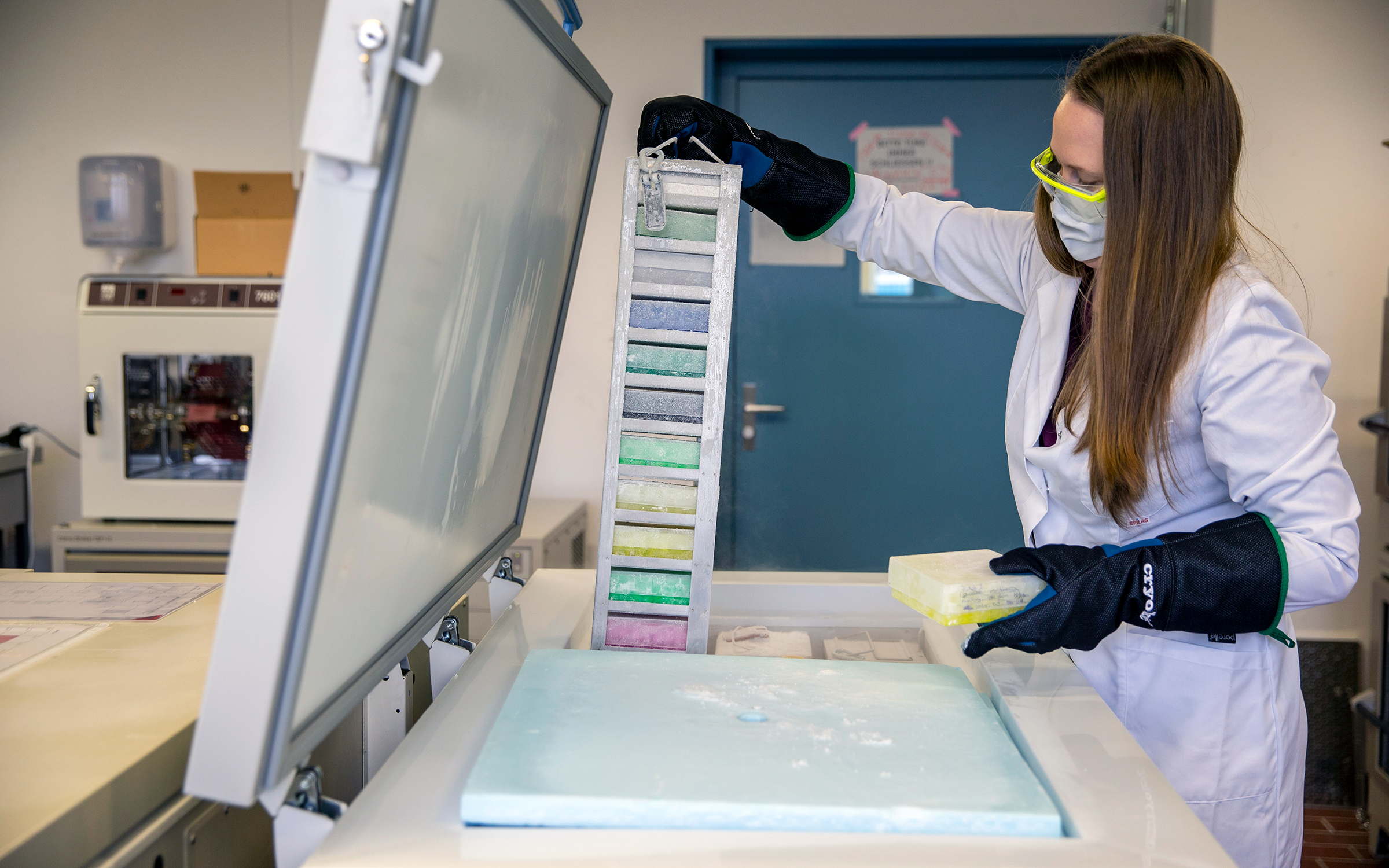
Tiefgefrorene Abwasserproben erlauben auch spätere Analysen, sofern dazu erst neue Verfahren erforscht werden müssen. (Foto: Eawag, Esther Michel)
Deep-frozen wastewater samples can also be analysed at a later date, provided that new methods need to be researched first. (Photo: Eawag, Esther Miche)

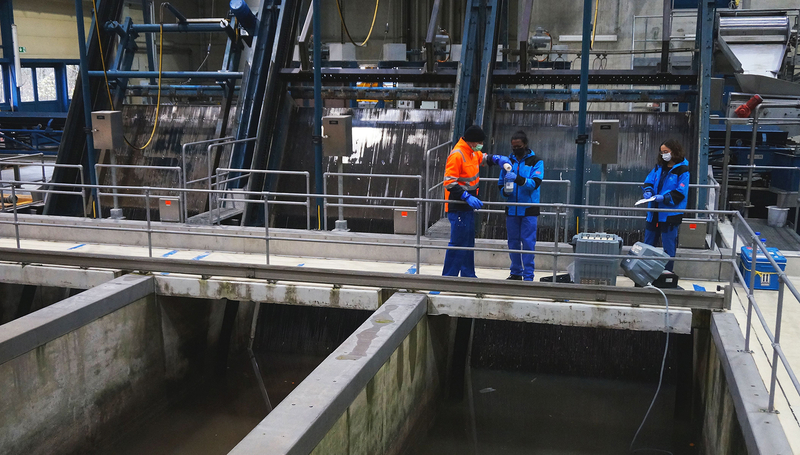
Cover picture: Sampling during the corona epidemic at the Werdhölzli wastewater treatment plant in Zurich (Photo: Eawag, Andri Bryner)
 

Original publications

Extbase Variable Dump
array(3 items)
   publications => '34703,34768' (11 chars)
   libraryUrl => '' (0 chars)
   layout => '0' (1 chars)
Extbase Variable Dump
array(2 items)
   0 => Snowflake\Publications\Domain\Model\Publicationprototypepersistent entity (uid=34703, pid=124)
      originalId => protected34703 (integer)
      authors => protected'Baumgartner, S.; Salvisberg, M.; Schmidhalter, P.; Julian,&nb
         sp;T. R.; Ort, C.; Singer, H.
' (120 chars) title => protected'Insights into respiratory illness at the population level through parallel a
         nalysis of pharmaceutical and viral markers in wastewater
' (133 chars) journal => protected'Nature Water' (12 chars) year => protected2025 (integer) volume => protected3 (integer) issue => protected'' (0 chars) startpage => protected'580' (3 chars) otherpage => protected'589' (3 chars) categories => protected'' (0 chars) description => protected'Wastewater as a medium contains information on both circulating pathogens an
         d drug consumption at the population level. This study combines tracking of
         respiratory viruses and quantification of pharmaceuticals as untargeted indi
         cators of symptoms related to acute respiratory infections and influenza-lik
         e illnesses such as coughing, fever and pain. From January 2021 to June 2024
         , raw wastewater samples from ten locations covering 23% of the Swiss popula
         tion were analysed. This encompassed 15 pharmaceuticals and four priority re
         spiratory viruses including severe acute respiratory syndrome coronavirus vi
         rus-2 (SARS-CoV-2), respiratory syncytial virus (RSV), influenza A and influ
         enza B viruses. The pharmaceutical compounds dextromethorphan, pheniramine,
         clarithromycin, acetaminophen and codeine showed a strong correlation with r
         espiratory virus loads in wastewater. This enabled the estimation of pathoge
         n-specific and cumulative symptom treatment in the population. In 2021 and 2
         024, notable increases in pharmaceutical loads without corresponding increas
         es in viral loads signalled high community symptoms linked to unsurveilled p
         athogens. This study demonstrates that pharmaceutical surveillance can infor
         m respiratory disease burden and highlights the value of integrated surveill
         ance for assessing emerging public health threats beyond those routinely mon
         itored.
' (1375 chars) serialnumber => protected'' (0 chars) doi => protected'10.1038/s44221-025-00437-4' (26 chars) uid => protected34703 (integer) _localizedUid => protected34703 (integer)modified _languageUid => protectedNULL _versionedUid => protected34703 (integer)modified pid => protected124 (integer)
1 => Snowflake\Publications\Domain\Model\Publicationprototypepersistent entity (uid=34768, pid=124) originalId => protected34768 (integer) authors => protected'Gan, C.; Pitton, M.; de Korne-Elenbaas, J.; Cobuccio, L.
         ; Cassini, A.; Ort, C.; Julian, T. R.
' (133 chars) title => protected'Retrospective wastewater tracking of measles outbreak in western Switzerland
          in winter 2024
' (91 chars) journal => protected'Environmental Science and Technology Letters' (44 chars) year => protected2025 (integer) volume => protected12 (integer) issue => protected'6' (1 chars) startpage => protected'689' (3 chars) otherpage => protected'694' (3 chars) categories => protected'measles; wastewater surveillance; digital PCR; outbreak detection; strain di
         fferentiation
' (89 chars) description => protected'Measles outbreaks remain a significant public health challenge, despite high
          vaccination coverage in many regions. Wastewater-based surveillance (WBS) o
         ffers a noninvasive and community-level approach to monitoring the circulati
         on of pathogens, including the measles virus. Here, we retrospectively appli
         ed a duplex digital PCR assay to distinguish between wild-type and vaccine s
         trains of the measles virus in wastewater samples available from an existing
          national WBS program. Samples originated from the wastewater treatment plan
         t serving the Lausanne city catchment area, where an outbreak occurred befor
         e spreading to the broader Canton Vaud region. Despite high vaccination rate
         s, viral loads of the measles wild type were detected during the first trans
         mission event involving 21 cases identified within a week. However, viral lo
         ads were no longer detectable after the initial 21 cases, despite an additio
         nal 30 cases reported in the following 3 weeks, possibly due to lower incide
         nce rate or location outside the catchment. Measles vaccine strain was not d
         etected during the outbreak. Our results demonstrate the complementarity of
         WBS with clinical surveillance and suggest its potential as an early warning
          system for measles and other vaccine-preventable diseases. Further improvem
         ents in the assay sensitivity and integration with epidemiological data coul
         d enhance the utility of WBS for outbreak detection and control.
' (1432 chars) serialnumber => protected'' (0 chars) doi => protected'10.1021/acs.estlett.5c00244' (27 chars) uid => protected34768 (integer) _localizedUid => protected34768 (integer)modified _languageUid => protectedNULL _versionedUid => protected34768 (integer)modified pid => protected124 (integer)
Baumgartner, S.; Salvisberg, M.; Schmidhalter, P.; Julian, T. R.; Ort, C.; Singer, H. (2025) Insights into respiratory illness at the population level through parallel analysis of pharmaceutical and viral markers in wastewater, Nature Water, 3, 580-589, doi:10.1038/s44221-025-00437-4, Institutional Repository
Gan, C.; Pitton, M.; de Korne-Elenbaas, J.; Cobuccio, L.; Cassini, A.; Ort, C.; Julian, T. R. (2025) Retrospective wastewater tracking of measles outbreak in western Switzerland in winter 2024, Environmental Science and Technology Letters, 12(6), 689-694, doi:10.1021/acs.estlett.5c00244, Institutional Repository