News Detail

Trees need water to cool the city

September 12, 2025 | ETH Zürich, D-BAUG, Iris Mickein

Urban trees are often seen as natural allies in fighting summer heat waves. But how much they actually help to cool their surroundings depends heavily on how moist the soil is. This is the main finding of a new study, led by environmental engineers at ETH Zurich and Eawag, which investigated several urban neighbourhoods in Zurich.

The research team wanted to understand how well trees can cool cities and what trees need to do so. The conclusion is clear: water is essential. Only when the soil around the trees is sufficiently moist can the trees noticeably lower the surrounding air temperature. The study also shows that evaporation from the ground itself plays a crucial role, cooling the air in a similar way to a damp sponge slowly drying out.

In Zurich’s less densely built neighbourhoods, where there is more space for greenery, watered trees can create areas largely free from heat stress. In more compact districts, however, even extensive greening reaches its limits – especially on very hot days. The cooling potential of urban greenery depends on both the availability of space for vegetation and the trees’ water supply.

Another finding from the study was that shade is a primary cooling mechanism for thermal comfort, making trees more effective than shrubs and irrigated grass. Irrigation strengthens this effect by sustaining evaporative cooling, and the researchers suggest automated systems that adjust to weather forecasts to keep soils most during prolonged heat.

Cities need broader heat management plans

The study’s findings can help cities plan and maintain green spaces more effectively, while also understanding their limitations. Planting trees is not sufficient – they must also be watered, especially in locations where they can have the greatest cooling impact. The researchers also recommend further investigation into factors such as tree species, soil type and tree age to better understand and optimise the cooling potential of urban greenery.

Yet, even with irrigation and strategic tree planting planning, the study shows that trees alone cannot fully offset heat stress during extreme summer days. “On heatwave days in Zurich, it will not be possible to create heat shelters that fully solve heat by only using trees and water”, explains Lucas Gobatti, first author and doctoral student at ETH Zurich’s Department of Civil, Environmental and Geomatic Engineering and at the aquatic research institute Eawag. “The city should also consider improving heat adaptation plans, following examples such as Barcelona, where citizens are given access to public buildings to cool down, rehydrate and reduce heat exhaustion during heatwaves.”
 

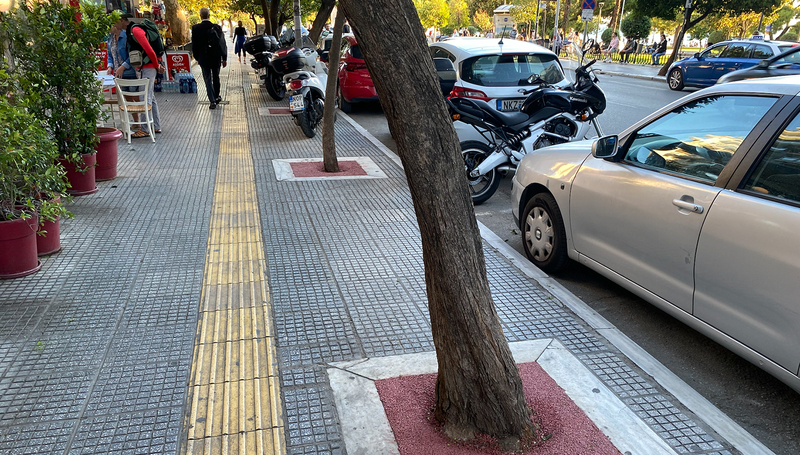
Cover picture: A tree with little space for collecting rainwater from the street will suffer from water deficit, reducing its capacity to cool down its surroundings. (Photo: Lucas Gobatti)
 

Original publication

Extbase Variable Dump
array(3 items)
   publications => '34732' (5 chars)
   libraryUrl => '' (0 chars)
   layout => '0' (1 chars)
Extbase Variable Dump
array(1 item)
   0 => Snowflake\Publications\Domain\Model\Publicationprototypepersistent entity (uid=34732, pid=124)
      originalId => protected34732 (integer)
      authors => protected'Gobatti, L.; Bach, P. M.; Maurer, M.; Leitão, J.&n
         bsp;P.
' (82 chars) title => protected'Impact of soil moisture content on urban tree evaporative cooling and human
         thermal comfort
' (91 chars) journal => protected'npj Urban Sustainability' (24 chars) year => protected2025 (integer) volume => protected5 (integer) issue => protected'' (0 chars) startpage => protected'26 (16 pp.)' (11 chars) otherpage => protected'' (0 chars) categories => protected'' (0 chars) description => protected'Urban temperatures are rising, and urban trees can help mitigate the consequ
         ences of heat stress. However, the influence of water availability on the ev
         aporative cooling efficiency of trees across diverse urban settings remains
         insufficiently understood. We modelled how varying soil moisture, built envi
         ronment and tree amounts affect human thermal comfort. Our results show that
          increasing tree cover and maintaining high soil moisture through irrigation
          can generate areas of 'no thermal stress' in Zurich during an average summe
         r day, primarily via direct soil evaporation and in less dense Local Climate
          Zones. In denser built environments and without enough soil moisture, achie
         ving such thermal comfort proved more challenging. On extreme summer days, h
         owever, even extensive tree planting and full irrigation were insufficient t
         o alleviate heat stress, indicating the need for additional adaptation strat
         egies. Our study underscores the critical but limited role of tree planting
         and water management in mitigating urban heat, offering practical recommenda
         tions for green infrastructure managers. (Figure presented.)
' (1124 chars) serialnumber => protected'' (0 chars) doi => protected'10.1038/s42949-025-00220-0' (26 chars) uid => protected34732 (integer) _localizedUid => protected34732 (integer)modified _languageUid => protectedNULL _versionedUid => protected34732 (integer)modified pid => protected124 (integer)
Gobatti, L.; Bach, P. M.; Maurer, M.; Leitão, J. P. (2025) Impact of soil moisture content on urban tree evaporative cooling and human thermal comfort, npj Urban Sustainability, 5, 26 (16 pp.), doi:10.1038/s42949-025-00220-0, Institutional Repository