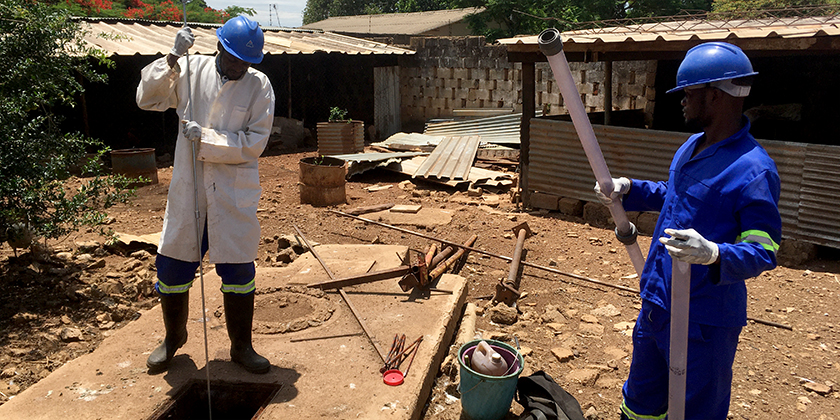
Sustainable management requires estimates of the Q&Q that are accumulating at community to city-wide scales.
Sustainable management of faecal sludge requires reasonable estimates of the quantities and qualities (Q&Q) that are accumulating at community to city-wide scale. In situ Q&Qs of faecal sludge are difficult to estimate, as faecal sludge is often stored underground in containments, records frequently do not exist, and construction is not standardized, but estimates are necessary for planning scenarios as it represents the total amount and characteristics of faecal sludge that needs to be managed. For more on measuring in situ volumes of faecal sludge, refer to the Volaser. In the past, people have estimated Q&Qs based on literature values from other contexts, or educated guesses from users and emptying service providers, but these estimates were not adequate to capture the desired accuracy and range of variability.
To address this deficiency, a methodology was developed by Eawag/Sandec, using forms of demographic (e.g. income level, number of users), environmental (e.g. soil conditions, groundwater), and technical (e.g. containment type, inputs to containment) forms of data to group together accumulated Q&Qs of faecal sludge to make localized projections. Demographic, environmental, and technical (DET) forms of data are also spatially analyzable, which is important for city-wide planning. This methodology has evolved during implementations in seven cities, and is now fully described in a book chapter in the IWA publication ‘Methods of Faecal Sludge Analysis’, which can be found here. Further developments we are working on to improve the methodology include remote sensing, and different types of machine learning and predictive modeling
Publications are listed below, steps in methodology development include:
Q&Q studies in Kampala, Uganda, and Hanoi, Vietnam, where the first sampling plans were tested during conceptualization of the methodology.
Two Master theses in Dar es Salaam, Tanzania, which looked at Q&Q on a neighborhood scale. The first conceptualization tests for the Volaser were also done here.
Determining Q&Q of faecal sludge in Sircilla, a small town in India, where different methods for measuring faecal sludge accumulation rate were tested and compared.
Collaboration with the Systems Analysis & Modeling department at Eawag to analyze spatial patterns in Q&Q data, and to explore whether models could be made from existing data that can be used in the future for making predictions with increased accuracy at a lower cost.
Large scale Q&Q study in Lusaka, Zambia, where the objective was to make estimates of accumulating faecal sludge Q&Qs in Lusaka. 400+ samples were taken in situ from onsite sanitation technologies all over the city.
Sharing of raw data for 845 samples taken in four cities (180 Kampala, Uganda, 80 Hanoi, Vietnam, 164 Sircilla, India, 421 Lusaka, Zambia)
Collaborators
Makarere University
National Water and Sewerage Corporation (Uganda)
Hanoi University of Civil Engineering
University of Dar es Salaam
University of Zambia
CDD Society
Kwame Nkrumah University of Science and Technology
array(10 items)0 => Snowflake\Publications\Domain\Model\Publicationprototypepersistent entity (uid=30343, pid=124)originalId => protected30343 (integer)
authors => protected'Andriessen, N.; Appiah-Effah, E.; Browne, S. J. I.; al Jahjah, R.; Kabika, J.; Kinobe, J. R.; Korir, N .; Nishimwe, P.; Niwagaba, C. B.; Pradeep, R.; Prasad,&n bsp;P.; Tembo, J. M.; William, A.; Ambuehl, B.; Strande, L.' (312 chars)
title => protected'Quantities and qualities of fecal sludge: experiences from field implementat ion with a Volaser in 7 countries during a pandemic' (127 chars)
journal => protected'Frontiers in Water' (18 chars)
year => protected2023 (integer)
volume => protected5 (integer)
issue => protected'' (0 chars)
startpage => protected'1130081 (14 pp.)' (16 chars)
otherpage => protected'' (0 chars)
categories => protected'accumulation rate; characteristics; statistical relations; standardized appr oaches; distance sensor; fecal sludge' (113 chars)
description => protected'Reasonable estimates for quantities and qualities (Q&Q) of fecal sludge that accumulate in onsite sanitation containments are fundamental for the de sign of appropriate management and treatment solutions, from community to ci ty-scale. There are increasing attempts to improve Q&Q estimates, but cu rrent approaches are still at a conceptual level, and are not yet standardiz ed with confirmed statistical relationships. To reach this level, we will ne ed consistent approaches for planning, measuring, and global collaborations. Hence, the objectives of this study were: (1) to assess and compare Q&Q of fecal sludge from seven cities and communities, and explore statistical relationships that could be used to increase accuracy of Q&Q estimations ; (2) to test and launch the Volaser device for measuring <em>in situ</em> v olumes of fecal sludge; and (3) to capture lessons learned from field implem entation with collaborators in seven countries during a global pandemic when no international travel was possible. The study took place in Ghana, India, Lebanon, Kenya, Sierra Leone, Uganda, and Zambia during the COVID-19 pandem ic. Q&Qs were measured in 204 containments with a Volaser, laboratory an alysis, and questionnaire. Results indicate that there are differences in To tal Solids (TS) and Chemical Oxygen Demand (COD) in fecal sludge based on co ntainment type, toilet type, source, and whether there is a water connection on the premises. Based on the results of this study, together with previous ly published open-source data, an empirical relationship for Volatile Solids (VS) and TS of 0.49 (<em>R</em><sup>2</sup> = 0.88) was established using 1 ,206 data points. For COD/TS, no significant relationship was observed. Deve loping such empirical relationships will be useful for planning and modeling approaches. An external evaluation was conducted to evaluate overall projec t management, Volaser technology transfer, and effects of collaborating duri ng the COVID-19 pandemic...' (2450 chars)
serialnumber => protected'' (0 chars)
doi => protected'10.3389/frwa.2023.1130081' (25 chars)
uid => protected30343 (integer)
_localizedUid => protected30343 (integer)modified_languageUid => protectedNULL
_versionedUid => protected30343 (integer)modifiedpid => protected124 (integer)1 => Snowflake\Publications\Domain\Model\Publicationprototypepersistent entity (uid=22150, pid=124)originalId => protected22150 (integer)
authors => protected'Strande, L.; Englund, M.; Andriessen, N.; Carbajal, J.&n bsp;P.; Scheidegger, A.' (104 chars)
title => protected'Estimating quantities and qualities (Q&Q) of faecal sludge at community to city‐wide scales' (97 chars)
journal => protected'In: Velkushanova, K.; Strande, L.; Ronteltap, M.; Koottatep,& nbsp;T.; Brdjanovic, D.; Buckley, C. (Eds.), Methods for faecal sl udge analysis' (165 chars)
year => protected2021 (integer)
volume => protected0 (integer)
issue => protected'' (0 chars)
startpage => protected'115' (3 chars)
otherpage => protected'144' (3 chars)
categories => protected'' (0 chars)
description => protected'' (0 chars)
serialnumber => protected'' (0 chars)
doi => protected'' (0 chars)
uid => protected22150 (integer)
_localizedUid => protected22150 (integer)modified_languageUid => protectedNULL
_versionedUid => protected22150 (integer)modifiedpid => protected124 (integer)2 => Snowflake\Publications\Domain\Model\Publicationprototypepersistent entity (uid=20400, pid=124)originalId => protected20400 (integer)
authors => protected'Englund, M.; Carbajal, J. P.; Ferré, A.; Bassan, M .; Hoai Vu, A. T.; Nguyen, V. A.; Strande, L.' (146 chars)
title => protected'Modelling quantities and qualities (Q&Q) of faecal sludge in Hanoi, Viet nam and Kampala, Uganda for improved management solutions' (133 chars)
journal => protected'Journal of Environmental Management' (35 chars)
year => protected2020 (integer)
volume => protected261 (integer)
issue => protected'' (0 chars)
startpage => protected'110202 (13 pp.)' (15 chars)
otherpage => protected'' (0 chars)
categories => protected'low-income; fecal sludge; sanitation; septage; demographic; wastewater' (70 chars)
description => protected'The importance of faecal sludge management is gaining recognition. However, methods are still lacking to reasonably estimate the quantities and qualitie s (Q&Q) that need to be managed, which makes the planning for and implem enting of management solutions quite difficult. The objective of this study was to collect and analyse Q&Q of faecal sludge at a citywide scale, and to evaluate whether "SPA-DET" data (=> spatially analysable - demographi c, environmental and technical) could then be used as predictors of Q&Q of faecal sludge. 60 field samples and questionnaires from Hanoi and 180 fro m Kampala were analysed. Software tools were used in an iterative process to predict total solids (TS) and emptying frequency in both Hanoi, Vietnam and Kampala, Uganda. City-specific data could be predicted with types of "SPA-D ET" data as input variables, and model performance was improved by analysing septic tanks and pit latrines separately. Individual models were built for TS concentrations and emptying frequency. In addition, a model was built acr oss both cities for emptying frequency of septic tanks based on number of us ers and containment volume, indicating predictive models can be relevant for multiple cities. Number of users, containment volume, truck volume and inco me level were identified as the most common variables for the correction fun ction. Results confirm the high intrinsic variability of faecal sludge chara cteristics, and illustrate the importance of moving beyond simple reporting of city-wide average values for estimations of Q&Q. The collected data a nd developed scripts have been made available for replication in future stud ies.' (1676 chars)
serialnumber => protected'0301-4797' (9 chars)
doi => protected'10.1016/j.jenvman.2020.110202' (29 chars)
uid => protected20400 (integer)
_localizedUid => protected20400 (integer)modified_languageUid => protectedNULL
_versionedUid => protected20400 (integer)modifiedpid => protected124 (integer)3 => Snowflake\Publications\Domain\Model\Publicationprototypepersistent entity (uid=17728, pid=124)originalId => protected17728 (integer)
authors => protected'Englund, M.; Carbajal, J. P.; Strande, L.' (61 chars)
title => protected'Method to estimate quantities and qualities of faecal sludge' (60 chars)
journal => protected'Sandec News' (11 chars)
year => protected2018 (integer)
volume => protected19 (integer)
issue => protected'' (0 chars)
startpage => protected'8' (1 chars)
otherpage => protected'9' (1 chars)
categories => protected'' (0 chars)
description => protected'The design of appropriate management and treatment solutions for faecal slud ge depends on knowing its quantities and qualities. Previously there has bee n no method to determine reasonable estimates of quantities and qualities; h owever, Sandec's research is addressing this need.' (278 chars)
serialnumber => protected'1420-5572' (9 chars)
doi => protected'' (0 chars)
uid => protected17728 (integer)
_localizedUid => protected17728 (integer)modified_languageUid => protectedNULL
_versionedUid => protected17728 (integer)modifiedpid => protected124 (integer)4 => Snowflake\Publications\Domain\Model\Publicationprototypepersistent entity (uid=17246, pid=124)originalId => protected17246 (integer)
authors => protected'Strande, L.; Schoebitz, L.; Bischoff, F.; Ddiba, D.; Oke llo, F.; Englund, M.; Ward, B. J.; Niwagaba, C.&nbs p;B.' (156 chars)
title => protected'Methods to reliably estimate faecal sludge quantities and qualities for the design of treatment technologies and management solutions' (133 chars)
journal => protected'Journal of Environmental Management' (35 chars)
year => protected2018 (integer)
volume => protected223 (integer)
issue => protected'' (0 chars)
startpage => protected'898' (3 chars)
otherpage => protected'907' (3 chars)
categories => protected'accumulation rate; developing country; fecal sludge management; sanitation; quantities and qualities' (100 chars)
description => protected'Sanitation access in urban areas of low-income countries is provided through unstandardized onsite technologies containing accumulated faecal sludge. Th e demand for infrastructure to manage faecal sludge is increasing, however, no reliable method exists to estimate total accumulated quantities and quali ties (Q&Q) This proposed approach averages out complexities to estimate cond itions at a centralized to semi-centralized scale required for management an d treatment technology solutions, as opposed to previous approaches evaluati ng what happens in individual containments. Empirical data, demographic data , and questionnaires were used in Kampala, Uganda to estimate total faecal s ludge accumulation in the city, resulting in 270 L/cap∙year for pit latrin es and 280 L/cap∙year for septic tanks. Septic tank sludge was more dilute than pit latrine sludge, however, public toilet was not a distinguishing fa ctor. Non-household sources of sludge represent a significant fraction of th e total and have different characteristics than household-level sludge. Inco me level, water connection, black water only, solid waste, number of users, containment volume, emptying frequency, and truck size were predictors of sl udge quality. Empirical relationships such as a COD:TS of 1.09 ± 0.56 could be used for more resource efficient sampling campaigns. Based on this appro ach, spatially available demographic, technical and environmental (SPA-DET) data and statistical relationships between parameters could be used to predi ct Q&Q of faecal sludge.' (1544 chars)
serialnumber => protected'0301-4797' (9 chars)
doi => protected'10.1016/j.jenvman.2018.06.100' (29 chars)
uid => protected17246 (integer)
_localizedUid => protected17246 (integer)modified_languageUid => protectedNULL
_versionedUid => protected17246 (integer)modifiedpid => protected124 (integer)5 => Snowflake\Publications\Domain\Model\Publicationprototypepersistent entity (uid=15563, pid=124)originalId => protected15563 (integer)
authors => protected'Schoebitz, L.; Bischoff, F.; Lohri, C. R.; Niwagaba,&nbs p;C. B.; Siber, R.; Strande, L.' (122 chars)
title => protected'GIS analysis and optimisation of faecal sludge logistics at city-wide scale in Kampala, Uganda' (94 chars)
journal => protected'Sustainability' (14 chars)
year => protected2017 (integer)
volume => protected9 (integer)
issue => protected'2' (1 chars)
startpage => protected'194 (16 pp.)' (12 chars)
otherpage => protected'' (0 chars)
categories => protected'safely managed sanitation; information and communications technology; collec tion and transport; service coverage; faecal sludge management; onsite sanit ation; Sub-Saharan Africa' (177 chars)
description => protected'The majority of residents in low- and middle-income countries are served by onsite sanitation. Equitable access to sanitation, including emptying, colle ction, and transport services for the accumulation of faecal sludge remains a major challenge. Comprehensive information on service coverage by mechanic al faecal sludge emptying service providers is lacking. The purpose of this study is to analyse the spatial distribution of service coverage and identif y areas without faecal sludge emptying services in Kampala, Uganda. The stud y uses GIS (geographic information systems) as a tool to analyse real-time d ata of service providers based on GPS (global positioning system) units that were installed in a representative number of trucks. Of the total recorded 5653 emptying events, 27% were located outside Kampala city boundaries. Of t hose within Kampala city boundaries, 37% were classified as non-household cu stomers. Areas without service provision accounted for 13% of the total area . Service provision normalised by population density revealed much greater s ervice provision in medium- and high-income areas than low- and very low-inc ome areas. The employed method provides a powerful tool to optimise faecal s ludge management on a city-wide scale by increasing sustainability of the pl anning and decision-making process, increasing access to service provision a nd reducing faecal sludge transport times and costs.' (1420 chars)
serialnumber => protected'' (0 chars)
doi => protected'10.3390/su9020194' (17 chars)
uid => protected15563 (integer)
_localizedUid => protected15563 (integer)modified_languageUid => protectedNULL
_versionedUid => protected15563 (integer)modifiedpid => protected124 (integer)6 => Snowflake\Publications\Domain\Model\Publicationprototypepersistent entity (uid=11874, pid=124)originalId => protected11874 (integer)
authors => protected'Schoebitz, L.; Bassan, M.; Ferré, A.; Vu, T. H.&nb sp;A.; Nguyen, V. A.; Strande, L.' (124 chars)
title => protected'FAQ: faecal sludge quantification and characterization – field trial of me thodology in Hanoi, Vietnam' (103 chars)
journal => protected'In: WEDC conference 37' (22 chars)
year => protected2014 (integer)
volume => protected0 (integer)
issue => protected'' (0 chars)
startpage => protected'1954 (6 pp.)' (12 chars)
otherpage => protected'' (0 chars)
categories => protected'' (0 chars)
description => protected'Characterizing and quantifying faecal sludge (FS) at a city-wide scale in lo w- and middle-income countries is essential for designing and planning appro priate FS treatment facilities. However, there currently is no accurate meth odology for the estimation of these values. The FAQ (faecal sludge quantific ation and characterization) study developed a methodology, and is validating it in Hanoi, Vietnam and Kampala, Uganda. The method utilizes spatially ana lysed demographic data as a predictor of FS characteristics. Extensive sampl ing has been conducted to field test the presented method. This paper presen ts results of collected and analysed secondary data, and preliminary results of the TS, VS, COD and SCOD concentrations from household septic tanks in H anoi, which were on average 26,471, 19,395, 37,541 and 713 mg/L respectively , and ongoing data analysis is being conducted.' (883 chars)
serialnumber => protected'' (0 chars)
doi => protected'' (0 chars)
uid => protected11874 (integer)
_localizedUid => protected11874 (integer)modified_languageUid => protectedNULL
_versionedUid => protected11874 (integer)modifiedpid => protected124 (integer)7 => Snowflake\Publications\Domain\Model\Publicationprototypepersistent entity (uid=9545, pid=124)originalId => protected9545 (integer)
authors => protected'Schoebitz, L.; Niwagaba, C.; Francis, O.; Bischoff, F.; Strande, L.' (92 chars)
title => protected'FAQ: faecal sludge quantification and characterization – Kampala' (66 chars)
journal => protected'Sandec News' (11 chars)
year => protected2014 (integer)
volume => protected15 (integer)
issue => protected'' (0 chars)
startpage => protected'12' (2 chars)
otherpage => protected'13' (2 chars)
categories => protected'' (0 chars)
description => protected'Through the collaboration between Sandec, Makerere University and the Privat e Emptier Association Uganda (PEAU), a new methodology for quantifying and c haracterizing faecal sludge on a city-wide scale that was developed by Sande c is being field tested in Kampala, Uganda.' (271 chars)
serialnumber => protected'1420-5572' (9 chars)
doi => protected'' (0 chars)
uid => protected9545 (integer)
_localizedUid => protected9545 (integer)modified_languageUid => protectedNULL
_versionedUid => protected9545 (integer)modifiedpid => protected124 (integer)8 => Snowflake\Publications\Domain\Model\Publicationprototypepersistent entity (uid=11868, pid=124)originalId => protected11868 (integer)
authors => protected'Bassan, M.; Tchonda, T.; Yiougo, L.; Zoellig, H.; Mahama ne, I.; Mbéguéré, M.; Strande, L.' (127 chars)
title => protected'Characterization of faecal sludge during dry and rainy seasons in Ouagadougo u, Burkina Faso' (91 chars)
journal => protected'In: WEDC conference 36' (22 chars)
year => protected2013 (integer)
volume => protected0 (integer)
issue => protected'' (0 chars)
startpage => protected'1814 (6 pp.)' (12 chars)
otherpage => protected'' (0 chars)
categories => protected'' (0 chars)
description => protected'Faecal sludge (FS) management is a challenging problem in low-income countri es where large parts of the urban population rely on onsite sanitation syste ms. The design of treatment plants relies on accurate knowledge of FS charac teristics, but this information is lacking. The goal of this study, conducte d between December 2010 and September 2011, was to determine physical and ch emical characteristics of raw FS from collection and transport trucks in 5 d ischarge sites in Ouagadougou. Over 100 samples directly collected during tr uck discharge were analysed. Analyses included suspended solids, volatile su spended solids, total solids, total volatile solids, sludge volume index, ch emical oxygen demand, biological oxygen demand, and heavy metals. The FS cha racteristics were highly variable, but had similar characteristics for FS co llected during the dry and rainy seasons and at different discharge sites. T he type of onsite system had an influence on FS characteristics.' (976 chars)
serialnumber => protected'' (0 chars)
doi => protected'' (0 chars)
uid => protected11868 (integer)
_localizedUid => protected11868 (integer)modified_languageUid => protectedNULL
_versionedUid => protected11868 (integer)modifiedpid => protected124 (integer)9 => Snowflake\Publications\Domain\Model\Publicationprototypepersistent entity (uid=22371, pid=124)originalId => protected22371 (integer)
authors => protected'Prasad, P.; Andriessen, N.; Moorthy, A.; Das, A.; Coppen s, K.; Pradeep, R.; Strande, L.' (122 chars)
title => protected'Methods for estimating quantities and qualities (Q&Q) of faecal sludge: field evaluation in Sircilla, India' (111 chars)
journal => protected'Journal of Water, Sanitation and Hygiene for Development' (56 chars)
year => protected2021 (integer)
volume => protected11 (integer)
issue => protected'3' (1 chars)
startpage => protected'494' (3 chars)
otherpage => protected'504' (3 chars)
categories => protected'accumulation rate; method evaluation; pit latrine; sanitation; septic tank; sludge blanket' (90 chars)
description => protected'Estimates of accumulated quantities and qualities (Q&Q) of faecal sludge are essential for developing city-wide management plans. However, standardi zed approaches are lacking, and examples in scientific literature make use o f diverse methodologies and parameters, making their comparability and trans ferability difficult. This study field-tested an approach for estimating Q&a mp;Q in Sircilla, India, and compared three methods for measuring accumulate d sludge: (1) faecal sludge accumulation rate from <em>in situ</em> measurem ent with a core sampler; (2) faecal sludge accumulation rate with volume emp tied by desludging truck; and (3) sludge blanket accumulation rate <em>in si tu</em> with a core sampler. Measurements were taken at households and comme rcial establishments, samples were analysed for characteristics, and demogra phic, environmental, and technical data were collected with a questionnaire. The median TS, VS, and COD concentrations for all containments were 26.8, 1 7.8, and 32.0 g/L, respectively. The median faecal sludge accumulation rate estimated with the core sampler and truck were 53 and 96 L/cap·year, respec tively. The median sludge blanket accumulation rate was 17 L/cap·year. Cont inued data collection in this fashion will lead to a better understanding of what is accumulating in onsite containments at regional levels.' (1356 chars)
serialnumber => protected'2043-9083' (9 chars)
doi => protected'10.2166/washdev.2021.269' (24 chars)
uid => protected22371 (integer)
_localizedUid => protected22371 (integer)modified_languageUid => protectedNULL
_versionedUid => protected22371 (integer)modifiedpid => protected124 (integer)
Quantities and qualities of fecal sludge: experiences from field implementation with a Volaser in 7 countries during a pandemic
Reasonable estimates for quantities and qualities (Q&Q) of fecal sludge that accumulate in onsite sanitation containments are fundamental for the design of appropriate management and treatment solutions, from community to city-scale. There are increasing attempts to improve Q&Q estimates, but current approaches are still at a conceptual level, and are not yet standardized with confirmed statistical relationships. To reach this level, we will need consistent approaches for planning, measuring, and global collaborations. Hence, the objectives of this study were: (1) to assess and compare Q&Q of fecal sludge from seven cities and communities, and explore statistical relationships that could be used to increase accuracy of Q&Q estimations; (2) to test and launch the Volaser device for measuring in situ volumes of fecal sludge; and (3) to capture lessons learned from field implementation with collaborators in seven countries during a global pandemic when no international travel was possible. The study took place in Ghana, India, Lebanon, Kenya, Sierra Leone, Uganda, and Zambia during the COVID-19 pandemic. Q&Qs were measured in 204 containments with a Volaser, laboratory analysis, and questionnaire. Results indicate that there are differences in Total Solids (TS) and Chemical Oxygen Demand (COD) in fecal sludge based on containment type, toilet type, source, and whether there is a water connection on the premises. Based on the results of this study, together with previously published open-source data, an empirical relationship for Volatile Solids (VS) and TS of 0.49 (R2 = 0.88) was established using 1,206 data points. For COD/TS, no significant relationship was observed. Developing such empirical relationships will be useful for planning and modeling approaches. An external evaluation was conducted to evaluate overall project management, Volaser technology transfer, and effects of collaborating during the COVID-19 pandemic. Success factors for collaborating with new and existing partners without face-to-face meetings included laboratory capacity and experience with analytical methods, study objectives that were relevant for the partner and locality, and a strong quality assurance plan to ensure comparability of results. The lessons learned can be taken forward as ways to reduce carbon footprint, and contribute to resilient, inclusive development research projects.
Andriessen, N.; Appiah-Effah, E.; Browne, S. J. I.; al Jahjah, R.; Kabika, J.; Kinobe, J. R.; Korir, N.; Nishimwe, P.; Niwagaba, C. B.; Pradeep, R.; Prasad, P.; Tembo, J. M.; William, A.; Ambuehl, B.; Strande, L. (2023) Quantities and qualities of fecal sludge: experiences from field implementation with a Volaser in 7 countries during a pandemic, Frontiers in Water, 5, 1130081 (14 pp.), doi:10.3389/frwa.2023.1130081, Institutional Repository
Strande, L.; Englund, M.; Andriessen, N.; Carbajal, J. P.; Scheidegger, A. (2021) Estimating quantities and qualities (Q&Q) of faecal sludge at community to city‐wide scales, In: Velkushanova, K.; Strande, L.; Ronteltap, M.; Koottatep, T.; Brdjanovic, D.; Buckley, C. (Eds.), Methods for faecal sludge analysis, 115-144, Institutional Repository
Modelling quantities and qualities (Q&Q) of faecal sludge in Hanoi, Vietnam and Kampala, Uganda for improved management solutions
The importance of faecal sludge management is gaining recognition. However, methods are still lacking to reasonably estimate the quantities and qualities (Q&Q) that need to be managed, which makes the planning for and implementing of management solutions quite difficult. The objective of this study was to collect and analyse Q&Q of faecal sludge at a citywide scale, and to evaluate whether "SPA-DET" data (=> spatially analysable - demographic, environmental and technical) could then be used as predictors of Q&Q of faecal sludge. 60 field samples and questionnaires from Hanoi and 180 from Kampala were analysed. Software tools were used in an iterative process to predict total solids (TS) and emptying frequency in both Hanoi, Vietnam and Kampala, Uganda. City-specific data could be predicted with types of "SPA-DET" data as input variables, and model performance was improved by analysing septic tanks and pit latrines separately. Individual models were built for TS concentrations and emptying frequency. In addition, a model was built across both cities for emptying frequency of septic tanks based on number of users and containment volume, indicating predictive models can be relevant for multiple cities. Number of users, containment volume, truck volume and income level were identified as the most common variables for the correction function. Results confirm the high intrinsic variability of faecal sludge characteristics, and illustrate the importance of moving beyond simple reporting of city-wide average values for estimations of Q&Q. The collected data and developed scripts have been made available for replication in future studies.
Englund, M.; Carbajal, J. P.; Ferré, A.; Bassan, M.; Hoai Vu, A. T.; Nguyen, V. A.; Strande, L. (2020) Modelling quantities and qualities (Q&Q) of faecal sludge in Hanoi, Vietnam and Kampala, Uganda for improved management solutions, Journal of Environmental Management, 261, 110202 (13 pp.), doi:10.1016/j.jenvman.2020.110202, Institutional Repository
Method to estimate quantities and qualities of faecal sludge
The design of appropriate management and treatment solutions for faecal sludge depends on knowing its quantities and qualities. Previously there has been no method to determine reasonable estimates of quantities and qualities; however, Sandec's research is addressing this need.
Englund, M.; Carbajal, J. P.; Strande, L. (2018) Method to estimate quantities and qualities of faecal sludge, Sandec News, 19, 8-9, Institutional Repository
Methods to reliably estimate faecal sludge quantities and qualities for the design of treatment technologies and management solutions
Sanitation access in urban areas of low-income countries is provided through unstandardized onsite technologies containing accumulated faecal sludge. The demand for infrastructure to manage faecal sludge is increasing, however, no reliable method exists to estimate total accumulated quantities and qualities (Q&Q) This proposed approach averages out complexities to estimate conditions at a centralized to semi-centralized scale required for management and treatment technology solutions, as opposed to previous approaches evaluating what happens in individual containments. Empirical data, demographic data, and questionnaires were used in Kampala, Uganda to estimate total faecal sludge accumulation in the city, resulting in 270 L/cap∙year for pit latrines and 280 L/cap∙year for septic tanks. Septic tank sludge was more dilute than pit latrine sludge, however, public toilet was not a distinguishing factor. Non-household sources of sludge represent a significant fraction of the total and have different characteristics than household-level sludge. Income level, water connection, black water only, solid waste, number of users, containment volume, emptying frequency, and truck size were predictors of sludge quality. Empirical relationships such as a COD:TS of 1.09 ± 0.56 could be used for more resource efficient sampling campaigns. Based on this approach, spatially available demographic, technical and environmental (SPA-DET) data and statistical relationships between parameters could be used to predict Q&Q of faecal sludge.
Strande, L.; Schoebitz, L.; Bischoff, F.; Ddiba, D.; Okello, F.; Englund, M.; Ward, B. J.; Niwagaba, C. B. (2018) Methods to reliably estimate faecal sludge quantities and qualities for the design of treatment technologies and management solutions, Journal of Environmental Management, 223, 898-907, doi:10.1016/j.jenvman.2018.06.100, Institutional Repository
GIS analysis and optimisation of faecal sludge logistics at city-wide scale in Kampala, Uganda
The majority of residents in low- and middle-income countries are served by onsite sanitation. Equitable access to sanitation, including emptying, collection, and transport services for the accumulation of faecal sludge remains a major challenge. Comprehensive information on service coverage by mechanical faecal sludge emptying service providers is lacking. The purpose of this study is to analyse the spatial distribution of service coverage and identify areas without faecal sludge emptying services in Kampala, Uganda. The study uses GIS (geographic information systems) as a tool to analyse real-time data of service providers based on GPS (global positioning system) units that were installed in a representative number of trucks. Of the total recorded 5653 emptying events, 27% were located outside Kampala city boundaries. Of those within Kampala city boundaries, 37% were classified as non-household customers. Areas without service provision accounted for 13% of the total area. Service provision normalised by population density revealed much greater service provision in medium- and high-income areas than low- and very low-income areas. The employed method provides a powerful tool to optimise faecal sludge management on a city-wide scale by increasing sustainability of the planning and decision-making process, increasing access to service provision and reducing faecal sludge transport times and costs.
Schoebitz, L.; Bischoff, F.; Lohri, C. R.; Niwagaba, C. B.; Siber, R.; Strande, L. (2017) GIS analysis and optimisation of faecal sludge logistics at city-wide scale in Kampala, Uganda, Sustainability, 9(2), 194 (16 pp.), doi:10.3390/su9020194, Institutional Repository
FAQ: faecal sludge quantification and characterization – field trial of methodology in Hanoi, Vietnam
Characterizing and quantifying faecal sludge (FS) at a city-wide scale in low- and middle-income countries is essential for designing and planning appropriate FS treatment facilities. However, there currently is no accurate methodology for the estimation of these values. The FAQ (faecal sludge quantification and characterization) study developed a methodology, and is validating it in Hanoi, Vietnam and Kampala, Uganda. The method utilizes spatially analysed demographic data as a predictor of FS characteristics. Extensive sampling has been conducted to field test the presented method. This paper presents results of collected and analysed secondary data, and preliminary results of the TS, VS, COD and SCOD concentrations from household septic tanks in Hanoi, which were on average 26,471, 19,395, 37,541 and 713 mg/L respectively, and ongoing data analysis is being conducted.
Schoebitz, L.; Bassan, M.; Ferré, A.; Vu, T. H. A.; Nguyen, V. A.; Strande, L. (2014) FAQ: faecal sludge quantification and characterization – field trial of methodology in Hanoi, Vietnam, In: WEDC conference 37, 1954 (6 pp.), Institutional Repository
FAQ: faecal sludge quantification and characterization – Kampala
Through the collaboration between Sandec, Makerere University and the Private Emptier Association Uganda (PEAU), a new methodology for quantifying and characterizing faecal sludge on a city-wide scale that was developed by Sandec is being field tested in Kampala, Uganda.
Characterization of faecal sludge during dry and rainy seasons in Ouagadougou, Burkina Faso
Faecal sludge (FS) management is a challenging problem in low-income countries where large parts of the urban population rely on onsite sanitation systems. The design of treatment plants relies on accurate knowledge of FS characteristics, but this information is lacking. The goal of this study, conducted between December 2010 and September 2011, was to determine physical and chemical characteristics of raw FS from collection and transport trucks in 5 discharge sites in Ouagadougou. Over 100 samples directly collected during truck discharge were analysed. Analyses included suspended solids, volatile suspended solids, total solids, total volatile solids, sludge volume index, chemical oxygen demand, biological oxygen demand, and heavy metals. The FS characteristics were highly variable, but had similar characteristics for FS collected during the dry and rainy seasons and at different discharge sites. The type of onsite system had an influence on FS characteristics.
Bassan, M.; Tchonda, T.; Yiougo, L.; Zoellig, H.; Mahamane, I.; Mbéguéré, M.; Strande, L. (2013) Characterization of faecal sludge during dry and rainy seasons in Ouagadougou, Burkina Faso, In: WEDC conference 36, 1814 (6 pp.), Institutional Repository
Methods for estimating quantities and qualities (Q&Q) of faecal sludge: field evaluation in Sircilla, India
Estimates of accumulated quantities and qualities (Q&Q) of faecal sludge are essential for developing city-wide management plans. However, standardized approaches are lacking, and examples in scientific literature make use of diverse methodologies and parameters, making their comparability and transferability difficult. This study field-tested an approach for estimating Q&Q in Sircilla, India, and compared three methods for measuring accumulated sludge: (1) faecal sludge accumulation rate from in situ measurement with a core sampler; (2) faecal sludge accumulation rate with volume emptied by desludging truck; and (3) sludge blanket accumulation rate in situ with a core sampler. Measurements were taken at households and commercial establishments, samples were analysed for characteristics, and demographic, environmental, and technical data were collected with a questionnaire. The median TS, VS, and COD concentrations for all containments were 26.8, 17.8, and 32.0 g/L, respectively. The median faecal sludge accumulation rate estimated with the core sampler and truck were 53 and 96 L/cap·year, respectively. The median sludge blanket accumulation rate was 17 L/cap·year. Continued data collection in this fashion will lead to a better understanding of what is accumulating in onsite containments at regional levels.
Prasad, P.; Andriessen, N.; Moorthy, A.; Das, A.; Coppens, K.; Pradeep, R.; Strande, L. (2021) Methods for estimating quantities and qualities (Q&Q) of faecal sludge: field evaluation in Sircilla, India, Journal of Water, Sanitation and Hygiene for Development, 11(3), 494-504, doi:10.2166/washdev.2021.269, Institutional Repository