Department Sanitation, Water and Solid Waste for Development

Volaser measuring device
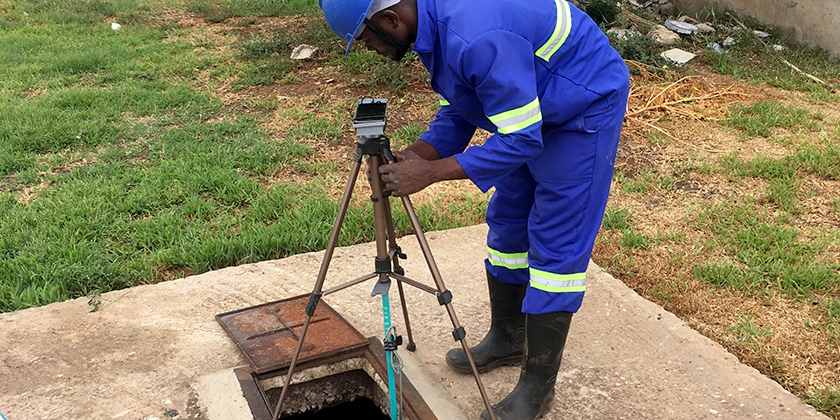
Sustainable management of faecal sludge requires reasonable estimates of the quantities and qualities (Q&Q) that are accumulating at community to city-wide scale. In situ accumulation rates are difficult to determine as faecal sludge is often stored underground in containments, records frequently do not exist, and construction is not standardized, but estimates are necessary for planning scenarios as it represents the total amount of faecal sludge that needs to be managed. In the past, people have estimated accumulation based on literature values from other contexts, or educated guesses from users and emptying service providers, but these esitmates were not adequate to capture the desired accuracy and range of variability. To address the need for an affordable, accurate and easy to use device for measuring in situ volumes of faecal sludge, Eawag developed the Volaser (volume + laser) measuring device. The Volaser can be used to measure the volume of onsite sanitation containments and in situ volumes of faecal sludge. It consists of a tripod with distance-laser unit, a probe, and a smartphone application to operate the device. The smartphone is mounted on top of the tripod, the tripod is then set up over a vertical access port to the containment, and is lowered so that the laser-unit is fully inside the containment, but not immersed in the sludge. Then, the measurement is started in the app, and the top part is rotated manually while the laser measures the distance to the walls and the angle of rotation, in order to calculate the horizontal surface area of the containment. Afterwards, the distance from the top of the containment to the sludge surface and the GPS coordinates are also recorded. The depth of the containment is determined manually with a probe (approximately 300cm length). The volume of the sludge and of the containment can then be calculated.

The final version of the Volaser is comprised of 3D printed parts and components that can be obtained globally (either online and/or locally), and can be assembled by anyone, anywhere in the world. The assembly and operation manual will be available here soon.  

More information on how to make estimations for Q&Q of faecal sludge at community to city-wide scales can be found here.

Collaborators

  • Tribecraft AG
  • JLS Digital
  • Zürcher Hochschule der Künste (ZHdK)
  • ETH Zürich
  • SDC (funder)
  • Eawag (funder)

Volaser - Assembly and operation manual
Volaser: A faecal sludge measuring device - Assembly and users’ guide. Andriessen, N. & Strande, L. (2023)

This manual provides step-by-step guidance on how to assemble and operate a Volaser device.

Smartphone application

The Volaser smartphone application can be downloaded from www.github.com/volaser .

Videos

Publications

The Volaser: In Situ Measurements of Volumes of Faecal Sludge. Andriessen, N. & Strande, L. Sandec News, 2020

Extbase Variable Dump
array(2 items)
   publications => '30343' (5 chars)
   libraryUrl => '' (0 chars)
Extbase Variable Dump
array(1 item)
   0 => Snowflake\Publications\Domain\Model\Publicationprototypepersistent entity (uid=30343, pid=124)
      originalId => protected30343 (integer)
      authors => protected'Andriessen, N.; Appiah-Effah, E.; Browne, S. J. I.;
          al Jahjah, R.; Kabika, J.; Kinobe, J. R.; Korir, N
         .; Nishimwe, P.; Niwagaba, C. B.; Pradeep, R.; Prasad,&n
         bsp;P.; Tembo, J. M.; William, A.; Ambuehl, B.; Strande,
          L.
' (312 chars) title => protected'Quantities and qualities of fecal sludge: experiences from field implementat
         ion with a Volaser in 7 countries during a pandemic
' (127 chars) journal => protected'Frontiers in Water' (18 chars) year => protected2023 (integer) volume => protected5 (integer) issue => protected'' (0 chars) startpage => protected'1130081 (14 pp.)' (16 chars) otherpage => protected'' (0 chars) categories => protected'accumulation rate; characteristics; statistical relations; standardized appr
         oaches; distance sensor; fecal sludge
' (113 chars) description => protected'Reasonable estimates for quantities and qualities (Q&Q) of fecal sludge
         that accumulate in onsite sanitation containments are fundamental for the de
         sign of appropriate management and treatment solutions, from community to ci
         ty-scale. There are increasing attempts to improve Q&Q estimates, but cu
         rrent approaches are still at a conceptual level, and are not yet standardiz
         ed with confirmed statistical relationships. To reach this level, we will ne
         ed consistent approaches for planning, measuring, and global collaborations.
          Hence, the objectives of this study were: (1) to assess and compare Q&Q
          of fecal sludge from seven cities and communities, and explore statistical
         relationships that could be used to increase accuracy of Q&Q estimations
         ; (2) to test and launch the Volaser device for measuring <em>in situ</em> v
         olumes of fecal sludge; and (3) to capture lessons learned from field implem
         entation with collaborators in seven countries during a global pandemic when
          no international travel was possible. The study took place in Ghana, India,
          Lebanon, Kenya, Sierra Leone, Uganda, and Zambia during the COVID-19 pandem
         ic. Q&amp;Qs were measured in 204 containments with a Volaser, laboratory an
         alysis, and questionnaire. Results indicate that there are differences in To
         tal Solids (TS) and Chemical Oxygen Demand (COD) in fecal sludge based on co
         ntainment type, toilet type, source, and whether there is a water connection
          on the premises. Based on the results of this study, together with previous
         ly published open-source data, an empirical relationship for Volatile Solids
          (VS) and TS of 0.49 (<em>R</em><sup>2</sup> = 0.88) was established using 1
         ,206 data points. For COD/TS, no significant relationship was observed. Deve
         loping such empirical relationships will be useful for planning and modeling
          approaches. An external evaluation was conducted to evaluate overall projec
         t management, Volaser technology transfer, and effects of collaborating duri
         ng the COVID-19 pandemic...
' (2450 chars) serialnumber => protected'' (0 chars) doi => protected'10.3389/frwa.2023.1130081' (25 chars) uid => protected30343 (integer) _localizedUid => protected30343 (integer)modified _languageUid => protectedNULL _versionedUid => protected30343 (integer)modified pid => protected124 (integer)
Andriessen, N.; Appiah-Effah, E.; Browne, S. J. I.; al Jahjah, R.; Kabika, J.; Kinobe, J. R.; Korir, N.; Nishimwe, P.; Niwagaba, C. B.; Pradeep, R.; Prasad, P.; Tembo, J. M.; William, A.; Ambuehl, B.; Strande, L. (2023) Quantities and qualities of fecal sludge: experiences from field implementation with a Volaser in 7 countries during a pandemic, Frontiers in Water, 5, 1130081 (14 pp.), doi:10.3389/frwa.2023.1130081, Institutional Repository

Contact