Department Environmental Chemistry

Extracellular enzymes
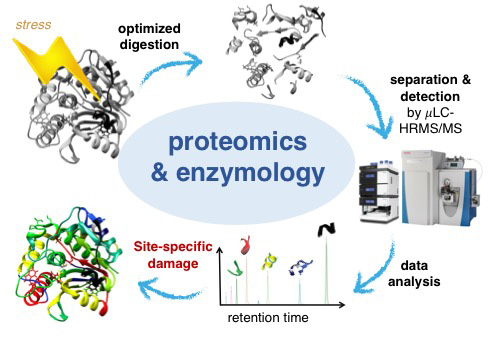
Extracellular enzymes are major drivers of biogeochemical nutrient and carbon cycling in surface water. We investigate the activity of these enzymes to degrade pollutants (projects on pharmaceutical fate and natural toxins) study the decay of the enzymes themselves. Photoinactivation and biotransformation are the major inactivation process of these enzymes. We study the underlying molecular changes that cause inactivation of enzymes. We track changes in activity during exposure to external stress (i.e., light and oxidants) and combine this with information on molecular modifications of the enzymes‘ structure.  

We demonstrated how light exposure leads to a rapid loss of phosphatase, aminopeptidase and glucosidase activities of biofilm samples and model enzymes. An optimized proteomics approach allowed simultaneous observation of inactivation and molecular changes. Site-specific fingerprints of degradation kinetics have been generated and visualized in the three-dimensional proteins and intramolecular reactions could be traced within the molecule. 

We included comprehensive suspect screening of oxidation products from discrete reactions of enzymes with photochemically derived singlet oxygen in surface waters.

Currently, we collaborate with colleagues to study site-specific damage of oxygenases that are involved in hydroxylating persistent (poly)cyclic chlorinated and nitrated hydrocarbons with the group of Thomas Hofstetter (Project on Enzyme Mechanisms and Kinetics of Organic Contaminant Oxygenation).

Publications

Extbase Variable Dump
array(2 items)
   publications => '21649,20604,17091' (17 chars)
   libraryUrl => '' (0 chars)
Extbase Variable Dump
array(3 items)
   0 => Snowflake\Publications\Domain\Model\Publicationprototypepersistent entity (uid=21649, pid=124)
      originalId => protected21649 (integer)
      authors => protected'Egli, C. M.; Stravs, M. A.; Janssen, E. M.&nbs
         p;L.
' (80 chars) title => protected'Inactivation and site-specific oxidation of aquatic extracellular bacterial
         leucine aminopeptidase by singlet oxygen
' (116 chars) journal => protected'Environmental Science and Technology' (36 chars) year => protected2020 (integer) volume => protected54 (integer) issue => protected'22' (2 chars) startpage => protected'14403' (5 chars) otherpage => protected'14412' (5 chars) categories => protected'' (0 chars) description => protected'Extracellular enzymes are master recyclers of organic matter, and to predict
          their functional lifetime, we need to understand their environmental transf
         ormation processes. In surface waters, direct and indirect photochemical tra
         nsformation is a known driver of inactivation. We investigated molecular cha
         nges that occur along with inactivation in aminopeptidase, an abundant class
          of extracellular enzymes. We studied the inactivation kinetics and localize
         d oxidation caused by singlet oxygen, <sup>1</sup>O<sub>2</sub>, a major pho
         tochemically derived oxidant toward amino acids. Aminopeptidase showed secon
         d-order inactivation rate constants with <sup>1</sup>O<sub>2</sub> comparabl
         e to those of free amino acids. We then visualized site-specific oxidation k
         inetics within the three-dimensional protein and demonstrated that fastest o
         xidation occurred around the active site and at other reactive amino acids.
         However, second-order oxidation rate constants did not correlate strictly wi
         th the <sup>1</sup>O<sub>2</sub>-accessible surface areas of those amino aci
         ds. We inspected site-specific processes by a comprehensive suspect screenin
         g for 723,288 possible transformation products. We concluded that histidine
         involved in zinc coordination at the active site reacted slower than what wa
         s expected by its accessibility, and we differentiated between two competing
          reaction pathways of <sup>1</sup>O<sub>2</sub> with tryptophan residues. Th
         is systematic analysis can be directly applied to other proteins and transfo
         rmation reactions.
' (1538 chars) serialnumber => protected'0013-936X' (9 chars) doi => protected'10.1021/acs.est.0c04696' (23 chars) uid => protected21649 (integer) _localizedUid => protected21649 (integer)modified _languageUid => protectedNULL _versionedUid => protected21649 (integer)modified pid => protected124 (integer)
1 => Snowflake\Publications\Domain\Model\Publicationprototypepersistent entity (uid=20604, pid=124) originalId => protected20604 (integer) authors => protected'Egli,&nbsp;C.&nbsp;M.; Natumi,&nbsp;R.&nbsp;S.; Jones,&nbsp;M.&nbsp;R.; Jans
         sen,&nbsp;E.&nbsp;M.&nbsp;-L.
' (105 chars) title => protected'Inhibition of extracellular enzymes exposed to cyanopeptides' (60 chars) journal => protected'Chimia' (6 chars) year => protected2020 (integer) volume => protected74 (integer) issue => protected'3' (1 chars) startpage => protected'122' (3 chars) otherpage => protected'128' (3 chars) categories => protected'aquatic enzymes; biogeochemical cycling; cyanobacteria; harmful algae bloom;
          microbial loop
' (91 chars) description => protected'Harmful cyanobacterial blooms in freshwater ecosystems produce bioactive sec
         ondary metabolites including cyanopeptides that pose ecological and human he
         alth risks. Only adverse effects of one class of cyanopeptides, microcystins
         , have been studied extensively and have consequently been included in water
          quality assessments. Inhibition is a commonly observed effect for enzymes e
         xposed to cyanopeptides and has mostly been investigated for human biologica
         lly relevant model enzymes. Here, we investigated the inhibition of ubiquito
         us aquatic enzymes by cyanobacterial metabolites. Hydrolytic enzymes are uti
         lized in the metabolism of aquatic organisms and extracellularly by heterotr
         ophic bacteria to obtain assimilable substrates. The ubiquitous occurrence o
         f hydrolytic enzymes leads to the co-occurrence with cyanopeptides especiall
         y during cyanobacterial blooms. Bacterial leucine aminopeptidase and alkalin
         e phosphatase were exposed to cyanopeptide extracts of different cyanobacter
         ial strains (<em>Microcystis aeruginosa </em> wild type and microcystin-free
          mutant,<em> Planktothrix rubescens</em>) and purified cyanopeptides. We obs
         erved inhibition of aminopeptidase and phosphatase upon exposure, especially
          to the apolar fractions of the cyanobacterial extracts. Exposure to the dom
         inant cyanopeptides in these extracts confirmed that purified microcystins,
         aerucyclamide A and cyanopeptolin A inhibit the aminopeptidase in the low mg
          L<sup>-1</sup> range while the phosphatase was less affected. Inhibition of
          aquatic enzymes can reduce the turnover of nutrients and carbon substrates
         and may also impair metabolic functions of grazing organisms.
' (1657 chars) serialnumber => protected'0009-4293' (9 chars) doi => protected'10.2533/chimia.2020.122' (23 chars) uid => protected20604 (integer) _localizedUid => protected20604 (integer)modified _languageUid => protectedNULL _versionedUid => protected20604 (integer)modified pid => protected124 (integer)
2 => Snowflake\Publications\Domain\Model\Publicationprototypepersistent entity (uid=17091, pid=124) originalId => protected17091 (integer) authors => protected'Egli,&nbsp;C.&nbsp;M.; Janssen,&nbsp;E.&nbsp;M.&nbsp;L.' (55 chars) title => protected'A proteomics approach to trace site-specific damage in aquatic extracellular
          enzymes during photoinactivation
' (109 chars) journal => protected'Environmental Science and Technology' (36 chars) year => protected2018 (integer) volume => protected52 (integer) issue => protected'14' (2 chars) startpage => protected'7671' (4 chars) otherpage => protected'7679' (4 chars) categories => protected'' (0 chars) description => protected'Extracellular enzymes are major drivers of biogeochemical nutrient and carbo
         n cycling in surface water. While photoinactivation is regarded as a major i
         nactivation process of these enzymes, the underlying molecular changes have
         received little attention. This study demonstrate how light exposure leads t
         o a rapid loss of phosphatase, aminopeptidase and glucosidase activities of
         biofilm samples and model enzymes. Here, an optimized proteomics approach al
         lowed simultaneous observation of inactivation and molecular changes. Site-s
         pecific fingerprints of degradation kinetics have been generated and visuali
         zed in the three-dimensional proteins. Oxidation of tryptophan, the chromoph
         oric target, initiated secondary reactions. Evidence was obtained that tyros
         ine residues act as intramolecular antioxidants, reflected in decelerated de
         cay of tryptophan- and enhanced decay of tyrosine-containing peptides. In ad
         dition, subsequent methionine oxidation and disulfide reduction contribute t
         o heterogeneous photodamage. The proximity to tryptophan residues explains >
         95% of the photodamage across the protein structures. The presence of redox-
         active organic matter or a model antioxidant in solution quenched not only p
         hotoinactivation and tryptophan oxidation but also all subsequent damage. Th
         e developed analytical approach can be applied to other research questions i
         n environmental sciences where site-specific damage in a protein is essentia
         l.
' (1446 chars) serialnumber => protected'0013-936X' (9 chars) doi => protected'10.1021/acs.est.7b06439' (23 chars) uid => protected17091 (integer) _localizedUid => protected17091 (integer)modified _languageUid => protectedNULL _versionedUid => protected17091 (integer)modified pid => protected124 (integer)
Egli, C. M.; Stravs, M. A.; Janssen, E. M. L. (2020) Inactivation and site-specific oxidation of aquatic extracellular bacterial leucine aminopeptidase by singlet oxygen, Environmental Science and Technology, 54(22), 14403-14412, doi:10.1021/acs.est.0c04696, Institutional Repository
Egli, C. M.; Natumi, R. S.; Jones, M. R.; Janssen, E. M. -L. (2020) Inhibition of extracellular enzymes exposed to cyanopeptides, Chimia, 74(3), 122-128, doi:10.2533/chimia.2020.122, Institutional Repository
Egli, C. M.; Janssen, E. M. L. (2018) A proteomics approach to trace site-specific damage in aquatic extracellular enzymes during photoinactivation, Environmental Science and Technology, 52(14), 7671-7679, doi:10.1021/acs.est.7b06439, Institutional Repository

Additional publication

Elisabeth M.-L. Janssen and Kristopher McNeill (2015) Environmental photooxidation of extracellular phosphatase and the effects of dissolved organic matter. Environmental Science and Technology, 49 (2), pp. 889-896. DOI: 10.1021/es504211x.

Rachel A. Lundeen, Elisabeth M.-L. Janssen, Chiheng Chu, Kristopher McNeill (2014) Environmental photochemistry of amino acids, peptides and proteins. Chimia, 68 (11), pp. 814-817. https://doi.org/10.2533/chimia.2014.812.

Elisabeth M.-L. Janssen, Paul R. Erickson, Kristopher McNeill (2014) Dual roles of dissolved organic matter as sensitizer and quencher in the photooxidation of tryptophan. Environ. Sci. Technol., 48(9), pp. 4916-24.  DOI:10.1021/es500535a