Department Water Resources and Drinking Water

Mitigation of geogenic groundwater contamination

Water Resource Quality (WRQ) was an integrated project running from 2006-2012 at Eawag that aimed to develop a generally applicable framework for the mitigation of geogenic contamination in groundwater used for drinking, in particular concerning arsenic and fluoride. We combined natural and social scientific expertise for the solution of a health problem that affects 100s of millions of people worldwide. The mitigation framework developed by the WRQ team from Eawag can help decision makers and water resource managers to identify contaminated regions and to provide feasible options to help reduce the effects of contamination.

Geogenic Contamination

Geogenic contamination refers to naturally occurring elevated concentrations of certain elements in groundwater (such as arsenic, fluoride, uranium or selenium) which have a negative health effect on humans consuming this water. Geogenic contamination of groundwater might be a result of geochemical characteristics of the aquifer material - eg. high concentrations of the contaminant in the rock matrix, dissolving during water-rock interaction, or occur due to environmental conditions such as an arid climate or reducing conditions in the aquifer which facilitate the contaminant to occur in a more mobile state.

The most wide-spread geogenic contaminants are arsenic and fluoride, affecting the health of hundreds of millions of people worldwide.

Fluoride

Fluoride is the 13th most abundant element in the earth’s crust (625 mg/kg) and exists in trace amounts in almost all groundwaters across the world. According to estimations from UNESCO, more than 200 million people worldwide rely on drinking water with fluoride concentrations exceeding the present WHO guideline of 1.5 mg/L. Fluorosis, associated with elevated fluoride concentrations in drinking water has been reported in a range of countries.

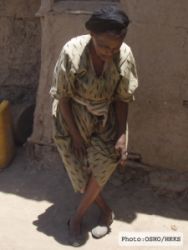
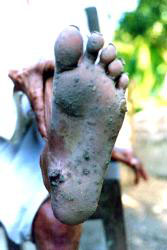
While low fluoride intake may prevent dental caries, excess intake causes different types of fluorosis; primarily dental and skeletal fluorosis. White line striations on the teeth followed by brown patches and, in severe cases, brittling of the enamel are common symptoms of dental fluorosis. This is not only a health problem but also has psychological and social impacts, as people are ashamed and possibly ostracised due to their bad teeth. Skeletal fluorosis first causes pain in different joints, then limits joint movement, leading to stiffness and skeletal crippling. Besides dental and skeletal fluorosis, other manifestations such as nervousness, depression and muscle weakness have been reported in connection with high fluoride intake.

More information

Where does fluoride groundwater contamination occur?

What are the effects of fluoride on human health?

International Society for Fluoride Research

WHO: Fluoride in Drinking Water
 

Arsenic

The WHO guideline value for arsenic in drinking water has been set to 10 µg/L, though in several countries higher values are used (e.g. 50 µg/L in China).

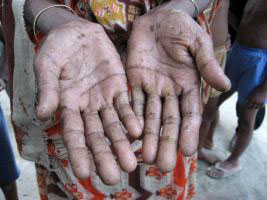
High arsenic concentrations in groundwater have been found to be responsible for health problems summarized under the term arsenicosis, which develop over a period of several years. Symptoms of arsenicosis range from skin disorders (melanosis, keratosis) to cardiovascular diseases, cancer and the impairment of the neurodevelopment of children. Since there is no cure for arsenicosis to date, the provision of safe water for the prevention of this disease is the vital mitigation approach.

More information

Where does arsenic groundwater contamination occur?
What are the effects of arsenic on human health?

WHO: Arsenic in Drinking Water
 

Team

WRQ was an inter-disciplinary project and the development of the framework relied on the integration of expertise from a range of fields. An understanding of the physical system, together with socio-economic and behavioural factors at different scales were necessary. Scientists from three Eawag departments were involved:

The project team therefore comprised geochemical specialists, modelers and social scientists and relied on the cooperation with valuable global partners. It was initiated and led by Dr. Annette Johnson, who passed away in November 2015. One of her special areas was the handling of geogenic trace substances in ground water and drinking water (click for further information on Annette Johnsons research).
 

WRQ team at Eawag

Dr. Michael Berg Deputy Head of Department Tel. +41 58 765 5078 Send Mail
  • GIS modelling and arsenic removal
  • WRQ project management
  • Arsenic removal
  • Deep well evaluation
  • GIS modelling and arsenic removal
  • Development of online GIS modelling tools

  • Material flow analysis
  • Uptake of fluoride through food and water
  • Institutional and socio-economic research

Former team members

Dr. Annette Johnson

WRQ project manager
Fluoride removal and GIS modelling

Dr. Chris Zurbrügg

WRQ project management

Dr. Christoph Lüthi

Institutional settings and enabling environments

Dr. Hansi Mosler

Psychological acceptance and promotion studies

Anja Bretzler

WRQ managing assistant
Fluoride removal filters

Dr. Luis Rodriguez-Lado

Post-doctoral researcher
Development of online GIS modelling tools

Dr. Hanspeter Bader

Material flow analysis

Jennifer Inauen


Alexandra Huber


Lars Osterwalder


Dr. Heiko Gebauer


Dr. Richard Johnston


Dr. Manouchehr Amini


Dr. Lenny Winkel


Dr. Robert Tobias


Dr. Nasreen Khan


Yama Tomonaga


Kim Müller


Thomas Rosenberg


Partners

The WRQ team maintains partnerships with research institutions and NGOs in a range of countries where problems occur due to geogenic contamination of drinking water.

Ethiopia

Addis Ababa University, Ethiopia

In 2009 Eawag and Addis Ababa University (AAU) launched a three-year research project funded by the Swiss National Science Foundation and the Swiss Agency for Development and Cooperation (SNF-SDC) with the title “Optimization and Acceptance of Fluoride Removal Options in Rural Ethiopia”.

The WRQ fluoride removal team is working together with Dr. Feleke Zewge from AAU's Chemistry Department and Head of the Fluorosis Mitigation Office on the development and testing of different filter materials based on aluminium oxide or calcium phosphate for the removal of fluoride from drinking water.

The institutional support for the implementation of fluoride mitigation strategies is being investigated in cooperation with Prof. Yacob Arsano from the Department of Political Science and International Relations.


Non-Government Organisations (NGOs)

Field trials of bone char-based filters on a household as well as community scale are being undertaken in rural communities in the Rift Valley in cooperation with the Oromo Self-Help Organisation (OSHO) and Swiss Interchurch Aid (HEKS). OSHO offers vital assistance in the implementation, distribution and monitoring of filters and in the realisation of household surveys on filter use and acceptance. We are grateful to HEKS for their financial support

Bangladesh

Extensive work on arsenic mitigation in Bangladesh would not be possible without the cooperation with a range of local partners:

1) Dr. Kazi Matin Ahmed, professor in the University of Dhaka's Geology Department, is a global expert on arsenic contamination of groundwater. We work together in assessing the quality of groundwater in  different geological units, not only in terms of arsenic but other chemical parameters including iron, manganese, and salinity. By identifying strata which yield favorable water for all chemical parameters, new water sources can be installed which truly provide safe drinking water.


2) UNICEF Bangladesh has been one of the leading agencies responding to the arsenic threat facing Bangladesh. Our team of environmental psychologists is fielding surveys with support from UNICEF to identify the driving psychological factors which cause people to adopt (or to not adopt) new arsenic-safe sources of drinking water. Results will inform an ongoing revision of UNICEF's arsenic communication strategy. Our team members also coordinate with UNICEF Bangladesh on interpretation of nation-wide drinking water quality surveys.

3)  SONO Technology Research (STR), LTD, Kushtia, Bangladesh and Prof. Abul Hussam of George Mason University (GMU) in Fairfax, Virginia, USA, have developed the award-winning SONO arsenic removal filter. In collaboration with STI and Prof. Abul Hussam, Eawag scientists have carried out research to test the long-term performance of the filters and help to better understand the physical and chemical processes in the different filter sections.

4) Dhaka Community Hospital

Kenya

Catholic Diocese of Nakuru


In spring 2006, Eawag and the Catholic Diocese of Nakuru (CDN) launched a joint collaboration with the main objectives:

  • to further develop and optimize a low-cost defluoridation method known as contact precipitation
  • to investigate the removal processes for bone char defluoridation and contact precipitation
  • to foster implementation and dissemination of apatite-based defluoridation treatment

The Water Programme of the Catholic Diocese of Nakuru (CDN) was created in 1985. Today the Programme employs approximately 60 people and operates in several areas within Eastern Africa. Major activities are: drilling of deep wells, construction of water schemes and rainwater harvesting.

While working on the different water projects it became apparent that high levels of fluoride in the raw water lead to negative health impacts, commonly known as fluorosis. In 1998, a new section called CDN Water Quality (CDN WQ) was initiated as part of the Water Programme that took over the challenge to find a way to reduce fluoride levels in the water for safe human consumption.

CDN WQ comprises four working groups dealing with the production of bone char and calcium phosphate pellets, filter implementation, water quality testing and awareness creation. Up to date, more than 50 community and 1,000 household filters for fluoride removal have been implemented by CDN WQ in different parts of Kenya.

For further information, please contact info@cdnwaterquality.co.ke

China

Since September 2009, researchers from the Research Center for Eco-Environmental Sciences in Beijing and from the China Medical University in Shenyang are our partners in the REMARC project (Risk Maps of Arsenic Contamination in Groundwaters of China). Their valuable contribution to the project made it possible to dispose of a database of 2,369 sampling points covering the provinces of Inner Mongolia, Gansu, Shanxi, Heilongjiang and Ningxia that will be used to build the risk models.


Mr. Guifan Sun
(Prof., MD)
Arsenic and Fluoride Research Centre, School of Public Health, China Medical University.
No. 92 Bei Er Road, Heping District, Shenyang, PR China, Postal Code: 110001
Telephone: +86-24-2326-1744
Fax: +86-24-2326-1744
E-mail: sungf@mail.cmu.edu.cn

Prof Dr. Jianbo Shi
(Researcher, PhD)
State Key Laboratory of Environmental Chemistry and Ecotoxicology
Research Center for Eco-Environmental Sciences.
Chinese Academy of Sciences, P.O. Box 2871, Beijing 100085, China.
Telephone: +86-10-6284 9334
E-mail: jbshi@rcees.ac.cn

Ms. Quanmei Zheng,
(Prof., MD)
Department of Geochemical Diseases, School of Public Health, China Medical University.
No. 92 Bei Er Road, Heping District, ShenyanChina Medical University.
No. 92 Bei Er Road, Heping District, Shenyang, PR China, Postal Code: 110001
Telephone: +86-24-2326-1744
Fax: +86-24-2326-1744
E-mail: qmzheng@mail.cmu.edu.cn

Ms. Shuhua Xi
(Prof. PhD.)
Department of Geochemical Diseases, School of Public Health, China Medical University.
No. 92 Bei Er Road, Heping District, Shenyang China Medical University.
No. 92 Bei Er Road, Heping District, Shenyang, PR China, Postal Code: 110001
Telephone: +86-24-2326-1744
Fax: +86-24-2326-1744
E-mail: shxi@mail.cmu.edu.cn

Qiang Zhang
(PhD student)
Arsenic and Fluoride Research Centre, School of Public Health, China Medical University.
No. 92 Bei Er Road, Heping District, Shenyang, PR China, Postal Code: 110001
Telephone: +86-24-2326-1744
Fax: +86-24-2326-1744
E-mail: z2008@gmail.com

Iran

Isfahan University of Technology (IUT)


Eawag has long standing working relations with the College of Agriculture of Isfahan University of Technology (IUT) in Iran. In the past we have collaborated in many projects, including:

  • Cation exchange capacity of arid soils [1]
  • Mapping risk of cadmium and lead [2]
  • Modelling cadmium variability [3]
  • Modelling runoff and erosion using SWAT [4]
  • Estimation of field capacity and wilting point for arid soils of central Iran from basic soil physical and chemical properties [5]
  • Spatial and temporal variations of nitrate concentration in the groundwaters of Isfahan province, central Iran
  • Temporal and spatial variability of soil moisture in Iran
  • Assessment of regional water endowments, water constraints to food production, and implications for virtual water trade in Iran
  • Hydrologic and water quality modeling of Zayandehrud Watershed
  • Transport of cadmium, zinc, copper, and lead in a sewage sludge amended calcareous soil
  • Estimating soil shear strength, saturated hydraulic conductivity and infiltration using pedotransfer function and artificial neural network


[1] Amini, M., K. C. Abbaspour, H. Khademi, N. Fathianpour, M. Afyuni, and R. Schulin. 2005. Neural Network Models to predict Cation Exchange Capacity in Arid Regions of Iran. European Journal of Soil Science. 56 (4): 551-559.

[2] Amini, M. Afyuni, H. Khademi, K. C. Abbaspour, R. Schulin. 2005. Mapping risk of cadmium and lead contamination to human health in soils of Central Iran. Science of Total Environment 347:54-77.

[3] Amini, M., M. Afyuni, H. Khademi, K. C. Abbaspour. 2005. Variability of Available Cadmium in Relation to Soil Properties and Landuse in Arid region of Central Iran. Water Air and Soil Pollution, 162:205-218.

[4] Rostamian, R., S. F. Mousavi, M. Heidarpour, M. Afyuni and K. C. Abbaspour. 2007. Application of SWAT Model for Estimating Runoff and Sediment in a Mountainous Watershed in Central Iran. The fourth International SWAT conference, Delft, Netherland.

[5] Nourbakhsh, F. M. Afyuni, K.C. Abbaspour, and R. Schulin. 2005. Estimation of field capacity and wilting point from basic soil physical and chemical properties. Arid Land Research and Management. 19:81-85.

Our research partners at IUT have agreed to collaborate with the WRQ project for a more detail and comprehensive study of F in Iran. The IUT collaborators include:

Prof. Majid Afyuni Environmental Soil Physics
Prof. Seyed Farhad Mousavi Groundwater Resources
Prof. Hossein Khademi Soil Minerology and Genesis
Dr. Ahmad Khatoonabadi
Social Science
Dr. Amir Khoshgoftar Soil Chemist

Vietnam

Hanoi University of Science: Centre of Environmental Technology and Sustainable Development


A long-term education and research partnership has been established between the Swiss Federal Institute of Aquatic Science and Technology (Eawag) and the Hanoi University of Science. Capacity building is accomplished by applied research projects in environmental chemistry and environmental engineering, as well as in pilot-scale and scaling-up studies for enhancing drinking water quality. Senior Vietnamese researchers and graduated students are educated in project planning and performing research including a strong emphasis on analytical quality control and elaborate data interpretation.

Arsenic contamination of groundwater and drinking water in Vietnam was discovered in 1998 within this capacity building program [1]. This finding has led to manifold studies, such as

  • research on arsenic removal options [2]
  • investigating the levels and state of human arsenic exposure [3]
  • development of a low-cost biosensor for arsenic analysis [4]
  • elucidation of geochemical mechanism(s) leading to arsenic contamination of groundwater [5]
  • blanket groundwater surveys of the Red River Delta (Northern Vietnam) and the Mekong Delta (Cambodia and Southern Vietnam) [3, 6]


[1] “Arsenic Contamination of Groundwater and Drinking Water in Vietnam: A Human Health Threat.” Berg M. et al. 2001, Environ. Sci. Technol. 35, 2621–2626.

[2] “Arsenic Removal from Groundwater by Household Sand Filters: Comparative Field Study, Model Calculations, and Health Benefits.” Berg M. et al. 2006, Environ. Sci. Technol. 40, 5567–73.

[3] “Magnitude of arsenic pollution in the Mekong and Red River Deltas – Cambodia and Vietnam.” Berg M. et al. 2007, Sci. Total Environ. 372, 413–425.

[4] “Bacterial Bioassay for Rapid and Accurate Analysis of Arsenic in Highly Variable Groundwater Samples.” Trang et al. 2005, Environ. Sci. Technol. 39, 7625–30.

[5] “Hydrological and Sedimentary Controls Leading to Arsenic Contamination of Groundwater in the Hanoi Area, Vietnam.” Berg M. et al. submitted.

[6] “Arsenic and Manganese Contamination of Drinking Water Resources in Cambodia: Coincidence of Risk Areas with Low Relief Topography.” Buschmann et al 2007, Environ. Sci. Technol. 41, 2146–2152.

Publications

Water Quality

Extbase Variable Dump
array(2 items)
   publications => '5733,5789,5777,5912,12286,12287,5788,5910,5694,6071' (51 chars)
   libraryUrl => '' (0 chars)
Extbase Variable Dump
array(10 items)
   0 => Snowflake\Publications\Domain\Model\Publicationprototypepersistent entity (uid=5733, pid=124)
      originalId => protected5733 (integer)
      authors => protected'Amini, M.; Abbaspour, K. C.; Berg, M.; Winkel, L.; 
         Hug, S. J.; Hoehn, E.; Yang, H.; Johnson, C. A
         .
' (153 chars) title => protected'Statistical modeling of global geogenic arsenic contamination in groundwater' (76 chars) journal => protected'Environmental Science and Technology' (36 chars) year => protected2008 (integer) volume => protected42 (integer) issue => protected'10' (2 chars) startpage => protected'3669' (4 chars) otherpage => protected'3675' (4 chars) categories => protected'' (0 chars) description => protected'Contamination of groundwaters with geogenic arsenic poses a major health ris
         k to millions of people. Although the main geochemical mechanisms of arsenic
          mobilization are well understood, the worldwide scale of affected regions i
         s still unknown. In this study we used a large database of measured arsenic
         concentration in groundwaters (around 20,000 data points) from around the wo
         rld as well as digital maps of physical characteristics such as soil, geolog
         y, climate, and elevation to model probability maps of global arsenic contam
         ination. A novel rule-based statistical procedure was used to combine the ph
         ysical data and expert knowledge to delineate two process regions for arseni
         c mobilization: “reducing” and “high-pH/oxidizing”. Arsenic concentr
         ations were modeled in each region using regression analysis and adaptive ne
         uro-fuzzy inferencing followed by Latin hypercube sampling for uncertainty p
         ropagation to produce probability maps. The derived global arsenic models co
         uld benefit from more accurate geologic information and aquifer chemical/phy
         sical information. Using some proxy surface information, however, the models
          explained 77% of arsenic variation in reducing regions and 68% of arsenic v
         ariation in high-pH/oxidizing regions. The probability maps based on the abo
         ve models correspond well with the known contaminated regions around the wor
         ld and delineate new untested areas that have a high probability of arsenic
         contamination. Notable among these regions are South East and North West of
         China in Asia, Central Australia, New Zealand, Northern Afghanistan, and Nor
         thern Mali and Zambia in Africa.
' (1628 chars) serialnumber => protected'0013-936X' (9 chars) doi => protected'10.1021/es702859e' (17 chars) uid => protected5733 (integer) _localizedUid => protected5733 (integer)modified _languageUid => protectedNULL _versionedUid => protected5733 (integer)modified pid => protected124 (integer)
1 => Snowflake\Publications\Domain\Model\Publicationprototypepersistent entity (uid=5789, pid=124) originalId => protected5789 (integer) authors => protected'Amini, M.; Mueller, K.; Abbaspour, K. C.; Rosenberg,&nbs
         p;T.; Afyuni, M.; Møller, K. N.; Sarr, M.; Johnson,&nbs
         p;C. A.
' (164 chars) title => protected'Statistical modeling of global geogenic fluoride contamination in groundwate
         rs
' (78 chars) journal => protected'Environmental Science and Technology' (36 chars) year => protected2008 (integer) volume => protected42 (integer) issue => protected'10' (2 chars) startpage => protected'3662' (4 chars) otherpage => protected'3668' (4 chars) categories => protected'' (0 chars) description => protected'The use of groundwater with high fluoride concentrations poses a health thre
         at to millions of people around the world. This study aims at providing a gl
         obal overview of potentially fluoride-rich groundwaters by modeling fluoride
          concentration. A large database of worldwide fluoride concentrations as wel
         l as available information on related environmental factors such as soil pro
         perties, geological settings, and climatic and topographical information on
         a global scale have all been used in the model. The modeling approach combin
         es geochemical knowledge with statistical methods to devise a rule-based sta
         tistical procedure, which divides the world into 8 different “process regi
         ons”. For each region a separate predictive model was constructed. The end
          result is a global probability map of fluoride concentration in the groundw
         ater. Comparisons of the modeled and measured data indicate that 60−70% of
          the fluoride variation could be explained by the models in six process regi
         ons, while in two process regions only 30% of the variation in the measured
         data was explained. Furthermore, the global probability map corresponded wel
         l with fluorotic areas described in the international literature. Although t
         he probability map should not replace fluoride testing, it can give a first
         indication of possible contamination and thus may support the planning proce
         ss of new drinking water projects.
' (1402 chars) serialnumber => protected'0013-936X' (9 chars) doi => protected'10.1021/es071958y' (17 chars) uid => protected5789 (integer) _localizedUid => protected5789 (integer)modified _languageUid => protectedNULL _versionedUid => protected5789 (integer)modified pid => protected124 (integer)
2 => Snowflake\Publications\Domain\Model\Publicationprototypepersistent entity (uid=5777, pid=124) originalId => protected5777 (integer) authors => protected'Winkel, L.; Berg, M.; Amini, M.; Hug, S. J.; Johnso
         n, C. A.
' (94 chars) title => protected'Predicting groundwater arsenic contamination in Southeast Asia from surface
         parameters
' (86 chars) journal => protected'Nature Geoscience' (17 chars) year => protected2008 (integer) volume => protected1 (integer) issue => protected'' (0 chars) startpage => protected'536' (3 chars) otherpage => protected'542' (3 chars) categories => protected'' (0 chars) description => protected'Arsenic contamination of groundwater resources threatens the health of milli
         ons of people worldwide, particularly in the densely populated river deltas
         of Southeast Asia. Although many arsenic-affected areas have been identified
          in recent years, a systematic evaluation of vulnerable areas remains to be
         carried out. Here we present maps pinpointing areas at risk of groundwater a
         rsenic concentrations exceeding 10 g l<SUP>-1</SUP>. These maps were produce
         d by combining geological and surface soil parameters in a logistic regressi
         on model, calibrated with 1,756 aggregated and geo-referenced groundwater da
         ta points from the Bengal, Red River and Mekong deltas. We show that Holocen
         e deltaic and organic-rich surface sediments are key indicators for arsenic
         risk areas and that the combination of surface parameters is a successful ap
         proach to predict groundwater arsenic contamination. Predictions are in good
          agreement with the known spatial distribution of arsenic contamination, and
          further indicate elevated risks in Sumatra and Myanmar, where no groundwate
         r studies exist.
' (1080 chars) serialnumber => protected'1752-0894' (9 chars) doi => protected'10.1038/ngeo254' (15 chars) uid => protected5777 (integer) _localizedUid => protected5777 (integer)modified _languageUid => protectedNULL _versionedUid => protected5777 (integer)modified pid => protected124 (integer)
3 => Snowflake\Publications\Domain\Model\Publicationprototypepersistent entity (uid=5912, pid=124) originalId => protected5912 (integer) authors => protected'Winkel,&nbsp;L.; Berg,&nbsp;M.; Stengel,&nbsp;C.; Rosenberg,&nbsp;T.' (68 chars) title => protected'Hydrogeological survey assessing arsenic and other groundwater contaminants
         in the lowlands of Sumatra, Indonesia
' (113 chars) journal => protected'Applied Geochemistry' (20 chars) year => protected2008 (integer) volume => protected23 (integer) issue => protected'11' (2 chars) startpage => protected'3019' (4 chars) otherpage => protected'3028' (4 chars) categories => protected'' (0 chars) description => protected'Groundwater conditions in the lowlands of Sumatra, where peat swamps are the
          dominant landscape, were investigated. Based on topography, soil and geolog
         ical surface properties, this large area (about 100,000 km<SUP>2</SUP>) is v
         ulnerable to groundwater As enrichment under reducing aquifer conditions. Th
         e reconnaissance groundwater survey was conducted in the province of South S
         umatra, covering both presumed low- and high-risk areas of As enrichment. Fi
         ve distinct types of groundwater were recognized, reflecting a variety of ge
         ological sources and chemical conditions which are understood to be typical
         for the whole east coast of Sumatra. Groundwater collected from tubewells in
          the youngest (Holocene) swamp deposits had elevated As concentrations (>10
         μg L<SUP>−1</SUP>) with a maximum of 65 μg L<SUP>−1</SUP>. Other eleme
         nts exceeding the WHO drinking water guideline values include B, Mn, and Se.
          In contrast to large deltas of continental South and SE Asia, significantly
          lower sediment loads are transported by the rivers of Sumatra. The organic-
         rich Holocene sediments are hence relatively thin. Tubewells tapping the old
         est geological formations of the study area (middle Miocene to Pliocene) hav
         e a broad range of redox conditions reflecting variations in aquifer geochem
         istry. This group is generally characterized by alkaline pH conditions and h
         igh contents of Na, B, Se, and Sr. Oxic groundwaters were found in regions e
         levated above 20 m a.s.l. and are characterized by low concentrations of dis
         solved solids and acidic pH values (average 5.1). To date, groundwater data
         for the increasingly populated island of Sumatra are non-existent in the int
         ernational literature and this study thus provides a basis for future in-dep
         th groundwater studies. The complete georeferenced database of groundwater a
         nalysis is provided as supplementary material.
' (1870 chars) serialnumber => protected'0883-2927' (9 chars) doi => protected'10.1016/j.apgeochem.2008.06.021' (31 chars) uid => protected5912 (integer) _localizedUid => protected5912 (integer)modified _languageUid => protectedNULL _versionedUid => protected5912 (integer)modified pid => protected124 (integer)
4 => Snowflake\Publications\Domain\Model\Publicationprototypepersistent entity (uid=12286, pid=124) originalId => protected12286 (integer) authors => protected'Berg,&nbsp;M.; Amini,&nbsp;M.; Hug,&nbsp;S.&nbsp;J.; Johnson,&nbsp;C.&nbsp;A
         .; Winkel,&nbsp;L.
' (94 chars) title => protected'Delineating areas of groundwater arsenic contamination from surface paramete
         rs and geology at depth
' (99 chars) journal => protected'In: Jean,&nbsp;J.-S.; Bundschuh,&nbsp;J.; Bhattacharya,&nbsp;P. (Eds.), Arse
         nic in geosphere and human diseases. As-2010. Proceedings of the 3rd interna
         tional congress on arsenic in the environment
' (197 chars) year => protected2010 (integer) volume => protected0 (integer) issue => protected'' (0 chars) startpage => protected'79' (2 chars) otherpage => protected'81' (2 chars) categories => protected'' (0 chars) description => protected'' (0 chars) serialnumber => protected'' (0 chars) doi => protected'' (0 chars) uid => protected12286 (integer) _localizedUid => protected12286 (integer)modified _languageUid => protectedNULL _versionedUid => protected12286 (integer)modified pid => protected124 (integer)
5 => Snowflake\Publications\Domain\Model\Publicationprototypepersistent entity (uid=12287, pid=124) originalId => protected12287 (integer) authors => protected'Rodríguez-Lado,&nbsp;L.; Amini,&nbsp;M.; Johnson,&nbsp;C.&nbsp;A.; Berg,&nb
         sp;M.; Sun,&nbsp;G.; Zhang,&nbsp;Q.; Shi,&nbsp;J.; Zhang,&nbsp;K.
' (141 chars) title => protected'Potential arsenic hazard risk in groundwater in China' (53 chars) journal => protected'In: Jean,&nbsp;J.-S.; Bundschuh,&nbsp;J.; Bhattacharya,&nbsp;P. (Eds.), Arse
         nic in geosphere and human diseases. As-2010. Proceedings of the 3rd interna
         tional congress on arsenic in the environment
' (197 chars) year => protected2010 (integer) volume => protected0 (integer) issue => protected'' (0 chars) startpage => protected'154' (3 chars) otherpage => protected'155' (3 chars) categories => protected'' (0 chars) description => protected'' (0 chars) serialnumber => protected'' (0 chars) doi => protected'' (0 chars) uid => protected12287 (integer) _localizedUid => protected12287 (integer)modified _languageUid => protectedNULL _versionedUid => protected12287 (integer)modified pid => protected124 (integer)
6 => Snowflake\Publications\Domain\Model\Publicationprototypepersistent entity (uid=5788, pid=124) originalId => protected5788 (integer) authors => protected'Buschmann,&nbsp;J.; Berg,&nbsp;M.; Stengel,&nbsp;C.; Winkel,&nbsp;L.; Sampso
         n,&nbsp;M.&nbsp;L.; Trang,&nbsp;P.&nbsp;T.&nbsp;K.; Hung Viet,&nbsp;P.
' (146 chars) title => protected'Contamination of drinking water resources in the Mekong delta floodplains: a
         rsenic and other trace metals pose serious health risks to population
' (145 chars) journal => protected'Environment International' (25 chars) year => protected2008 (integer) volume => protected34 (integer) issue => protected'6' (1 chars) startpage => protected'756' (3 chars) otherpage => protected'764' (3 chars) categories => protected'manganese; trace elements; salinity; drinking water; Vietnam; Cambodia' (70 chars) description => protected'This study presents a transnational groundwater survey of the 62,000 km<SUP>
         2</SUP> Mekong delta floodplain (Southern Vietnam and bordering Cambodia) an
         d assesses human health risks associated with elevated concentrations of dis
         solved toxic elements. The lower Mekong delta generally features saline grou
         ndwater. However, where groundwater salinity is <1 g L<SUP>−</SUP> <SUP>1<
         /SUP> Total Dissolved Solids (TDS), the rural population started exploiting
         shallow groundwater as drinking water in replacement of microbially contamin
         ated surface water. In groundwater used as drinking water, arsenic concentra
         tions ranged from 0.1–1340 µg L<SUP>−</SUP> <SUP>1</SUP>, with 37% of t
         he studied wells exceeding the WHO guidelines of 10 µg L<SUP>−</SUP> <SUP
         >1</SUP> arsenic. In addition, 50% exceeded the manganese WHO guideline of 0
         .4 mg L<SUP>−</SUP> <SUP>1</SUP>, with concentrations being particularly h
         igh in Vietnam (range 1.0–34 mg L<SUP>−</SUP> <SUP>1</SUP>). Other eleme
         nts of (minor) concern are Ba, Cd, Ni, Se, Pb and U. Our measurements imply
         that groundwater contamination is of geogenic origin and caused by natural a
         noxic conditions in the aquifers. Chronic arsenic poisoning is the most seri
         ous health risk for the ~2 million people drinking this groundwater without
         treatment, followed by malfunction in children's development through excessi
         ve manganese uptake. Government agencies, water specialists and scientists m
         ust get aware of the serious situation. Mitigation measures are urgently nee
         ded to protect the unaware people from such health problems.
' (1580 chars) serialnumber => protected'0160-4120' (9 chars) doi => protected'10.1016/j.envint.2007.12.025' (28 chars) uid => protected5788 (integer) _localizedUid => protected5788 (integer)modified _languageUid => protectedNULL _versionedUid => protected5788 (integer)modified pid => protected124 (integer)
7 => Snowflake\Publications\Domain\Model\Publicationprototypepersistent entity (uid=5910, pid=124) originalId => protected5910 (integer) authors => protected'Rodríguez Lado,&nbsp;L.; Polya,&nbsp;D.; Winkel,&nbsp;L.; Berg,&nbsp;M.; He
         gan,&nbsp;A.
' (88 chars) title => protected'Modelling arsenic hazard in Cambodia: a geostatistical approach using ancill
         ary data
' (84 chars) journal => protected'Applied Geochemistry' (20 chars) year => protected2008 (integer) volume => protected23 (integer) issue => protected'11' (2 chars) startpage => protected'3010' (4 chars) otherpage => protected'3018' (4 chars) categories => protected'' (0 chars) description => protected'The As concentration in shallow groundwater in Cambodia was estimated using
         1329 georeferenced water samples collected during the period 1999–2004 fro
         m wells between 16–100 m depth. Arsenic concentrations were estimated usin
         g block regression-kriging on the log transformed As measurements. Auxiliary
          raster maps (DEM-parameters, remote sensing images and geology) were conver
         ted to 16 principal components that were used to explain the distribution of
          As over the study area. The regression-kriging model was validated using an
          external set of 276 samples, and the results were compared to those obtaine
         d by ordinary block kriging. The regression analysis revealed that there is
         a good correlation between topographic environmental variables and the conte
         nt of As in groundwater. This result is broadly consistent with the findings
          of previous studies and is not unexpected given models of microbial mediate
         d As mobilization in recent low lying sediments. Kândal, Prey Vêng and Kâ
         mpóng Cham are the provinces with the highest potential As hazard, indicati
         ng the requirement for development and implementation of policy control meas
         ures. The regression-kriging model explained 48% of the variability in the v
         alidation set. However, the model does not show good results for the predict
         ion of high As concentration. This points to the existence of local environm
         ental factors, not captured by this model, that highly influence the mobiliz
         ation of As in groundwater. Even if the results of the validation of regress
         ion-kriging and ordinary kriging are similar, the regression kriging approac
         h provides a more realistic description of the distribution of As since it a
         lso captures the large-scale variation of As in the study area.
' (1735 chars) serialnumber => protected'0883-2927' (9 chars) doi => protected'10.1016/j.apgeochem.2008.06.028' (31 chars) uid => protected5910 (integer) _localizedUid => protected5910 (integer)modified _languageUid => protectedNULL _versionedUid => protected5910 (integer)modified pid => protected124 (integer)
8 => Snowflake\Publications\Domain\Model\Publicationprototypepersistent entity (uid=5694, pid=124) originalId => protected5694 (integer) authors => protected'Berg,&nbsp;M.; Trang,&nbsp;P.&nbsp;T.&nbsp;K.; Stengel,&nbsp;C.; Buschmann,&
         nbsp;J.; Hung Viet,&nbsp;P.; Van Dan,&nbsp;N.; Giger,&nbsp;W.; Stüben,&nbsp
         ;D.
' (155 chars) title => protected'Hydrological and sedimentary controls leading to arsenic contamination of gr
         oundwater in the Hanoi area, Vietnam: the impact of iron-arsenic ratios, pea
         t, river bank deposits, and excessive groundwater abstraction
' (213 chars) journal => protected'Chemical Geology' (16 chars) year => protected2008 (integer) volume => protected249 (integer) issue => protected'1–2' (5 chars) startpage => protected'91' (2 chars) otherpage => protected'112' (3 chars) categories => protected'hydrology; water isotopes; iron-arsenic ratio; sediment extraction; seasonal
          fluctuations; irrigation
' (101 chars) description => protected'Groundwater contamination by arsenic in Vietnam poses a serious health threa
         t to millions of people. In the larger Hanoi area, elevated arsenic levels a
         re present in both, the Holocene and Pleistocene aquifers. Family-based tube
         wells predominantly tap the Holocene aquifer, while the Hanoi water works ex
         tract more than 600,000 m<SUP>3</SUP>/day of groundwater from the Pleistocen
         e aquifer. Detailed groundwater and sediment investigations were conducted a
         t three locations exhibiting distinct geochemical conditions, i.e., i) high
         levels of dissolved arsenic (av. 121 µg/L) at the river bank, ii) low level
         s of dissolved arsenic (av. 21 µg/L) at the river bank and, iii) medium lev
         els of dissolved arsenic (60 µg/L) in an area of buried peat and excessive
         groundwater abstraction. Seasonal fluctuations in water chemistry were studi
         ed over a time span of 14 months. <BR/> Sediment-bound arsenic (1.3–22 µg
         /g) is in a natural range. Arsenic correlates with iron (<I>r</I><SUP>2</SUP
         >>0.8) with variation related to grain size. Sediment leaching experiments s
         howed that arsenic can readily be mobilized at each of the three locations.
         Low levels of arsenic in groundwater (<10 µg/L) generally exhibit manganese
          reducing conditions, whereas elevated levels are caused by reductive dissol
         ution under iron- and sulphate reducing conditions. Average arsenic concentr
         ations in groundwater are twofold higher at the river bank than in the peat
         area. The lower levels of arsenic contamination in the peat area are likely
         controlled by the high abundance of iron present in both the aqueous and sed
         iment phases. With median molar Fe/As ratios of 350 in water and 8700 in the
          sediments of the peat area, reduced iron possibly forms new mineral phases
         that resorb (or sequester) previously released arsenic to the sediment. Desp
         ite similar redox conditions, resorption is much less significant at the riv
         er bank (Fe/As(aq)=68, Fe/As(s)=4700), and hence, arsenic concentrations in
         groundwater reach consid...
' (3176 chars) serialnumber => protected'0009-2541' (9 chars) doi => protected'10.1016/j.chemgeo.2007.12.007' (29 chars) uid => protected5694 (integer) _localizedUid => protected5694 (integer)modified _languageUid => protectedNULL _versionedUid => protected5694 (integer)modified pid => protected124 (integer)
9 => Snowflake\Publications\Domain\Model\Publicationprototypepersistent entity (uid=6071, pid=124) originalId => protected6071 (integer) authors => protected'Buschmann,&nbsp;J.; Berg,&nbsp;M.' (33 chars) title => protected'Impact of sulfate reduction on the scale of arsenic contamination in groundw
         ater of the Mekong, Bengal and Red River deltas
' (123 chars) journal => protected'Applied Geochemistry' (20 chars) year => protected2009 (integer) volume => protected24 (integer) issue => protected'7' (1 chars) startpage => protected'1278' (4 chars) otherpage => protected'1286' (4 chars) categories => protected'' (0 chars) description => protected'Arsenic-enriched groundwater has been a pressing human health issue for more
          than a decade, with tens of millions of people worldwide being at risk of c
         hronic As poisoning through the consumption of As-burdened groundwater. To e
         lucidate the importance of dissolved S on the scale of As concentrations, th
         e composition of groundwater samples from 926 locations spanning over the fl
         oodplains of three severely arsenic affected regions in Asia (Bengal-, Mekon
         g-, Red River deltas), were assessed. A binary mixing model based on Cl<SUP>
         −</SUP> or B as conservative tracers implies that two types of water may b
         e regarded as end-members with respect to groundwater composition in these d
         eltas, namely surface derived water (approximated by river water) and saline
          water identical to residual sea water. Six redox zones were distinguished b
         y comparing the model-calculated concentrations with the measured values. On
         ly one zone (denoted methanogenic) had very high average As concentrations a
         nd they were significantly higher than in the other zones – for all three
         regions, regardless of applying Cl<SUP>−</SUP> or B as a tracer in the mod
         el. Average As concentrations ± standard error in the methanogenic zone wer
         e 182 ± 23 μg L<SUP>−1</SUP> (<I>n</I> = 50%), 41 ± 6 μg L<SUP>−1</S
         UP> (<I>n</I> = 43%), and 61 ± 20 μg L<SUP>−1</SUP> (<I>n</I> = 24%) in
         the Mekong, Red River and Bengal delta, respectively. Arsenic levels were si
         gnificantly lower in the SO<SUB>4</SUB>-reducing and the Fe-reducing zones,
         where averages were 23 ± 7 μg L<SUP>−1</SUP> (<I>n</I> = 27%, zone I), 1
         4 ± 3 μg L<SUP>−1</SUP> (<I>n</I> = 48%, zone S) and 26 ± 9 μg L<SUP
         >−1</SUP> (<I>n</I> = 64%, zone S). These results suggest that a sufficien
         t supply of inhibits the release of As to groundwater and that reduction may
          be as important as Fe reduction in controlling the enrichment of As in grou
         ndwater.
' (1908 chars) serialnumber => protected'0883-2927' (9 chars) doi => protected'10.1016/j.apgeochem.2009.04.002' (31 chars) uid => protected6071 (integer) _localizedUid => protected6071 (integer)modified _languageUid => protectedNULL _versionedUid => protected6071 (integer)modified pid => protected124 (integer)
Amini, M.; Abbaspour, K. C.; Berg, M.; Winkel, L.; Hug, S. J.; Hoehn, E.; Yang, H.; Johnson, C. A. (2008) Statistical modeling of global geogenic arsenic contamination in groundwater, Environmental Science and Technology, 42(10), 3669-3675, doi:10.1021/es702859e, Institutional Repository
Amini, M.; Mueller, K.; Abbaspour, K. C.; Rosenberg, T.; Afyuni, M.; Møller, K. N.; Sarr, M.; Johnson, C. A. (2008) Statistical modeling of global geogenic fluoride contamination in groundwaters, Environmental Science and Technology, 42(10), 3662-3668, doi:10.1021/es071958y, Institutional Repository
Winkel, L.; Berg, M.; Amini, M.; Hug, S. J.; Johnson, C. A. (2008) Predicting groundwater arsenic contamination in Southeast Asia from surface parameters, Nature Geoscience, 1, 536-542, doi:10.1038/ngeo254, Institutional Repository
Winkel, L.; Berg, M.; Stengel, C.; Rosenberg, T. (2008) Hydrogeological survey assessing arsenic and other groundwater contaminants in the lowlands of Sumatra, Indonesia, Applied Geochemistry, 23(11), 3019-3028, doi:10.1016/j.apgeochem.2008.06.021, Institutional Repository
Berg, M.; Amini, M.; Hug, S. J.; Johnson, C. A.; Winkel, L. (2010) Delineating areas of groundwater arsenic contamination from surface parameters and geology at depth, In: Jean, J.-S.; Bundschuh, J.; Bhattacharya, P. (Eds.), Arsenic in geosphere and human diseases. As-2010. Proceedings of the 3rd international congress on arsenic in the environment, 79-81, Institutional Repository
Rodríguez-Lado, L.; Amini, M.; Johnson, C. A.; Berg, M.; Sun, G.; Zhang, Q.; Shi, J.; Zhang, K. (2010) Potential arsenic hazard risk in groundwater in China, In: Jean, J.-S.; Bundschuh, J.; Bhattacharya, P. (Eds.), Arsenic in geosphere and human diseases. As-2010. Proceedings of the 3rd international congress on arsenic in the environment, 154-155, Institutional Repository
Buschmann, J.; Berg, M.; Stengel, C.; Winkel, L.; Sampson, M. L.; Trang, P. T. K.; Hung Viet, P. (2008) Contamination of drinking water resources in the Mekong delta floodplains: arsenic and other trace metals pose serious health risks to population, Environment International, 34(6), 756-764, doi:10.1016/j.envint.2007.12.025, Institutional Repository
Rodríguez Lado, L.; Polya, D.; Winkel, L.; Berg, M.; Hegan, A. (2008) Modelling arsenic hazard in Cambodia: a geostatistical approach using ancillary data, Applied Geochemistry, 23(11), 3010-3018, doi:10.1016/j.apgeochem.2008.06.028, Institutional Repository
Berg, M.; Trang, P. T. K.; Stengel, C.; Buschmann, J.; Hung Viet, P.; Van Dan, N.; Giger, W.; Stüben, D. (2008) Hydrological and sedimentary controls leading to arsenic contamination of groundwater in the Hanoi area, Vietnam: the impact of iron-arsenic ratios, peat, river bank deposits, and excessive groundwater abstraction, Chemical Geology, 249(1–2), 91-112, doi:10.1016/j.chemgeo.2007.12.007, Institutional Repository
Buschmann, J.; Berg, M. (2009) Impact of sulfate reduction on the scale of arsenic contamination in groundwater of the Mekong, Bengal and Red River deltas, Applied Geochemistry, 24(7), 1278-1286, doi:10.1016/j.apgeochem.2009.04.002, Institutional Repository

Water Resources / Water Availability

Extbase Variable Dump
array(2 items)
   publications => '5830,5771,5776,6157' (19 chars)
   libraryUrl => '' (0 chars)
Extbase Variable Dump
array(4 items)
   0 => Snowflake\Publications\Domain\Model\Publicationprototypepersistent entity (uid=5830, pid=124)
      originalId => protected5830 (integer)
      authors => protected'Rostamian,&nbsp;R.; Jaleh,&nbsp;A.; Afyuni,&nbsp;M.; Mousavi,&nbsp;S.&nbsp;F
         .; Heidarpour,&nbsp;M.; Jalalian,&nbsp;A.; Abbaspour,&nbsp;K.&nbsp;C.
' (145 chars) title => protected'Application of a SWAT model for estimating runoff and sediment in two mounta
         inous basins in central Iran
' (104 chars) journal => protected'Hydrological Sciences Journal' (29 chars) year => protected2008 (integer) volume => protected53 (integer) issue => protected'5' (1 chars) startpage => protected'977' (3 chars) otherpage => protected'988' (3 chars) categories => protected'SWAT-CUP; uncertainty analysis; SUFI-2; sediment; runoff; Iran' (62 chars) description => protected'The Soil and Water Assessment Tool (SWAT) was used to model runoff and sedim
         ent in the Beheshtabad (3860 km<SUP>2</SUP>) and Vanak (3198 km<SUP>2</SUP>)
          watersheds in the northern Karun catchment in central Iran. Model calibrati
         on and uncertainty analysis were performed with sequential uncertainty fitti
         ng (SUFI-2), which is one of the programs interfaced with SWAT, in the packa
         ge SWAT-CUP (SWAT Calibration Uncertainty Programs). Two measures were used
         to assess the goodness of calibration and uncertainty analysis: (a) the perc
         entage of data bracketed by the 95% prediction uncertainty (95PPU) (<I>P</I>
          factor), and (b) the ratio of average thickness of the 95PPU band to the st
         andard deviation of the corresponding measured variable (<I>D</I> factor). I
         deally, the <I>P</I> factor should tend towards 1 with a <I>D</I> factor clo
         se to zero. These measures together indicate the strength of the calibration
         -uncertainty analysis. Runoff and sediment data from four hydrometric statio
         ns in each basin were used for calibration and validation. The <I>P</I> fact
         or for Beheshtabad stations ranged from 0.31 to 0.86, while those for Vanak
         stations were between 0.71 and 0.80. The <I>D</I> factor for Beheshtabad ran
         ged from 0.3 to 1.1, and for Vanak it was 0.77–1.16. These measures indica
         te a fair model calibration and accounting of uncertainties. The predicted r
         unoff values were quite similar to those for discharge.
' (1423 chars) serialnumber => protected'0262-6667' (9 chars) doi => protected'10.1623/hysj.53.5.977' (21 chars) uid => protected5830 (integer) _localizedUid => protected5830 (integer)modified _languageUid => protectedNULL _versionedUid => protected5830 (integer)modified pid => protected124 (integer)
1 => Snowflake\Publications\Domain\Model\Publicationprototypepersistent entity (uid=5771, pid=124) originalId => protected5771 (integer) authors => protected'Schuol,&nbsp;J.; Abbaspour,&nbsp;K.&nbsp;C.; Yang,&nbsp;H.; Srinivasan,&nbsp
         ;R.; Zehnder,&nbsp;A.&nbsp;J.&nbsp;B.
' (113 chars) title => protected'Modeling blue and green water availability in Africa' (52 chars) journal => protected'Water Resources Research' (24 chars) year => protected2008 (integer) volume => protected44 (integer) issue => protected'7' (1 chars) startpage => protected'1' (1 chars) otherpage => protected'18' (2 chars) categories => protected'' (0 chars) description => protected'Despite the general awareness that in Africa many people and large areas are
          suffering from insufficient water supply, spatially and temporally detailed
          information on freshwater availability and water scarcity is so far rather
         limited. By applying a semidistributed hydrological model SWAT (Soil and Wat
         er Assessment Tool), the freshwater components blue water flow (i.e., water
         yield plus deep aquifer recharge), green water flow (i.e., actual evapotrans
         piration), and green water storage (i.e., soil water) were estimated at a su
         bbasin level with monthly resolution for the whole of Africa. Using the prog
         ram SUFI-2 (Sequential Uncertainty Fitting Algorithm), the model was calibra
         ted and validated at 207 discharge stations, and prediction uncertainties we
         re quantified. The presented model and its results could be used in various
         advanced studies on climate change, water and food security, and virtual wat
         er trade, among others. The model results are generally good albeit with lar
         ge prediction uncertainties in some cases. These uncertainties, however, dis
         close the actual knowledge about the modeled processes. The effect of consid
         ering these model-based uncertainties in advanced studies is shown for the c
         omputation of water scarcity indicators.
' (1256 chars) serialnumber => protected'0043-1397' (9 chars) doi => protected'10.1029/2007WR006609' (20 chars) uid => protected5771 (integer) _localizedUid => protected5771 (integer)modified _languageUid => protectedNULL _versionedUid => protected5771 (integer)modified pid => protected124 (integer)
2 => Snowflake\Publications\Domain\Model\Publicationprototypepersistent entity (uid=5776, pid=124) originalId => protected5776 (integer) authors => protected'Yang,&nbsp;J.; Reichert,&nbsp;P.; Abbaspour,&nbsp;K.&nbsp;C.; Xia,&nbsp;J.;
         Yang,&nbsp;H.
' (89 chars) title => protected'Comparing uncertainty analysis techniques for a SWAT application to the Chao
         he Basin in China
' (93 chars) journal => protected'Journal of Hydrology' (20 chars) year => protected2008 (integer) volume => protected358 (integer) issue => protected'1–2' (5 chars) startpage => protected'1' (1 chars) otherpage => protected'23' (2 chars) categories => protected'uncertainty analysis; watershed modeling; Bayesian inference; SUFI-2; GLUE;
         ParaSol
' (83 chars) description => protected'Distributed watershed models are increasingly being used to support decision
         s about alternative management strategies in the areas of land use change, c
         limate change, water allocation, and pollution control. For this reason it i
         s important that these models pass through a careful calibration and uncerta
         inty analysis. To fulfil this demand, in recent years, scientists have come
         up with various uncertainty analysis techniques for watershed models. To det
         ermine the differences and similarities of these techniques we compared five
          uncertainty analysis procedures: Generalized Likelihood Uncertainty Estimat
         ion (GLUE), Parameter Solution (ParaSol), Sequential Uncertainty FItting alg
         orithm (SUFI-2), and a Bayesian framework implemented using Markov chain Mon
         te Carlo (MCMC) and Importance Sampling (IS) techniques. As these techniques
          are different in their philosophies and leave the user some freedom in form
         ulating the generalized likelihood measure, objective function, or likelihoo
         d function, a literal comparison between these techniques is not possible. A
         s there is a small spectrum of different applications in hydrology for the f
         irst three techniques, we made this choice according to their typical use in
          hydrology. For Bayesian inference, we used a recently developed likelihood
         function that does not obviously violate the statistical assumptions, namely
          a continuous-time autoregressive error model. We implemented all these tech
         niques for the soil and water assessment tool (SWAT) and applied them to the
          Chaohe Basin in China. We compared the results with respect to the posterio
         r parameter distributions, performances of their best estimates, prediction
         uncertainty, conceptual bases, computational efficiency, and difficulty of i
         mplementation. The comparison results for these categories are listed and th
         e advantages and disadvantages are analyzed. From the point of view of the a
         uthors, if computationally feasible, Bayesian-based approaches are most reco
         mmendable because of the...
' (2108 chars) serialnumber => protected'0022-1694' (9 chars) doi => protected'10.1016/j.jhydrol.2008.05.012' (29 chars) uid => protected5776 (integer) _localizedUid => protected5776 (integer)modified _languageUid => protectedNULL _versionedUid => protected5776 (integer)modified pid => protected124 (integer)
3 => Snowflake\Publications\Domain\Model\Publicationprototypepersistent entity (uid=6157, pid=124) originalId => protected6157 (integer) authors => protected'Abbaspour,&nbsp;K.&nbsp;C.; Faramarzi,&nbsp;M.; Ghasemi,&nbsp;S.&nbsp;S.; Ya
         ng,&nbsp;H.
' (87 chars) title => protected'Assessing the impact of climate change on water resources in Iran' (65 chars) journal => protected'Water Resources Research' (24 chars) year => protected2009 (integer) volume => protected45 (integer) issue => protected'10' (2 chars) startpage => protected'1' (1 chars) otherpage => protected'16' (2 chars) categories => protected'' (0 chars) description => protected'As water resources become further stressed due to increasing levels of socie
         tal demand, understanding the effect of climate change on various components
          of the water cycle is of strategic importance in management of this essenti
         al resource. In this study, we used a hydrologic model of Iran to study the
         impact of future climate on the country's water resources. The hydrologic mo
         del was created using the Soil and Water Assessment Tool (SWAT) model and ca
         librated for the period from 1980 to 2002 using daily river discharges and a
         nnual wheat yield data at a subbasin level. Future climate scenarios for per
         iods of 2010–2040 and 2070–2100 were generated from the Canadian Global
         Coupled Model (CGCM 3.1) for scenarios A1B, B1, and A2, which were downscale
         d for 37 climate stations across the country. The hydrologic model was then
         applied to these periods to analyze the effect of future climate on precipit
         ation, blue water, green water, and yield of wheat across the country. For f
         uture scenarios we found that in general, wet regions of the country will re
         ceive more rainfall while dry regions will receive less. Analysis of daily r
         ainfall intensities indicated more frequent and larger-intensity floods in t
         he wet regions and more prolonged droughts in the dry regions. When aggregat
         ed to provincial levels, the differences in the predictions due to the three
          future scenarios were smaller than the uncertainty in the hydrologic model.
          However, at the subbasin level the three climate scenarios produced quite d
         ifferent results in the dry regions of the country, although the results in
         the wet regions were more or less similar.
' (1638 chars) serialnumber => protected'0043-1397' (9 chars) doi => protected'10.1029/2008WR007615' (20 chars) uid => protected6157 (integer) _localizedUid => protected6157 (integer)modified _languageUid => protectedNULL _versionedUid => protected6157 (integer)modified pid => protected124 (integer)
Rostamian, R.; Jaleh, A.; Afyuni, M.; Mousavi, S. F.; Heidarpour, M.; Jalalian, A.; Abbaspour, K. C. (2008) Application of a SWAT model for estimating runoff and sediment in two mountainous basins in central Iran, Hydrological Sciences Journal, 53(5), 977-988, doi:10.1623/hysj.53.5.977, Institutional Repository
Schuol, J.; Abbaspour, K. C.; Yang, H.; Srinivasan, R.; Zehnder, A. J. B. (2008) Modeling blue and green water availability in Africa, Water Resources Research, 44(7), 1-18, doi:10.1029/2007WR006609, Institutional Repository
Yang, J.; Reichert, P.; Abbaspour, K. C.; Xia, J.; Yang, H. (2008) Comparing uncertainty analysis techniques for a SWAT application to the Chaohe Basin in China, Journal of Hydrology, 358(1–2), 1-23, doi:10.1016/j.jhydrol.2008.05.012, Institutional Repository
Abbaspour, K. C.; Faramarzi, M.; Ghasemi, S. S.; Yang, H. (2009) Assessing the impact of climate change on water resources in Iran, Water Resources Research, 45(10), 1-16, doi:10.1029/2008WR007615, Institutional Repository

Food and Water Uptake

Extbase Variable Dump
array(2 items)
   publications => '8801,5625,5626,6561' (19 chars)
   libraryUrl => '' (0 chars)
Extbase Variable Dump
array(4 items)
   0 => Snowflake\Publications\Domain\Model\Publicationprototypepersistent entity (uid=8801, pid=124)
      originalId => protected8801 (integer)
      authors => protected'Malde,&nbsp;M.&nbsp;K.; Scheidegger,&nbsp;R.; Julshamn,&nbsp;K.; Bader,&nbsp
         ;H.-P.
' (82 chars) title => protected'Substance flow analysis: a case study of fluoride exposure through food and
         beverages in young children living in Ethiopia
' (122 chars) journal => protected'Environmental Health Perspectives' (33 chars) year => protected2011 (integer) volume => protected119 (integer) issue => protected'4' (1 chars) startpage => protected'579' (3 chars) otherpage => protected'584' (3 chars) categories => protected'defluoridation; endemic fluorosis; Ethiopia; Rift Valley; substance flow ana
         lysis; Wonji Shoa Sugar Estate
' (106 chars) description => protected'Context: Dental and skeletal fluorosis is endemic in the Ethiopian Rift Vall
         ey. Children are especially vulnerable to excessive fluoride intake because
         their permanent teeth are still being formed. Strategies to reduce the total
          fluoride intake by children are thus warranted.<BR/>Case presentation: By c
         ombining the results of field studies in Ethiopia, the relevant pathways for
          fluoride intake have been identified in 28 children 2–5 years of age livi
         ng in two villages on the Wonji Shoa Sugar Estate in the Ethiopian Rift Vall
         ey. The focus of the present study was to simulate the fluoride intake of th
         e children using the methods of material flow analysis (MFA) and substance f
         low analysis.<BR/>Discussion: With a model based on MFA, we quantified the p
         otential reduction in total fluoride intake given different scenarios—for
         example, by reducing the fluoride intake from drinking water and cooking wat
         er. The results show clearly that only by removing fluoride completely from
         both drinking and cooking water does the probability of remaining below the
         daily tolerable upper intake level exceed 50%. Both prepared food and food i
         ngredients must be taken into consideration when assessing the total fluorid
         e intake by children living in high-fluoride areas.<BR/>Relevance: This know
         ledge will help health personnel, the government, and the food authorities t
         o give scientifically based advice on strategies for reducing the total fluo
         ride intake by children living in high-fluoride areas in the Ethiopian Rift
         Valley.
' (1527 chars) serialnumber => protected'0091-6765' (9 chars) doi => protected'10.1289/ehp.1002365' (19 chars) uid => protected8801 (integer) _localizedUid => protected8801 (integer)modified _languageUid => protectedNULL _versionedUid => protected8801 (integer)modified pid => protected124 (integer)
1 => Snowflake\Publications\Domain\Model\Publicationprototypepersistent entity (uid=5625, pid=124) originalId => protected5625 (integer) authors => protected'Roberts,&nbsp;L.&nbsp;C.; Hug,&nbsp;S.&nbsp;J.; Dittmar,&nbsp;J.; Voegelin,&
         nbsp;A.; Saha,&nbsp;G.&nbsp;C.; Ali,&nbsp;M.&nbsp;A.; Badruzzaman,&nbsp;A.&n
         bsp;B.&nbsp;M.; Kretzschmar,&nbsp;R.
' (188 chars) title => protected'Spatial distribution and temporal variability of arsenic in irrigated rice f
         ields in Bangladesh. 1. irrigation water
' (116 chars) journal => protected'Environmental Science and Technology' (36 chars) year => protected2007 (integer) volume => protected41 (integer) issue => protected'17' (2 chars) startpage => protected'5960' (4 chars) otherpage => protected'5966' (4 chars) categories => protected'' (0 chars) description => protected'Around 38% of the area of Bangladesh is irrigated with groundwater to grow d
         ry season crops, most importantly boro rice. Due to high As concentrations i
         n many groundwaters, over 1000 tons of As are thus transferred to arable soi
         ls each year, creating a potential risk for future food production. We studi
         ed the reactions and changing speciation of As, Fe, P, and other elements in
          initially anoxic water during and after irrigation and the resulting spatia
         l distribution of As input to paddy soils near Sreenagar (Munshiganj), 30 km
          south of Dhaka, in January and April 2005 and February 2006. The irrigation
          water had a constant concentration of 397 ± 7 μg L<SUP>-1</SUP> As (∼84
         % As <SUP>III</SUP>), 11 ± 0.1 mg L<SUP>-1</SUP> Fe, and 2 ± 0.1 mg L<SUP>
         -1</SUP> P. During the fast flow along the longest irrigation channel (152 m
         ) As, Fe, and P speciation changed, but total concentrations did not decreas
         e significantly, indicating that As input to fields was independent of the l
         ength of the irrigation channels. In contrast, during slow water flow across
          the fields, As, Fe, and P concentrations decreased strongly with increasing
          distance from the water inlet, due to formation and settling of As- and P-b
         earing Fe aggregates and by adsorption to soil minerals. Total As concentrat
         ions in field water were ∼3 times higher close to the inlet than in the op
         posite field corner shortly after irrigation, and decreased to below 35 μg
         L<SUP>-1</SUP> over the next 72 h. The laterally heterogeneous transfer of A
         s, Fe, and P from irrigation water to soil has important consequences for th
         eir distribution in irrigated fields and needs to be considered in sampling
         and in assessing the dynamics and mass balances of As fluxes among irrigatio
         n water, soil, and floodwater.
' (1778 chars) serialnumber => protected'0013-936X' (9 chars) doi => protected'10.1021/es070298u' (17 chars) uid => protected5625 (integer) _localizedUid => protected5625 (integer)modified _languageUid => protectedNULL _versionedUid => protected5625 (integer)modified pid => protected124 (integer)
2 => Snowflake\Publications\Domain\Model\Publicationprototypepersistent entity (uid=5626, pid=124) originalId => protected5626 (integer) authors => protected'Dittmar,&nbsp;J.; Voegelin,&nbsp;A.; Roberts,&nbsp;L.&nbsp;C.; Hug,&nbsp;S.&
         nbsp;J.; Saha,&nbsp;G.&nbsp;C.; Ali,&nbsp;M.&nbsp;A.; Badruzzaman,&nbsp;A.&n
         bsp;B.&nbsp;M.; Kretzschmar,&nbsp;R.
' (188 chars) title => protected'Spatial distribution and temporal variability of arsenic in irrigated rice f
         ields in Bangladesh. 2. Paddy soil
' (110 chars) journal => protected'Environmental Science and Technology' (36 chars) year => protected2007 (integer) volume => protected41 (integer) issue => protected'17' (2 chars) startpage => protected'5967' (4 chars) otherpage => protected'5972' (4 chars) categories => protected'' (0 chars) description => protected'Arsenic-rich groundwater from shallow tube wells is widely used for the irri
         gation of <I>boro</I> rice in Bangladesh and West Bengal. In the long term t
         his may lead to the accumulation of As in paddy soils and potentially have a
         dverse effects on rice yield and quality. In the companion article in this i
         ssue, we have shown that As input into paddy fields with irrigation water is
          laterally heterogeneous. To assess the potential for As accumulation in soi
         l, we investigated the lateral and vertical distribution of As in rice field
          soils near Sreenagar (Munshiganj, Bangladesh) and its changes over a 1 year
          cycle of irrigation and monsoon flooding. At the study site, 18 paddy field
         s are irrigated with water from a shallow tube well containing 397 ± 7 μg
         L<SUP>-1</SUP> As. The analysis of soil samples collected before irrigation
         in December 2004 showed that soil As concentrations in paddy fields did not
         depend on the length of the irrigation channel between well and field inlet.
          Within individual fields, however, soil As contents decreased with increasi
         ng distance to the water inlet, leading to highly variable topsoil As conten
         ts (11-35 mg kg<SUP>-1</SUP>,0-10 cm). Soil As contents after irrigation (Ma
         y 2005) showed that most As input occurred close to the water inlet and that
          most As was retained in the top few centimeters of soil. After monsoon floo
         ding (December 2005), topsoil As contents were again close to levels measure
         d before irrigation. Thus, As input during irrigation was at least partly co
         unteracted by As mobilization during monsoon flooding. However, the persisti
         ng lateral As distribution suggests net arsenic accumulation over the past 1
         5 years. More pronounced As accumulation may occur in regions with several r
         ice crops per year, less intense monsoon flooding, or different irrigation s
         chemes. The high lateral and vertical heterogeneity of soil As contents must
          be taken into account in future studies related to As accumulation in paddy
          soils and potential As ...
' (2019 chars) serialnumber => protected'0013-936X' (9 chars) doi => protected'10.1021/es0702972' (17 chars) uid => protected5626 (integer) _localizedUid => protected5626 (integer)modified _languageUid => protectedNULL _versionedUid => protected5626 (integer)modified pid => protected124 (integer)
3 => Snowflake\Publications\Domain\Model\Publicationprototypepersistent entity (uid=6561, pid=124) originalId => protected6561 (integer) authors => protected'Roberts,&nbsp;L.&nbsp;C.; Hug,&nbsp;S.&nbsp;J.; Dittmar,&nbsp;J.; Voegelin,&
         nbsp;A.; Kretzschmar,&nbsp;R.; Wehrli,&nbsp;B.; Cirpka,&nbsp;O.&nbsp;A.; Sah
         a,&nbsp;G.&nbsp;C.; Ali,&nbsp;M.&nbsp;A.; Badruzzaman,&nbsp;A.&nbsp;B.&nbsp;
         M.
' (230 chars) title => protected'Arsenic release from paddy soils during monsoon flooding' (56 chars) journal => protected'Nature Geoscience' (17 chars) year => protected2010 (integer) volume => protected3 (integer) issue => protected'1' (1 chars) startpage => protected'53' (2 chars) otherpage => protected'59' (2 chars) categories => protected'' (0 chars) description => protected'Bangladesh relies heavily on groundwater for the irrigation of dry-season ri
         ce. However, the groundwater used for irrigation often contains high concent
         rations of arsenic, potentially jeopardizing the future of rice production i
         n the country. In seasonally flooded fields, topsoil arsenic concentrations
         decrease during the monsoon season, suggesting that flooding attenuates arse
         nic accumulation in the soils. Here we examine the chemistry of soil porewat
         er and floodwater during the monsoon season in rice paddies in Munshiganj, B
         angladesh, to assess whether flooding releases significant quantities of ars
         enic from the soils. We estimate that between 51 and 250 mg m<SUP>−2</SUP>
          of soil arsenic is released into floodwater during the monsoon season. This
          corresponds to a loss of 13–62% of the arsenic added to soils through irr
         igation each year. The arsenic was distributed throughout the entire floodwa
         ter column by vertical mixing and was laterally removed when the floodwater
         receded. We conclude that monsoon floodwater removes a large amount of the a
         rsenic added to paddy soils through irrigation, and suggest that non-flooded
          soils are particularly at risk of arsenic accumulation.
' (1196 chars) serialnumber => protected'1752-0894' (9 chars) doi => protected'10.1038/ngeo723' (15 chars) uid => protected6561 (integer) _localizedUid => protected6561 (integer)modified _languageUid => protectedNULL _versionedUid => protected6561 (integer)modified pid => protected124 (integer)
Malde, M. K.; Scheidegger, R.; Julshamn, K.; Bader, H.-P. (2011) Substance flow analysis: a case study of fluoride exposure through food and beverages in young children living in Ethiopia, Environmental Health Perspectives, 119(4), 579-584, doi:10.1289/ehp.1002365, Institutional Repository
Roberts, L. C.; Hug, S. J.; Dittmar, J.; Voegelin, A.; Saha, G. C.; Ali, M. A.; Badruzzaman, A. B. M.; Kretzschmar, R. (2007) Spatial distribution and temporal variability of arsenic in irrigated rice fields in Bangladesh. 1. irrigation water, Environmental Science and Technology, 41(17), 5960-5966, doi:10.1021/es070298u, Institutional Repository
Dittmar, J.; Voegelin, A.; Roberts, L. C.; Hug, S. J.; Saha, G. C.; Ali, M. A.; Badruzzaman, A. B. M.; Kretzschmar, R. (2007) Spatial distribution and temporal variability of arsenic in irrigated rice fields in Bangladesh. 2. Paddy soil, Environmental Science and Technology, 41(17), 5967-5972, doi:10.1021/es0702972, Institutional Repository
Roberts, L. C.; Hug, S. J.; Dittmar, J.; Voegelin, A.; Kretzschmar, R.; Wehrli, B.; Cirpka, O. A.; Saha, G. C.; Ali, M. A.; Badruzzaman, A. B. M. (2010) Arsenic release from paddy soils during monsoon flooding, Nature Geoscience, 3(1), 53-59, doi:10.1038/ngeo723, Institutional Repository

Dittmar, J., Voegelin, A., Roberts, L. C., Hug, S. J. Saha, G. C., Ali, M. A., Badruzzaman, A. B. M., Kretzschmar, R. (2007) Spatial Distribution and Temporal Variability of Arsenic in Irrigated Rice Fields in Bangladesh. 2. Paddy Soil. Environmental Science & Technology 41(17), 5967-5972

Technologies

Extbase Variable Dump
array(2 items)
   publications => '6746,5894,5904,5892,6411,4236,4242,4823,5291' (44 chars)
   libraryUrl => '' (0 chars)
Extbase Variable Dump
array(9 items)
   0 => Snowflake\Publications\Domain\Model\Publicationprototypepersistent entity (uid=6746, pid=124)
      originalId => protected6746 (integer)
      authors => protected'Hug,&nbsp;S.&nbsp;J.; Gaertner,&nbsp;D.; Roberts,&nbsp;L.&nbsp;C.; Schirmer,
         &nbsp;M.; Ruettimann,&nbsp;T.; Rosenberg,&nbsp;T.&nbsp;M.; Badruzzaman,&nbsp
         ;A.&nbsp;B.&nbsp;M.; Ali,&nbsp;M.&nbsp;A.
' (193 chars) title => protected'Avoiding high concentrations of arsenic, manganese and salinity in deep tube
         wells in Munshiganj District, Bangladesh
' (116 chars) journal => protected'Applied Geochemistry' (20 chars) year => protected2011 (integer) volume => protected26 (integer) issue => protected'7' (1 chars) startpage => protected'1077' (4 chars) otherpage => protected'1085' (4 chars) categories => protected'' (0 chars) description => protected'Over 85% of shallow tubewells (STWs) in the district of Mushiganj, Banglades
         h, are affected by As concentrations above 50 μg/L. Deep tubewells (DTWs) a
         re among the preferred mitigation options for reducing exposure to As. Aroun
         d the town of Sreenagar (30 km South of Dhaka) water samples were collected
         from existing STWs and DTWs, monitoring wells (5–210 m depth) and newly in
         stalled DTWs. Analysis of water samples from 2005 to 2010 indentified three
         types of groundwater currently used for drinking: (1) Shallow water from 20
         to 100 m deep dark-grey sediments with high As-concentrations (100–1000 μ
         g/L), intermediate-high Fe (2–11 mg/L), intermediate Mn (0.2–1 mg/L) rel
         atively low EC (400–900 μS/cm) dominated by Ca–Mg–. (2) Water from 14
         0 to 180 m deep light-grey sediments with low As (<10 μg/L), intermediate M
         n (0.2–1.0 mg/L), intermediate Fe (1–5 mg/L), low total organic C, N and
          , and intermediate EC (1200–1800 μS/cm) dominated by Ca–Mg––Na–C
         l. (3) Deep water from 190 to 240 m deep brown sediments with low As (<10 μ
         g/L), high Mn (2–5 mg/L), low Fe (<3 mg/L), and high EC (2000–3000 μS/c
         m) dominated by Ca–Mg–Na–Cl with high Ca and Cl concentrations. Drille
         rs have traditionally used the transition from grey to brown sediments as an
          indicator for the depth from which safe drinking water can be obtained. How
         ever, in most of the tubewells in the studied area of over 190 m depth, Mn e
         xceeds the WHO-limit of 0.4 mg Mn/L by a factor 2–5 and the water tastes n
         oticeably saline. Based on the depth-resolved water compositions and a small
          survey of DTWs in a 2.5 × 2.5 km<SUP>2</SUP> area, a depth range of 150–
         180 m with light-grey sediments is recommended for the construction of new D
         TWs. Pumping tests have shown that the deeper aquifer is largely separated f
         rom the upper aquifer, such that small volume water abstraction for drinking
          with hand pumps can be deemed safe as long as wells are periodically tested
         . DTWs are an excellent ...
' (2201 chars) serialnumber => protected'0883-2927' (9 chars) doi => protected'10.1016/j.apgeochem.2011.03.012' (31 chars) uid => protected6746 (integer) _localizedUid => protected6746 (integer)modified _languageUid => protectedNULL _versionedUid => protected6746 (integer)modified pid => protected124 (integer)
1 => Snowflake\Publications\Domain\Model\Publicationprototypepersistent entity (uid=5894, pid=124) originalId => protected5894 (integer) authors => protected'Hug,&nbsp;S.&nbsp;J.; Leupin,&nbsp;O.&nbsp;X.; Berg,&nbsp;M.' (60 chars) title => protected'Bangladesh and Vietnam: different groundwater compositions require different
          approaches to arsenic mitigation
' (109 chars) journal => protected'Environmental Science and Technology' (36 chars) year => protected2008 (integer) volume => protected42 (integer) issue => protected'17' (2 chars) startpage => protected'6318' (4 chars) otherpage => protected'6323' (4 chars) categories => protected'' (0 chars) description => protected'' (0 chars) serialnumber => protected'0013-936X' (9 chars) doi => protected'10.1021/es7028284' (17 chars) uid => protected5894 (integer) _localizedUid => protected5894 (integer)modified _languageUid => protectedNULL _versionedUid => protected5894 (integer)modified pid => protected124 (integer)
2 => Snowflake\Publications\Domain\Model\Publicationprototypepersistent entity (uid=5904, pid=124) originalId => protected5904 (integer) authors => protected'Katsoyiannis,&nbsp;I.&nbsp;A.; Ruettimann,&nbsp;T.; Hug,&nbsp;S.&nbsp;J.' (72 chars) title => protected'pH dependence of fenton reagent generation and As(III) oxidation and removal
          by corrosion of zero valent iron in aerated water
' (126 chars) journal => protected'Environmental Science and Technology' (36 chars) year => protected2008 (integer) volume => protected42 (integer) issue => protected'19' (2 chars) startpage => protected'7424' (4 chars) otherpage => protected'7430' (4 chars) categories => protected'' (0 chars) description => protected'Corrosion of zerovalent iron (ZVI) in oxygen-containing water produces react
         ive intermediates that can oxidize various organic and inorganic compounds.
         We investigated the kinetics and mechanism of Fenton reagent generation and
         As(III) oxidation and removal by ZVI (0.1m<SUP>2</SUP>/g) from pH 3-11 in ae
         rated water. Observed half-lives for the oxidation of initially 500 μg/L As
         (III) by 150 mg Fe(0)/L were 26-80 min at pH 3-9. At pH 11, no As(III) oxida
         tion was observed during the first two hours. Dissolved Fe(II) reached 325,
         140, and 6 μM at pH 3, 5, and 7. H<SUB>2</SUB>O<SUB>2</SUB> concentrations
         peaked within 10 min at 1.2, 0.4, and <0.1 μM at pH 3, 5, and 7, and then d
         ecreased to undetectable levels. Addition of 2,2′-bipyridine (1-3 mM), pre
         vented Fe(II) oxidation by O<SUB>2</SUB> and H<SUB>2</SUB>O<SUB>2</SUB> and
         inhibited As(III) oxidation. 2-propanol (14 mM), scavenging OH-radicals, que
         nched the As(III) oxidation at pH 3, but had almost no effect at pH 5 and 7.
          Experimental data and kinetic modeling suggest that As(III) was oxidized ma
         inly in solution by the Fenton reaction and removed by sorption on newly for
         med hydrous ferric oxides. OH-radials are the main oxidant for As(III) at lo
         w pH, whereas a more selective oxidant oxidizes As(III) at circumneutral pH.
' (1292 chars) serialnumber => protected'0013-936X' (9 chars) doi => protected'10.1021/es800649p' (17 chars) uid => protected5904 (integer) _localizedUid => protected5904 (integer)modified _languageUid => protectedNULL _versionedUid => protected5904 (integer)modified pid => protected124 (integer)
3 => Snowflake\Publications\Domain\Model\Publicationprototypepersistent entity (uid=5892, pid=124) originalId => protected5892 (integer) authors => protected'Katsoyiannis,&nbsp;I.&nbsp;A.; Zikoudi,&nbsp;A.; Hug,&nbsp;S.' (61 chars) title => protected'Arsenic removal from groundwaters containing iron, ammonium, manganese and p
         hosphate: a case study from a treatment unit in northern Greece
' (139 chars) journal => protected'Desalination' (12 chars) year => protected2008 (integer) volume => protected224 (integer) issue => protected'1–3' (5 chars) startpage => protected'330' (3 chars) otherpage => protected'339' (3 chars) categories => protected'arsenic; phosphate; biological oxidation; manganese oxides; ammonium; nitrif
         ication
' (83 chars) description => protected'The city of Malgara in the municipality of Aksios, in northern Greece, relie
         s on local groundwater for the municipal water supply. The groundwater has p
         H 7.9 and contains elevated concentrations of arsenic (20 µg/L), phosphate
         (550 µg/L), manganese (235 µg/L) and ammonium (1.2 mg/L), whereas the iron
          concentration (165 µg/L) is relatively low. Arsenic, manganese and ammoniu
         m exceed the parametric values, according to the EC directive 98/83. This di
         rective has been adopted as national law since the beginning of 2003 and a g
         roundwater treatment plant is in operation since the beginning of 2005. The
         treatment plant consists of aeration, up-flow filtration for the biological
         oxidation of ammonium, manganese and arsenic, followed by coagulation with F
         eClSO<SUB>4</SUB> at a concentration of 2.3 mg Fe/L, and final down-flow fil
         tration for the removal of arsenic and the additional iron. In a final stage
         , the water is disinfected with NaOCl before the distribution to the consume
         rs. During aeration, Fe(II) is oxidized and some phosphate is sorbed on the
         formed iron oxides but remains in suspension until it is removed during the
         subsequent biological filtration stage. Mn(II) is oxidized by biological oxi
         dation and the produced insoluble manganese oxides are removed by filtration
         . NH<SUB>4</SUB><SUP>+</SUP> is biologically oxidized and removed from the w
         ater via nitrification and formation of nitrates. As(III) is oxidized but no
         t removed during the biological filtration stage. Arsenic is removed to belo
         w 10 µg/L during the subsequent coagulation and filtration treatment stage.
          Similarly, the final concentrations of Fe(tot), Mn(tot) and NH<SUB>4</SUB><
         SUP>+</SUP> are below the EC parametric values of 200, 50 and 500 µg/L resp
         ectively.
' (1757 chars) serialnumber => protected'0011-9164' (9 chars) doi => protected'10.1016/j.desal.2007.06.014' (27 chars) uid => protected5892 (integer) _localizedUid => protected5892 (integer)modified _languageUid => protectedNULL _versionedUid => protected5892 (integer)modified pid => protected124 (integer)
4 => Snowflake\Publications\Domain\Model\Publicationprototypepersistent entity (uid=6411, pid=124) originalId => protected6411 (integer) authors => protected'Kaegi,&nbsp;R.; Voegelin,&nbsp;A.; Folini,&nbsp;D.; Hug,&nbsp;S.' (64 chars) title => protected'Effect of phosphate, silicate, and Ca on the morphology, structure and eleme
         ntal composition of Fe(III)-precipitates formed in aerated Fe(II) and As(III
         ) containing water
' (170 chars) journal => protected'Geochimica et Cosmochimica Acta' (31 chars) year => protected2010 (integer) volume => protected74 (integer) issue => protected'20' (2 chars) startpage => protected'5798' (4 chars) otherpage => protected'5816' (4 chars) categories => protected'' (0 chars) description => protected'We investigated Fe(III)-precipitates formed from Fe(II) oxidation in water a
         t pH 7 as a function of dissolved Fe(II), As(III), phosphate, and silicate i
         n the absence and presence of Ca. We used transmission electron microscopy (
         TEM), including selected area electron diffraction (SAED) and energy dispers
         ive X-ray spectroscopy (EDX) to characterize the morphology, structure and e
         lemental composition of the precipitates. Results from our companion X-ray a
         bsorption spectroscopy (XAS) study suggested that the oxidation of Fe(II) le
         ads to the sequential formation of distinct polymeric units in the following
          order: Fe(III)–phosphate oligomers in the presence of phosphate, silicate
         -rich hydrous ferric oxide (HFO-Si) at high Si/Fe (>0.5) or 2-line ferrihydr
         ite (2L-Fh) at lower Si/Fe (0.1–0.5), and lepidocrocite (Lp) in the absenc
         e of phosphate at low Si/Fe (<0.1). Results from this study show that the si
         ze of the polymeric units increased along the same sequence and that the agg
         regation of these polymeric units resulted in spherical particles with chara
         cteristic surface textures changing from smooth to coarse. The diameter of t
         
         
         articles precipitated from Ca-containing than from Ca-free solutions. These
         trends suggested that the size of the spherical particles was controlled by
         the charge of the polymeric units. Spherical particles coagulated into flocs
          whose size was larger in the presence than in the absence of Ca. Further ob
         servations pointed to the importance of Fe(II) oxidation and polymerization
         versus polymer aggregation and floc formation kinetics in controlling the sp
         atial arrangement of the different polymeric units within Fe(III)-precipitat
         es. The resulting structural and compositional heterogeneity of short-range-
         ordered Fe(III)-precipitates likely affects their colloidal stability and th
         eir chemical reactivity ...
' (2101 chars) serialnumber => protected'0016-7037' (9 chars) doi => protected'10.1016/j.gca.2010.07.017' (25 chars) uid => protected6411 (integer) _localizedUid => protected6411 (integer)modified _languageUid => protectedNULL _versionedUid => protected6411 (integer)modified pid => protected124 (integer)
5 => Snowflake\Publications\Domain\Model\Publicationprototypepersistent entity (uid=4236, pid=124) originalId => protected4236 (integer) authors => protected'Hug,&nbsp;S.&nbsp;J.; Canonica,&nbsp;L.; Wegelin,&nbsp;M.; Gechter,&nbsp;D.;
          von Gunten,&nbsp;U.
' (96 chars) title => protected'Solar oxidation and removal of arsenic at circumneutral pH in iron containin
         g waters
' (84 chars) journal => protected'Environmental Science and Technology' (36 chars) year => protected2001 (integer) volume => protected35 (integer) issue => protected'10' (2 chars) startpage => protected'2114' (4 chars) otherpage => protected'2121' (4 chars) categories => protected'' (0 chars) description => protected'An estimated 30-50 million people in Bangladesh consume groundwater with ars
         enic contents far above accepted limits. A better understanding of arsenic r
         edox kinetics and simple water treatment procedures are urgently needed. We
         have studied thermal and photochemical As(III) oxidation in the laboratory,
         on a time scale of hours, in water containing 500 μg/L As(III), 0.06-5 mg/L
          Fe(II,III), and 4-6 mM bicarbonate at pH 6.5-8.0. As(V) was measured colori
         metrically, and As(III) and As(tot) were measured by As(III)/As(tot)-specifi
         c hydride-generation AAS. Dissolved oxygen and micromolar hydrogenperoxide d
         id not oxidize As(III) on a time scale of hours. As(III) was partly oxidized
          in the dark by addition of Fe(II) to aerated water, presumably by reactive
         intermediates formed in the reduction of oxygen by Fe(II). In solutions cont
         aining 0.06-5 mg/L Fe(II,III), over 90% of As(III) could be oxidized photoch
         emically within 2-3 h by illumination with 90 W/m<sup>2</sup> UV-A light. Ci
         trate, by forming Fe(III)citrate complexes that are photolyzed with high qua
         ntum yields, strongly accelerated As(III) oxidation. The photoproduct of cit
         rate (3-oxoglutaric acid) induced rapid flocculation and precipitation of Fe
         (III). In laboratory tests, 80-90% of total arsenic was removed after additi
         on of 50 μM citrate or 100-200 μL (4-8 drops) of lemon juice/L, illuminati
         on for 2-3 h, and precipitation. The same procedure was able to remove 45-78
         % of total arsenic in first field trials in Bangladesh.
' (1499 chars) serialnumber => protected'0013-936X' (9 chars) doi => protected'10.1021/es001551s' (17 chars) uid => protected4236 (integer) _localizedUid => protected4236 (integer)modified _languageUid => protectedNULL _versionedUid => protected4236 (integer)modified pid => protected124 (integer)
6 => Snowflake\Publications\Domain\Model\Publicationprototypepersistent entity (uid=4242, pid=124) originalId => protected4242 (integer) authors => protected'Hug,&nbsp;S.&nbsp;J.' (20 chars) title => protected'An adapted water treatment option in Bangladesh: solar oxidation and removal
          of arsenic (SORAS)
' (95 chars) journal => protected'Environmental Sciences: International Journal on Environmental Physiology an
         d Toxicology
' (88 chars) year => protected2001 (integer) volume => protected8 (integer) issue => protected'5' (1 chars) startpage => protected'467' (3 chars) otherpage => protected'479' (3 chars) categories => protected'arsenic; oxidation; iron; arsenic removal; solar oxidation; adapted technolo
         gy; photochemical oxidation; photocatalyzed oxidation; Bangladesh
' (141 chars) description => protected'An estimated one-third of Bangladesh's population of 130 million is exposed
         to arsenic from consumption of ground water with arsenic concentrations abov
         e the currently accepted limit of 50 ppb. Until all wells are tested and ars
         enic-free water is available, most people will continue to depend on water w
         ith unknown arsenic concentrations and are at high risk of chronic arsenic p
         oisoning. Several adapted arsenic removal technologies are now available and
          are briefly reviewed. Typically, arsenic is oxidized and partly precipitate
         d in a first unit, followed by adsorption in a second unit acting as a filte
         r column. Many of these technologies are convenient and efficient and should
          be applied as quickly as possible. However, the construction and maintenanc
         e of removal units require technical skills, special materials and often che
         micals. Clogging of the filters and growth of pathogens remain unresolved is
         sues and partly delay the large-scale introduction of units using filter col
         umns. Another option, Solar Oxidation and Removal of Arsenic (SORAS), is a v
         ery simple water treatment method that involves the addition of 4-8 drops of
          lemon juice per liter of water, followed by exposure to sunlight for severa
         l hours in UVA-transparent containers such as PET bottles. After sedimentati
         on of the precipitates, the water is decanted and/or filtered. SORAS can be
         applied in waters in which clearly visible brown iron (hydr)oxide precipitat
         es are formed, which is the case with iron concentrations above 8 mg/L. Unde
         r this condition, SORAS is able to remove 75-90% of the arsenic. Although SO
         RAS might not be as convenient as filtering methods and does not always reac
         h the limit of 50 ppb, it is applicable immediately at no cost and bacteriol
         ogical risk. Waters with high iron content also have the highest probability
          of elevated arsenic concentrations, such that SORAS could immediately lead
         to a four-fold reduction of the arsenic intake in a large fraction of the po
         pulation until better me...
' (2020 chars) serialnumber => protected'0915-955X' (9 chars) doi => protected'' (0 chars) uid => protected4242 (integer) _localizedUid => protected4242 (integer)modified _languageUid => protectedNULL _versionedUid => protected4242 (integer)modified pid => protected124 (integer)
7 => Snowflake\Publications\Domain\Model\Publicationprototypepersistent entity (uid=4823, pid=124) originalId => protected4823 (integer) authors => protected'Roberts,&nbsp;L.&nbsp;C.; Hug,&nbsp;S.&nbsp;J.; Ruettimann,&nbsp;T.; Billah,
         &nbsp;M.&nbsp;M.; Khan,&nbsp;A.&nbsp;W.; Rahman,&nbsp;M.&nbsp;T.
' (140 chars) title => protected'Arsenic removal with iron(II) and iron(III) in waters with high silicate and
          phosphate concentrations
' (101 chars) journal => protected'Environmental Science and Technology' (36 chars) year => protected2004 (integer) volume => protected38 (integer) issue => protected'1' (1 chars) startpage => protected'307' (3 chars) otherpage => protected'315' (3 chars) categories => protected'' (0 chars) description => protected'Arsenic removal by passive treatment, in which naturally present Fe(II) is o
         xidized by aeration and the forming iron-(III) (hydr)oxides precipitate with
          adsorbed arsenic, is the simplest conceivable water treatment option. Howev
         er, competing anions and low iron concentrations often require additional ir
         on. Application of Fe(II) instead of the usually applied Fe(III) is shown to
          be advantageous, as oxidation of Fe(II) by dissolved oxygen causes partial
         oxidation of As(III) and iron(III) (hydr)oxides formed from Fe(II) have high
         er sorption capacities. In simulated groundwater (8.2 mM HCO<sub>3</sub><sup
         >-</sup>, 2.5 mM Ca<sup>2+</sup>, 1.6 mM Mg<sup>2+</sup>, 30 mg/L Si, 3 mg/
         L P, 500 ppb As(III), or As(V), pH 7.0 ± 0.1), addition of Fe(II) clearly l
         eads to better As removal than Fe(III). Multiple additions of Fe(II) further
          improved the removal of As(III). A competitive coprecipitation model that c
         onsiders As(III) oxidation explains the observed results and allows the esti
         mation of arsenic removal under different conditions. Lowering 500 μg/L As(
         III) to below 50 μg/L As(tot) in filtered water required >80 mg/L Fe(III),
         50-55 mg/L Fe(II) in one single addition, and 20-25 mg/L in multiple additio
         ns. With As(V), 10-12 mg/L Fe(II) and 15-18 mg/L Fe(III) was required. In th
         e absence of Si and P, removal efficiencies for Fe(II) and Fe(III) were simi
         lar: 30-40 mg/L was required for As(III), and 2.0-2.5 mg/L was required for
         As(V). In a field study with 22 tubewells in Bangladesh, passive treatment e
         fficiently removed phosphate, but iron contents were generally too low for e
         fficient arsenic removal.
' (1621 chars) serialnumber => protected'0013-936X' (9 chars) doi => protected'10.1021/es0343205' (17 chars) uid => protected4823 (integer) _localizedUid => protected4823 (integer)modified _languageUid => protectedNULL _versionedUid => protected4823 (integer)modified pid => protected124 (integer)
8 => Snowflake\Publications\Domain\Model\Publicationprototypepersistent entity (uid=5291, pid=124) originalId => protected5291 (integer) authors => protected'Berg,&nbsp;M.; Luzi,&nbsp;S.; Trang,&nbsp;P.&nbsp;T.&nbsp;K.; Viet,&nbsp;P.&
         nbsp;H.; Giger,&nbsp;W.; Stüben,&nbsp;D.
' (117 chars) title => protected'Arsenic removal from groundwater by household sand filters: comparative fiel
         d study, model calculations, and health benefits
' (124 chars) journal => protected'Environmental Science and Technology' (36 chars) year => protected2006 (integer) volume => protected40 (integer) issue => protected'17' (2 chars) startpage => protected'5567' (4 chars) otherpage => protected'5573' (4 chars) categories => protected'' (0 chars) description => protected'Arsenic removal efficiencies of 43 household sand filters were studied in ru
         ral areas of the Red River Delta in Vietnam. Simultaneously, raw groundwater
          from the same households and additional 31 tubewells was sampled to investi
         gate arsenic coprecipitation with hydrous ferric iron from solution, i.e., w
         ithout contact to sand surfaces. From the groundwaters containing 10-382 μg
         /L As, 99%, 90%, and 71%, respectively. The concentration of dissolved iron
         in groundwater was the decisive factor for the removal of arsenic. Residual
         arsenic levels below 50 Ag/L were achieved by 90% of the studied sand filter
         s, and 40% were even below 10 Ag/L. Fe/As ratios of >= 50 or >= 250 were req
         uired to ensure arsenic removal to levels below 50 or 10 Ag/L, respectively.
          Phosphate concentrations > 2.5 mg P/L slightly hampered the sand filter and
          coprecipitation efficiencies. Interestingly, the overall arsenic eliminatio
         n was higher than predicted from model calculations based on sorption consta
         nts determined from coprecipitation experiments with artificial groundwater.
          This observation is assumed to result from As(III) oxidation involving Mn,
         microorganisms, and possibly dissolved organic matter present in the natural
          groundwaters. Clear evidence of lowered arsenic burden for people consuming
          sand-filtered water is demonstrated from hair analyses. The investigated sa
         nd filters proved to operate fast and robust for a broad range of groundwate
         r composition and are thus also a viable option for mitigation in other arse
         nic affected regions. An estimation conducted for Bangladesh indicates that
         a median residual level of 25 Ag/L arsenic could be reached in 84% of the po
         lluted groundwater. The easily observable removal of iron from the pumped wa
         ter makes the effect of a sand filter immediately recognizable even to peopl
         e who are not aware of the arsenic problem.
' (1867 chars) serialnumber => protected'0013-936X' (9 chars) doi => protected'10.1021/es060144z' (17 chars) uid => protected5291 (integer) _localizedUid => protected5291 (integer)modified _languageUid => protectedNULL _versionedUid => protected5291 (integer)modified pid => protected124 (integer)
Hug, S. J.; Gaertner, D.; Roberts, L. C.; Schirmer, M.; Ruettimann, T.; Rosenberg, T. M.; Badruzzaman, A. B. M.; Ali, M. A. (2011) Avoiding high concentrations of arsenic, manganese and salinity in deep tubewells in Munshiganj District, Bangladesh, Applied Geochemistry, 26(7), 1077-1085, doi:10.1016/j.apgeochem.2011.03.012, Institutional Repository
Hug, S. J.; Leupin, O. X.; Berg, M. (2008) Bangladesh and Vietnam: different groundwater compositions require different approaches to arsenic mitigation, Environmental Science and Technology, 42(17), 6318-6323, doi:10.1021/es7028284, Institutional Repository
Katsoyiannis, I. A.; Ruettimann, T.; Hug, S. J. (2008) pH dependence of fenton reagent generation and As(III) oxidation and removal by corrosion of zero valent iron in aerated water, Environmental Science and Technology, 42(19), 7424-7430, doi:10.1021/es800649p, Institutional Repository
Katsoyiannis, I. A.; Zikoudi, A.; Hug, S. (2008) Arsenic removal from groundwaters containing iron, ammonium, manganese and phosphate: a case study from a treatment unit in northern Greece, Desalination, 224(1–3), 330-339, doi:10.1016/j.desal.2007.06.014, Institutional Repository
Kaegi, R.; Voegelin, A.; Folini, D.; Hug, S. (2010) Effect of phosphate, silicate, and Ca on the morphology, structure and elemental composition of Fe(III)-precipitates formed in aerated Fe(II) and As(III) containing water, Geochimica et Cosmochimica Acta, 74(20), 5798-5816, doi:10.1016/j.gca.2010.07.017, Institutional Repository
Hug, S. J.; Canonica, L.; Wegelin, M.; Gechter, D.; von Gunten, U. (2001) Solar oxidation and removal of arsenic at circumneutral pH in iron containing waters, Environmental Science and Technology, 35(10), 2114-2121, doi:10.1021/es001551s, Institutional Repository
Hug, S. J. (2001) An adapted water treatment option in Bangladesh: solar oxidation and removal of arsenic (SORAS), Environmental Sciences: International Journal on Environmental Physiology and Toxicology, 8(5), 467-479, Institutional Repository
Roberts, L. C.; Hug, S. J.; Ruettimann, T.; Billah, M. M.; Khan, A. W.; Rahman, M. T. (2004) Arsenic removal with iron(II) and iron(III) in waters with high silicate and phosphate concentrations, Environmental Science and Technology, 38(1), 307-315, doi:10.1021/es0343205, Institutional Repository
Berg, M.; Luzi, S.; Trang, P. T. K.; Viet, P. H.; Giger, W.; Stüben, D. (2006) Arsenic removal from groundwater by household sand filters: comparative field study, model calculations, and health benefits, Environmental Science and Technology, 40(17), 5567-5573, doi:10.1021/es060144z, Institutional Repository

Behavioural Change

Extbase Variable Dump
array(2 items)
   publications => '7572,7282,7494,6985,6734,6614,6324,6288,6253,12514,5787,5774,5381' (65 chars)
   libraryUrl => '' (0 chars)
Extbase Variable Dump
array(13 items)
   0 => Snowflake\Publications\Domain\Model\Publicationprototypepersistent entity (uid=7572, pid=124)
      originalId => protected7572 (integer)
      authors => protected'Huber,&nbsp;A.&nbsp;C.; Tobias,&nbsp;R.; Mosler,&nbsp;H.-J.' (59 chars)
      title => protected'Evidence-based tailoring of behavior-change campaigns: increasing fluoride-f
         ree water consumption in rural Ethiopia with persuasion
' (131 chars) journal => protected'Applied Psychology: Health and Well-Being' (41 chars) year => protected2014 (integer) volume => protected6 (integer) issue => protected'1' (1 chars) startpage => protected'96' (2 chars) otherpage => protected'118' (3 chars) categories => protected'behavior-change campaigns; Ethiopia; fluoride-removal filter; intervention;
         perceived costs; perceived vulnerability; persuasion; tailored interventions
' (152 chars) description => protected'Two hundred million people worldwide are at risk of developing dental and sk
         eletal fluorosis due to excessive fluoride uptake from their water. Since me
         dical treatment of the disease is difficult and mostly ineffective, preventi
         ng fluoride uptake is crucial. In the Ethiopian Rift Valley, a fluoride-remo
         val community filter was installed. Despite having access to a fluoride filt
         er, the community used the filter sparingly. During a baseline assessment, 1
         73 face-to-face interviews were conducted to identify psychological factors
         that influence fluoride-free water consumption. Based on the results, two be
         havior-change campaigns were implemented: a traditional information interven
         tion targeting perceived vulnerability, and an evidence-based persuasion int
         ervention regarding perceived costs. The interventions were tailored to hous
         ehold characteristics. The campaigns were evaluated with a survey and analyz
         ed in terms of their effectiveness in changing behavior and targeted psychol
         ogical factors. While the intervention targeting perceived vulnerability sho
         wed no desirable effects, cost persuasion decreased the perceived costs and
         increased the consumption of fluoride-free water. This showed that altering
         subjective perceptions can change behavior even without changing objective c
         ircumstances. Moreover, interventions are more effective if they are based o
         n evidence and tailored to specific households.
' (1415 chars) serialnumber => protected'1758-0846' (9 chars) doi => protected'10.1111/aphw.12018' (18 chars) uid => protected7572 (integer) _localizedUid => protected7572 (integer)modified _languageUid => protectedNULL _versionedUid => protected7572 (integer)modified pid => protected124 (integer)
1 => Snowflake\Publications\Domain\Model\Publicationprototypepersistent entity (uid=7282, pid=124) originalId => protected7282 (integer) authors => protected'Inauen,&nbsp;J.; Tobias,&nbsp;R.; Molser,&nbsp;H.-J.' (52 chars) title => protected'Predicting water consumption habits for seven arsenic-safe water options in
         Bangladesh
' (86 chars) journal => protected'BMC Public Health' (17 chars) year => protected2013 (integer) volume => protected13 (integer) issue => protected'' (0 chars) startpage => protected'417 (10 pp.)' (12 chars) otherpage => protected'' (0 chars) categories => protected'habitual health behavior; social-cognitive predictors; arsenic-safe drinking
          water; regression; Bangladesh
' (106 chars) description => protected'Background: In Bangladesh, 20 million people are at the risk of developing a
         rsenicosis because of excessive arsenic intake. Despite increased awareness,
          many of the implemented arsenic-safe water options are not being sufficient
         ly used by the population. This study investigated the role of social-cognit
         ive factors in explaining the habitual use of arsenic-safe water options.<br
          /> Methods: Eight hundred seventy-two randomly selected households in six a
         rsenic-affected districts of rural Bangladesh, which had access to an arseni
         c-safe water option, were interviewed using structured face-to-face intervie
         ws in November 2009. Habitual use of arsenic-safe water options, severity, v
         ulnerability, affective and instrumental attitudes, injunctive and descripti
         ve norms, self-efficacy, and coping planning were measured. The data were an
         alyzed using multiple linear regressions.<br /> Results. Linear regression r
         evealed that self-efficacy (<em>B</em> = 0.42, <em>SE</em> = .03, <em>p</em>
          &lt; .001), the instrumental attitude towards the safe water option (<em>B<
         /em> = 0.24, <em>SE</em> = .04, <em>p</em> &lt; .001), the affective attitud
         e towards contaminated tube wells (<em>B</em> = −0.04, <em>SE</em> = .02,
         <em>p</em> = .024), vulnerability (<em>B</em> = −0.20, <em>SE</em> = .02,
         <em>p</em> &lt; .001), as well as injunctive (<em>B</em> = 0.08, <em>SE</e
         m> = 0.04, <em>p</em> = .049) and descriptive norms (<em>B</em> = 0.34, <em>
         SE</em> = .03, <em>p</em> &lt; .001) primarily explained the habitual use
         of arsenic-safe water options (<em>R</em><em><sup>2</sup></em> = 0.688). Thi
         s model proved highly generalizable to all seven arsenic-safe water options
         investigated, even though habitual use of single options were predicted on t
         he basis of parameters estimated without these options.<br /> Conclusions. T
         his general model for the habitual use of arsenic-safe water options may pro
         ve useful to predict other water consumption habits. Behavior-change interve
         ntions are derived from ...
' (2068 chars) serialnumber => protected'' (0 chars) doi => protected'10.1186/1471-2458-13-417' (24 chars) uid => protected7282 (integer) _localizedUid => protected7282 (integer)modified _languageUid => protectedNULL _versionedUid => protected7282 (integer)modified pid => protected124 (integer)
2 => Snowflake\Publications\Domain\Model\Publicationprototypepersistent entity (uid=7494, pid=124) originalId => protected7494 (integer) authors => protected'Sonego,&nbsp;I.&nbsp;L.; Huber,&nbsp;A.&nbsp;C.; Mosler,&nbsp;H.-J.' (67 chars) title => protected'Does the implementation of hardware need software? A longitudinal study on f
         luoride-removal filter use in Ethiopia
' (114 chars) journal => protected'Environmental Science and Technology' (36 chars) year => protected2013 (integer) volume => protected47 (integer) issue => protected'22' (2 chars) startpage => protected'12661' (5 chars) otherpage => protected'12668' (5 chars) categories => protected'' (0 chars) description => protected'Evidence suggests that the effectiveness of technology designed to provide s
         afe and healthy water is dependent on the degree of its use. In addition to
         providing safe water "hardware" (i.e., new infrastructure or equipment) to p
         opulations at risk, it might be necessary to also provide suitable "software
         " programs (behavior change strategies) to support use. A longitudinal surve
         y was conducted in rural Ethiopia following the distribution of fluoride-rem
         oval household filters. Three intervention groups were evaluated. Group 1 on
         ly received the hardware, i.e., the fluoride-removal filter. Groups 2 and 3
         also received software in the form of two evidence-based psychological inter
         ventions: a planning and social prompts intervention and an educational work
         shop with pledging. Group 2 received both software interventions, and Group
         3 only received the educational workshop. The effects of the hardware and so
         ftware on behavior and thus filter use were analyzed along with specific psy
         chological factors. The results showed that the provision of the hardware al
         one (the fluoride-removal filter) was not enough to ensure sufficient use of
          the equipment. The addition of a software component in the form of psycholo
         gical interventions increased filter use up to 80%. An increase in filter us
         e was measured following each intervention resulting in the health-risk bein
         g minimized. We conclude that it is necessary that the implementation of har
         dware of this nature is accompanied by evidence-based intervention software.
' (1520 chars) serialnumber => protected'0013-936X' (9 chars) doi => protected'10.1021/es402787s' (17 chars) uid => protected7494 (integer) _localizedUid => protected7494 (integer)modified _languageUid => protectedNULL _versionedUid => protected7494 (integer)modified pid => protected124 (integer)
3 => Snowflake\Publications\Domain\Model\Publicationprototypepersistent entity (uid=6985, pid=124) originalId => protected6985 (integer) authors => protected'Huber,&nbsp;A.&nbsp;C.; Mosler,&nbsp;H.-J.' (42 chars) title => protected'Determining behavioral factors for interventions to increase safe water cons
         umption: a cross-sectional field study in rural Ethiopia
' (132 chars) journal => protected'International Journal of Environmental Health Research' (54 chars) year => protected2013 (integer) volume => protected23 (integer) issue => protected'2' (1 chars) startpage => protected'96' (2 chars) otherpage => protected'107' (3 chars) categories => protected'interventions; behavior change; drinking water; RANAS; Ethiopia' (63 chars) description => protected'In developing countries, the lack of safe water options leads to many health
          risks. In the Ethiopian Rift Valley, most water sources are contaminated wi
         th an excess of fluoride. The consumption of fluoride-contaminated water lea
         ds to dental and skeletal fluorosis. The article presents an approach to des
         igning community interventions based on evidence from quantitative data. Aft
         er installing a community filter, a baseline study was conducted in 211 hous
         eholds to survey the acceptance and usage of the filter. To identify importa
         nt psychological factors that lead to health behavior change, the Risk, Atti
         tude, Norm, Ability, Self-regulation (RANAS) model was taken into account. D
         escriptive statistics were calculated for behavioral determinants, and their
          influence on consumption was analyzed with a linear regression. For every b
         ehavioral factor, an intervention potential (IP) was calculated. It was foun
         d that perceived distance, factual knowledge, commitment, and taste strongly
          influenced participants' consumption behavior and therefore should be tackl
         ed for interventions.
' (1085 chars) serialnumber => protected'0960-3123' (9 chars) doi => protected'10.1080/09603123.2012.699032' (28 chars) uid => protected6985 (integer) _localizedUid => protected6985 (integer)modified _languageUid => protectedNULL _versionedUid => protected6985 (integer)modified pid => protected124 (integer)
4 => Snowflake\Publications\Domain\Model\Publicationprototypepersistent entity (uid=6734, pid=124) originalId => protected6734 (integer) authors => protected'Huber,&nbsp;A.&nbsp;C.; Bhend,&nbsp;S.; Mosler,&nbsp;H.-J.' (58 chars) title => protected'Determinants of exclusive consumption of fluoride-free water: a cross-sectio
         nal household study in rural Ethiopia
' (113 chars) journal => protected'Journal of Public Health (Berlin, Heidelberg)' (45 chars) year => protected2012 (integer) volume => protected20 (integer) issue => protected'3' (1 chars) startpage => protected'269' (3 chars) otherpage => protected'278' (3 chars) categories => protected'fluoride removal filter; behavior change; status norm; perceived behavior co
         ntrol; attitudinal beliefs; habit
' (109 chars) description => protected'<I>Aim</I>. The occurrence of high fluoride concentrations in the ground- an
         d surface water all over the world leads to the risk of developing dental an
         d skeletal fluorosis. In Ethiopia, 8 million people depend on water sources
         with excessive fluoride. In four project areas in the Ethiopian Rift Valley,
          fluoride removal household filters based on bone char media have been imple
         mented. This study examines possible predictors of consuming filtered water
         derived from various behavior change theories.<BR/> <I>Subject and methods</
         I>. In a complete cross-sectional survey, 160 filter users were interviewed
         through structured face-to-face interviews. A logistic regression was carrie
         d out to reveal factors predicting consumption of filtered water.<BR/> <I>Re
         sults</I>. The results show that the consumption of fluoride-free water is m
         ainly related to people's pride in offering filtered water to guests (status
          norm) and the feeling of being able to produce enough water with the filter
          (perceived behavioral control). Moreover, the study showed that the more fi
         lter users like the taste of filtered water and the more expensive they perc
         eive the filter media, the more likely users will exclusively consume filter
         ed water (attitudinal beliefs). Furthermore, perceiving the act of filling a
         s a matter of habit (perceived habit) enhances filtered water consumption.<B
         R/> <I>Conclusion</I>. Based on the results, possible intervention strategie
         s to change the influential psychological factors and, hence, increase the c
         onsumption of treated water can be designed.
' (1564 chars) serialnumber => protected'2198-1833' (9 chars) doi => protected'10.1007/s10389-011-0445-z' (25 chars) uid => protected6734 (integer) _localizedUid => protected6734 (integer)modified _languageUid => protectedNULL _versionedUid => protected6734 (integer)modified pid => protected124 (integer)
5 => Snowflake\Publications\Domain\Model\Publicationprototypepersistent entity (uid=6614, pid=124) originalId => protected6614 (integer) authors => protected'Tobias,&nbsp;R.; Berg,&nbsp;M.' (30 chars) title => protected'Sustainable use of arsenic-removing sand filters in Vietnam: psychological a
         nd social factors
' (93 chars) journal => protected'Environmental Science and Technology' (36 chars) year => protected2011 (integer) volume => protected45 (integer) issue => protected'8' (1 chars) startpage => protected'3260' (4 chars) otherpage => protected'3267' (4 chars) categories => protected'' (0 chars) description => protected'Elevated arsenic concentrations in drinking water pose a health threat to mi
         llions of people. Although point-of-use sand filters provide an effective te
         chnical solution for mitigating arsenic exposure, the actual reduction in he
         alth risk also depends on psychological factors that influence behaviors rel
         ated to this device. For example, acquiring a sand filter must be preferred
         to competing options for investing effort and money and, once installed, the
          users must regularly maintain the filters. These key behaviors of sustainab
         le use are related to psychological factors, such as problem awareness, bene
         fits and costs, social and affective influences, and the perception of pract
         ical difficulties. This study investigated the sustainable use of arsenic-re
         moving sand filters in Vietnam. Based on questionnaire surveys, data were ga
         thered in 319 rural households and analyzed with regression models. Psycholo
         gical factors explained significant variance in the investigated key behavio
         rs. Significant factors included perceived improvements in water healthiness
          and taste, monetary costs, social norms, and affective influences. In quest
         ions with open answers, interviewees mentioned various practical problems, p
         articularly those related to the inflexibility of the device and the effort
         of changing the sand. Interestingly, many interviewees operate the sand filt
         ers for removing iron from the water but are unaware of problems with arseni
         c.
' (1446 chars) serialnumber => protected'0013-936X' (9 chars) doi => protected'10.1021/es102076x' (17 chars) uid => protected6614 (integer) _localizedUid => protected6614 (integer)modified _languageUid => protectedNULL _versionedUid => protected6614 (integer)modified pid => protected124 (integer)
6 => Snowflake\Publications\Domain\Model\Publicationprototypepersistent entity (uid=6324, pid=124) originalId => protected6324 (integer) authors => protected'Mosler,&nbsp;H.-J.; Blöchliger,&nbsp;O.&nbsp;R.; Inauen,&nbsp;J.' (65 chars) title => protected'Personal, social, and situational factors influencing the consumption of dri
         nking water from arsenic-safe deep tubewells in Bangladesh
' (134 chars) journal => protected'Journal of Environmental Management' (35 chars) year => protected2010 (integer) volume => protected91 (integer) issue => protected'6' (1 chars) startpage => protected'1316' (4 chars) otherpage => protected'1323' (4 chars) categories => protected'Bangladesh; arsenic mitigation; health-protective behaviour; protection moti
         vation theory; theory of planned behaviour; social acceptance; social barrie
         rs
' (154 chars) description => protected'Naturally occurring arsenic in groundwater in Bangladesh poses a well-known
         public health threat. The aim of the present study is to investigate fosteri
         ng and hindering factors of people's use of deep tubewells that provide arse
         nic-safe drinking water, derived from the Protection Motivation Theory and t
         he Theory of Planned Behavior. Structured personal interviews were conducted
          with 222 households in rural Sreenagar, Bangladesh. Multiple linear regress
         ions were carried out to identify the most influential personal, social, and
          situational behavior determinants. Data revealed that social factors explai
         ned greater variance in the consumption of drinking water from deep tubewell
         s than did situational and personal factors. In an overall regression, socia
         l factors played the biggest role. In particular, social norms seem to stron
         gly influence deep tubewell use. But also self-efficacy and the perceived ta
         ste of shallow tubewell water proved influential. Concurrently considering o
         ther important factors, such as the most mentioned response cost (i.e., time
          needed to collect deep tubewell water), we propose a socially viable proced
         ure for installing deep tubewells for the extended consumption of arsenic-sa
         fe drinking water by the Bangladeshi population.
' (1264 chars) serialnumber => protected'0301-4797' (9 chars) doi => protected'10.1016/j.jenvman.2010.02.012' (29 chars) uid => protected6324 (integer) _localizedUid => protected6324 (integer)modified _languageUid => protectedNULL _versionedUid => protected6324 (integer)modified pid => protected124 (integer)
7 => Snowflake\Publications\Domain\Model\Publicationprototypepersistent entity (uid=6288, pid=124) originalId => protected6288 (integer) authors => protected'Kraemer,&nbsp;S.&nbsp;M.; Mosler,&nbsp;H.-J.' (44 chars) title => protected'Persuasion factors influencing the decision to use sustainable household wat
         er treatment
' (88 chars) journal => protected'International Journal of Environmental Health Research' (54 chars) year => protected2010 (integer) volume => protected20 (integer) issue => protected'1' (1 chars) startpage => protected'61' (2 chars) otherpage => protected'79' (2 chars) categories => protected'intervention; solar water disinfection (SODIS); behaviour change; campaign;
         persuasion; convictions
' (99 chars) description => protected'Solar water disinfection (SODIS) is a sustainable water treatment method. Wi
         th the help of the sun and plastic bottles, water is treated and illnesses p
         revented. This paper aims to identify the factors influencing SODIS uptake,
         that is, why someone may become a SODIS user. This uptake decision can be in
         fluenced by persuasion. From behaviour theory, variables are recognised whic
         h have been proven to influence intention and behaviour and simultaneously c
         an be influenced by persuasion. A total of (<I>n</I> = 878) structured inter
         views were conducted in a field study in Zimbabwe. Linear and binary logisti
         c regressions showed that several of the initially proposed persuasion varia
         bles have significant influence. Persuasion factors have a stronger influenc
         e on the uptake of SODIS use and on intention to use SODIS in the future tha
         n on the amount of SODIS water consumed. Ideas are presented for using the e
         ffective variables in future SODIS campaigns and campaigns in other fields.
' (987 chars) serialnumber => protected'0960-3123' (9 chars) doi => protected'10.1080/09603120903398301' (25 chars) uid => protected6288 (integer) _localizedUid => protected6288 (integer)modified _languageUid => protectedNULL _versionedUid => protected6288 (integer)modified pid => protected124 (integer)
8 => Snowflake\Publications\Domain\Model\Publicationprototypepersistent entity (uid=6253, pid=124) originalId => protected6253 (integer) authors => protected'Tamas,&nbsp;A.; Tobias,&nbsp;R.; Mosler,&nbsp;H.-J.' (51 chars) title => protected'Promotion of solar water disinfection: comparing the effectiveness of differ
         ent strategies in a longitudinal field study in Bolivia
' (131 chars) journal => protected'Health Communication' (20 chars) year => protected2009 (integer) volume => protected24 (integer) issue => protected'8' (1 chars) startpage => protected'711' (3 chars) otherpage => protected'722' (3 chars) categories => protected'' (0 chars) description => protected'Solar water disinfection (SODIS) is a simple method designed to treat microb
         iologically contaminated drinking water at the household level. This study f
         ocused on the effective promotion of the SODIS method using various strategi
         es. In a longitudinal field study, we compared 2 interpersonal strategies (p
         romoters and opinion leaders) and a centralized strategy (health fair) with
         a control group. Indicators of effectiveness were SODIS knowledge, SODIS ado
         ption rate, and potential reach. The results suggest that use of promoters i
         s the most successful strategy in terms of reaching people and changing thei
         r behavior toward SODIS use. The opinion leaders - although less effective -
          show some potential to stimulate communication among people about SODIS. On
         ly the health fair did not have a big impact on behavior. Further discussion
          includes the costs of the various promotional activities, limitations, and
         recommendations for future projects.
' (948 chars) serialnumber => protected'1041-0236' (9 chars) doi => protected'10.1080/10410230903264022' (25 chars) uid => protected6253 (integer) _localizedUid => protected6253 (integer)modified _languageUid => protectedNULL _versionedUid => protected6253 (integer)modified pid => protected124 (integer)
9 => Snowflake\Publications\Domain\Model\Publicationprototypepersistent entity (uid=12514, pid=124) originalId => protected12514 (integer) authors => protected'Graf,&nbsp;J.' (13 chars) title => protected'Water disinfection and hygiene behaviour in an urban slum in Kenya: impact o
         n childhood diarrhoea and influence of beliefs
' (122 chars) journal => protected'' (0 chars) year => protected2007 (integer) volume => protected0 (integer) issue => protected'' (0 chars) startpage => protected'44&nbsp;p' (9 chars) otherpage => protected'' (0 chars) categories => protected'solar water disinfection; safe drinking water; hygiene; diarrhoea; health be
         haviour
' (83 chars) description => protected'Diarrhoea is one of the major causes of childhood death in developing countr
         ies. In this research project, we studied factors that presumably affect the
          incidence of diarrhoea among young children in urban slums: consumption of
         safe drinks, hygiene behaviour, cleanliness of household surroundings and th
         e quality of raw water. Beliefs concerning the causes of diarrhoea were also
          related to health-improving behaviour, namely the application of the water-
         treatment method SODIS (solar water disinfection) and hygiene behaviour. We
         conducted a survey in Kibera, a huge shantytown in Nairobi, Kenya. Field wor
         kers interviewed a random sample of 500 households. Analysis with regression
          models revealed that two out of the four postulated factors (mentioned abov
         e) were significant: children have a lower risk of contracting diarrhoea whe
         n they consume high percentages of safe drinks and live in households with g
         ood hygiene behaviour. As regards beliefs, we found that biomedical knowledg
         e of children’s diarrhoea as well as the perceived social norm for treatin
         g water are associated with the use of SODIS and good hygiene behaviour. The
         se findings underline the importance of water treatment at household level a
         nd safe hygiene practices for protecting the health of young children growin
         g up in urban slum settlements. Our data suggest that these measures are mor
         e important for diarrhoea prevention than efforts focussing on cleaning up n
         eighbourhoods.
' (1458 chars) serialnumber => protected'' (0 chars) doi => protected'' (0 chars) uid => protected12514 (integer) _localizedUid => protected12514 (integer)modified _languageUid => protectedNULL _versionedUid => protected12514 (integer)modified pid => protected124 (integer)
10 => Snowflake\Publications\Domain\Model\Publicationprototypepersistent entity (uid=5787, pid=124) originalId => protected5787 (integer) authors => protected'Heri,&nbsp;S.; Mosler,&nbsp;H.-J.' (33 chars) title => protected'Factors affecting the diffusion of solar water disinfection: a field study i
         n Bolivia
' (85 chars) journal => protected'Health Education and Behavior' (29 chars) year => protected2008 (integer) volume => protected35 (integer) issue => protected'4' (1 chars) startpage => protected'541' (3 chars) otherpage => protected'560' (3 chars) categories => protected'diffusion of innovations; dissemination; solar water disinfection; safe drin
         king water; adoption; health behavior
' (113 chars) description => protected'This study examines a broad array of theory-based factors derived from diffu
         sion research that affect the current and intended use of solar water disinf
         ection (SODIS), a simple, low-cost technology for treating drinking water at
          the household level. The perceived attributes of an innovation, the nature
         of the social system in which it is diffused, the extent of change agents' p
         romotional efforts in diffusing it, and the nature of the communication chan
         nels used were operationalized by 16 variables. The aim of the study is to d
         etermine the influence of each factor and its predictive power. Eight areas
         in Bolivia were visited, and 644 families were interviewed on the basis of a
          structured questionnaire. Simultaneous multiple regression analysis showed
         that 9 of the 16 factors derived from diffusion research contributed signifi
         cantly to predicting the current use of SODIS. The implications of the findi
         ngs for customizing future SODIS diffusion activities are outlined.
' (979 chars) serialnumber => protected'1090-1981' (9 chars) doi => protected'10.1177/1090198108321248' (24 chars) uid => protected5787 (integer) _localizedUid => protected5787 (integer)modified _languageUid => protectedNULL _versionedUid => protected5787 (integer)modified pid => protected124 (integer)
11 => Snowflake\Publications\Domain\Model\Publicationprototypepersistent entity (uid=5774, pid=124) originalId => protected5774 (integer) authors => protected'Moser,&nbsp;S.; Mosler,&nbsp;H.-J.' (34 chars) title => protected'Differences in influence patterns between groups predicting the adoption of
         a solar disinfection technology for drinking water in Bolivia
' (137 chars) journal => protected'Social Science and Medicine' (27 chars) year => protected2008 (integer) volume => protected67 (integer) issue => protected'4' (1 chars) startpage => protected'497' (3 chars) otherpage => protected'504' (3 chars) categories => protected'Bolivia; diffusion of innovations; adopter groups; drinking water; health pr
         omotion
' (83 chars) description => protected'The lack of safe drinking water is one of the major problems faced by develo
         ping countries. The consequences of contaminated water are diseases such as
         diarrhea, one of the main causes of infant mortality. Because of its simplic
         ity, solar water-disinfection technology provides a good way of treating wat
         er at the household level. Despite its obvious advantages and considerable p
         romotional activities, this innovation has had rather a slow uptake. We cond
         ucted a field survey in which 644 households in Bolivia were interviewed in
         order to gain insights on motivations that resulted in adopting the technolo
         gy. The aim was to examine possible differences in the predictors for adopti
         ng this technology during the diffusion process using the theory of innovati
         on diffusion. Our findings indicate that early adoption was predicted by inc
         reased involvement in the topic of drinking water and that adoption in the m
         iddle of the diffusion process was predicted by increased involvement by opi
         nion leaders and by recognition of a majority who supported the technology.
         Finally, late adoption was predicted by recognition that a majority had alre
         ady adopted. Suggestions for future promotional strategies are outlined.
' (1212 chars) serialnumber => protected'0277-9536' (9 chars) doi => protected'10.1016/j.socscimed.2008.04.002' (31 chars) uid => protected5774 (integer) _localizedUid => protected5774 (integer)modified _languageUid => protectedNULL _versionedUid => protected5774 (integer)modified pid => protected124 (integer)
12 => Snowflake\Publications\Domain\Model\Publicationprototypepersistent entity (uid=5381, pid=124) originalId => protected5381 (integer) authors => protected'Altherr,&nbsp;A.-M.; Mosler,&nbsp;H.-J.; Tobias,&nbsp;R.; Butera,&nbsp;F.' (73 chars) title => protected'Attitudinal and relational factors predicting the use of solar water disinfe
         ction: a field study in Nicaragua
' (109 chars) journal => protected'Health Education and Behavior' (29 chars) year => protected2008 (integer) volume => protected35 (integer) issue => protected'2' (1 chars) startpage => protected'1' (1 chars) otherpage => protected'14' (2 chars) categories => protected'SODIS; water disinfection; health promotion; diarrhea' (53 chars) description => protected'Solar water disinfection (SODIS) is an uncomplicated and cheap technology pr
         oviding individuals with safe drinking water by exposing water-filled plasti
         c bottles to sunlight for 6 hours to kill waterborne pathogens. Two communit
         ies were visited, and 81 families (40 SODIS users and 41 nonusers) were inte
         rviewed. The relationship between several factors and the intention to use S
         ODIS in the future and actual use were tested. The results showed that inten
         tion to use and actual use are mainly related to an overall positive attitud
         e, intention to use is related to the use of SODIS by neighbors, and actual
         use is related to knowledge about SODIS; SODIS users reported a significantl
         y lower incidence in diarrhea than SODIS nonusers. These results suggest tha
         t promotion activities should aim at creating a positive attitude, for examp
         le, by choosing a promoter that is able to inspire confidence in the new tec
         hnology.
' (920 chars) serialnumber => protected'1090-1981' (9 chars) doi => protected'10.1177/1090198106288251' (24 chars) uid => protected5381 (integer) _localizedUid => protected5381 (integer)modified _languageUid => protectedNULL _versionedUid => protected5381 (integer)modified pid => protected124 (integer)
Huber, A. C.; Tobias, R.; Mosler, H.-J. (2014) Evidence-based tailoring of behavior-change campaigns: increasing fluoride-free water consumption in rural Ethiopia with persuasion, Applied Psychology: Health and Well-Being, 6(1), 96-118, doi:10.1111/aphw.12018, Institutional Repository
Inauen, J.; Tobias, R.; Molser, H.-J. (2013) Predicting water consumption habits for seven arsenic-safe water options in Bangladesh, BMC Public Health, 13, 417 (10 pp.), doi:10.1186/1471-2458-13-417, Institutional Repository
Sonego, I. L.; Huber, A. C.; Mosler, H.-J. (2013) Does the implementation of hardware need software? A longitudinal study on fluoride-removal filter use in Ethiopia, Environmental Science and Technology, 47(22), 12661-12668, doi:10.1021/es402787s, Institutional Repository
Huber, A. C.; Mosler, H.-J. (2013) Determining behavioral factors for interventions to increase safe water consumption: a cross-sectional field study in rural Ethiopia, International Journal of Environmental Health Research, 23(2), 96-107, doi:10.1080/09603123.2012.699032, Institutional Repository
Huber, A. C.; Bhend, S.; Mosler, H.-J. (2012) Determinants of exclusive consumption of fluoride-free water: a cross-sectional household study in rural Ethiopia, Journal of Public Health (Berlin, Heidelberg), 20(3), 269-278, doi:10.1007/s10389-011-0445-z, Institutional Repository
Tobias, R.; Berg, M. (2011) Sustainable use of arsenic-removing sand filters in Vietnam: psychological and social factors, Environmental Science and Technology, 45(8), 3260-3267, doi:10.1021/es102076x, Institutional Repository
Mosler, H.-J.; Blöchliger, O. R.; Inauen, J. (2010) Personal, social, and situational factors influencing the consumption of drinking water from arsenic-safe deep tubewells in Bangladesh, Journal of Environmental Management, 91(6), 1316-1323, doi:10.1016/j.jenvman.2010.02.012, Institutional Repository
Kraemer, S. M.; Mosler, H.-J. (2010) Persuasion factors influencing the decision to use sustainable household water treatment, International Journal of Environmental Health Research, 20(1), 61-79, doi:10.1080/09603120903398301, Institutional Repository
Tamas, A.; Tobias, R.; Mosler, H.-J. (2009) Promotion of solar water disinfection: comparing the effectiveness of different strategies in a longitudinal field study in Bolivia, Health Communication, 24(8), 711-722, doi:10.1080/10410230903264022, Institutional Repository
Graf, J. (2007) Water disinfection and hygiene behaviour in an urban slum in Kenya: impact on childhood diarrhoea and influence of beliefs, 44 p, Institutional Repository
Heri, S.; Mosler, H.-J. (2008) Factors affecting the diffusion of solar water disinfection: a field study in Bolivia, Health Education and Behavior, 35(4), 541-560, doi:10.1177/1090198108321248, Institutional Repository
Moser, S.; Mosler, H.-J. (2008) Differences in influence patterns between groups predicting the adoption of a solar disinfection technology for drinking water in Bolivia, Social Science and Medicine, 67(4), 497-504, doi:10.1016/j.socscimed.2008.04.002, Institutional Repository
Altherr, A.-M.; Mosler, H.-J.; Tobias, R.; Butera, F. (2008) Attitudinal and relational factors predicting the use of solar water disinfection: a field study in Nicaragua, Health Education and Behavior, 35(2), 1-14, doi:10.1177/1090198106288251, Institutional Repository

Institutional Analysis

Extbase Variable Dump
array(2 items)
   publications => '7699,7491,6281' (14 chars)
   libraryUrl => '' (0 chars)
Extbase Variable Dump
array(3 items)
   0 => Snowflake\Publications\Domain\Model\Publicationprototypepersistent entity (uid=7699, pid=124)
      originalId => protected7699 (integer)
      authors => protected'Khan,&nbsp;N.&nbsp;I.; Brouwer,&nbsp;R.; Yang,&nbsp;H.' (54 chars)
      title => protected'Household's willingness to pay for arsenic safe drinking water in Bangladesh' (76 chars)
      journal => protected'Journal of Environmental Management' (35 chars)
      year => protected2014 (integer)
      volume => protected143 (integer)
      issue => protected'' (0 chars)
      startpage => protected'151' (3 chars)
      otherpage => protected'161' (3 chars)
      categories => protected'contingent valuation; arsenic; drinking water; willingness to pay; health ri
         sks; Bangladesh
' (91 chars) description => protected'This study examines willingness to pay (WTP) in Bangladesh for arsenic (As)
         safe drinking water across different As-risk zones, applying a double bound
         discrete choice value elicitation approach. The study aims to provide a robu
         st estimate of the benefits of As safe drinking water supply, which is compa
         red to the results from a similar study published almost 10 years ago using
         a single bound estimation procedure. Tests show that the double bound valuat
         ion design does not suffer from anchoring or incentive incompatibility effec
         ts. Health risk awareness levels are high and households are willing to pay
         on average about 5 percent of their disposable average annual household inco
         me for As safe drinking water. Important factors influencing WTP include the
          bid amount to construct communal deep tubewell for As safe water supply, th
         e risk zone where respondents live, household income, water consumption, awa
         reness of water source contamination, whether household members are affected
          by As contamination, and whether they already take mitigation measures.
' (1060 chars) serialnumber => protected'0301-4797' (9 chars) doi => protected'10.1016/j.jenvman.2014.04.018' (29 chars) uid => protected7699 (integer) _localizedUid => protected7699 (integer)modified _languageUid => protectedNULL _versionedUid => protected7699 (integer)modified pid => protected124 (integer)
1 => Snowflake\Publications\Domain\Model\Publicationprototypepersistent entity (uid=7491, pid=124) originalId => protected7491 (integer) authors => protected'Khan,&nbsp;N.&nbsp;I.; Yang,&nbsp;H.' (36 chars) title => protected'Arsenic mitigation in Bangladesh: an analysis of institutional stakeholders'
          opinions
' (85 chars) journal => protected'Science of the Total Environment' (32 chars) year => protected2014 (integer) volume => protected488 (integer) issue => protected'' (0 chars) startpage => protected'493' (3 chars) otherpage => protected'504' (3 chars) categories => protected'Willingness to Walk (WTW); stakeholder; arsenic mitigation; deep tubewell (D
         TW); institutional; Willingness to Pay (WTP)
' (120 chars) description => protected'While Bangladesh made significant achievements in safe water coverage via in
         stallation of shallow tubewells (STWs) nationwide, this success was shattere
         d by the discovery of arsenic (As) in the STWs. The extent and severity of A
         s groundwater contamination throughout Bangladesh and its detrimental effect
         s on human health are well known and demand long-term sustainable mitigation
         . It is an immensely complex and expensive task to bring tens of millions of
          arsenic exposed people under safe water coverage. While various mitigation
         measures have been undertaken by various organizations, most have not achiev
         ed their expected outcomes due to technical, spatial and socio-economic chal
         lenges. Better understanding of these challenges by institutional stakeholde
         rs is crucial for sustainable arsenic mitigation in Bangladesh. In this stud
         y, institutional stakeholders' opinions on various aspects of As mitigation
         were elicited to identify their preferences for and reservations of specific
          mitigation measures. The current status of As mitigation activities and the
          factors influencing the success of As mitigation were also explored. Instit
         utional weakness, lack of accountability and a latency period were the major
          factors hindering sustainable As mitigation. The results also suggested tha
         t the stakeholders' understanding of the As problem and their preferences fo
         r the different mitigation measures have a significant impact on the effecti
         veness of As mitigation. Mitigation of As contamination is a complex issue t
         hat requires a coordinated effort from various levels of stakeholders. The c
         oncept of "paying for water", which is currently potentially unknown in the
         rural areas of Bangladesh, also needs to be developed as this will create a
         stronger sense of user ownership of As safe water and thus better water mana
         gement.
' (1831 chars) serialnumber => protected'0048-9697' (9 chars) doi => protected'10.1016/j.scitotenv.2013.11.007' (31 chars) uid => protected7491 (integer) _localizedUid => protected7491 (integer)modified _languageUid => protectedNULL _versionedUid => protected7491 (integer)modified pid => protected124 (integer)
2 => Snowflake\Publications\Domain\Model\Publicationprototypepersistent entity (uid=6281, pid=124) originalId => protected6281 (integer) authors => protected'Johnston,&nbsp;R.&nbsp;B.; Hanchett,&nbsp;S.; Hoque Khan,&nbsp;M.' (65 chars) title => protected'The socio-economics of arsenic removal' (38 chars) journal => protected'Nature Geoscience' (17 chars) year => protected2010 (integer) volume => protected3 (integer) issue => protected'' (0 chars) startpage => protected'2' (1 chars) otherpage => protected'3' (1 chars) categories => protected'' (0 chars) description => protected'Nearly an eighth of the population in Bangladesh relies on arsenic-contamina
         ted drinking water. Arsenic-removal filters could help to reduce exposure, b
         ut their price is high for the poor and their maintenance is cumbersome.
' (224 chars) serialnumber => protected'1752-0894' (9 chars) doi => protected'10.1038/ngeo735' (15 chars) uid => protected6281 (integer) _localizedUid => protected6281 (integer)modified _languageUid => protectedNULL _versionedUid => protected6281 (integer)modified pid => protected124 (integer)
Khan, N. I.; Brouwer, R.; Yang, H. (2014) Household's willingness to pay for arsenic safe drinking water in Bangladesh, Journal of Environmental Management, 143, 151-161, doi:10.1016/j.jenvman.2014.04.018, Institutional Repository
Khan, N. I.; Yang, H. (2014) Arsenic mitigation in Bangladesh: an analysis of institutional stakeholders' opinions, Science of the Total Environment, 488, 493-504, doi:10.1016/j.scitotenv.2013.11.007, Institutional Repository
Johnston, R. B.; Hanchett, S.; Hoque Khan, M. (2010) The socio-economics of arsenic removal, Nature Geoscience, 3, 2-3, doi:10.1038/ngeo735, Institutional Repository