Department Environmental Toxicology

European Partnership for the Assessment of Risks from Chemicals (PARC)
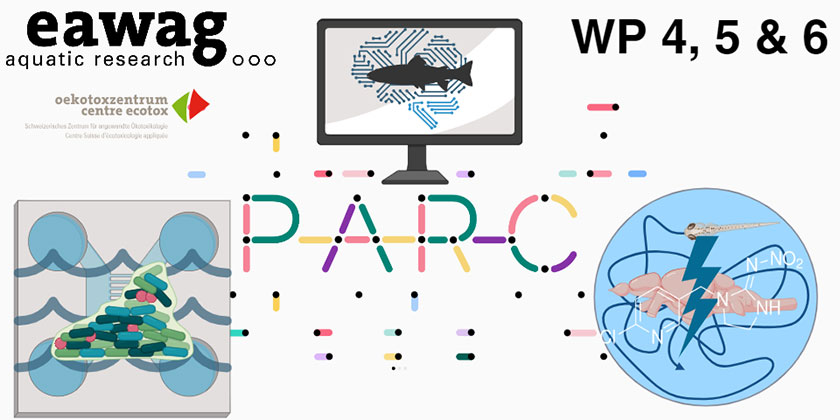
Chemical risk assessment is meant to ensure the safety of chemicals for both human health and the environment. However, the rising number of highly diverse chemicals on the market, for which toxicological and exposure data is not always available, challenge the current regulatory system. Here, new toxicological methods can help streamlining the process of filling these data gaps. Likewise, improving the dialogue between science, policymakers, and the public can lead to rapid prioritization of new chemicals in terms of research and regulatory needs. This then feeds into the agile adaptation of the regulatory process, ensuring higher safety for the public while simultaneously reducing the need for currently required animal tests, thus saving both resources and animal lives.

The Partnership for the Assessment of Risks from Chemicals (PARC)[SC1]  is a Horizon Europe project funded by the European Union. It is aimed at revising and improving the chemical risk assessment process to suit the possibilities and needs of the 21st century. This effort is brought forward through research and innovation that are closely linked to society. By including over 200 partners from 29 countries, spanning diverse disciplines, PARC puts a particularly strong focus on interdisciplinary collaboration across research fields and stakeholders. PARC activities support the EU Green Deal zero pollution goal as well as the EU Chemicals Strategy for Sustainability.

At Eawag and the Ecotox Centre, PARC is represented through several projects, covering a diverse array of aspects:

WP4 Monitoring and Exposure

Under PARC WP4 Monitoring and Exposure, whose overall goal is “to monitor chemicals guided by regulatory challenges both in humans and in the environment, observing different sources, chemical fates and exposure pathways”:

  • Contribution to the project design of targeted monitoring activities (WP 4.2.3) and prioritization of chemicals and activities based on existing knowledge (WP 4.2.1, 4.2.2)

Team

Prof. Dr. Juliane Hollender Senior scientist / Group leader Tel. +41 58 765 5493 Send Mail

Team

Prof. Dr. Juliane Hollender Senior scientist / Group leader Tel. +41 58 765 5493 Send Mail
Corina Meyer Scientist Tel. +41 58 765 6799 Send Mail

Team

Prof. Dr. Juliane Hollender Senior scientist / Group leader Tel. +41 58 765 5493 Send Mail
Dr. Steven Chow Scientist Tel. +41 58 765 5665 Send Mail

WP5 Hazard Assessment

Under PARC WP5 Hazard Assessment, the overall focus is “on hazard assessment for human and environmental health on three different directions: fill data gaps, develop and/or improve methodologies for hazard assessment to progress toward next generation risk assessment (NGRA)”, all projects under WP5.2.:

  • The project on machine learning where available data will be surveyed using available databases and data cleaned for further processing. Focus will be on acute toxicity data across taxa on the one hand and on mode-of-action specific assay information on the other.

Team

Prof. Dr. Kristin Schirmer Group leader and deputy head of department Tel. +41 58 765 5266 Send Mail
Dr. Christoph Schuer Postdoctoral Scientist Tel. +41 58 765 5684 Send Mail
  • The project on a microfluidic device with immobilized synthetic phototrophic biofilms, where the optimal conditions for a reproducible biofilm formation will be identified. This will be achieved by testing different inoculation conditions as well as the various flow velocities in the microfluidic device.

Team

Prof. Dr. Kristin Schirmer Group leader and deputy head of department Tel. +41 58 765 5266 Send Mail
  • The project on zebrafish behavioral effects of neurotoxicants will focus on the consolidation of the pipeline for concomitant assessment of behavioral alterations and the underlying structural and molecular changes occurring in the nervous system of larval zebrafish upon exposure to neurotoxic substances as well as during the depuration period.

Team

Dr. Ksenia Groh Group Leader Tel. +41 58 765 5182 Send Mail
Dr. Colette vom Berg Head of department Tel. +41 58 765 5535 Send Mail
Severin Ammann Lab Technician Tel. +41 58 765 6407 Send Mail
René Schönenberger Lab Technician Tel. +41 58 765 5105 Send Mail

WP6 Innovation in Regulatory Risk Assessment

Under PARC WP6 Innovation in Regulatory Risk Assessment, the main goal is “to drive innovation in regulatory risk assessment by strengthening its scientific basis, with implementation of NGRA as ultimate goal”:

  • Contribution to a review of risk assessment methodology, through a case study led by FOEN and Eawag, which will analyze the differences and similarities in environmental risk assessment of pesticides performed under different prospective and retrospective regulations, aiming to advance the one substance one assessment goal (WP 6.3). This project will make use of extensive experience with risk assessment for pesticides in Switzerland and in Europe, built by the project team during the last decade.

Team

  • Case study to contribute to the current discussion on mixture allocation factors  (MAF) for the prospective risk assessment of chemicals. Different MAF types are applied on fresh water monitoring datasets to find statistical evidence for a MAF that minimizes mixture effects of single substances and to discuss the limitations of each MAF type in the context of real monitoring data. s (WP 6.4.1)

Team

Dr. Marion Junghans Ecotox Centre Tel. +41 58 765 5401 Send Mail
Fabian Balk Researcher Tel. +41 58 765 6478 Send Mail
  • In this case study, the current mixture risk assessment for water bodies used by certain swiss cantons (Junghans et al., 2013, Aqua & Gas, 93(5), 54-61) will be expanded with endpoints relevant to the european water framework directive (WFD), the methodology compared to conventional mixture risk assessments and assessed for consideration as amendment for the WFD (WP 6.4.1)

Team

Dr. Marion Junghans Ecotox Centre Tel. +41 58 765 5401 Send Mail
Fabian Balk Researcher Tel. +41 58 765 6478 Send Mail
  • In WP 6.4.4, models for landscape-based environmental risk assessment are being developed. Different case studies provide data to inform model design. Eawag/OZ leads a case study on linking pesticide use to monitoring data: Based on chemical monitoring data (water, sediment, fish) and biotest data for five agricultural sites, we want to calculate exposure-activity ratios that will then be compared with biological monitoring data. The main aims are (1) to understand the predictive power of the EAR approach at the selected sites and (2) to check for established adverse outcome pathways (AOPs) being evidenced by the data for further investigation.

Team

Publikationen

Extbase Variable Dump
array(2 items)
   publications => '33052,33005,32823,32142' (23 chars)
   libraryUrl => '' (0 chars)
Extbase Variable Dump
array(4 items)
   0 => Snowflake\Publications\Domain\Model\Publicationprototypepersistent entity (uid=33052, pid=124)
      originalId => protected33052 (integer)
      authors => protected'Gasser, L.; Schür, C.; Perez-Cruz, F.; Schirmer, K.; Ba
         ity-Jesi, M.
' (93 chars) title => protected'Machine learning-based prediction of fish acute mortality: implementation, i
         nterpretation, and regulatory relevance
' (115 chars) journal => protected'Environmental Science: Advances' (31 chars) year => protected2024 (integer) volume => protected3 (integer) issue => protected'8' (1 chars) startpage => protected'1124' (4 chars) otherpage => protected'1138' (4 chars) categories => protected'' (0 chars) description => protected'Regulation of chemicals requires knowledge of their toxicological effects on
          a large number of species, which has traditionally been acquired through in
          vivo testing. The recent effort to find alternatives based on machine learn
         ing, however, has not focused on guaranteeing transparency, comparability an
         d reproducibility, which makes it difficult to assess advantages and disadva
         ntages of these methods. Also, comparable baseline performances are needed.
         In this study, we trained regression models on the ADORE "t-F2F" challenge p
         roposed in [Schür et al., Nature Scientific data, 2023] to predict acute mo
         rtality, measured as LC50 (lethal concentration 50), of organic compounds on
          fishes. We trained LASSO, random forest (RF), XGBoost, Gaussian process (GP
         ) regression models, and found a series of aspects that are stable across mo
         dels: (i) using mass or molar concentrations does not affect performances; (
         ii) the performances are only weakly dependent on the molecular representati
         ons of the chemicals, but (iii) strongly on how the data is split. Overall,
         the tree-based models RF and XGBoost performed best and we were able to pred
         ict the log10-transformed LC50 with a root mean square error of 0.90, which
         corresponds to an order of magnitude on the original LC50 scale. On a local
         level, on the other hand, the models are not able to consistently predict th
         e toxicity of individual chemicals accurately enough. Predictions for single
          chemicals are mostly influenced by a few chemical properties while taxonomi
         c traits are not captured sufficiently by the models. We discuss technical a
         nd conceptual improvements for these challenges to enhance the suitability o
         f in silico methods to environmental hazard assessment. Accordingly, this wo
         rk showcases state-of-the-art models and contributes to the ongoing discussi
         on on regulatory integration.
' (1853 chars) serialnumber => protected'' (0 chars) doi => protected'10.1039/d4va00072b' (18 chars) uid => protected33052 (integer) _localizedUid => protected33052 (integer)modified _languageUid => protectedNULL _versionedUid => protected33052 (integer)modified pid => protected124 (integer)
1 => Snowflake\Publications\Domain\Model\Publicationprototypepersistent entity (uid=33005, pid=124) originalId => protected33005 (integer) authors => protected'Adamovsky, O.; Groh, K. J.; Białk-Bielińska, A.; Esche
         r, B. I.; Beaudouin, R.; Mora Lagares, L.; Tollefsen,&nb
         sp;K. E.; Fenske, M.; Mulkiewicz, E.; Creusot, N.; Sosno
         wska, A.; Loureiro, S.; Beyer, J.; Repetto, G.; Štern,&
         nbsp;A.; Lopes, I.; Monteiro, M.; Zikova-Kloas, A.; Eleršek,
          T.; Vračko, M.; Zdybel, S.; Puzyn, T.; Koczur, W.
         ; Ebsen Morthorst, J.; Holbech, H.; Carlsson, G.; Örn, 
         S.; Herrero, Ó.; Siddique, A.; Liess, M.; Braun, G.; Sr
         ebny, V.; Žegura, B.; Hinfray, N.; Brion, F.; Knapen,&n
         bsp;D.; Vandeputte, E.; Stinckens, E.; Vergauwen, L.; Behrend
         t, L.; João Silva, M.; Blaha, L.; Kyriakopoulou, K.
' (832 chars) title => protected'Exploring BPA alternatives - environmental levels and toxicity review' (69 chars) journal => protected'Environment International' (25 chars) year => protected2024 (integer) volume => protected189 (integer) issue => protected'' (0 chars) startpage => protected'108728 (29 pp.)' (15 chars) otherpage => protected'' (0 chars) categories => protected'BPA alternatives; biological activity; in silico; invertebrates; vertebrates' (76 chars) description => protected'Bisphenol A alternatives are manufactured as potentially less harmful substi
         tutes of bisphenol A (BPA) that offer similar functionality. These alternati
         ves are already in the market, entering the environment and thus raising eco
         logical concerns. However, it can be expected that levels of BPA alternative
         s will dominate in the future, they are limited information on their environ
         mental safety. The EU PARC project highlights BPA alternatives as priority c
         hemicals and consolidates information on BPA alternatives, with a focus on e
         nvironmental relevance and on the identification of the research gaps. The r
         eview highlighted aspects and future perspectives. In brief, an extension of
          environmental monitoring is crucial, extending it to cover BPA alternatives
          to track their levels and facilitate the timely implementation of mitigatio
         n measures. The biological activity has been studied for BPA alternatives, b
         ut in a non-systematic way and prioritized a limited number of chemicals. Fo
         r several BPA alternatives, the data has already provided substantial eviden
         ce regarding their potential harm to the environment. We stress the importan
         ce of conducting more comprehensive assessments that go beyond the tradition
         al reproductive studies and focus on overlooked relevant endpoints. Future r
         esearch should also consider mixture effects, realistic environmental concen
         trations, and the long-term consequences on biota and ecosystems.
' (1433 chars) serialnumber => protected'0160-4120' (9 chars) doi => protected'10.1016/j.envint.2024.108728' (28 chars) uid => protected33005 (integer) _localizedUid => protected33005 (integer)modified _languageUid => protectedNULL _versionedUid => protected33005 (integer)modified pid => protected124 (integer)
2 => Snowflake\Publications\Domain\Model\Publicationprototypepersistent entity (uid=32823, pid=124) originalId => protected32823 (integer) authors => protected'Posthuma, L.; Bloor, M.; Campos, B.; Groh, K.; Leopold,&
         nbsp;A.; Sanderson, H.; Schreiber, H.; Schür, C.; Thomas,&nb
         sp;P.
' (157 chars) title => protected'Green Swans countering chemical pollution' (41 chars) journal => protected'Integrated Environmental Assessment and Management' (50 chars) year => protected2024 (integer) volume => protected20 (integer) issue => protected'3' (1 chars) startpage => protected'888' (3 chars) otherpage => protected'891' (3 chars) categories => protected'' (0 chars) description => protected'If a problem has exponential features, its solution asks for counter-exponen
         tial approaches. Chemical pollution appears to be such a problem. Analyses o
         f chemical hazards to human health, biodiversity, and ecosystem services and
          estimates of the cost of inaction suggest the potential for adverse impacts
         , and analyses of trends in the chemical economy appear exponential in kind.
          Here, we argue that we need and can develop an exponential and application-
         focused mindset in thinking about solutions.
' (500 chars) serialnumber => protected'1551-3777' (9 chars) doi => protected'10.1002/ieam.4915' (17 chars) uid => protected32823 (integer) _localizedUid => protected32823 (integer)modified _languageUid => protectedNULL _versionedUid => protected32823 (integer)modified pid => protected124 (integer)
3 => Snowflake\Publications\Domain\Model\Publicationprototypepersistent entity (uid=32142, pid=124) originalId => protected32142 (integer) authors => protected'Schür, C.; Gasser, L.; Perez-Cruz, F.; Schirmer, K.; Ba
         ity-Jesi, M.
' (93 chars) title => protected'A benchmark dataset for machine learning in ecotoxicology' (57 chars) journal => protected'Scientific Data' (15 chars) year => protected2023 (integer) volume => protected10 (integer) issue => protected'1' (1 chars) startpage => protected'718 (20 pp.)' (12 chars) otherpage => protected'' (0 chars) categories => protected'' (0 chars) description => protected'The use of machine learning for predicting ecotoxicological outcomes is prom
         ising, but underutilized. The curation of data with informative features req
         uires both expertise in machine learning as well as a strong biological and
         ecotoxicological background, which we consider a barrier of entry for this k
         ind of research. Additionally, model performances can only be compared acros
         s studies when the same dataset, cleaning, and splittings were used. Therefo
         re, we provide <em>ADORE</em>, an extensive and well-described dataset on ac
         ute aquatic toxicity in three relevant taxonomic groups (fish, crustaceans,
         and algae). The core dataset describes ecotoxicological experiments and is e
         xpanded with phylogenetic and species-specific data on the species as well a
         s chemical properties and molecular representations. Apart from challenging
         other researchers to try and achieve the best model performances across the
         whole dataset, we propose specific relevant challenges on subsets of the dat
         a and include datasets and splittings corresponding to each of these challen
         ge as well as in-depth characterization and discussion of train-test splitti
         ng approaches.
' (1154 chars) serialnumber => protected'' (0 chars) doi => protected'10.1038/s41597-023-02612-2' (26 chars) uid => protected32142 (integer) _localizedUid => protected32142 (integer)modified _languageUid => protectedNULL _versionedUid => protected32142 (integer)modified pid => protected124 (integer)
Gasser, L.; Schür, C.; Perez-Cruz, F.; Schirmer, K.; Baity-Jesi, M. (2024) Machine learning-based prediction of fish acute mortality: implementation, interpretation, and regulatory relevance, Environmental Science: Advances, 3(8), 1124-1138, doi:10.1039/d4va00072b, Institutional Repository
Adamovsky, O.; Groh, K. J.; Białk-Bielińska, A.; Escher, B. I.; Beaudouin, R.; Mora Lagares, L.; Tollefsen, K. E.; Fenske, M.; Mulkiewicz, E.; Creusot, N.; Sosnowska, A.; Loureiro, S.; Beyer, J.; Repetto, G.; Štern, A.; Lopes, I.; Monteiro, M.; Zikova-Kloas, A.; Eleršek, T.; Vračko, M.; Zdybel, S.; Puzyn, T.; Koczur, W.; Ebsen Morthorst, J.; Holbech, H.; Carlsson, G.; Örn, S.; Herrero, Ó.; Siddique, A.; Liess, M.; Braun, G.; Srebny, V.; Žegura, B.; Hinfray, N.; Brion, F.; Knapen, D.; Vandeputte, E.; Stinckens, E.; Vergauwen, L.; Behrendt, L.; João Silva, M.; Blaha, L.; Kyriakopoulou, K. (2024) Exploring BPA alternatives - environmental levels and toxicity review, Environment International, 189, 108728 (29 pp.), doi:10.1016/j.envint.2024.108728, Institutional Repository
Posthuma, L.; Bloor, M.; Campos, B.; Groh, K.; Leopold, A.; Sanderson, H.; Schreiber, H.; Schür, C.; Thomas, P. (2024) Green Swans countering chemical pollution, Integrated Environmental Assessment and Management, 20(3), 888-891, doi:10.1002/ieam.4915, Institutional Repository
Schür, C.; Gasser, L.; Perez-Cruz, F.; Schirmer, K.; Baity-Jesi, M. (2023) A benchmark dataset for machine learning in ecotoxicology, Scientific Data, 10(1), 718 (20 pp.), doi:10.1038/s41597-023-02612-2, Institutional Repository

Kontakt

WP 4 Monitoring and Exposure

WP 4 Monitoring and Exposure
Prof. Dr. Juliane Hollender Senior scientist / Group leader Tel. +41 58 765 5493 Send Mail
WP 4 Monitoring and Exposure

WP5 Hazard Assessment

Dr. Colette vom Berg Head of department Tel. +41 58 765 5535 Send Mail

WP6 Innovation in Regulatory Risk Assessment

Dr. Marion Junghans Ecotox Centre Tel. +41 58 765 5401 Send Mail

In collaboration with

Funding

Europäische Union
Staatssekretariat für Bildung, Forschung und Innovation (SBFI)
Eawag