Innovationen im Bereich nicht-netzwerk basierter Wasser- und Abwassersysteme – ein inter- und transdisziplinäres strategisches Forschungsprogramm
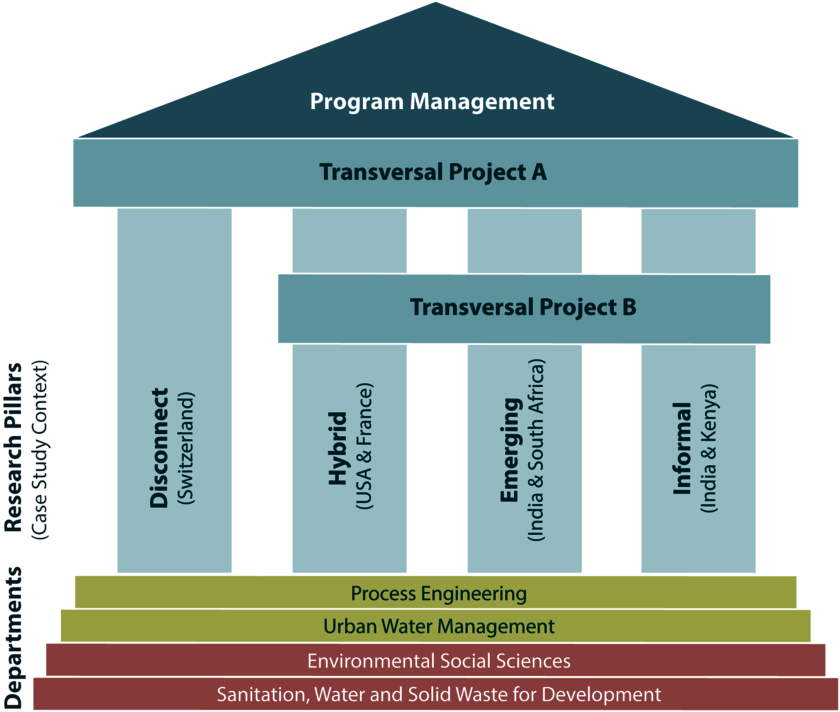
Wings (Water and sanitation innovations for non-grid solutions) möchte innovative nicht-netzwerk basierte Wasser- und Abwassersysteme entwickeln, die bzgl. ihrer Leistung mit konventionellen, netzwerk basierten Wasser- und Abwasserinfrastrukturen vergleichbar sind. Wir tun dies, indem wir:
solche Systeme aus unterschiedlichen Perspektiven (Ingenieurswesen, Entscheidungsanalyse, Entwicklungsstudien, Transitions-und Innovationsstudien und Verhaltensstudien) heraus untersuchen.
eng mit den wichtigsten Akteuren aus verschiedenen Sektoren und Entscheidungsebenen zusammenarbeiten.
in verschiedenen sozio-ökonomischen Kontexten (Forschungssäulen) von industrialisierten Ländern bis hin zu aufstrebenden und sich entwickelnden Ländern forschen.
uns mit konzeptionellen und methodischen Fragen befassen, die bestehende Forschungsprojekte in verschiedenen Kontexten aufeinander beziehen und verbinden (transversale Projekte).
auf aktuelle und abgeschlossene Projekte im Feld der Siedlungswasserwirtschaft aufbauen.
Hintergrund
Im Laufe der Geschichte war das Management urbaner Wassersysteme eine Kernaufgabe von Zivilgesellschaften. Dies spiegelt die Bedeutung dieser Systeme für das menschliche Wohlergehen und den Umweltschutz wider. Der heutige, konventionelle Ansatz der Siedlungswasserwirtschaft baut auf gefestigte sozio-technische Systeme, die sich über das letzte Jahrhundert entwickelt haben und die meisten der Wasser- und Hygieneprobleme, die OECD Ländern zusetzten, gelöst haben. Diese vorwiegend zentralisierten und netzwerk basierten Systeme behandeln und bieten verlässlich Trinkwasser und transportieren, behandeln und entsoren Abwasser sicher. Herausforderungen sind allerdings Bevölkerungswachstum (sowohl positives als auch negatives), Klimawandel, neuartige Schadstoffe, als auch die Notwendigkeit, alternde Leitungsnetze wiederherzustellen und zu ersetzen.
Obwohl die Debatte, ob es in OECD Ländern einen Bedarf nach neuen Ansätzen gibt, anhält, erkennen führende Forschungsinstitute, internationale Organisationen und nationale Regierungen zunehmend an, dass der konventionelle Ansatz der Siedlungswasserwirtschaft nicht die einzige Lösung für schnell wachsende Städte in Ländern mit niedrigem oder mittlerem Einkommen in Afrika, Asien und Lateinamerika sein kann. Da zentralisierte, leitunsgebundene Wassersysteme unerreichbar für einen grossen Teil der weltweiten Stadtbevölkerung sind, gibt es einen grossen Bedarf fundamental neue Konzepte zu entwickeln, d.h. flexiblere, kostengünstigere und ressourcenschonende nicht-netzwerk basierte Systme, die mit heutigen und zukünftigen Herausforderungen urbaner Wasserwirtschaft umgehen können.
Unsere Forschung organisieren wir in vier Forschungssäulen. Jede dieser Forschungssäulen umfasst eine typische sozio-technische Systemkonfiguration.
Wings Disconnect
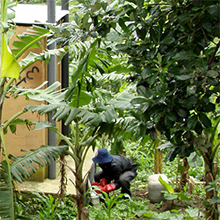
Wings Disconnect ermittelt die Bedingungen für dezentrale Wasser- und Abwassersysteme in Kontexten mit bewährten Governance-Strukturen, mittlerem bis hohem Einkommen und einem hohen Grad an Zentralisierung. Verglichen mit dem dominierenden Konzept der Wasserversorgung und Kanalisation versprechen dezentrale Systeme vorteilhafter auf neue Anforderungen wie rasche demographische Veränderungen, Klimawandel und andere Planungsunsicherheiten reagieren zu können. Hinzu kommt eine wachsende Besorgnis, dass es finanziell nicht nachhaltig sein könnte, die bestehenden, alternden Leitungsnetze zu erhalten.
Wings Disconnect möchte die wissenschaftliche Grundlage für eine Bewertung liefern, ob ein Systemwechsel diese Bedenken ausräumen und die Nachhaltigkeit verbessern könnte. Um dies zu erreichen, gehen wir näher darauf ein, wo und wann es möglich ist, vom zentralen System zu entkoppeln und nicht-netzwerk basierte Systeme (besonders Kleinkläranlagen) zu implementieren und wir identifizieren potentielle Transitionspfade. Dies beinhaltet die Entwicklung und Methoden zur Bestimmung eines optimalen Grads infrastruktureller Zentralisierung, zur Quantifizierung der Leistung ganzer Systeme, zur Identifikation industrieller Möglichkeiten und zur Unterstützung von Entscheidungsprozessen über die Zeit.
Aktuelle Projekte
Wir untersuchen die Herausforderungen modularer Infrastrukturen für die Schweizer Wirtschaft und Gesellschaft am Beispiel der Siedlungswasserwirtschaft.
Decentralisation changes wastewater quantity and quality that is discharged to the sewer. We investigate the effects of these changes on the operation of existing centralised sewer systems.
Wings Hybrid untersucht neue Modelle und Methoden, um Nährstoffe, Wasser und Energie in zukünftigen Städten zu recyceln, insbesondere im Kontext des Klimawandels. Konventioneller Weise wird gemischtes Abwasser in einer zentralen Kläranlage getrennt und behandelt. Wir möchten tragfähige Alternativen für grosstechnische Anwendungen etablieren, welche die Abwasserströme getrennt je nach Typ und Konzentration ihrer enthaltenen Schmutzstoffe sammeln und behandeln. Dadurch können Wasser, Nährstoffe und Energie leicht zurückgewonnen werden, was wiederum die Wasser- und Energieproduktivität erhöht.
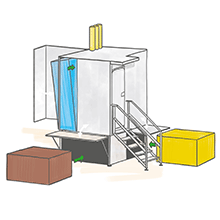
Wings Hybrid entwickelt Urinseparierung und -behandlung weiter, um anthropogene Nährstoffe in der Landwirtschaft wieder zu verwenden, ebenso wie Grauwasserbehandlung, um Wasser mit hoher chemischer und mikrobieller Qualität zurück zu gewinnen. Dazu gehört die technische Entwicklung und Optimierung durch praktische Tests in einem Living Lab, die Implementierung von Demonstrationsprojekten und die Zusammenarbeit mit Partnern aus der Industrie.
Aktuelle Projekte
In Autarky entwickeln wir kleine Anlagen für die getrennte Behandlung von Urin, Abwasser und Fäkalien direkt in der Toilette.
Wings Emerging untersucht Innovationen in aufstrebenden Märkten, charakterisiert durch rasante Urbanisierung, eine wachsende Mittelklasse und gesamtwirtschaftliches Wachstum, mündend in einem steigenden Lebensstandard, einer erhöhten Bautätigkeit als auch in einer erhöhten Ressourcennachfrage (Wasser, Energie, Services). Wegen dieser besonderen Charakteristika nehmen wir an, dass Neubaugebiete in Schwellenländern zu den vielversprechendsten Leitmärkten für innovative, nicht-netzwerk basierte Lösungen wie ganzheitliche Konzepte für Wasser, Abwasser, Abfall und Energie zählen.
Wings Emerging möchte Entscheidungsträger und Nischenanbieter beim Übergang zu holistischen vor-Ort Wassersystemen und bei der Etablierung einer systemischen Sicht auf urbanes Wassermanagement inspirieren und unterstützen. Dies beinhaltet die relevanten Fähigkeiten, um mit solchen Innovationen erfolgreich zu sein, zu analysieren, Innovationspfade, um nicht-netzwerk basierte Lösungen einzuführen, zu untersuchen und Hemmnisse und Treiber für ihre Verbreitung zu erforschen.
Aktuelle Projekte
4S is assessing small-scale sanitation systems in South Asia to provide policy recommendations for improved sanitation system design, implementation and O&M.
RADEC will herausfinden, wie Schwellenländer sowohl industrielle Sprünge als auch die Transition zu ökologischer Nachhaltigkeit erreichen können, indem es die industriellen und soziotechnischen Aspekte dezentraler Wasser- und Sanitärsysteme in China, Indien und Südafrika analysiert
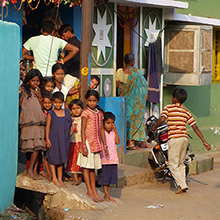
Wings Informal analysiert nicht-netzwerk basierte Lösungen für einige der schwierigsten, komplexesten und am schnellsten wachsenden bebauten Umgebungen in Entwicklungsländern - informelle Siedlungen. Bewohner dieser Gebiete sind benachteiligt, da es ihnen an formellem Zugang zu Land, Wohnungen und grundlegenden städtischen Leistungen fehlt. Lösungen werden daher auf soliden Technologiekonzepten fussen müssen und gleichzeitig den Bedürfnissen und spezifischen Ressourcenbeschränkungen, die in diesen Gebieten zu finden sind, entsprechen müssen.
Die grösseren Komplexitäten von aktuellen, heterogenen Sanitärsystemen zu verstehen mit besonderem Fokus auf ihre Schnittstellen, ist das Ziel von Wings Informal. Dazu gehört das Umfeld zu analysieren, das die erfolgreiche Einführung dieser Lösungen behindert oder unterstützt, die Skalierungsvoraussetzungen für Geschäftsmodelle mit einem besonderen Fokus auf Container-basierte Systeme zu erforschen und Herausforderungen und Möglichkeiten bei der Skalierung von Innovationen in informellen Siedlungen zu identifizieren.
Aktuelle Projekte
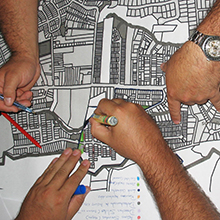
The aim of CWIS research is to develop a method that synthesizes existing information about the sanitation landscapes of cities in India and that presents comprehensive sanitation solutions.
We seek to understand how formal and informal institutions, planning procedures and resources drive or constrain informal settlements upgrading in Sub Saharan Africa cities.
Development of systematic but generic methods for the generation of locally appropriate sanitation system options and for the quantification of sustainability performance indicators.
Transversale Projekte bündeln konzeptionelle und methodische Bedürfnisse der vier Forschungssäulen und/oder des gesamten Programms. Dadurch stärken sie die Verbindung innerhalb des interdisziplinären Forschungsteams.
Aktuelle Projekte
The INTEGRATE project aims at strengthening inter- and transdisciplinary integration within and across the strategic research program Wings.
The Lighthouse Project focuses on visible examples of onsite and decentralised urban water management systems, which will play a key role in enabling sustainability transitions.
array(20 items)0 => Snowflake\Publications\Domain\Model\Publicationprototypepersistent entity (uid=23625, pid=124)originalId => protected23625 (integer)
authors => protected'Heiberg, J.; Truffer, B.; Binz, C.' (49 chars)
title => protected'Assessing transitions through socio-technical configuration analysis – a m ethodological framework and a case study in the water sector' (136 chars)
journal => protected'Research Policy' (15 chars)
year => protected2022 (integer)
volume => protected51 (integer)
issue => protected'1' (1 chars)
startpage => protected'104363 (19 pp.)' (15 chars)
otherpage => protected'' (0 chars)
categories => protected'socio-technical configuration analysis; geography of transitions; socio-tech nical alignments; discourse; modular water technologies' (131 chars)
description => protected'Classic accounts of transitions research have predominantly built on reconst ructions of historical transition processes and in-depth case studies to ide ntify and conceptualize socio-technical change. While such approaches have s ubstantively improved our understanding of transitions, they often suffer fr om methodological nationalism and a lack of generalizability beyond spatial and sectoral boundaries. To address this gap, we propose a novel methodology – socio-technical configuration analysis (STCA) – to map and measure so cio-technical alignment processes across time and space. STCA provides a con figurational and dynamic perspective on how social and technical elements ge t aligned into "configurations that work", allowing for the identification o f differentiated transition trajectories at and across spatial and sectoral contexts. The methodology's value is illustrated with the empirical case of an ongoing shift from centralized to more modular infrastructure configurati ons in the global water sector. Building on this illustration, we outline po tential contributions of STCA to configurational theorizing in transition st udies, sketching the contours of what we believe could become a generative e pistemological approach for this field.' (1255 chars)
serialnumber => protected'0048-7333' (9 chars)
doi => protected'10.1016/j.respol.2021.104363' (28 chars)
uid => protected23625 (integer)
_localizedUid => protected23625 (integer)modified_languageUid => protectedNULL
_versionedUid => protected23625 (integer)modifiedpid => protected124 (integer)1 => Snowflake\Publications\Domain\Model\Publicationprototypepersistent entity (uid=23992, pid=124)originalId => protected23992 (integer)
authors => protected'Duque, N.; Bach, P. M.; Scholten, L.; Fappiano, F.; Maurer, M.' (92 chars)
title => protected'A simplified sanitary sewer system generator for exploratory modelling at ci ty-scale' (84 chars)
journal => protected'Water Research' (14 chars)
year => protected2022 (integer)
volume => protected209 (integer)
issue => protected'' (0 chars)
startpage => protected'117903 (12 pp.)' (15 chars)
otherpage => protected'' (0 chars)
categories => protected'algorithmic network generation; wastewater infrastructure; geographic inform ation system (GIS); foul sewer system modelling; network topology' (141 chars)
description => protected'Future climatic, demographic, technological, urban and socio-economic challe nges call for more flexible and sustainable wastewater infrastructure system s. Exploratory modelling can help to investigate the consequences of these d evelopments on the infrastructure. In order to explore large numbers of adap tation strategies, we need to re-balance the degree of realism of sewer netw ork and ability to reflect key performance characteristics against the model 's parsimony and computational efficiency. We present a spatially explicit a lgorithm for creating sanitary sewer networks that realistically represent k ey characteristics of a real system. Basic topographic, demographic and urba n characteristics are abstracted into a squared grid of 'Blocks' which are t he foundation for the sewer network's topology delineation. We compare three different pipe dimensioning approaches and found a good balance between det ail and computational efficiency. With a basic hydraulic performance assessm ent, we demonstrate that we attain a computationally efficient and high-fide lity wastewater sewer network with adequate hydraulic performance. A spatial resolution of 250 m Block size in combination with a sequential Pipe-by-Pi pe (PBP) design algorithm provides a sound trade-off between computational t ime and fidelity of relevant structural and hydraulic properties for explora tory modelling. We can generate a simplified sewer network (both topology an d hydraulic design) in 18 s using PBP, versus 36 min using a highly detaile d model or 1 s using a highly abstract model. Moreover, this simplification can cut up to 1/10<sup>th</sup> to 1/50<sup>th</sup> the computational time for the hydraulic simulations depending on the routing method implemented. We anticipate our model to be a starting point for sophisticated exploratory modelling into possible infrastructure adaptation measures of topological a nd loading changes of sewer systems for long-term planning.' (1959 chars)
serialnumber => protected'0043-1354' (9 chars)
doi => protected'10.1016/j.watres.2021.117903' (28 chars)
uid => protected23992 (integer)
_localizedUid => protected23992 (integer)modified_languageUid => protectedNULL
_versionedUid => protected23992 (integer)modifiedpid => protected124 (integer)2 => Snowflake\Publications\Domain\Model\Publicationprototypepersistent entity (uid=24447, pid=124)originalId => protected24447 (integer)
authors => protected'Heiberg, J.; Truffer, B.' (34 chars)
title => protected'Overcoming the harmony fallacy: how values shape the course of innovation sy stems' (81 chars)
journal => protected'Environmental Innovation and Societal Transitions' (49 chars)
year => protected2022 (integer)
volume => protected42 (integer)
issue => protected'' (0 chars)
startpage => protected'411' (3 chars)
otherpage => protected'428' (3 chars)
categories => protected'technological innovation systems (TIS); values; institutional logics; socio- technical configuration analysis; geography of transitions; modular water te chnologies' (162 chars)
description => protected'The technological innovation systems (TIS) framework is one of the dominant perspectives in transitions studies to analyze success conditions and system failures of newly emerging technologies and industries. So far, TIS studies mostly adopted a rather harmonious view on the values of actors and by this were unable to address competition, conflicts and, in particular, battles o ver diverging directionalities within the system. To empirically assess this potential “harmony fallacy”, we identify values as part of underlying i nstitutional logics of major organizations in the field of modular water tec hnologies in Switzerland by means of 26 expert interviews. We show how logic s may condition collaboration patterns and technological preferences. This a nalysis inspires key conceptual tasks of innovation system analysis, like th e identification of system failures, the setting of appropriate system bound aries and the formulation of better policy recommendations.' (971 chars)
serialnumber => protected'2210-4224' (9 chars)
doi => protected'10.1016/j.eist.2022.01.012' (26 chars)
uid => protected24447 (integer)
_localizedUid => protected24447 (integer)modified_languageUid => protectedNULL
_versionedUid => protected24447 (integer)modifiedpid => protected124 (integer)3 => Snowflake\Publications\Domain\Model\Publicationprototypepersistent entity (uid=23878, pid=124)originalId => protected23878 (integer)
authors => protected'Larsen, T. A.; Riechmann, M. E.; Udert, K. M.' (75 chars)
title => protected'State of the art of urine treatment technologies: a critical review.' (68 chars)
journal => protected'Water Research X' (16 chars)
year => protected2021 (integer)
volume => protected13 (integer)
issue => protected'' (0 chars)
startpage => protected'100114 (20 pp.)' (15 chars)
otherpage => protected'' (0 chars)
categories => protected'nitrogen recovery; phosphorus recovery; pharmaceutical removal; environmenta l protection; volume reduction; energy production' (125 chars)
description => protected'Over the last 15 years, urine treatment technologies have developed from lab studies of a few pioneers to an interesting innovation, attracting attentio n from a growing number of process engineers. In this broad review, we prese nt literature from more than a decade on biological, physical-chemical and e lectrochemical urine treatment processes. Like in the first review on urine treatment from 2006, we categorize the technologies according to the followi ng objectives: stabilization, volume reduction, targeted N-recovery, targete d P-recovery, nutrient removal, sanitization, and handling of organic microp ollutants. We add energy recovery as a new objective, because extensive work has been done on electrochemical energy harvesting, especially with bio-ele ctrochemical systems. Our review reveals that biological processes are a goo d choice for urine stabilization. They have the advantage of little demand f or chemicals and energy. Due to instabilities, however, they are not suited for bathroom applications and they cannot provide the desired volume reducti on on their own. A number of physical-chemical treatment technologies are ap plicable at bathroom scale and can provide the necessary volume reduction, b ut only with a steady supply of chemicals and often with high demand for ene rgy and maintenance. Electrochemical processes is a recent, but rapidly grow ing field, which could give rise to exciting technologies at bathroom scale, although energy production might only be interesting for niche applications . The review includes a qualitative assessment of all unit processes. A quan titative comparison of treatment performance was not the goal of the study a nd could anyway only be done for complete treatment trains. An important nex t step in urine technology research and development will be the combination of unit processes to set up and test robust treatment trains. We hope that t he present review will help guide these efforts to accelerate the developmen t towards a mature techn...' (2065 chars)
serialnumber => protected'2589-9147' (9 chars)
doi => protected'10.1016/j.wroa.2021.100114' (26 chars)
uid => protected23878 (integer)
_localizedUid => protected23878 (integer)modified_languageUid => protectedNULL
_versionedUid => protected23878 (integer)modifiedpid => protected124 (integer)4 => Snowflake\Publications\Domain\Model\Publicationprototypepersistent entity (uid=22780, pid=124)originalId => protected22780 (integer)
authors => protected'Hacker, M. E.; Binz, C.' (38 chars)
title => protected'Institutional barriers to on-site alternative water systems: a conceptual fr amework and systematic analysis of the literature' (125 chars)
journal => protected'Environmental Science and Technology' (36 chars)
year => protected2021 (integer)
volume => protected55 (integer)
issue => protected'12' (2 chars)
startpage => protected'8267' (4 chars)
otherpage => protected'8277' (4 chars)
categories => protected'on-site; decentralized; institutional barriers; urban water management; soci o-technical complexity; alternative water system' (124 chars)
description => protected'Scientists are increasingly exploring on-site water systems to supplement co nventional centralized water and wastewater infrastructure. While major tech nological advancements have been achieved, we still lack a systematic view o n the non-technical, or institutional, elements that constitute important ba rriers to the uptake of on-site urban water management systems. This paper p resents a conceptual framework distinguishing between institutional barriers in six key dimensions: <em>Equity</em>, <em>Knowledge and Capabilities</em> , <em>Financial Investment</em>, <em>Legal and Regulatory Frameworks</em>, < em>Legitimacy</em>, and <em>Market Structures</em>. The analysis of the exis ting literature covering these barriers is translated into a typology of the socio-technical complexity of different types of alternative water systems (e.g., non-potable reuse, rainwater systems, and nutrient recovery). Finding s show that socio-technical complexity increases with the pollution load in the source water, correlating to potential health risk, and the number of se ctors involved in the value chain of an alternative water system. For exampl e, greywater reuse for toilet flushing might have systematically less comple x institutional barriers than source separation for agricultural reuse. This study provides practitioners with easily accessible means of understanding non-technical barriers for various types of on-site reuse systems and provid es researchers with a conceptual framework for capturing socio-technical com plexity in the adoption of alternative water systems.' (1573 chars)
serialnumber => protected'0013-936X' (9 chars)
doi => protected'10.1021/acs.est.0c07947' (23 chars)
uid => protected22780 (integer)
_localizedUid => protected22780 (integer)modified_languageUid => protectedNULL
_versionedUid => protected22780 (integer)modifiedpid => protected124 (integer)5 => Snowflake\Publications\Domain\Model\Publicationprototypepersistent entity (uid=22955, pid=124)originalId => protected22955 (integer)
authors => protected'Larsen, T. A.; Gruendl, H.; Binz, C.' (56 chars)
title => protected'The potential contribution of urine source separation to the SDG agenda - a review of the progress so far and future development options' (136 chars)
journal => protected'Environmental Science: Water Research and Technology' (52 chars)
year => protected2021 (integer)
volume => protected7 (integer)
issue => protected'7' (1 chars)
startpage => protected'1161' (4 chars)
otherpage => protected'1176' (4 chars)
categories => protected'' (0 chars)
description => protected'Sanitation and wastewater management are highly relevant for reaching a numb er of interconnected sustainable development goals (SDGs), especially SDG 6, the provision of safe drinking water and adequate sanitation for all as wel l as protection of water resources against pollution, and SDG 14.1, reducing nutrient emissions to the marine environment. Recent evidence increasingly shows that conventional sewer-based wastewater management will not be able t o reach these targets. Rather than further optimizing and diffusing this age ing infrastructure paradigm, radical innovations like urine source separatio n technologies could help to leapfrog towards faster achievement of the SDGs . The technology would simplify on-site sanitation and develop a closed-loop nutrient cycle, thereby allowing for exceptionally high nutrient removal fr om wastewater and direct reuse in agriculture from the first day of implemen tation. Radical innovations, however, need decades to materialize. Based on a review of relevant academic and grey literature, we show how the past thre e decades of development of urine source separation have brought breakthroug hs in toilet design and treatment processes, enabling the technology's value chain to reach the brink of maturity. In a short outlook, we discuss how th e technology may reach global diffusion over the next decade, with the main remaining challenges relating to the creation of mass-markets for urine-dive rting toilets, automation and mass-production of treatment systems, and the legitimation of fertilizer produced from urine in the agricultural sector.' (1594 chars)
serialnumber => protected'2053-1400' (9 chars)
doi => protected'10.1039/D0EW01064B' (18 chars)
uid => protected22955 (integer)
_localizedUid => protected22955 (integer)modified_languageUid => protectedNULL
_versionedUid => protected22955 (integer)modifiedpid => protected124 (integer)6 => Snowflake\Publications\Domain\Model\Publicationprototypepersistent entity (uid=22375, pid=124)originalId => protected22375 (integer)
authors => protected'Reynaert, E.; Hess, A.; Morgenroth, E.' (53 chars)
title => protected'Making waves: why water reuse frameworks need to co-evolve with emerging sma ll-scale technologies' (97 chars)
journal => protected'Water Research X' (16 chars)
year => protected2021 (integer)
volume => protected11 (integer)
issue => protected'' (0 chars)
startpage => protected'100094 (5 pp.)' (14 chars)
otherpage => protected'' (0 chars)
categories => protected'on-site non-potable water reuse; decentralized; regulatory and legal framewo rks; guidelines; standards; field test' (114 chars)
description => protected'Novel technologies allow to reuse or recycle water for on-site applications such as toilet flushing, showering, or hand washing at the household- or bui lding-scale. Many of these technologies have now reached technology readines s levels that require for verification and validation testing in the field. Results from such field tests of decentralized water reuse systems have been published over the past few years, and observed performance is often compar ed to quality targets from water reuse frameworks (WRFs). An inspection of t en recent journal publications reveals that targets from WRFs are often misi nterpreted, and the emphasis of these publications is too often on demonstra ting successful aspects of the technologies rather than critically evaluatin g the quality of the produced water. We hypothesize that some of these misin terpretations are due to ambiguous definition of scopes of WRFs (e.g., "unre stricted urban reuse") and unclear applicability for novel recycling systems that treat the water for applications that go beyond the reuse scopes defin ed in current WRFs. Additional challenges are linked to the verification of WRF quality targets in small-scale and decentralized systems under economic and organizational constraints. Current WRFs are not suitable for all possib le reuse cases, and there is need for a critical discussion of quality targe ts and associated monitoring methods. As the scope of water reuse has expand ed greatly over the past years, WRFs need to address new applications and ad vances in technology, including in monitoring capacities.' (1577 chars)
serialnumber => protected'2589-9147' (9 chars)
doi => protected'10.1016/j.wroa.2021.100094' (26 chars)
uid => protected22375 (integer)
_localizedUid => protected22375 (integer)modified_languageUid => protectedNULL
_versionedUid => protected22375 (integer)modifiedpid => protected124 (integer)7 => Snowflake\Publications\Domain\Model\Publicationprototypepersistent entity (uid=21911, pid=124)originalId => protected21911 (integer)
authors => protected'Spuhler, D.; Scheidegger, A.; Maurer, M.' (55 chars)
title => protected'Ex-ante quantification of nutrient, total solids, and water flows in sanitat ion systems' (87 chars)
journal => protected'Journal of Environmental Management' (35 chars)
year => protected2021 (integer)
volume => protected280 (integer)
issue => protected'' (0 chars)
startpage => protected'111785 (17 pp.)' (15 chars)
otherpage => protected'' (0 chars)
categories => protected'sustainable sanitation; substance flow modelling; resource recovery; structu red decision making; multi-criteria decision analysis' (129 chars)
description => protected'To prioritise sustainable sanitation systems in strategic sanitation plannin g, indicators such as local appropriateness or resource recovery have to be known at the pre-planning phase. The quantification of resource recovery rem ains a challenge because existing substance flow models require large amount s of input data and can therefore only be applied for a few options at a tim e for which implementation examples exist. This paper aims to answer two que stions: How can we predict resource recovery and losses of sanitation system s ex-ante at the pre-planning phase? And how can we do this efficiently to c onsider the entire sanitation system option space? The approach builds on an existing model to create all valid sanitation systems from a set of convent ional and emerging technologies and to evaluate their appropriateness for a given application case. It complements the previous model with a Substance F low Model (SFM) and with transfer coefficients from a technology library to quantify nutrients (phosphorus and nitrogen), total solids (as an indicator for energy and organics), and water flows in sanitation systems ex ante. The transfer coefficients are based on literature data and expert judgement. Un certainties resulting from the variability of literature data or ignorance o f experts are explicitly considered, allowing to assess the robustness of th e model output. Any (future) technologies or additional products can easily be added to the library. The model is illustrated with a small didactic exam ple showing how 12 valid system configurations are generated from a few tech nologies, and how substance flows, recovery ratios, and losses to soil, air, and water are quantified considering uncertainties. The recovery ratios var y between 0 and 28% for phosphorus, 0–10% for nitrogen, 0–26% for total solids, and 0–12% for water. The uncertainties reflect the high variabilit y of the literature data but are comparable to those obtained in studies usi ng a conventional post-a...' (3741 chars)
serialnumber => protected'0301-4797' (9 chars)
doi => protected'10.1016/j.jenvman.2020.111785' (29 chars)
uid => protected21911 (integer)
_localizedUid => protected21911 (integer)modified_languageUid => protectedNULL
_versionedUid => protected21911 (integer)modifiedpid => protected124 (integer)8 => Snowflake\Publications\Domain\Model\Publicationprototypepersistent entity (uid=21740, pid=124)originalId => protected21740 (integer)
authors => protected'Hess, A.; Bettex, C.; Morgenroth, E.' (51 chars)
title => protected'Influence of intermittent flow on removal of organics in a biological activa ted carbon filter (BAC) used as post-treatment for greywater' (136 chars)
journal => protected'Water Research X' (16 chars)
year => protected2020 (integer)
volume => protected9 (integer)
issue => protected'' (0 chars)
startpage => protected'100078 (10 pp.)' (15 chars)
otherpage => protected'' (0 chars)
categories => protected'biologically activated carbon (BAC); intermittent flow; bioregeneration; bio filtration; greywater' (97 chars)
description => protected'Highly variable flow has to be expected in decentralized greywater treatment and can lead to intermittent operation of the treatment system. However, fe w studies have addressed the influence of variable flow on the treatment per formance of a biological activated carbon filter (BAC). In this study, we in vestigated the influence of intermittent flow using small-scale BAC columns, which treat greywater as a second treatment step following a membrane biore actor (MBR). Three operating strategies to respond to variable flow were eva luated. The activated carbon was characterized before and after the experime nts in terms of biological activity and sorption capacity. The performance o f the BAC filters was assessed based on total organic carbon (TOC) removal, TOC fractions and growth potential. No significant differences were observed between constant flow compared to on-off operation with intermittent flow o ver the range of tested influent concentrations. Peaks with high TOC during 24 h periods were attenuated by sorption and biological degradation. Adsorb ed TOC was released after switching back to normal concentrations for influe nt concentrations more than 5 times higher than usually observed, the BAC fu nctioned as a temporary sink. In line with these results, the high influent TOC values led to increased biological activity in the filter but did not in fluence the sorption capacity. The experiments showed that intermittent flow does not negatively impact the performance of a BAC and that there is no ne ed for additional equalization tanks to buffer the variable flow, for exampl e in household-scale greywater treatment.' (1637 chars)
serialnumber => protected'2589-9147' (9 chars)
doi => protected'10.1016/j.wroa.2020.100078' (26 chars)
uid => protected21740 (integer)
_localizedUid => protected21740 (integer)modified_languageUid => protectedNULL
_versionedUid => protected21740 (integer)modifiedpid => protected124 (integer)9 => Snowflake\Publications\Domain\Model\Publicationprototypepersistent entity (uid=20568, pid=124)originalId => protected20568 (integer)
authors => protected'Hoffmann, S.; Feldmann, U.; Bach, P. M.; Binz, C.; Farrelly, M.; Frantzeskaki, N.; Hiessl, H.; Inauen, J.; Larsen, T. A.; Lienert, J.; Londong, J.; Lüthi, C. ; Maurer, M.; Mitchell, C.; Morgenroth, E.; Nelson, K.&n bsp;L.; Scholten, L.; Truffer, B.; Udert, K. M.' (371 chars)
title => protected'A research agenda for the future of urban water management: exploring the po tential of non-grid, small-grid, and hybrid solutions' (129 chars)
journal => protected'Environmental Science and Technology' (36 chars)
year => protected2020 (integer)
volume => protected54 (integer)
issue => protected'9' (1 chars)
startpage => protected'5312' (4 chars)
otherpage => protected'5322' (4 chars)
categories => protected'urban water management; non-grid systems; small-grid systems; hybrid systems ; research agenda; transdisciplinary integration' (124 chars)
description => protected'Recent developments in high- and middle-income countries have exhibited a sh ift from conventional urban water systems to alternative solutions that are more diverse in source separation, decentralization, and modularization. The se solutions include non-grid, small-grid, and hybrid systems to address suc h pressing global challenges as climate change, eutrophication, and rapid ur banization. They close loops, recover valuable resources, and adapt quickly to changing boundary conditions such as population size. Moving to such alte rnative solutions requires both technical and social innovations to co-evolv e over time into integrated socio-technical urban water systems. Current imp lementations of alternative systems in high- and middle-income countries are promising, but they also underline the need for research questions to be ad dressed from technical, social, and transformative perspectives. Future rese arch should apply a transdisciplinary research approach through socio-techni cal "lighthouse" projects that apply alternative urban water systems at scal e. Such research should leverage experience from lighthouse projects in a ra nge of socio-economic contexts, identify their potentials and limitations fr om an integrated perspective, and share their successes and failures across the urban water sector.' (1315 chars)
serialnumber => protected'0013-936X' (9 chars)
doi => protected'10.1021/acs.est.9b05222' (23 chars)
uid => protected20568 (integer)
_localizedUid => protected20568 (integer)modified_languageUid => protectedNULL
_versionedUid => protected20568 (integer)modifiedpid => protected124 (integer)10 => Snowflake\Publications\Domain\Model\Publicationprototypepersistent entity (uid=19278, pid=124)originalId => protected19278 (integer)
authors => protected'Larsen, T. A.' (23 chars)
title => protected'Urine source separation for global nutrient management' (54 chars)
journal => protected'In: O’Bannon, D. J. (Eds.), Women in water quality. Investigatio ns by prominent female engineers' (108 chars)
year => protected2020 (integer)
volume => protected0 (integer)
issue => protected'' (0 chars)
startpage => protected'99' (2 chars)
otherpage => protected'111' (3 chars)
categories => protected'' (0 chars)
description => protected'The sewer-based paradigm for wastewater management at the global scale is no t successful neither from a humanitarian nor from an environmental perspecti ve. The systems are too expensive for the largest part of the global populat ion. Source separation and resource recovery offer an alternative for sanita tion and water pollution control. This chapter illustrates the importance bu t also the challenges of urine source separation for efficient nutrient remo val and recovery.<br />' (479 chars)
serialnumber => protected'' (0 chars)
doi => protected'10.1007/978-3-030-17819-2_6' (27 chars)
uid => protected19278 (integer)
_localizedUid => protected19278 (integer)modified_languageUid => protectedNULL
_versionedUid => protected19278 (integer)modifiedpid => protected124 (integer)11 => Snowflake\Publications\Domain\Model\Publicationprototypepersistent entity (uid=19943, pid=124)originalId => protected19943 (integer)
authors => protected'Pakizer, K.; Fischer, M.; Lieberherr, E.' (55 chars)
title => protected'Policy instrument mixes for operating modular technology within hybrid water systems' (84 chars)
journal => protected'Environmental Science and Policy' (32 chars)
year => protected2020 (integer)
volume => protected105 (integer)
issue => protected'' (0 chars)
startpage => protected'120' (3 chars)
otherpage => protected'133' (3 chars)
categories => protected'water governance; modular water technology; hybrid water systems; policy ins truments; QCA' (89 chars)
description => protected'Water systems are experiencing dynamic societal demands and extreme environm ental changes. The integration of modular water systems into existing centra lized infrastructures, creating hybrid systems, could mitigate these challen ges by enabling more resilient water management. However, the existence of t echnological alternatives has not changed the continuous reliance on central ized water infrastructure. Supportive policy instruments are key to foster t he operation of modular technology within hybrid water systems. This article focuses on the role of substantive and procedural policy instruments for th e successful operation of modular water systems within a hybrid water infras tructure. Based on Qualitative Comparative Analysis (QCA), we can confirm th e claim in the literature that relying on regulatory instruments is relevant for operating modular technology within hybrid systems. However, we also fi nd combinations of policy instruments where regulatory instruments do not ma tter. Furthermore, we find that procedural instruments emphasizing stakehold er participation interplay with different substantive policy instruments to support the successful operation of modular systems.' (1192 chars)
serialnumber => protected'1462-9011' (9 chars)
doi => protected'10.1016/j.envsci.2019.12.009' (28 chars)
uid => protected19943 (integer)
_localizedUid => protected19943 (integer)modified_languageUid => protectedNULL
_versionedUid => protected19943 (integer)modifiedpid => protected124 (integer)12 => Snowflake\Publications\Domain\Model\Publicationprototypepersistent entity (uid=19120, pid=124)originalId => protected19120 (integer)
authors => protected'Gründl, H.; Larsen, T. A.' (41 chars)
title => protected'The toilet revolution: improved water pollution control and reuse of wastewa ter in urban slums and in modern cities' (115 chars)
journal => protected'World Architecture' (18 chars)
year => protected2019 (integer)
volume => protected0 (integer)
issue => protected'06' (2 chars)
startpage => protected'36' (2 chars)
otherpage => protected'39' (2 chars)
categories => protected'' (0 chars)
description => protected'With two new toilet systems, one for urban slums and the other for modern ci ties, we can at the same time improve water pollution control and further th e economic reuse of wastewater. For urban slums, the Blue Diversion Toilet i s an appealing, affordable and safe technical solution. It is designed for i ndustrialised manufacturing and implements a sustainable sanitation value ch ain with total resource recovery and zero discharge. The important concept o f the toilet is urine source separation. This concept that can also revoluti onise wastewater management in the modern cities of industrialised and fast industrialising countries. With the new urine-separating toilet Save! this t oilet revolution can spread on a global scale, offering a cost-efficient mea sure to help save surface water from eutrophication, make reuse of wastewate r easier and cheaper and – as a side effect - provide fertiliser for urban and rural agriculture.' (935 chars)
serialnumber => protected'1002-4832' (9 chars)
doi => protected'' (0 chars)
uid => protected19120 (integer)
_localizedUid => protected19120 (integer)modified_languageUid => protectedNULL
_versionedUid => protected19120 (integer)modifiedpid => protected124 (integer)13 => Snowflake\Publications\Domain\Model\Publicationprototypepersistent entity (uid=18784, pid=124)originalId => protected18784 (integer)
authors => protected'Maurer, M.; Hoffmann, S.' (34 chars)
title => protected'Sanierungsfall Abwassersystem' (29 chars)
journal => protected'Volkswirtschaft' (15 chars)
year => protected2019 (integer)
volume => protected89 (integer)
issue => protected'6' (1 chars)
startpage => protected'12' (2 chars)
otherpage => protected'15' (2 chars)
categories => protected'' (0 chars)
description => protected'Mit einem Wiederbeschaffungswert von 230 Milliarden Franken zählt die Wasse rversorgung und Abwasserentsorgung in der Schweiz zu den wertvollsten Infras trukturbauten. Alternde Leitungen, steigende Bevölkerungszahlen und zunehme nde Urbanisierung verlangen in den nächsten 30 Jahren Investitionen von ins gesamt 130 Milliarden Franken. Auf globaler Ebene schätzt die OECD die Inve stitionen in die Siedlungswasserwirtschaft auf jährlich 900 Milliarden Fran ken. Dieser hohe Investitionsbedarf und der global steigende Druck, neue Ans ätze zu finden, bieten einen Spielraum für innovative Lösungen. Die Schwe iz hat mit ihrer Spitzenforschung in diesem Bereich und dem aktuellen Bedarf an Infrastrukturerneuerung ein ungenutztes «Lead-Market»-Potenzial. Dazu braucht es aber ein gesamtschweizerisches Impulsprogram, das die fragmentier ten Infrastrukturentscheide der Gemeinden koordiniert.' (890 chars)
serialnumber => protected'1011-386X' (9 chars)
doi => protected'' (0 chars)
uid => protected18784 (integer)
_localizedUid => protected18784 (integer)modified_languageUid => protectedNULL
_versionedUid => protected18784 (integer)modifiedpid => protected124 (integer)14 => Snowflake\Publications\Domain\Model\Publicationprototypepersistent entity (uid=18914, pid=124)originalId => protected18914 (integer)
authors => protected'Schneider, M. Y.; Carbajal, J. P.; Furrer, V.; Ster kele, B.; Maurer, M.; Villez, K.' (123 chars)
title => protected'Beyond signal quality: the value of unmaintained pH, dissolved oxygen, and o xidation-reduction potential sensors for remote performance monitoring of on -site sequencing batch reactors' (183 chars)
journal => protected'Water Research' (14 chars)
year => protected2019 (integer)
volume => protected161 (integer)
issue => protected'' (0 chars)
startpage => protected'639' (3 chars)
otherpage => protected'651' (3 chars)
categories => protected'ammonium valley; decentralised wastewater treatment; feature engineering; lo w-maintenance sensors; online measurement; soft sensor' (130 chars)
description => protected'Sensor maintenance is time-consuming and is a bottleneck for monitoring on-s ite wastewater treatment systems. Hence, we compare maintained and unmaintai ned sensors to monitor the biological performance of a small-scale sequencin g batch reactor (SBR). The sensor types are ion-selective pH, optical dissol ved oxygen (DO), and oxidation-reduction potential (ORP) with platinum elect rode. We created soft sensors using engineered features: ammonium valley for pH, oxidation ramp for DO, and nitrite ramp for the ORP. Four soft sensors based on unmaintained pH sensors correctly identified the completion of the ammonium oxidation (89–91 out of 107 cycles), about as many times as soft sensors based on a maintained pH sensor (91 out of 107 cycles). In contrast, the DO soft sensor using data from a maintained sensor showed slightly bett er (89 out of 96 cycles) detection performance than that using data from two unmaintained sensors (77, respectively 82 out of 96 correct). Furthermore, the DO soft sensor using maintained data is much less sensitive to the optim isation of cut-off frequency and slope tolerance than the soft sensor using unmaintained data. The nitrite ramp provided no useful information on the st ate of nitrite oxidation, so no comparison of maintained and unmaintained OR P sensors was possible in this case. We identified two hurdles when designin g soft sensors for unmaintained sensors: i) Sensors’ type- and design-spec ific deterioration affects performance. ii) Feature engineering for soft sen sors is sensor type specific, and the outcome is strongly influenced by oper ational parameters such as the aeration rate. In summary, the results with t he provided soft sensors show that frequent sensor maintenance is not necess arily needed to monitor the performance of SBRs. Without sensor maintenance monitoring smalls-scale SBRs becomes practicable, which could improve the re liability of unstaffed on-site treatment systems substantially.' (1963 chars)
serialnumber => protected'0043-1354' (9 chars)
doi => protected'10.1016/j.watres.2019.06.007' (28 chars)
uid => protected18914 (integer)
_localizedUid => protected18914 (integer)modified_languageUid => protectedNULL
_versionedUid => protected18914 (integer)modifiedpid => protected124 (integer)15 => Snowflake\Publications\Domain\Model\Publicationprototypepersistent entity (uid=19048, pid=124)originalId => protected19048 (integer)
authors => protected'Thürlimann, C. M.; Udert, K. M.; Morgenroth, E.; V illez, K.' (90 chars)
title => protected'Stabilizing control of a urine nitrification process in the presence of sens or drift' (84 chars)
journal => protected'Water Research' (14 chars)
year => protected2019 (integer)
volume => protected165 (integer)
issue => protected'' (0 chars)
startpage => protected'114958 (10 pp.)' (15 chars)
otherpage => protected'' (0 chars)
categories => protected'nitrite control; inflection point; shape constrained splines; relative measu rement; online experiment; nitrification' (116 chars)
description => protected'Sensor drift is commonly observed across engineering disciplines, particular ly in harsh media such as wastewater. In this study, a novel stabilizing con troller for nitrification of high strength ammonia solutions is designed bas ed on online signal derivatives. The controller uses the derivative of a dri fting nitrite signal to determine if nitrite-oxidizing bacteria (NOB) are su bstrate limited or substrate inhibited. To ensure a meaningful interpretatio n of the derivative signal, the process is excited in a cyclic manner by rep eatedly exposing the NOB to substrate-limited and substrate-inhibited condit ions. The resulting control system successfully prevented nitrite accumulati ons for a period of 72 days in a laboratory-scale reactor. Slow disturbances in the form of feed composition changes and temperature changes were succes sfully handled by the controller while short-term temperature disturbances a re shown to pose a challenge to the current version of this controller. Most importantly, we demonstrate that drift-tolerant control for the purpose of process stabilization can be achieved without sensor redundancy by combining deliberate input excitation, qualitative trend analysis, and coarse process knowledge.' (1227 chars)
serialnumber => protected'0043-1354' (9 chars)
doi => protected'10.1016/j.watres.2019.114958' (28 chars)
uid => protected19048 (integer)
_localizedUid => protected19048 (integer)modified_languageUid => protectedNULL
_versionedUid => protected19048 (integer)modifiedpid => protected124 (integer)16 => Snowflake\Publications\Domain\Model\Publicationprototypepersistent entity (uid=16797, pid=124)originalId => protected16797 (integer)
authors => protected'Aubert, A. H.; Bauer, R.; Lienert, J.' (57 chars)
title => protected'A review of water-related serious games to specify use in environmental Mult i-Criteria Decision Analysis' (104 chars)
journal => protected'Environmental Modelling and Software' (36 chars)
year => protected2018 (integer)
volume => protected105 (integer)
issue => protected'' (0 chars)
startpage => protected'64' (2 chars)
otherpage => protected'78' (2 chars)
categories => protected'Multi-Criteria Decision Analysis; sustainability; serious game; gamification ; stakeholder participation; behavioral operational research' (136 chars)
description => protected'Serious games and gamification are nowadays pervasive. They are used to comm unicate about science and sometimes to involve citizens in science (e.g. cit izen science). Concurrently, environmental decision analysis is challenged b y the high cognitive load of the decision-making process and the possible bi ases threatening the rationality assumptions. Difficult decision-making proc esses can result in incomplete preference construction, and are generally li mited to few participants. We reviewed 43 serious games and gamified applica tions related to water. We covered the broad diversity of serious games, whi ch could be explained by the still unsettled terminology in the research are a of gamification and serious gaming. We discuss how existing games could be nefit early steps of Multi-Criteria Decision Analysis (MCDA), including prob lem structuring, stakeholder analysis, defining objectives, and exploring al ternatives. We argue that no existing game allows for preference elicitation ; one of the most challenging steps of MCDA. We propose many research opport unities for behavioral operational research.' (1108 chars)
serialnumber => protected'1364-8152' (9 chars)
doi => protected'10.1016/j.envsoft.2018.03.023' (29 chars)
uid => protected16797 (integer)
_localizedUid => protected16797 (integer)modified_languageUid => protectedNULL
_versionedUid => protected16797 (integer)modifiedpid => protected124 (integer)17 => Snowflake\Publications\Domain\Model\Publicationprototypepersistent entity (uid=11408, pid=124)originalId => protected11408 (integer)
authors => protected'Reymond, P.; Renggli, S.; Lüthi, C.' (51 chars)
title => protected'Towards sustainable sanitation in an urbanising world' (53 chars)
journal => protected'In: Ergen, M. (Eds.), Sustainable urbanization' (51 chars)
year => protected2016 (integer)
volume => protected0 (integer)
issue => protected'' (0 chars)
startpage => protected'115' (3 chars)
otherpage => protected'134' (3 chars)
categories => protected'urban sanitation; sanitation planning; decentralised sanitation; wastewater management; faecal sludge management' (112 chars)
description => protected'Urban sanitation in low‐ and middle‐income countries is at an inflection point. It is increasingly acknowledged that conventional sewer‐based sani tation cannot be the only solution for expanding urban areas. There are othe r objective reasons apart from the lack of capital. The lack of stable energ y supplies, of spare parts and of human resources for reliable operation, an d the increasing water scarcity are factors that seriously limit the expansi on of centralised systems. This chapter argues that a new paradigm for urban sanitation is possible, if the heterogeneity within developing cities is re flected in the implementation of different sanitation systems, adapted to ea ch urban context and integrated under one institutional roof. This new parad igm entails: (1) innovative management arrangements; (2) increased participa tion and the integration of individual, community and private sector initiat ives; (3) thinking at scale to open new opportunities; (4) improved analysis of the situation and awareness raising. Moving beyond conventional approach es towards sustainable urbanisation needs to follow both a top‐down and a bottom‐up approach, with proper incentives and a variety of sanitation sys tems which, in a future perspective, will become part of the 'urban ecosyste m'.' (1295 chars)
serialnumber => protected'' (0 chars)
doi => protected'10.5772/63726' (13 chars)
uid => protected11408 (integer)
_localizedUid => protected11408 (integer)modified_languageUid => protectedNULL
_versionedUid => protected11408 (integer)modifiedpid => protected124 (integer)18 => Snowflake\Publications\Domain\Model\Publicationprototypepersistent entity (uid=10590, pid=124)originalId => protected10590 (integer)
authors => protected'Larsen, T. A.; Hoffmann, S.; Lüthi, C.; Truffer, B .; Maurer, M.' (94 chars)
title => protected'Emerging solutions to the water challenges of an urbanizing world' (65 chars)
journal => protected'Science' (7 chars)
year => protected2016 (integer)
volume => protected352 (integer)
issue => protected'6288' (4 chars)
startpage => protected'928' (3 chars)
otherpage => protected'933' (3 chars)
categories => protected'' (0 chars)
description => protected'The top priorities for urban water sustainability include the provision of s afe drinking water, wastewater handling for public health, and protection ag ainst flooding. However, rapidly aging infrastructure, population growth, an d increasing urbanization call into question current urban water management strategies, especially in the fast-growing urban areas in Asia and Africa. W e review innovative approaches in urban water management with the potential to provide locally adapted, resource-efficient alternative solutions. Promis ing examples include new concepts for stormwater drainage, increased water p roductivity, distributed or on-site treatment of wastewater, source separati on of human waste, and institutional and organizational reforms. We conclude that there is an urgent need for major transdisciplinary efforts in researc h, policy, and practice to develop alternatives with implications for cities and aquatic ecosystems alike.' (942 chars)
serialnumber => protected'0036-8075' (9 chars)
doi => protected'10.1126/science.aad8641' (23 chars)
uid => protected10590 (integer)
_localizedUid => protected10590 (integer)modified_languageUid => protectedNULL
_versionedUid => protected10590 (integer)modifiedpid => protected124 (integer)19 => Snowflake\Publications\Domain\Model\Publicationprototypepersistent entity (uid=8241, pid=124)originalId => protected8241 (integer)
authors => protected'Eggimann, S.; Truffer, B.; Maurer, M.' (52 chars)
title => protected'To connect or not to connect? Modelling the optimal degree of centralisation for wastewater infrastructures' (107 chars)
journal => protected'Water Research' (14 chars)
year => protected2015 (integer)
volume => protected84 (integer)
issue => protected'' (0 chars)
startpage => protected'218' (3 chars)
otherpage => protected'231' (3 chars)
categories => protected'sustainable network infrastructure planning; geographic information system; sewer modelling; algorithmic network generation; wastewater infrastructure; degree of centralisation' (176 chars)
description => protected'The strong reliance of most utility services on centralised network infrastr uctures is becoming increasingly challenged by new technological advances in decentralised alternatives. However, not enough effort has been made to dev elop planning tools designed to address the implications of these new opport unities and to determine the optimal degree of centralisation of these infra structures. We introduce a planning tool for sustainable network infrastruct ure planning (SNIP), a two-step techno-economic heuristic modelling approach based on shortest path-finding and hierarchical-agglomerative clustering al gorithms to determine the optimal degree of centralisation in the field of w astewater management. This SNIP model optimises the distribution of wastewat er treatment plants and the sewer network outlay relative to several cost an d sewer-design parameters. Moreover, it allows us to construct alternative o ptimal wastewater system designs taking into account topography, economies o f scale as well as the full size range of wastewater treatment plants. We qu antify and confirm that the optimal degree of centralisation decreases with increasing terrain complexity and settlement dispersion while showing that t he effect of the latter exceeds that of topography. Case study results for a Swiss community indicate that the calculated optimal degree of centralisati on is substantially lower than the current level.' (1417 chars)
serialnumber => protected'0043-1354' (9 chars)
doi => protected'10.1016/j.watres.2015.07.004' (28 chars)
uid => protected8241 (integer)
_localizedUid => protected8241 (integer)modified_languageUid => protectedNULL
_versionedUid => protected8241 (integer)modifiedpid => protected124 (integer)
Assessing transitions through socio-technical configuration analysis – a methodological framework and a case study in the water sector
Classic accounts of transitions research have predominantly built on reconstructions of historical transition processes and in-depth case studies to identify and conceptualize socio-technical change. While such approaches have substantively improved our understanding of transitions, they often suffer from methodological nationalism and a lack of generalizability beyond spatial and sectoral boundaries. To address this gap, we propose a novel methodology – socio-technical configuration analysis (STCA) – to map and measure socio-technical alignment processes across time and space. STCA provides a configurational and dynamic perspective on how social and technical elements get aligned into "configurations that work", allowing for the identification of differentiated transition trajectories at and across spatial and sectoral contexts. The methodology's value is illustrated with the empirical case of an ongoing shift from centralized to more modular infrastructure configurations in the global water sector. Building on this illustration, we outline potential contributions of STCA to configurational theorizing in transition studies, sketching the contours of what we believe could become a generative epistemological approach for this field.
Heiberg, J.; Truffer, B.; Binz, C. (2022) Assessing transitions through socio-technical configuration analysis – a methodological framework and a case study in the water sector, Research Policy, 51(1), 104363 (19 pp.), doi:10.1016/j.respol.2021.104363, Institutional Repository
A simplified sanitary sewer system generator for exploratory modelling at city-scale
Future climatic, demographic, technological, urban and socio-economic challenges call for more flexible and sustainable wastewater infrastructure systems. Exploratory modelling can help to investigate the consequences of these developments on the infrastructure. In order to explore large numbers of adaptation strategies, we need to re-balance the degree of realism of sewer network and ability to reflect key performance characteristics against the model's parsimony and computational efficiency. We present a spatially explicit algorithm for creating sanitary sewer networks that realistically represent key characteristics of a real system. Basic topographic, demographic and urban characteristics are abstracted into a squared grid of 'Blocks' which are the foundation for the sewer network's topology delineation. We compare three different pipe dimensioning approaches and found a good balance between detail and computational efficiency. With a basic hydraulic performance assessment, we demonstrate that we attain a computationally efficient and high-fidelity wastewater sewer network with adequate hydraulic performance. A spatial resolution of 250 m Block size in combination with a sequential Pipe-by-Pipe (PBP) design algorithm provides a sound trade-off between computational time and fidelity of relevant structural and hydraulic properties for exploratory modelling. We can generate a simplified sewer network (both topology and hydraulic design) in 18 s using PBP, versus 36 min using a highly detailed model or 1 s using a highly abstract model. Moreover, this simplification can cut up to 1/10th to 1/50th the computational time for the hydraulic simulations depending on the routing method implemented. We anticipate our model to be a starting point for sophisticated exploratory modelling into possible infrastructure adaptation measures of topological and loading changes of sewer systems for long-term planning.
Duque, N.; Bach, P. M.; Scholten, L.; Fappiano, F.; Maurer, M. (2022) A simplified sanitary sewer system generator for exploratory modelling at city-scale, Water Research, 209, 117903 (12 pp.), doi:10.1016/j.watres.2021.117903, Institutional Repository
Overcoming the harmony fallacy: how values shape the course of innovation systems
The technological innovation systems (TIS) framework is one of the dominant perspectives in transitions studies to analyze success conditions and system failures of newly emerging technologies and industries. So far, TIS studies mostly adopted a rather harmonious view on the values of actors and by this were unable to address competition, conflicts and, in particular, battles over diverging directionalities within the system. To empirically assess this potential “harmony fallacy”, we identify values as part of underlying institutional logics of major organizations in the field of modular water technologies in Switzerland by means of 26 expert interviews. We show how logics may condition collaboration patterns and technological preferences. This analysis inspires key conceptual tasks of innovation system analysis, like the identification of system failures, the setting of appropriate system boundaries and the formulation of better policy recommendations.
Heiberg, J.; Truffer, B. (2022) Overcoming the harmony fallacy: how values shape the course of innovation systems, Environmental Innovation and Societal Transitions, 42, 411-428, doi:10.1016/j.eist.2022.01.012, Institutional Repository
State of the art of urine treatment technologies: a critical review.
Over the last 15 years, urine treatment technologies have developed from lab studies of a few pioneers to an interesting innovation, attracting attention from a growing number of process engineers. In this broad review, we present literature from more than a decade on biological, physical-chemical and electrochemical urine treatment processes. Like in the first review on urine treatment from 2006, we categorize the technologies according to the following objectives: stabilization, volume reduction, targeted N-recovery, targeted P-recovery, nutrient removal, sanitization, and handling of organic micropollutants. We add energy recovery as a new objective, because extensive work has been done on electrochemical energy harvesting, especially with bio-electrochemical systems. Our review reveals that biological processes are a good choice for urine stabilization. They have the advantage of little demand for chemicals and energy. Due to instabilities, however, they are not suited for bathroom applications and they cannot provide the desired volume reduction on their own. A number of physical-chemical treatment technologies are applicable at bathroom scale and can provide the necessary volume reduction, but only with a steady supply of chemicals and often with high demand for energy and maintenance. Electrochemical processes is a recent, but rapidly growing field, which could give rise to exciting technologies at bathroom scale, although energy production might only be interesting for niche applications. The review includes a qualitative assessment of all unit processes. A quantitative comparison of treatment performance was not the goal of the study and could anyway only be done for complete treatment trains. An important next step in urine technology research and development will be the combination of unit processes to set up and test robust treatment trains. We hope that the present review will help guide these efforts to accelerate the development towards a mature technology with pilot scale and eventually full-scale implementations.
Larsen, T. A.; Riechmann, M. E.; Udert, K. M. (2021) State of the art of urine treatment technologies: a critical review., Water Research X, 13, 100114 (20 pp.), doi:10.1016/j.wroa.2021.100114, Institutional Repository
Institutional barriers to on-site alternative water systems: a conceptual framework and systematic analysis of the literature
Scientists are increasingly exploring on-site water systems to supplement conventional centralized water and wastewater infrastructure. While major technological advancements have been achieved, we still lack a systematic view on the non-technical, or institutional, elements that constitute important barriers to the uptake of on-site urban water management systems. This paper presents a conceptual framework distinguishing between institutional barriers in six key dimensions: Equity, Knowledge and Capabilities, Financial Investment, Legal and Regulatory Frameworks, Legitimacy, and Market Structures. The analysis of the existing literature covering these barriers is translated into a typology of the socio-technical complexity of different types of alternative water systems (e.g., non-potable reuse, rainwater systems, and nutrient recovery). Findings show that socio-technical complexity increases with the pollution load in the source water, correlating to potential health risk, and the number of sectors involved in the value chain of an alternative water system. For example, greywater reuse for toilet flushing might have systematically less complex institutional barriers than source separation for agricultural reuse. This study provides practitioners with easily accessible means of understanding non-technical barriers for various types of on-site reuse systems and provides researchers with a conceptual framework for capturing socio-technical complexity in the adoption of alternative water systems.
Hacker, M. E.; Binz, C. (2021) Institutional barriers to on-site alternative water systems: a conceptual framework and systematic analysis of the literature, Environmental Science and Technology, 55(12), 8267-8277, doi:10.1021/acs.est.0c07947, Institutional Repository
The potential contribution of urine source separation to the SDG agenda - a review of the progress so far and future development options
Sanitation and wastewater management are highly relevant for reaching a number of interconnected sustainable development goals (SDGs), especially SDG 6, the provision of safe drinking water and adequate sanitation for all as well as protection of water resources against pollution, and SDG 14.1, reducing nutrient emissions to the marine environment. Recent evidence increasingly shows that conventional sewer-based wastewater management will not be able to reach these targets. Rather than further optimizing and diffusing this ageing infrastructure paradigm, radical innovations like urine source separation technologies could help to leapfrog towards faster achievement of the SDGs. The technology would simplify on-site sanitation and develop a closed-loop nutrient cycle, thereby allowing for exceptionally high nutrient removal from wastewater and direct reuse in agriculture from the first day of implementation. Radical innovations, however, need decades to materialize. Based on a review of relevant academic and grey literature, we show how the past three decades of development of urine source separation have brought breakthroughs in toilet design and treatment processes, enabling the technology's value chain to reach the brink of maturity. In a short outlook, we discuss how the technology may reach global diffusion over the next decade, with the main remaining challenges relating to the creation of mass-markets for urine-diverting toilets, automation and mass-production of treatment systems, and the legitimation of fertilizer produced from urine in the agricultural sector.
Larsen, T. A.; Gruendl, H.; Binz, C. (2021) The potential contribution of urine source separation to the SDG agenda - a review of the progress so far and future development options, Environmental Science: Water Research and Technology, 7(7), 1161-1176, doi:10.1039/D0EW01064B, Institutional Repository
Making waves: why water reuse frameworks need to co-evolve with emerging small-scale technologies
Novel technologies allow to reuse or recycle water for on-site applications such as toilet flushing, showering, or hand washing at the household- or building-scale. Many of these technologies have now reached technology readiness levels that require for verification and validation testing in the field. Results from such field tests of decentralized water reuse systems have been published over the past few years, and observed performance is often compared to quality targets from water reuse frameworks (WRFs). An inspection of ten recent journal publications reveals that targets from WRFs are often misinterpreted, and the emphasis of these publications is too often on demonstrating successful aspects of the technologies rather than critically evaluating the quality of the produced water. We hypothesize that some of these misinterpretations are due to ambiguous definition of scopes of WRFs (e.g., "unrestricted urban reuse") and unclear applicability for novel recycling systems that treat the water for applications that go beyond the reuse scopes defined in current WRFs. Additional challenges are linked to the verification of WRF quality targets in small-scale and decentralized systems under economic and organizational constraints. Current WRFs are not suitable for all possible reuse cases, and there is need for a critical discussion of quality targets and associated monitoring methods. As the scope of water reuse has expanded greatly over the past years, WRFs need to address new applications and advances in technology, including in monitoring capacities.
Reynaert, E.; Hess, A.; Morgenroth, E. (2021) Making waves: why water reuse frameworks need to co-evolve with emerging small-scale technologies, Water Research X, 11, 100094 (5 pp.), doi:10.1016/j.wroa.2021.100094, Institutional Repository
Ex-ante quantification of nutrient, total solids, and water flows in sanitation systems
To prioritise sustainable sanitation systems in strategic sanitation planning, indicators such as local appropriateness or resource recovery have to be known at the pre-planning phase. The quantification of resource recovery remains a challenge because existing substance flow models require large amounts of input data and can therefore only be applied for a few options at a time for which implementation examples exist. This paper aims to answer two questions: How can we predict resource recovery and losses of sanitation systems ex-ante at the pre-planning phase? And how can we do this efficiently to consider the entire sanitation system option space? The approach builds on an existing model to create all valid sanitation systems from a set of conventional and emerging technologies and to evaluate their appropriateness for a given application case. It complements the previous model with a Substance Flow Model (SFM) and with transfer coefficients from a technology library to quantify nutrients (phosphorus and nitrogen), total solids (as an indicator for energy and organics), and water flows in sanitation systems ex ante. The transfer coefficients are based on literature data and expert judgement. Uncertainties resulting from the variability of literature data or ignorance of experts are explicitly considered, allowing to assess the robustness of the model output. Any (future) technologies or additional products can easily be added to the library. The model is illustrated with a small didactic example showing how 12 valid system configurations are generated from a few technologies, and how substance flows, recovery ratios, and losses to soil, air, and water are quantified considering uncertainties. The recovery ratios vary between 0 and 28% for phosphorus, 0–10% for nitrogen, 0–26% for total solids, and 0–12% for water. The uncertainties reflect the high variability of the literature data but are comparable to those obtained in studies using a conventional post-ante material flow analysis (generally about 30% variability at the scale of a an urban area). Because the model is fully automated and based on literature data, it can be applied ex-ante to a large and diverse set of possible sanitation systems as shown with a real application case. From the 41 technologies available in the library, 101,548 systems are generated and substance flows are modelled. The resulting recovery ratios range from nothing to almost 100%. The two examples also show that recovery depend on technology interactions and has therefore to be assessed for all possible system configurations and not at the single technology level only. The examples also show that there exist trade-offs among different types of reuse (e.g. energy versus nutrients) or different sustainability indicators (e.g. local appropriateness versus resource recovery). These results show that there is a need for such an automated and generic approach that provides recovery data for all system configurations already at the pre-planning phase. The approach presented enables to integrate transparently the best available knowledge for a growing number of sanitation technologies into a planning process. The resulting resource recovery and loss ratios can be used to prioritise resource efficient systems in sanitation planning, either for the pre-selection or the detailed evaluation of options using e.g. MCDA. The results can also be used to guide future development of technology and system innovations. As resource recovery becomes more relevant and novel sanitation technologies and system options emerge, the approach presents itself as a useful tool for strategic sanitation planning in line with the Sustainable Development Goals (SDGs).
Spuhler, D.; Scheidegger, A.; Maurer, M. (2021) Ex-ante quantification of nutrient, total solids, and water flows in sanitation systems, Journal of Environmental Management, 280, 111785 (17 pp.), doi:10.1016/j.jenvman.2020.111785, Institutional Repository
Influence of intermittent flow on removal of organics in a biological activated carbon filter (BAC) used as post-treatment for greywater
Highly variable flow has to be expected in decentralized greywater treatment and can lead to intermittent operation of the treatment system. However, few studies have addressed the influence of variable flow on the treatment performance of a biological activated carbon filter (BAC). In this study, we investigated the influence of intermittent flow using small-scale BAC columns, which treat greywater as a second treatment step following a membrane bioreactor (MBR). Three operating strategies to respond to variable flow were evaluated. The activated carbon was characterized before and after the experiments in terms of biological activity and sorption capacity. The performance of the BAC filters was assessed based on total organic carbon (TOC) removal, TOC fractions and growth potential. No significant differences were observed between constant flow compared to on-off operation with intermittent flow over the range of tested influent concentrations. Peaks with high TOC during 24 h periods were attenuated by sorption and biological degradation. Adsorbed TOC was released after switching back to normal concentrations for influent concentrations more than 5 times higher than usually observed, the BAC functioned as a temporary sink. In line with these results, the high influent TOC values led to increased biological activity in the filter but did not influence the sorption capacity. The experiments showed that intermittent flow does not negatively impact the performance of a BAC and that there is no need for additional equalization tanks to buffer the variable flow, for example in household-scale greywater treatment.
Hess, A.; Bettex, C.; Morgenroth, E. (2020) Influence of intermittent flow on removal of organics in a biological activated carbon filter (BAC) used as post-treatment for greywater, Water Research X, 9, 100078 (10 pp.), doi:10.1016/j.wroa.2020.100078, Institutional Repository
A research agenda for the future of urban water management: exploring the potential of non-grid, small-grid, and hybrid solutions
Recent developments in high- and middle-income countries have exhibited a shift from conventional urban water systems to alternative solutions that are more diverse in source separation, decentralization, and modularization. These solutions include non-grid, small-grid, and hybrid systems to address such pressing global challenges as climate change, eutrophication, and rapid urbanization. They close loops, recover valuable resources, and adapt quickly to changing boundary conditions such as population size. Moving to such alternative solutions requires both technical and social innovations to co-evolve over time into integrated socio-technical urban water systems. Current implementations of alternative systems in high- and middle-income countries are promising, but they also underline the need for research questions to be addressed from technical, social, and transformative perspectives. Future research should apply a transdisciplinary research approach through socio-technical "lighthouse" projects that apply alternative urban water systems at scale. Such research should leverage experience from lighthouse projects in a range of socio-economic contexts, identify their potentials and limitations from an integrated perspective, and share their successes and failures across the urban water sector.
Hoffmann, S.; Feldmann, U.; Bach, P. M.; Binz, C.; Farrelly, M.; Frantzeskaki, N.; Hiessl, H.; Inauen, J.; Larsen, T. A.; Lienert, J.; Londong, J.; Lüthi, C.; Maurer, M.; Mitchell, C.; Morgenroth, E.; Nelson, K. L.; Scholten, L.; Truffer, B.; Udert, K. M. (2020) A research agenda for the future of urban water management: exploring the potential of non-grid, small-grid, and hybrid solutions, Environmental Science and Technology, 54(9), 5312-5322, doi:10.1021/acs.est.9b05222, Institutional Repository
Urine source separation for global nutrient management
The sewer-based paradigm for wastewater management at the global scale is not successful neither from a humanitarian nor from an environmental perspective. The systems are too expensive for the largest part of the global population. Source separation and resource recovery offer an alternative for sanitation and water pollution control. This chapter illustrates the importance but also the challenges of urine source separation for efficient nutrient removal and recovery.
Larsen, T. A. (2020) Urine source separation for global nutrient management, In: O’Bannon, D. J. (Eds.), Women in water quality. Investigations by prominent female engineers, 99-111, doi:10.1007/978-3-030-17819-2_6, Institutional Repository
Policy instrument mixes for operating modular technology within hybrid water systems
Water systems are experiencing dynamic societal demands and extreme environmental changes. The integration of modular water systems into existing centralized infrastructures, creating hybrid systems, could mitigate these challenges by enabling more resilient water management. However, the existence of technological alternatives has not changed the continuous reliance on centralized water infrastructure. Supportive policy instruments are key to foster the operation of modular technology within hybrid water systems. This article focuses on the role of substantive and procedural policy instruments for the successful operation of modular water systems within a hybrid water infrastructure. Based on Qualitative Comparative Analysis (QCA), we can confirm the claim in the literature that relying on regulatory instruments is relevant for operating modular technology within hybrid systems. However, we also find combinations of policy instruments where regulatory instruments do not matter. Furthermore, we find that procedural instruments emphasizing stakeholder participation interplay with different substantive policy instruments to support the successful operation of modular systems.
Pakizer, K.; Fischer, M.; Lieberherr, E. (2020) Policy instrument mixes for operating modular technology within hybrid water systems, Environmental Science and Policy, 105, 120-133, doi:10.1016/j.envsci.2019.12.009, Institutional Repository
The toilet revolution: improved water pollution control and reuse of wastewater in urban slums and in modern cities
With two new toilet systems, one for urban slums and the other for modern cities, we can at the same time improve water pollution control and further the economic reuse of wastewater. For urban slums, the Blue Diversion Toilet is an appealing, affordable and safe technical solution. It is designed for industrialised manufacturing and implements a sustainable sanitation value chain with total resource recovery and zero discharge. The important concept of the toilet is urine source separation. This concept that can also revolutionise wastewater management in the modern cities of industrialised and fast industrialising countries. With the new urine-separating toilet Save! this toilet revolution can spread on a global scale, offering a cost-efficient measure to help save surface water from eutrophication, make reuse of wastewater easier and cheaper and – as a side effect - provide fertiliser for urban and rural agriculture.
Gründl, H.; Larsen, T. A. (2019) The toilet revolution: improved water pollution control and reuse of wastewater in urban slums and in modern cities, World Architecture, 36-39, Institutional Repository
Sanierungsfall Abwassersystem
Mit einem Wiederbeschaffungswert von 230 Milliarden Franken zählt die Wasserversorgung und Abwasserentsorgung in der Schweiz zu den wertvollsten Infrastrukturbauten. Alternde Leitungen, steigende Bevölkerungszahlen und zunehmende Urbanisierung verlangen in den nächsten 30 Jahren Investitionen von insgesamt 130 Milliarden Franken. Auf globaler Ebene schätzt die OECD die Investitionen in die Siedlungswasserwirtschaft auf jährlich 900 Milliarden Franken. Dieser hohe Investitionsbedarf und der global steigende Druck, neue Ansätze zu finden, bieten einen Spielraum für innovative Lösungen. Die Schweiz hat mit ihrer Spitzenforschung in diesem Bereich und dem aktuellen Bedarf an Infrastrukturerneuerung ein ungenutztes «Lead-Market»-Potenzial. Dazu braucht es aber ein gesamtschweizerisches Impulsprogram, das die fragmentierten Infrastrukturentscheide der Gemeinden koordiniert.
Maurer, M.; Hoffmann, S. (2019) Sanierungsfall Abwassersystem, Volkswirtschaft, 89(6), 12-15, Institutional Repository
Beyond signal quality: the value of unmaintained pH, dissolved oxygen, and oxidation-reduction potential sensors for remote performance monitoring of on-site sequencing batch reactors
Sensor maintenance is time-consuming and is a bottleneck for monitoring on-site wastewater treatment systems. Hence, we compare maintained and unmaintained sensors to monitor the biological performance of a small-scale sequencing batch reactor (SBR). The sensor types are ion-selective pH, optical dissolved oxygen (DO), and oxidation-reduction potential (ORP) with platinum electrode. We created soft sensors using engineered features: ammonium valley for pH, oxidation ramp for DO, and nitrite ramp for the ORP. Four soft sensors based on unmaintained pH sensors correctly identified the completion of the ammonium oxidation (89–91 out of 107 cycles), about as many times as soft sensors based on a maintained pH sensor (91 out of 107 cycles). In contrast, the DO soft sensor using data from a maintained sensor showed slightly better (89 out of 96 cycles) detection performance than that using data from two unmaintained sensors (77, respectively 82 out of 96 correct). Furthermore, the DO soft sensor using maintained data is much less sensitive to the optimisation of cut-off frequency and slope tolerance than the soft sensor using unmaintained data. The nitrite ramp provided no useful information on the state of nitrite oxidation, so no comparison of maintained and unmaintained ORP sensors was possible in this case. We identified two hurdles when designing soft sensors for unmaintained sensors: i) Sensors’ type- and design-specific deterioration affects performance. ii) Feature engineering for soft sensors is sensor type specific, and the outcome is strongly influenced by operational parameters such as the aeration rate. In summary, the results with the provided soft sensors show that frequent sensor maintenance is not necessarily needed to monitor the performance of SBRs. Without sensor maintenance monitoring smalls-scale SBRs becomes practicable, which could improve the reliability of unstaffed on-site treatment systems substantially.
Schneider, M. Y.; Carbajal, J. P.; Furrer, V.; Sterkele, B.; Maurer, M.; Villez, K. (2019) Beyond signal quality: the value of unmaintained pH, dissolved oxygen, and oxidation-reduction potential sensors for remote performance monitoring of on-site sequencing batch reactors, Water Research, 161, 639-651, doi:10.1016/j.watres.2019.06.007, Institutional Repository
Stabilizing control of a urine nitrification process in the presence of sensor drift
Sensor drift is commonly observed across engineering disciplines, particularly in harsh media such as wastewater. In this study, a novel stabilizing controller for nitrification of high strength ammonia solutions is designed based on online signal derivatives. The controller uses the derivative of a drifting nitrite signal to determine if nitrite-oxidizing bacteria (NOB) are substrate limited or substrate inhibited. To ensure a meaningful interpretation of the derivative signal, the process is excited in a cyclic manner by repeatedly exposing the NOB to substrate-limited and substrate-inhibited conditions. The resulting control system successfully prevented nitrite accumulations for a period of 72 days in a laboratory-scale reactor. Slow disturbances in the form of feed composition changes and temperature changes were successfully handled by the controller while short-term temperature disturbances are shown to pose a challenge to the current version of this controller. Most importantly, we demonstrate that drift-tolerant control for the purpose of process stabilization can be achieved without sensor redundancy by combining deliberate input excitation, qualitative trend analysis, and coarse process knowledge.
Thürlimann, C. M.; Udert, K. M.; Morgenroth, E.; Villez, K. (2019) Stabilizing control of a urine nitrification process in the presence of sensor drift, Water Research, 165, 114958 (10 pp.), doi:10.1016/j.watres.2019.114958, Institutional Repository
A review of water-related serious games to specify use in environmental Multi-Criteria Decision Analysis
Serious games and gamification are nowadays pervasive. They are used to communicate about science and sometimes to involve citizens in science (e.g. citizen science). Concurrently, environmental decision analysis is challenged by the high cognitive load of the decision-making process and the possible biases threatening the rationality assumptions. Difficult decision-making processes can result in incomplete preference construction, and are generally limited to few participants. We reviewed 43 serious games and gamified applications related to water. We covered the broad diversity of serious games, which could be explained by the still unsettled terminology in the research area of gamification and serious gaming. We discuss how existing games could benefit early steps of Multi-Criteria Decision Analysis (MCDA), including problem structuring, stakeholder analysis, defining objectives, and exploring alternatives. We argue that no existing game allows for preference elicitation; one of the most challenging steps of MCDA. We propose many research opportunities for behavioral operational research.
Aubert, A. H.; Bauer, R.; Lienert, J. (2018) A review of water-related serious games to specify use in environmental Multi-Criteria Decision Analysis, Environmental Modelling and Software, 105, 64-78, doi:10.1016/j.envsoft.2018.03.023, Institutional Repository
Towards sustainable sanitation in an urbanising world
Urban sanitation in low‐ and middle‐income countries is at an inflection point. It is increasingly acknowledged that conventional sewer‐based sanitation cannot be the only solution for expanding urban areas. There are other objective reasons apart from the lack of capital. The lack of stable energy supplies, of spare parts and of human resources for reliable operation, and the increasing water scarcity are factors that seriously limit the expansion of centralised systems. This chapter argues that a new paradigm for urban sanitation is possible, if the heterogeneity within developing cities is reflected in the implementation of different sanitation systems, adapted to each urban context and integrated under one institutional roof. This new paradigm entails: (1) innovative management arrangements; (2) increased participation and the integration of individual, community and private sector initiatives; (3) thinking at scale to open new opportunities; (4) improved analysis of the situation and awareness raising. Moving beyond conventional approaches towards sustainable urbanisation needs to follow both a top‐down and a bottom‐up approach, with proper incentives and a variety of sanitation systems which, in a future perspective, will become part of the 'urban ecosystem'.
Reymond, P.; Renggli, S.; Lüthi, C. (2016) Towards sustainable sanitation in an urbanising world, In: Ergen, M. (Eds.), Sustainable urbanization, 115-134, doi:10.5772/63726, Institutional Repository
Emerging solutions to the water challenges of an urbanizing world
The top priorities for urban water sustainability include the provision of safe drinking water, wastewater handling for public health, and protection against flooding. However, rapidly aging infrastructure, population growth, and increasing urbanization call into question current urban water management strategies, especially in the fast-growing urban areas in Asia and Africa. We review innovative approaches in urban water management with the potential to provide locally adapted, resource-efficient alternative solutions. Promising examples include new concepts for stormwater drainage, increased water productivity, distributed or on-site treatment of wastewater, source separation of human waste, and institutional and organizational reforms. We conclude that there is an urgent need for major transdisciplinary efforts in research, policy, and practice to develop alternatives with implications for cities and aquatic ecosystems alike.
Larsen, T. A.; Hoffmann, S.; Lüthi, C.; Truffer, B.; Maurer, M. (2016) Emerging solutions to the water challenges of an urbanizing world, Science, 352(6288), 928-933, doi:10.1126/science.aad8641, Institutional Repository
To connect or not to connect? Modelling the optimal degree of centralisation for wastewater infrastructures
The strong reliance of most utility services on centralised network infrastructures is becoming increasingly challenged by new technological advances in decentralised alternatives. However, not enough effort has been made to develop planning tools designed to address the implications of these new opportunities and to determine the optimal degree of centralisation of these infrastructures. We introduce a planning tool for sustainable network infrastructure planning (SNIP), a two-step techno-economic heuristic modelling approach based on shortest path-finding and hierarchical-agglomerative clustering algorithms to determine the optimal degree of centralisation in the field of wastewater management. This SNIP model optimises the distribution of wastewater treatment plants and the sewer network outlay relative to several cost and sewer-design parameters. Moreover, it allows us to construct alternative optimal wastewater system designs taking into account topography, economies of scale as well as the full size range of wastewater treatment plants. We quantify and confirm that the optimal degree of centralisation decreases with increasing terrain complexity and settlement dispersion while showing that the effect of the latter exceeds that of topography. Case study results for a Swiss community indicate that the calculated optimal degree of centralisation is substantially lower than the current level.
Eggimann, S.; Truffer, B.; Maurer, M. (2015) To connect or not to connect? Modelling the optimal degree of centralisation for wastewater infrastructures, Water Research, 84, 218-231, doi:10.1016/j.watres.2015.07.004, Institutional Repository
array(5 items)0 => Snowflake\Publications\Domain\Model\Publicationprototypepersistent entity (uid=22292, pid=124)originalId => protected22292 (integer)
authors => protected'Deutsch, L.; Belcher, B.; Claus, R.; Hoffmann, S.' (69 chars)
title => protected'Leading inter- and transdisciplinary research: lessons from applying theorie s of change to a strategic research program' (119 chars)
journal => protected'Environmental Science and Policy' (32 chars)
year => protected2021 (integer)
volume => protected120 (integer)
issue => protected'' (0 chars)
startpage => protected'29' (2 chars)
otherpage => protected'41' (2 chars)
categories => protected'interdisciplinary; transdisciplinary; theory of change; leadership; urban wa ter management; research programs' (109 chars)
description => protected'Theory of Change (ToC) has been promoted as a useful tool in sustainability research for visioning, planning, communication, monitoring, evaluation and learning. It involves a mapping of steps towards a desired long-term goal su pplemented with continuous reflection on how and why change is expected to h appen in a particular context. However, there is limited reported experience with the development and application of ToCs in inter- and transdisciplinar y research contexts. While some previous publications have focused on ex-pos t application, there has been little discussion about the process of develop ing and using ToCs in strategic planning and monitoring in large inter- and transdisciplinary research programs. This article reports challenges and les sons learned from the experience of developing and using ToCs in the inter- and transdisciplinary research program <em>Wings</em> (<em>W</em>ater and sa nitation <strong>i</strong>nnovations for <em>n</em>on-<em>g</em>rid <em>s</ em>olutions). Challenges include (1) managing time constraints, (2) balancin g between concrete and abstract discussions, (3) ensuring diversity in group composition, (4) fluctuating between reservations and appreciation, and (5) fulfilling both service and science roles while leading the ToC process. Th e experience highlights the importance of alternating formal and informal in teraction formats throughout the process, ensuring heterogenous group format ion, involving early career scientists, being responsive to emergent needs a nd making the added value of developing and using ToCs explicit and tangible for all participants. Although these lessons are mainly derived from develo ping ToCs within the interdisciplinary program team, they can support other programs in both their inter- and transdisciplinary research endeavors.' (1819 chars)
serialnumber => protected'1462-9011' (9 chars)
doi => protected'10.1016/j.envsci.2021.02.009' (28 chars)
uid => protected22292 (integer)
_localizedUid => protected22292 (integer)modified_languageUid => protectedNULL
_versionedUid => protected22292 (integer)modifiedpid => protected124 (integer)1 => Snowflake\Publications\Domain\Model\Publicationprototypepersistent entity (uid=19890, pid=124)originalId => protected19890 (integer)
authors => protected'Pohl, C.; Fam, D.; Hoffmann, S.; Mitchell, C.' (65 chars)
title => protected'Exploring Julie Thompson Klein's framework for analysis of boundary work' (72 chars)
journal => protected'Issues in Interdisciplinary Studies' (35 chars)
year => protected2019 (integer)
volume => protected37 (integer)
issue => protected'2' (1 chars)
startpage => protected'62' (2 chars)
otherpage => protected'89' (2 chars)
categories => protected'boundary crossing; boundary work; facilitating expertise; facilitating leade rship; interdisciplinarity; Julie Thompson Klein; transdisciplinarity' (145 chars)
description => protected'Julie Thompson Klein’s contributions to interdisciplinary and transdiscipl inary research have enriched the way collaboration is discussed and handled by introducing concepts of boundary work and boundary crossing from the fiel d of Science and Technology Studies. In recent years, she has been integrati ng those concepts into crossdisciplinarity, an effort culminating in the dev elopment of a framework for a forthcoming book <em>(Beyond Interdisciplinari ty: Boundary Work, Collaboration, and Communication in the 21st Century)</em >. With her permission, we have used an earlier version of her framework to analyze boundary work and boundary crossing in transdisciplinary sustainable water management projects in Australia and Switzerland. The aim of using th e framework has been twofold: to explore and assess the heuristic value of t he framework, i.e. how it improves our conceptualization of boundary work in the two projects, and to examine the framework itself, i.e. whether some of the seven concepts involved are hard to work with or should be further deve loped.' (1070 chars)
serialnumber => protected'1081-4760' (9 chars)
doi => protected'' (0 chars)
uid => protected19890 (integer)
_localizedUid => protected19890 (integer)modified_languageUid => protectedNULL
_versionedUid => protected19890 (integer)modifiedpid => protected124 (integer)2 => Snowflake\Publications\Domain\Model\Publicationprototypepersistent entity (uid=19310, pid=124)originalId => protected19310 (integer)
authors => protected'Hoffmann, S.; Thompson Klein, J.; Pohl, C.' (57 chars)
title => protected'Linking transdisciplinary research projects with science and practice at lar ge: introducing insights from knowledge utilization' (127 chars)
journal => protected'Environmental Science and Policy' (32 chars)
year => protected2019 (integer)
volume => protected102 (integer)
issue => protected'' (0 chars)
startpage => protected'36' (2 chars)
otherpage => protected'42' (2 chars)
categories => protected'transdisciplinary research; socially robust knowledge; knowledge disseminati on; knowledge utilization; conceptual model; sustainability' (135 chars)
description => protected'Recent empirical studies show a persistent gap between 'socially robust' kno wledge produced by transdisciplinary research projects and its ability to pr omote change on a large scale. Current discourses about the 'project-to-scie nce-and-practice-at-large gap' have focused mainly on exploring various cond itions that need to be fulfilled to produce 'socially robust' knowledge. Yet , those discourses have rarely built on the broader literature of knowledge utilization, which Greenhalgh and Wieringa (2011) emphasize acknowledges 'th e fundamentally social ways in which knowledge emerges, circulates, and gets applied in practice.' Their insights are helpful in advancing our understan ding of why transdisciplinary research projects do or do not contribute to s ustainability on a large scale. Expanding Jahn et al. (2012)'s model of tran sdisciplinary research, we present a revised conceptual model of an ideal-ty pical, interactive and iterative transdisciplinary research process that add s two new phases from the field of knowledge utilization to their original t hree-phase model and accounts for the social and relational nature of knowle dge utilization. The revised model includes five phases through which transd isciplinary projects operate in different order: (i) defining sustainability problems, (ii) producing new knowledge, (iii) assessing new knowledge, (iv) disseminating new knowledge in realms of both science and practice and (v) using new knowledge in both realms.' (1479 chars)
serialnumber => protected'1462-9011' (9 chars)
doi => protected'10.1016/j.envsci.2019.08.011' (28 chars)
uid => protected19310 (integer)
_localizedUid => protected19310 (integer)modified_languageUid => protectedNULL
_versionedUid => protected19310 (integer)modifiedpid => protected124 (integer)3 => Snowflake\Publications\Domain\Model\Publicationprototypepersistent entity (uid=18945, pid=124)originalId => protected18945 (integer)
authors => protected'Hitziger, M.; Aragrande, M.; Berezowski, J. A.; Canali,& nbsp;M.; Del Rio Vilas, V.; Hoffmann, S.; Igrejas, G.; Keune, H.; Lux, A.; Bruce, M.; Palenberg, M. A.; Pohl,&nb sp;C.; Radeski, M.; Richter, I.; Robledo Abad, C.; Salerno,&n bsp;R. H.; Savic, S.; Schirmer, J.; Vogler, B. R.; Rüegg, S. R.' (403 chars)
title => protected'EVOLvINC: evaluating knowledge integration capacity in multistakeholder gove rnance' (82 chars)
journal => protected'Ecology and Society' (19 chars)
year => protected2019 (integer)
volume => protected24 (integer)
issue => protected'2' (1 chars)
startpage => protected'36 (16 pp.)' (11 chars)
otherpage => protected'' (0 chars)
categories => protected'knowledge integration; process evaluation; multistakeholder governance; poli cy cycle; transdisciplinarity' (105 chars)
description => protected'Research and policy processes in many fields, such as sustainability and hea lth, are increasingly relying on transdisciplinary cooperation among a multi tude of governmental, nongovernmental, and private actors from local to glob al levels. In the absence of hierarchical chains of command, multistakeholde r governance may accommodate conflicting or diverse interests and facilitate collective action, but its effectiveness depends on its capacity to integra te systems, transformation, and target knowledge. Approaches to foster such governance are nascent and quickly evolving, and methodological standards to facilitate comparison and learning from best practice are needed. However, there is currently no evaluation approach that (i) comprehensively assesses the capacity for knowledge integration in multistakeholder governance, (ii) draws on the best available knowledge that is being developed in various fie lds, and (iii) combines a systematic and transferable methodological design with pragmatic feasibility.<br /><br /> We brought together 20 experts from institutions in nine countries, all working on evaluation approaches for col laborative science–policy initiatives. In a synthesis process that include d a 2-day workshop and follow-up work among a core group of participants, we developed a tool for evaluating knowledge integration capacity in multistak eholder governance (EVOLvINC). Its 23 indicators incorporate previously defi ned criteria and components of transdisciplinary evaluations into a single, comprehensive framework that operationalizes the capacity for integrating sy stems, target, and transformation knowledge during an initiative’s (a) des ign and planning processes at the policy formulation stage, (b) organization and working processes at the implementation stage, and (c) sharing and lear ning processes at the evaluation stage of the policy cycle. EVOLvINC is (i) implemented through a questionnaire, (ii) builds on established indicators w here possible, (iii) off...' (3041 chars)
serialnumber => protected'1708-3087' (9 chars)
doi => protected'10.5751/ES-10935-240236' (23 chars)
uid => protected18945 (integer)
_localizedUid => protected18945 (integer)modified_languageUid => protectedNULL
_versionedUid => protected18945 (integer)modifiedpid => protected124 (integer)4 => Snowflake\Publications\Domain\Model\Publicationprototypepersistent entity (uid=17243, pid=124)originalId => protected17243 (integer)
authors => protected'Maag, S.; Alexander, T. J.; Kase, R.; Hoffmann, S.' (75 chars)
title => protected'Indicators for measuring the contributions of individual knowledge brokers' (74 chars)
journal => protected'Environmental Science and Policy' (32 chars)
year => protected2018 (integer)
volume => protected89 (integer)
issue => protected'' (0 chars)
startpage => protected'1' (1 chars)
otherpage => protected'9' (1 chars)
categories => protected'knowledge brokering; evaluation; contribution analysis; process indicators; attributable results indicators' (107 chars)
description => protected'An increasing number of knowledge brokers work at the interface between rese arch, policy and practice. Their function is to facilitate processes to fost er mutual learning among research, policy and practice. For some knowledge b rokers, practical methodologies to assess the quality of their work is an im portant concern. While frameworks exist for assessing research impact at the level of a project or program, few are available for assessing contribution s of individual knowledge brokers. In response to this, we have compiled a s et of indicators to measure the quantity and quality of the contributions of individual knowledge brokers to projects, programs or platforms at the inte rface between research, policy and practice. The set is based on a review of the literature and the experience of a group of knowledge brokers active in water research and management in Switzerland, including the co-authors of t his article. The set can be used by knowledge brokers to identify ways to im prove the effectiveness of their practices and to demonstrate the benefit of their work to their employers and other stakeholders. Our approach is flexi ble enough that it can be applied where there are limited resources availabl e for assessment.' (1233 chars)
serialnumber => protected'1462-9011' (9 chars)
doi => protected'10.1016/j.envsci.2018.06.002' (28 chars)
uid => protected17243 (integer)
_localizedUid => protected17243 (integer)modified_languageUid => protectedNULL
_versionedUid => protected17243 (integer)modifiedpid => protected124 (integer)
Leading inter- and transdisciplinary research: lessons from applying theories of change to a strategic research program
Theory of Change (ToC) has been promoted as a useful tool in sustainability research for visioning, planning, communication, monitoring, evaluation and learning. It involves a mapping of steps towards a desired long-term goal supplemented with continuous reflection on how and why change is expected to happen in a particular context. However, there is limited reported experience with the development and application of ToCs in inter- and transdisciplinary research contexts. While some previous publications have focused on ex-post application, there has been little discussion about the process of developing and using ToCs in strategic planning and monitoring in large inter- and transdisciplinary research programs. This article reports challenges and lessons learned from the experience of developing and using ToCs in the inter- and transdisciplinary research program Wings (Water and sanitation innovations for non-grid solutions). Challenges include (1) managing time constraints, (2) balancing between concrete and abstract discussions, (3) ensuring diversity in group composition, (4) fluctuating between reservations and appreciation, and (5) fulfilling both service and science roles while leading the ToC process. The experience highlights the importance of alternating formal and informal interaction formats throughout the process, ensuring heterogenous group formation, involving early career scientists, being responsive to emergent needs and making the added value of developing and using ToCs explicit and tangible for all participants. Although these lessons are mainly derived from developing ToCs within the interdisciplinary program team, they can support other programs in both their inter- and transdisciplinary research endeavors.
Deutsch, L.; Belcher, B.; Claus, R.; Hoffmann, S. (2021) Leading inter- and transdisciplinary research: lessons from applying theories of change to a strategic research program, Environmental Science and Policy, 120, 29-41, doi:10.1016/j.envsci.2021.02.009, Institutional Repository
Exploring Julie Thompson Klein's framework for analysis of boundary work
Julie Thompson Klein’s contributions to interdisciplinary and transdisciplinary research have enriched the way collaboration is discussed and handled by introducing concepts of boundary work and boundary crossing from the field of Science and Technology Studies. In recent years, she has been integrating those concepts into crossdisciplinarity, an effort culminating in the development of a framework for a forthcoming book (Beyond Interdisciplinarity: Boundary Work, Collaboration, and Communication in the 21st Century). With her permission, we have used an earlier version of her framework to analyze boundary work and boundary crossing in transdisciplinary sustainable water management projects in Australia and Switzerland. The aim of using the framework has been twofold: to explore and assess the heuristic value of the framework, i.e. how it improves our conceptualization of boundary work in the two projects, and to examine the framework itself, i.e. whether some of the seven concepts involved are hard to work with or should be further developed.
Pohl, C.; Fam, D.; Hoffmann, S.; Mitchell, C. (2019) Exploring Julie Thompson Klein's framework for analysis of boundary work, Issues in Interdisciplinary Studies, 37(2), 62-89, Institutional Repository
Linking transdisciplinary research projects with science and practice at large: introducing insights from knowledge utilization
Recent empirical studies show a persistent gap between 'socially robust' knowledge produced by transdisciplinary research projects and its ability to promote change on a large scale. Current discourses about the 'project-to-science-and-practice-at-large gap' have focused mainly on exploring various conditions that need to be fulfilled to produce 'socially robust' knowledge. Yet, those discourses have rarely built on the broader literature of knowledge utilization, which Greenhalgh and Wieringa (2011) emphasize acknowledges 'the fundamentally social ways in which knowledge emerges, circulates, and gets applied in practice.' Their insights are helpful in advancing our understanding of why transdisciplinary research projects do or do not contribute to sustainability on a large scale. Expanding Jahn et al. (2012)'s model of transdisciplinary research, we present a revised conceptual model of an ideal-typical, interactive and iterative transdisciplinary research process that adds two new phases from the field of knowledge utilization to their original three-phase model and accounts for the social and relational nature of knowledge utilization. The revised model includes five phases through which transdisciplinary projects operate in different order: (i) defining sustainability problems, (ii) producing new knowledge, (iii) assessing new knowledge, (iv) disseminating new knowledge in realms of both science and practice and (v) using new knowledge in both realms.
Hoffmann, S.; Thompson Klein, J.; Pohl, C. (2019) Linking transdisciplinary research projects with science and practice at large: introducing insights from knowledge utilization, Environmental Science and Policy, 102, 36-42, doi:10.1016/j.envsci.2019.08.011, Institutional Repository
EVOLvINC: evaluating knowledge integration capacity in multistakeholder governance
Research and policy processes in many fields, such as sustainability and health, are increasingly relying on transdisciplinary cooperation among a multitude of governmental, nongovernmental, and private actors from local to global levels. In the absence of hierarchical chains of command, multistakeholder governance may accommodate conflicting or diverse interests and facilitate collective action, but its effectiveness depends on its capacity to integrate systems, transformation, and target knowledge. Approaches to foster such governance are nascent and quickly evolving, and methodological standards to facilitate comparison and learning from best practice are needed. However, there is currently no evaluation approach that (i) comprehensively assesses the capacity for knowledge integration in multistakeholder governance, (ii) draws on the best available knowledge that is being developed in various fields, and (iii) combines a systematic and transferable methodological design with pragmatic feasibility.
We brought together 20 experts from institutions in nine countries, all working on evaluation approaches for collaborative science–policy initiatives. In a synthesis process that included a 2-day workshop and follow-up work among a core group of participants, we developed a tool for evaluating knowledge integration capacity in multistakeholder governance (EVOLvINC). Its 23 indicators incorporate previously defined criteria and components of transdisciplinary evaluations into a single, comprehensive framework that operationalizes the capacity for integrating systems, target, and transformation knowledge during an initiative’s (a) design and planning processes at the policy formulation stage, (b) organization and working processes at the implementation stage, and (c) sharing and learning processes at the evaluation stage of the policy cycle. EVOLvINC is (i) implemented through a questionnaire, (ii) builds on established indicators where possible, (iii) offers a consistent and transparent semiquantitative scoring and aggregation algorithm, and (iv) uses spider diagrams for visualizing results. The tool builds on experience and expertise from both the northern and southern hemispheres and was empirically validated with seven science–policy initiatives in six African and Asian countries.
As a generalized framework, EVOLvINC thus enables a structured reflection on the capacity of multistakeholder governance processes to foster knowledge integration. Its emphasis on dialog and exploration allows adaptation to contextual specificities, highlights relative strengths and weaknesses, and suggests avenues for shaping multistakeholder governance toward mutual learning, capacity building, and strengthened networks. The validation suggests that the adaptive capacity of multistakeholder governance could be best enhanced by considering systems characteristics at the policy formulation stage and fostering adaptive and generic learning at the evaluation stage of the policy cycle.
Hitziger, M.; Aragrande, M.; Berezowski, J. A.; Canali, M.; Del Rio Vilas, V.; Hoffmann, S.; Igrejas, G.; Keune, H.; Lux, A.; Bruce, M.; Palenberg, M. A.; Pohl, C.; Radeski, M.; Richter, I.; Robledo Abad, C.; Salerno, R. H.; Savic, S.; Schirmer, J.; Vogler, B. R.; Rüegg, S. R. (2019) EVOLvINC: evaluating knowledge integration capacity in multistakeholder governance, Ecology and Society, 24(2), 36 (16 pp.), doi:10.5751/ES-10935-240236, Institutional Repository
Indicators for measuring the contributions of individual knowledge brokers
An increasing number of knowledge brokers work at the interface between research, policy and practice. Their function is to facilitate processes to foster mutual learning among research, policy and practice. For some knowledge brokers, practical methodologies to assess the quality of their work is an important concern. While frameworks exist for assessing research impact at the level of a project or program, few are available for assessing contributions of individual knowledge brokers. In response to this, we have compiled a set of indicators to measure the quantity and quality of the contributions of individual knowledge brokers to projects, programs or platforms at the interface between research, policy and practice. The set is based on a review of the literature and the experience of a group of knowledge brokers active in water research and management in Switzerland, including the co-authors of this article. The set can be used by knowledge brokers to identify ways to improve the effectiveness of their practices and to demonstrate the benefit of their work to their employers and other stakeholders. Our approach is flexible enough that it can be applied where there are limited resources available for assessment.
Maag, S.; Alexander, T. J.; Kase, R.; Hoffmann, S. (2018) Indicators for measuring the contributions of individual knowledge brokers, Environmental Science and Policy, 89, 1-9, doi:10.1016/j.envsci.2018.06.002, Institutional Repository
array(16 items)0 => Snowflake\Publications\Domain\Model\Publicationprototypepersistent entity (uid=21892, pid=124)originalId => protected21892 (integer)
authors => protected'Beutler, P.; Larsen, T. A.; Maurer, M.; Staufer, P. ; Lienert, J.' (94 chars)
title => protected'Potenzial dezentraler Abwassersysteme' (37 chars)
journal => protected'Aqua & Gas' (10 chars)
year => protected2021 (integer)
volume => protected101 (integer)
issue => protected'1' (1 chars)
startpage => protected'66' (2 chars)
otherpage => protected'75' (2 chars)
categories => protected'' (0 chars)
description => protected'Werterhalt und Bewirtschaftung von Kanalisation und ARA können kleine Gemei nden vor Herausforderungen stellen. Es gibt Alternativen, aber lohnen sich d iese? Zwei Gemeinden wurden bei der strategischen Planung für ihr neues Abw assersystem unterstützt. Viele Ziele wurden als entscheidungsrelevant ident ifiziert, insbesondere Umweltschutzziele. Es zeigte sich, dass dezentrale Te chnologien mit Stoffstromseparierung die Anforderungen häufig besser erfül len können als konventionelle Abwassersysteme.' (503 chars)
serialnumber => protected'2235-5197' (9 chars)
doi => protected'' (0 chars)
uid => protected21892 (integer)
_localizedUid => protected21892 (integer)modified_languageUid => protectedNULL
_versionedUid => protected21892 (integer)modifiedpid => protected124 (integer)1 => Snowflake\Publications\Domain\Model\Publicationprototypepersistent entity (uid=23606, pid=124)originalId => protected23606 (integer)
authors => protected'Hacker, M. E.; Binz, C.' (38 chars)
title => protected'Navigating institutional complexity in socio-technical transitions' (66 chars)
journal => protected'Environmental Innovation and Societal Transitions' (49 chars)
year => protected2021 (integer)
volume => protected40 (integer)
issue => protected'' (0 chars)
startpage => protected'367' (3 chars)
otherpage => protected'381' (3 chars)
categories => protected'institutional complexity; transitions; alternative water sources; onsite wat er reuse' (84 chars)
description => protected'Transitions from one socio-technical regime configuration to another entail long phases of institutional complexity, where two or more field logics co-e xist in a sector and induce incompatibilities and frictions. This paper pres ents a dynamic phase model, which characterizes the types of institutional c omplexity that may build up and settle across various phases of a transition , illustrated with a case study from the diffusion of onsite water reuse in San Francisco. Results from semi-structured expert interviews and a focus gr oup demonstrate that different forms of institutional complexity may follow each other in a transition trajectory and that formidable strategic agency i s needed by the actors in a field in navigating prolonged phases of competin g cultural demands. Gaining a more balanced perspective of both organization al and field-level reconfigurations may help better explain why transitions succeed in some places and fail in others.' (954 chars)
serialnumber => protected'2210-4224' (9 chars)
doi => protected'10.1016/j.eist.2021.09.003' (26 chars)
uid => protected23606 (integer)
_localizedUid => protected23606 (integer)modified_languageUid => protectedNULL
_versionedUid => protected23606 (integer)modifiedpid => protected124 (integer)2 => Snowflake\Publications\Domain\Model\Publicationprototypepersistent entity (uid=22675, pid=124)originalId => protected22675 (integer)
authors => protected'Ulrich, L.; Reymond, P.; Chandragiri, R.; Lüthi, C.' (72 chars)
title => protected'Governance of small-scale sanitation in India. Institutional analysis and po licy recommendations. Small‐scale sanitation scaling‐up (4S) - project r eport vol. II' (165 chars)
journal => protected'' (0 chars)
year => protected2021 (integer)
volume => protected0 (integer)
issue => protected'' (0 chars)
startpage => protected'162 p' (10 chars)
otherpage => protected'' (0 chars)
categories => protected'' (0 chars)
description => protected'Small-scale sanitation (SSS) systems are making an increasingly important co ntribution to urban sanitation coverage in India, alongside large-scale sewa ge (wastewater) treatment plants (STPs) and the management of faecal sludge and septage from non-sewered sanitation systems. Such systems consist of sma ll-scale sewerage networks and STPs. They represent a wastewater management solution for buildings and neighbourhoods in rapidly growing cities, especia lly where a connection to the centralised sewerage network is not feasible i n the short to medium term. SSS systems can be implemented incrementally and flexibly, offering significant potential for cost-effective local wastewate r treatment and reuse.' (706 chars)
serialnumber => protected'' (0 chars)
doi => protected'' (0 chars)
uid => protected22675 (integer)
_localizedUid => protected22675 (integer)modified_languageUid => protectedNULL
_versionedUid => protected22675 (integer)modifiedpid => protected124 (integer)3 => Snowflake\Publications\Domain\Model\Publicationprototypepersistent entity (uid=21700, pid=124)originalId => protected21700 (integer)
authors => protected'Sutherland, C.; Reynaert, E.; Dhlamini, S.; Magwaza, F.; Lienert, J.; Riechmann, M. E.; Buthelezi, S.; Khumalo,& nbsp;D.; Morgenroth, E.; Udert, K. M.; Sindall, R. C.' (230 chars)
title => protected'Socio-technical analysis of a sanitation innovation in a peri-urban househol d in Durban, South Africa' (101 chars)
journal => protected'Science of the Total Environment' (32 chars)
year => protected2021 (integer)
volume => protected755 (integer)
issue => protected'' (0 chars)
startpage => protected'143284 (12 pp.)' (15 chars)
otherpage => protected'' (0 chars)
categories => protected'field test; water reuse; source separation; service delivery; social accepta nce; transdisciplinary research' (107 chars)
description => protected'The provision of water and sanitation for all that is safe, dignified, relia ble, affordable and sustainable is a major global challenge. While centraliz ed sewer-based sanitation systems remain the dominant approach to providing sanitation, the benefits of non-sewered onsite sanitation systems are increa singly being recognised. This paper presents the outcomes of the testing of the Blue Diversion Autarky Toilet (BDAT), a sanitation system providing hygi ene and dignity without relying on water and wastewater infrastructure, in a peri-urban household in Durban, South Africa. The BDAT was used by a single household as their only form of sanitation during three months of technical and social testing. An analysis based on technical data in combination with interpretive, qualitative research methods revealed that the BDAT functione d well and achieved high levels of social acceptance in the test household. The flushing, cleanliness and odour-free nature of the sanitation technology , its functionality, the household's previous sanitation experience, and the ir experience with and understanding of water scarcity, were the main factor s underpinning their positive response to this innovation in sanitation. The testing process resulted in broader developmental benefits for the househol d, including improved basic services due to the upgrading of the electrical and existing sanitation system, social learning, and improved relationships between household members and the local state. A transdisciplinary research process, which emerged through the assessment, enabled the integration of di fferent forms of knowledge from multiple actors to address the complexity of problems related to the development of socially just sanitation. The benefi t of engaging with societal actors in sanitation innovation and assessing it s outcomes using both the technical and social sciences is evident in this p aper.' (1905 chars)
serialnumber => protected'0048-9697' (9 chars)
doi => protected'10.1016/j.scitotenv.2020.143284' (31 chars)
uid => protected21700 (integer)
_localizedUid => protected21700 (integer)modified_languageUid => protectedNULL
_versionedUid => protected21700 (integer)modifiedpid => protected124 (integer)4 => Snowflake\Publications\Domain\Model\Publicationprototypepersistent entity (uid=23229, pid=124)originalId => protected23229 (integer)
authors => protected'Sutherland, C.; Reynaert, E.; Sindall, R. C.; Riechmann, M. E.; Magwaza, F.; Lienert, J.; Buthelezi, S.; Kh umalo, D.; Dhlamini, S.; Morgenroth, E.; Udert, K. M.' (230 chars)
title => protected'Innovation for improved hand hygiene: field testing the Autarky handwashing station in collaboration with informal settlement residents in Durban, South Africa' (159 chars)
journal => protected'Science of the Total Environment' (32 chars)
year => protected2021 (integer)
volume => protected796 (integer)
issue => protected'' (0 chars)
startpage => protected'149024 (13 pp.)' (15 chars)
otherpage => protected'' (0 chars)
categories => protected'community participation; hand hygiene; WASH; technology field test; water re cycling; transdisciplinary research' (111 chars)
description => protected'Safe and accessible water services for hand hygiene are critical to human he alth and well-being. However, access to handwashing facilities is limited in cities in the Global South, where rapid urbanisation, service backlogs, lac k of infrastructure and capacity, and water scarcity impact on the ability o f local governments to provide them. Community participation and the co-prod uction of knowledge in the development of innovative technologies, which are aligned with Water, Sanitation and Hygiene (WASH) principles, can lead to m ore sustainable and socially-acceptable hand hygiene systems. This paper pre sents the outcomes of the testing of the Autarky handwashing station, a tech nology that provides onsite treatment and recycling of handwashing water, in an informal settlement in Durban, South Africa. The transdisciplinary resea rch approach adopted enabled the participation of multiple stakeholders with different knowledge systems in the framing, testing and evaluation of the s ystem. The process of co-producing knowledge, as well as the outcomes of the testing, namely high levels of functionality and social acceptability of th e technology, supported the WASH principles. The evaluation revealed that th e Autarky handwashing station is a niche intervention that improved access t o safe and appealing handwashing facilities in an informal settlement. Its n ovel design, socially desirable features, reliability and ability to save wa ter increased its acceptance in the community. The testing of the system in a real-world context revealed the value of including communities in knowledg e production processes for technology innovation. Further work is required t o ensure that real-time monitoring of system function is feasible before suc h systems can be implemented at larger scale.' (1793 chars)
serialnumber => protected'0048-9697' (9 chars)
doi => protected'10.1016/j.scitotenv.2021.149024' (31 chars)
uid => protected23229 (integer)
_localizedUid => protected23229 (integer)modified_languageUid => protectedNULL
_versionedUid => protected23229 (integer)modifiedpid => protected124 (integer)5 => Snowflake\Publications\Domain\Model\Publicationprototypepersistent entity (uid=20080, pid=124)originalId => protected20080 (integer)
authors => protected'Doll, C.; Larsen, T. A.; Strande, L.; Udert, K.&nbs p;M.; Morgenroth, E.' (101 chars)
title => protected'Water Hub im NEST-Gebäude. Eine Plattform zum Testen von innovativen ressou rcenorientierten Sanitärsystemen' (109 chars)
journal => protected'Aqua & Gas' (10 chars)
year => protected2020 (integer)
volume => protected100 (integer)
issue => protected'2' (1 chars)
startpage => protected'52' (2 chars)
otherpage => protected'57' (2 chars)
categories => protected'' (0 chars)
description => protected'Mit innovativen Technologien werden im Water Hub unter realen Bedingungen Re ssourcen aus dem Abwasser gewonnen und Kreisläufe geschlossen. Die Forschun g in diesem Living Lab erlaubt es, praxisnahe Erfahrungen zu machen, Schwach stellen schnell zu identifizieren und das System zu optimieren. Bei der Impl ementierung dieser dezentralen Technologien spielen die lokalen Herausforder ungen und Begebenheiten stets eine wichtige Rolle.' (430 chars)
serialnumber => protected'2235-5197' (9 chars)
doi => protected'' (0 chars)
uid => protected20080 (integer)
_localizedUid => protected20080 (integer)modified_languageUid => protectedNULL
_versionedUid => protected20080 (integer)modifiedpid => protected124 (integer)6 => Snowflake\Publications\Domain\Model\Publicationprototypepersistent entity (uid=19941, pid=124)originalId => protected19941 (integer)
authors => protected'Narayan, A. S.; Fischer, M.; Lüthi, C.' (59 chars)
title => protected'Social network analysis for water, sanitation, and hygiene (WASH): applicati on in governance of decentralized wastewater treatment in India using a nove l validation methodology' (176 chars)
journal => protected'Frontiers in Environmental Science' (34 chars)
year => protected2020 (integer)
volume => protected7 (integer)
issue => protected'' (0 chars)
startpage => protected'198 (18 pp.)' (12 chars)
otherpage => protected'' (0 chars)
categories => protected'social network analysis; validation methodology; decentralized wastewater tr eatment; mega and secondary cities; citywide inclusive sanitation' (141 chars)
description => protected'Social network analysis (SNA) is a versatile and increasingly popular method ological tool to understand structures of relationships between actors invol ved in governance situations. Given the complexity of the set of stakeholder s involved in the governance of Water, Sanitation and Hygiene (WASH) and the diversity of their interests, this article proposes SNA to the WASH sector. The use of SNA as an appropriate diagnostic tool for planning Citywide Incl usive Sanitation is explored. Missing data is a major problem for SNA in the studies of governance situations, especially in low- and middle-income coun tries. Therefore, a novel validation methodology for incomplete SNA data, re lying on information from internal and external experts is proposed. SNA and the validation method is then applied to study the governance of decentrali zed wastewater treatment in four cities of India. The results corroborate ke y differences between mega and secondary cities in terms of institutions, co mmunity engagement and overall sanitation situation including aspects of dec entralized wastewater treatment plants, based on the city types.' (1128 chars)
serialnumber => protected'' (0 chars)
doi => protected'10.3389/fenvs.2019.00198' (24 chars)
uid => protected19941 (integer)
_localizedUid => protected19941 (integer)modified_languageUid => protectedNULL
_versionedUid => protected19941 (integer)modifiedpid => protected124 (integer)7 => Snowflake\Publications\Domain\Model\Publicationprototypepersistent entity (uid=20982, pid=124)originalId => protected20982 (integer)
authors => protected'Reymond, P.; Chandragiri, R.; Ulrich, L.' (55 chars)
title => protected'Governance arrangements for the scaling up of small-scale wastewater treatme nt and reuse systems - lessons from India' (117 chars)
journal => protected'Frontiers in Environmental Science' (34 chars)
year => protected2020 (integer)
volume => protected8 (integer)
issue => protected'' (0 chars)
startpage => protected'72 (16 pp.)' (11 chars)
otherpage => protected'' (0 chars)
categories => protected'decentralized wastewater management; sanitation governance; polycentric gove rnance; small-scale sanitation; sustainable urban water management; transiti on management; sustainability transition; water reuse' (205 chars)
description => protected'Environmental pollution and increasing water scarcity are key features of th e urban landscape of India today. The extension of centralized sewerage netw orks cannot keep up with city growth, and alternative sanitation systems are needed for citywide inclusive sanitation (CWIS). The government of India ma ndated larger buildings to be equipped with small-scale wastewater treatment plants (SSTP). This resulted in the emergence of a large number of technolo gy and service providers, and in the implementation of thousands of private SSTPs. However, this quick scaling up was not accompanied by the development of appropriate governance arrangements. As a result, a significant proporti on of SSTPs underperform and do not meet the effluent standards. Through a s ystematic analysis of governance arrangements around SSTPs, this contributio n analyses the scaling up process of small-scale wastewater management and r euse at building level in India, in particular in the state of Karnataka and the city of Bengaluru. This paper identifies the gaps in this multi-level, polycentric governance framework and investigates which arrangements are nee ded to enable the performance of SSTPs on the ground and to create the neces sary synergies between the relevant governmental agencies, the private secto r and civil society. The scaling up of SSTPs in India mainly followed a mark et governance approach within a governance environment that is traditionally very hierarchical. The authors argue that hybrid governance arrangements, b lending hierarchical, market and network governance are needed to foster mar ket regulation and stakeholder coordination, and increase the performance of the sector. They conclude that an efficient governance of SSS requires the creation of dedicated SSS units at state and city level, and the development of an online platform collating all databases, streamlining and supporting processes from establishment to monitoring, and allowing meaningful collabor ation between stakeholde...' (2451 chars)
serialnumber => protected'' (0 chars)
doi => protected'10.3389/fenvs.2020.00072' (24 chars)
uid => protected20982 (integer)
_localizedUid => protected20982 (integer)modified_languageUid => protectedNULL
_versionedUid => protected20982 (integer)modifiedpid => protected124 (integer)8 => Snowflake\Publications\Domain\Model\Publicationprototypepersistent entity (uid=20895, pid=124)originalId => protected20895 (integer)
authors => protected'Reynaert, E.; Greenwood, E. E.; Ndwandwe, B.; Riechmann, M. E.; Sindall, R. C.; Udert, K. M.; Morgenro th, E.' (163 chars)
title => protected'Practical implementation of true on-site water recycling systems for hand wa shing and toilet flushing' (101 chars)
journal => protected'Water Research X' (16 chars)
year => protected2020 (integer)
volume => protected7 (integer)
issue => protected'' (0 chars)
startpage => protected'100051 (13 pp.)' (15 chars)
otherpage => protected'' (0 chars)
categories => protected'field test; water recycling; hand washing; toilet flushing; wastewater reuse ; biologically activated membrane bioreactor (BAMBI)' (128 chars)
description => protected'On-site wastewater reuse can improve global access to clean water, sanitatio n and hygiene. We developed a treatment system (aerated bioreactor, ultrafil tration membrane, granular activated carbon and electrolysis for chlorine di sinfection) that recycles hand washing and toilet flush water.<br /> Three p rototypes were field-tested in non-sewered areas, one in Switzerland (hand w ashing) and two in South Africa (hand washing, toilet flushing), over period s of 63, 74 and 94 days, respectively.<br /> We demonstrated that the system is able to recycle sufficient quantities of safe and appealing hand washing and toilet flush water for domestic or public use in real-life applications . Chemical contaminants were effectively removed from the used water in all prototypes. Removal efficiencies were 99.7% for the chemical oxygen demand ( COD), 98.5% for total nitrogen (TN) and 99.9% for phosphate in a prototype t reating hand washing water, and 99.8% for COD, 95.7% for TN and 89.6% for ph osphate in a prototype treating toilet flush water. While this system allowe d for true recycling for the same application, most on-site wastewater reuse systems downcycle the treated water, i.e., reuse it for an application requ iring lower water quality. An analysis of 18 selected wastewater reuse speci fications revealed that at best these guidelines are only partially applicab le to innovative recycling systems as they are focused on the downcycling of water to the environment (e.g., use for irrigation). We believe that a para digm shift is necessary and advocate for the implementation of risk-based (a nd thus end-use dependent) system performance targets to evaluate water trea tment systems, which recycle and not only downcycle water.' (1730 chars)
serialnumber => protected'2589-9147' (9 chars)
doi => protected'10.1016/j.wroa.2020.100051' (26 chars)
uid => protected20895 (integer)
_localizedUid => protected20895 (integer)modified_languageUid => protectedNULL
_versionedUid => protected20895 (integer)modifiedpid => protected124 (integer)9 => Snowflake\Publications\Domain\Model\Publicationprototypepersistent entity (uid=19287, pid=124)originalId => protected19287 (integer)
authors => protected'Beutler, P.; Lienert, J.' (34 chars)
title => protected'Zukünftige Abwasserentsorgung im ländlichen Raum - Fallstudie 1. <em>Techn ischer Bericht zur Entscheidungsunterstützung für die Gemeinde</em>' (145 chars)
journal => protected'' (0 chars)
year => protected2020 (integer)
volume => protected0 (integer)
issue => protected'' (0 chars)
startpage => protected'247 p' (10 chars)
otherpage => protected'' (0 chars)
categories => protected'' (0 chars)
description => protected'' (0 chars)
serialnumber => protected'' (0 chars)
doi => protected'' (0 chars)
uid => protected19287 (integer)
_localizedUid => protected19287 (integer)modified_languageUid => protectedNULL
_versionedUid => protected19287 (integer)modifiedpid => protected124 (integer)10 => Snowflake\Publications\Domain\Model\Publicationprototypepersistent entity (uid=19244, pid=124)originalId => protected19244 (integer)
authors => protected'Cherunya, P. C.; Ahlborg, H.; Truffer, B.' (61 chars)
title => protected'Anchoring innovations in oscillating domestic spaces: why sanitation service offerings fail in informal settlements' (115 chars)
journal => protected'Research Policy' (15 chars)
year => protected2020 (integer)
volume => protected49 (integer)
issue => protected'1' (1 chars)
startpage => protected'103841 (16 pp.)' (15 chars)
otherpage => protected'' (0 chars)
categories => protected'practice theory; socio-technical transitions; oscillating domestic spaces; s anitation; Global South' (99 chars)
description => protected'A persistent conundrum for practitioners and researchers in the development context is that, often, newly provided and improved basic services are not m aintained by users despite seemingly superior functionality and user conveni ence. We argue that one major reason for this is an insufficient understandi ng of the context in which users have to manage their daily lives. We theref ore propose an approach to analysing the embedding of basic services that fo cuses on the users' daily practices. We do so by borrowing insights from 'so cio-technical transitions' and 'practice theory' in developing our concept o f <em>oscillating domestic spaces.</em> The concept reflects the need for pe ople to constantly respond to quickly changing and precarious circumstances by rearranging their daily practices in time and space and developing a mult iplicity of alternative options and partial solutions<em>.</em> We illustrat e the analytical approach in a case study of sanitation access in informal s ettlements of Nairobi, Kenya. The analysis shows how the introduction of a c ontainer-based toilet resulted in partial embedding. The innovation anchored to only a part of the oscillating domestic spaces and was in disarray with the needs of users most of the time. The conceptual approach contributes to the understanding about how users take part in sustainability transitions as well as the added value of the time-space dimension in analysing practices in highly complex contexts. We conclude by reflecting on the potential appli cability of the analytical approach to transition cases in the Global North.' (1596 chars)
serialnumber => protected'0048-7333' (9 chars)
doi => protected'10.1016/j.respol.2019.103841' (28 chars)
uid => protected19244 (integer)
_localizedUid => protected19244 (integer)modified_languageUid => protectedNULL
_versionedUid => protected19244 (integer)modifiedpid => protected124 (integer)11 => Snowflake\Publications\Domain\Model\Publicationprototypepersistent entity (uid=19630, pid=124)originalId => protected19630 (integer)
authors => protected'van Welie, M. J.; Truffer, B.; Yap, X.-S.' (61 chars)
title => protected'Towards sustainable urban basic services in low-income countries: a Technolo gical Innovation System analysis of sanitation value chains in Nairobi' (146 chars)
journal => protected'Environmental Innovation and Societal Transitions' (49 chars)
year => protected2019 (integer)
volume => protected33 (integer)
issue => protected'' (0 chars)
startpage => protected'196' (3 chars)
otherpage => protected'214' (3 chars)
categories => protected'innovation systems; Technological Innovation System; value chains; governanc e modes; sanitation; informal settlements' (117 chars)
description => protected'The provision of basic services suffers from a multitude of sustainability c hallenges in many cities of low-income countries. Sanitation provision faces particular challenges in the form of environmental contamination, high cost s, and large inequalities among urban residents. In recent years an increasi ng number of innovations in on-site systems have been developed, which have not yet evolved into fully functional alternatives to the existing regimes. We study three prominent recent on-site sanitation initiatives in informal s ettlements in Nairobi, Kenya that aimed at developing entire "sanitation val ue chains", which we conceptualize as an emerging Technological Innovation S ystem (TIS). The analysis leads us to propose alternative governance modes f or the TIS to overcome system failures such as capability, coordination and institutional barriers. Conceptually, the paper extends conventional TIS ana lyses towards entire value chains, enabling a wide range of transition proce sses to be addressed beyond informal settlements and low-income countries.' (1062 chars)
serialnumber => protected'2210-4224' (9 chars)
doi => protected'10.1016/j.eist.2019.06.002' (26 chars)
uid => protected19630 (integer)
_localizedUid => protected19630 (integer)modified_languageUid => protectedNULL
_versionedUid => protected19630 (integer)modifiedpid => protected124 (integer)12 => Snowflake\Publications\Domain\Model\Publicationprototypepersistent entity (uid=17905, pid=124)originalId => protected17905 (integer)
authors => protected'Yap, X.-S.; Truffer, B.' (33 chars)
title => protected'Shaping selection environments for industrial catch-up and sustainability tr ansitions: a systemic perspective on endogenizing windows of opportunity' (148 chars)
journal => protected'Research Policy' (15 chars)
year => protected2019 (integer)
volume => protected48 (integer)
issue => protected'' (0 chars)
startpage => protected'1030' (4 chars)
otherpage => protected'1047' (4 chars)
categories => protected'catch-up; socio-technical system; windows of opportunity; guidance of the se arch; directionality; technological innovation system' (129 chars)
description => protected'Transitioning economic sectors towards more sustainable futures is a major g lobal challenge, in particular for non-OECD countries. Policymakers in these countries are confronted with a double challenge: how to implement cleaner technologies and infrastructures while at the same time promoting rapid indu strial development. In catch-up studies, this trade-off has been increasingl y interpreted as providing windows of opportunity for gaining strong leaders hip in new generations of cleantech industries. In this paper, we maintain t hat in order to specify how these windows of opportunity can be endogenized, a deeper understanding is needed about whether, how and by whom the directi onality of innovation systems can be influenced. For this purpose, we propos e an analytical approach that draws on the technological innovation system f ramework extending the current understanding of directionality in two ways: first, we complement the prevalent top-down perspective with a bottom-up vie w exemplified by the institutional entrepreneurship literature. Second, we p osit that the focus has to be shifted from the manufacturing of single techn ologies to the transformation of entire socio-technical systems. The present ed framework is validated by a case study on recent shifts in the dominant t echnology in China's urban water management sector. Major changes in the cou ntry's sectoral selection environment led membrane bioreactor technology to become the dominant design in urban water management - a development that is unmatched in any other country in the world. Owing to these transformations , China's technology firms outcompete multinational players and therefore th ey show strong potentials for industrial leapfrogging. However, although the promise to solve environmental problems played a decisive role in the shapi ng of the selection environment, it remains unclear whether the observed tra nsformation leads the way to a more sustainable sector structure in the long er run. The case, howeve...' (2202 chars)
serialnumber => protected'0048-7333' (9 chars)
doi => protected'10.1016/j.respol.2018.10.002' (28 chars)
uid => protected17905 (integer)
_localizedUid => protected17905 (integer)modified_languageUid => protectedNULL
_versionedUid => protected17905 (integer)modifiedpid => protected124 (integer)13 => Snowflake\Publications\Domain\Model\Publicationprototypepersistent entity (uid=17232, pid=124)originalId => protected17232 (integer)
authors => protected'Eggimann, S.; Truffer, B.; Feldmann, U.; Maurer, M.' (71 chars)
title => protected'Screening European market potentials for small modular wastewater treatment systems – an inroad to sustainability transitions in urban water managemen t?' (154 chars)
journal => protected'Land Use Policy' (15 chars)
year => protected2018 (integer)
volume => protected78 (integer)
issue => protected'' (0 chars)
startpage => protected'711' (3 chars)
otherpage => protected'725' (3 chars)
categories => protected'decentralised wastewater treatment; conomies of scale; infrastructure planni ng; geographical information system; population density' (131 chars)
description => protected'Urban water management represents a core economic sector exposed to global w ater-related challenges. Recently, small modular system configurations have been identified to enable a potential sustainability transition in this last ing and rather conservative sector. The identification of current market pot entials of decentralised wastewater treatment is a first step to assess whet her decentralised treatment technologies could potentially be deployed on a larger scale in Europe, which would allow current decentralised wastewater t reatment technologies to develop and mature. The paper elaborates a method t o assess the market potential for decentralised wastewater treatment systems by starting from a raster-based geospatial modelling framework, to determin e the optimal degrees of centralisation for the case of Switzerland. The res ulting market potential is shown to be twenty times higher than the current market share of decentralised systems. In order to extrapolate these finding s to other countries, the calculated optimal degrees of centralisation were correlated with different spatial density measures to determine a reliable a nd widely available proxy: population density. Based on this indicator, the European market potentials for decentralised treatment systems are estimated to be about 100,000 units per annum serving around 35 million population eq uivalents. The paper concludes by discussing implications for future sustain ability transitions in urban water management by large-scale installation of small modular wastewater treatment systems.' (1564 chars)
serialnumber => protected'0264-8377' (9 chars)
doi => protected'10.1016/j.landusepol.2018.07.031' (32 chars)
uid => protected17232 (integer)
_localizedUid => protected17232 (integer)modified_languageUid => protectedNULL
_versionedUid => protected17232 (integer)modifiedpid => protected124 (integer)14 => Snowflake\Publications\Domain\Model\Publicationprototypepersistent entity (uid=17516, pid=124)originalId => protected17516 (integer)
authors => protected'van Welie, M. J.; Cherunya, P. C.; Truffer, B.; Mur phy, J. T.' (96 chars)
title => protected'Analysing transition pathways in developing cities: the case of Nairobi's sp lintered sanitation regime' (102 chars)
journal => protected'Technological Forecasting and Social Change' (43 chars)
year => protected2018 (integer)
volume => protected137 (integer)
issue => protected'' (0 chars)
startpage => protected'259' (3 chars)
otherpage => protected'271' (3 chars)
categories => protected'socio-technical regime; service regime; sectoral regime; transition pathways ; global south; sanitation' (102 chars)
description => protected'Today's rapid global urbanization highlights the need for long-term transfor mations of basic service sectors in developing cities in order to improve th e livelihoods of the urban poor. Sustainability transitions frameworks have proven fruitful for addressing these sort of challenges. However, they have been at pains so far in accounting for the heterogeneity and complexities th at typically characterize informal settlements in the Global South. We there fore propose a conceptual framework that extends the conventional analysis o f socio-technical regimes by distinguishing the two levels of <i>sectoral re gime</i> and <i>service regime</i>. Challenges for sustainability transition s may then be identified by missing alignments within and among the two regi me levels. The framework is applied to the sanitation sector of Nairobi, Ken ya, a city experiencing rapid population growth and a highly uneven provisio n of basic services. Drawing on a set of 152 in-depth interviews, observatio ns, and five focus group discussions, the paper reconstructs the prevailing service regimes and shows how they suffer from misalignments and dysfunction alities creating all sorts of problems at a sectoral level. We conclude that Nairobi's sanitation sector can best be characterized as representing a <i> splintered regime</i>. The paper concludes with a discussion of how the new conceptualization of socio-technical regimes suggests some new sustainable t ransition pathways and how this framework might also be instructive for tran sition challenges in cities of the Global North.' (1568 chars)
serialnumber => protected'0040-1625' (9 chars)
doi => protected'10.1016/j.techfore.2018.07.059' (30 chars)
uid => protected17516 (integer)
_localizedUid => protected17516 (integer)modified_languageUid => protectedNULL
_versionedUid => protected17516 (integer)modifiedpid => protected124 (integer)15 => Snowflake\Publications\Domain\Model\Publicationprototypepersistent entity (uid=10602, pid=124)originalId => protected10602 (integer)
authors => protected'Binz, C.; Truffer, B.; Coenen, L.' (48 chars)
title => protected'Path creation as a process of resource alignment and anchoring: industry for mation for on-site water recycling in Beijing' (121 chars)
journal => protected'Economic Geography' (18 chars)
year => protected2016 (integer)
volume => protected92 (integer)
issue => protected'2' (1 chars)
startpage => protected'172' (3 chars)
otherpage => protected'200' (3 chars)
categories => protected'evolutionary economic geography; path creation; resources; anchoring; techno logical innovation system; on-site water recycling' (126 chars)
description => protected'Where and how new industrial paths emerge are much debated questions in econ omic geography, especially in light of the recent evolutionary turn. This ar ticle contributes to the ongoing debate on path creation with a new analytic al framework that specifies the formation of <I>generic resources</I> in emb ryonic industries. It suggests that path creation processes are not only con ditioned by preexisting regional capabilities and technological relatedness but also by the way firm and nonfirm actors mobilize and anchor key resource s for industry formation. Our framework elaborates on the early industry dev elopment phase, extending the focus on regional knowledge spillovers in evol utionary economic geography (EEG) literature with recent insights on industr y formation dynamics from innovation studies. It understands early path crea tion as conditioned by four systemic resource formation processes—knowledg e creation, investment mobilization, market formation, and technology legiti mation—that can be mobilized both from inside or anchored from outside the region. The use and value of the analytical framework is illustrated by a c ase study on on-site water recycling technology (OST), based on interviews w ith 40 experts in three Chinese city regions. The findings suggest that, des pite possessing the least favorable initial conditions, a sizable OST indust ry developed only in Beijing. This is explained based on the specific anchor ing process of the four key resources in the early development stage of the industry. Our results imply that EEG would profit from incorporating a broad er set of variables than knowledge-based relatedness in explanations of regi onal industrial path creation.' (1702 chars)
serialnumber => protected'0013-0095' (9 chars)
doi => protected'10.1080/00130095.2015.1103177' (29 chars)
uid => protected10602 (integer)
_localizedUid => protected10602 (integer)modified_languageUid => protectedNULL
_versionedUid => protected10602 (integer)modifiedpid => protected124 (integer)
Potenzial dezentraler Abwassersysteme
Werterhalt und Bewirtschaftung von Kanalisation und ARA können kleine Gemeinden vor Herausforderungen stellen. Es gibt Alternativen, aber lohnen sich diese? Zwei Gemeinden wurden bei der strategischen Planung für ihr neues Abwassersystem unterstützt. Viele Ziele wurden als entscheidungsrelevant identifiziert, insbesondere Umweltschutzziele. Es zeigte sich, dass dezentrale Technologien mit Stoffstromseparierung die Anforderungen häufig besser erfüllen können als konventionelle Abwassersysteme.
Beutler, P.; Larsen, T. A.; Maurer, M.; Staufer, P.; Lienert, J. (2021) Potenzial dezentraler Abwassersysteme, Aqua & Gas, 101(1), 66-75, Institutional Repository
Navigating institutional complexity in socio-technical transitions
Transitions from one socio-technical regime configuration to another entail long phases of institutional complexity, where two or more field logics co-exist in a sector and induce incompatibilities and frictions. This paper presents a dynamic phase model, which characterizes the types of institutional complexity that may build up and settle across various phases of a transition, illustrated with a case study from the diffusion of onsite water reuse in San Francisco. Results from semi-structured expert interviews and a focus group demonstrate that different forms of institutional complexity may follow each other in a transition trajectory and that formidable strategic agency is needed by the actors in a field in navigating prolonged phases of competing cultural demands. Gaining a more balanced perspective of both organizational and field-level reconfigurations may help better explain why transitions succeed in some places and fail in others.
Hacker, M. E.; Binz, C. (2021) Navigating institutional complexity in socio-technical transitions, Environmental Innovation and Societal Transitions, 40, 367-381, doi:10.1016/j.eist.2021.09.003, Institutional Repository
Governance of small-scale sanitation in India. Institutional analysis and policy recommendations. Small‐scale sanitation scaling‐up (4S) - project report vol. II
Small-scale sanitation (SSS) systems are making an increasingly important contribution to urban sanitation coverage in India, alongside large-scale sewage (wastewater) treatment plants (STPs) and the management of faecal sludge and septage from non-sewered sanitation systems. Such systems consist of small-scale sewerage networks and STPs. They represent a wastewater management solution for buildings and neighbourhoods in rapidly growing cities, especially where a connection to the centralised sewerage network is not feasible in the short to medium term. SSS systems can be implemented incrementally and flexibly, offering significant potential for cost-effective local wastewater treatment and reuse.
Ulrich, L.; Reymond, P.; Chandragiri, R.; Lüthi, C. (2021) Governance of small-scale sanitation in India. Institutional analysis and policy recommendations. Small‐scale sanitation scaling‐up (4S) - project report vol. II, 162 p, Institutional Repository
Socio-technical analysis of a sanitation innovation in a peri-urban household in Durban, South Africa
The provision of water and sanitation for all that is safe, dignified, reliable, affordable and sustainable is a major global challenge. While centralized sewer-based sanitation systems remain the dominant approach to providing sanitation, the benefits of non-sewered onsite sanitation systems are increasingly being recognised. This paper presents the outcomes of the testing of the Blue Diversion Autarky Toilet (BDAT), a sanitation system providing hygiene and dignity without relying on water and wastewater infrastructure, in a peri-urban household in Durban, South Africa. The BDAT was used by a single household as their only form of sanitation during three months of technical and social testing. An analysis based on technical data in combination with interpretive, qualitative research methods revealed that the BDAT functioned well and achieved high levels of social acceptance in the test household. The flushing, cleanliness and odour-free nature of the sanitation technology, its functionality, the household's previous sanitation experience, and their experience with and understanding of water scarcity, were the main factors underpinning their positive response to this innovation in sanitation. The testing process resulted in broader developmental benefits for the household, including improved basic services due to the upgrading of the electrical and existing sanitation system, social learning, and improved relationships between household members and the local state. A transdisciplinary research process, which emerged through the assessment, enabled the integration of different forms of knowledge from multiple actors to address the complexity of problems related to the development of socially just sanitation. The benefit of engaging with societal actors in sanitation innovation and assessing its outcomes using both the technical and social sciences is evident in this paper.
Sutherland, C.; Reynaert, E.; Dhlamini, S.; Magwaza, F.; Lienert, J.; Riechmann, M. E.; Buthelezi, S.; Khumalo, D.; Morgenroth, E.; Udert, K. M.; Sindall, R. C. (2021) Socio-technical analysis of a sanitation innovation in a peri-urban household in Durban, South Africa, Science of the Total Environment, 755, 143284 (12 pp.), doi:10.1016/j.scitotenv.2020.143284, Institutional Repository
Innovation for improved hand hygiene: field testing the Autarky handwashing station in collaboration with informal settlement residents in Durban, South Africa
Safe and accessible water services for hand hygiene are critical to human health and well-being. However, access to handwashing facilities is limited in cities in the Global South, where rapid urbanisation, service backlogs, lack of infrastructure and capacity, and water scarcity impact on the ability of local governments to provide them. Community participation and the co-production of knowledge in the development of innovative technologies, which are aligned with Water, Sanitation and Hygiene (WASH) principles, can lead to more sustainable and socially-acceptable hand hygiene systems. This paper presents the outcomes of the testing of the Autarky handwashing station, a technology that provides onsite treatment and recycling of handwashing water, in an informal settlement in Durban, South Africa. The transdisciplinary research approach adopted enabled the participation of multiple stakeholders with different knowledge systems in the framing, testing and evaluation of the system. The process of co-producing knowledge, as well as the outcomes of the testing, namely high levels of functionality and social acceptability of the technology, supported the WASH principles. The evaluation revealed that the Autarky handwashing station is a niche intervention that improved access to safe and appealing handwashing facilities in an informal settlement. Its novel design, socially desirable features, reliability and ability to save water increased its acceptance in the community. The testing of the system in a real-world context revealed the value of including communities in knowledge production processes for technology innovation. Further work is required to ensure that real-time monitoring of system function is feasible before such systems can be implemented at larger scale.
Sutherland, C.; Reynaert, E.; Sindall, R. C.; Riechmann, M. E.; Magwaza, F.; Lienert, J.; Buthelezi, S.; Khumalo, D.; Dhlamini, S.; Morgenroth, E.; Udert, K. M. (2021) Innovation for improved hand hygiene: field testing the Autarky handwashing station in collaboration with informal settlement residents in Durban, South Africa, Science of the Total Environment, 796, 149024 (13 pp.), doi:10.1016/j.scitotenv.2021.149024, Institutional Repository
Water Hub im NEST-Gebäude. Eine Plattform zum Testen von innovativen ressourcenorientierten Sanitärsystemen
Mit innovativen Technologien werden im Water Hub unter realen Bedingungen Ressourcen aus dem Abwasser gewonnen und Kreisläufe geschlossen. Die Forschung in diesem Living Lab erlaubt es, praxisnahe Erfahrungen zu machen, Schwachstellen schnell zu identifizieren und das System zu optimieren. Bei der Implementierung dieser dezentralen Technologien spielen die lokalen Herausforderungen und Begebenheiten stets eine wichtige Rolle.
Doll, C.; Larsen, T. A.; Strande, L.; Udert, K. M.; Morgenroth, E. (2020) Water Hub im NEST-Gebäude. Eine Plattform zum Testen von innovativen ressourcenorientierten Sanitärsystemen, Aqua & Gas, 100(2), 52-57, Institutional Repository
Social network analysis for water, sanitation, and hygiene (WASH): application in governance of decentralized wastewater treatment in India using a novel validation methodology
Social network analysis (SNA) is a versatile and increasingly popular methodological tool to understand structures of relationships between actors involved in governance situations. Given the complexity of the set of stakeholders involved in the governance of Water, Sanitation and Hygiene (WASH) and the diversity of their interests, this article proposes SNA to the WASH sector. The use of SNA as an appropriate diagnostic tool for planning Citywide Inclusive Sanitation is explored. Missing data is a major problem for SNA in the studies of governance situations, especially in low- and middle-income countries. Therefore, a novel validation methodology for incomplete SNA data, relying on information from internal and external experts is proposed. SNA and the validation method is then applied to study the governance of decentralized wastewater treatment in four cities of India. The results corroborate key differences between mega and secondary cities in terms of institutions, community engagement and overall sanitation situation including aspects of decentralized wastewater treatment plants, based on the city types.
Narayan, A. S.; Fischer, M.; Lüthi, C. (2020) Social network analysis for water, sanitation, and hygiene (WASH): application in governance of decentralized wastewater treatment in India using a novel validation methodology, Frontiers in Environmental Science, 7, 198 (18 pp.), doi:10.3389/fenvs.2019.00198, Institutional Repository
Governance arrangements for the scaling up of small-scale wastewater treatment and reuse systems - lessons from India
Environmental pollution and increasing water scarcity are key features of the urban landscape of India today. The extension of centralized sewerage networks cannot keep up with city growth, and alternative sanitation systems are needed for citywide inclusive sanitation (CWIS). The government of India mandated larger buildings to be equipped with small-scale wastewater treatment plants (SSTP). This resulted in the emergence of a large number of technology and service providers, and in the implementation of thousands of private SSTPs. However, this quick scaling up was not accompanied by the development of appropriate governance arrangements. As a result, a significant proportion of SSTPs underperform and do not meet the effluent standards. Through a systematic analysis of governance arrangements around SSTPs, this contribution analyses the scaling up process of small-scale wastewater management and reuse at building level in India, in particular in the state of Karnataka and the city of Bengaluru. This paper identifies the gaps in this multi-level, polycentric governance framework and investigates which arrangements are needed to enable the performance of SSTPs on the ground and to create the necessary synergies between the relevant governmental agencies, the private sector and civil society. The scaling up of SSTPs in India mainly followed a market governance approach within a governance environment that is traditionally very hierarchical. The authors argue that hybrid governance arrangements, blending hierarchical, market and network governance are needed to foster market regulation and stakeholder coordination, and increase the performance of the sector. They conclude that an efficient governance of SSS requires the creation of dedicated SSS units at state and city level, and the development of an online platform collating all databases, streamlining and supporting processes from establishment to monitoring, and allowing meaningful collaboration between stakeholders. Through the case study of India, this paper contributes to understand the governance arrangements necessary for the successful scaling up of decentralized sanitation systems, and how to fulfill the potential of alternative solutions for sustainable urban water management. It contributes to governance studies by substantiating the concept of hybrid governance approach and proposing concrete measures to make it work for such distributed systems.
Reymond, P.; Chandragiri, R.; Ulrich, L. (2020) Governance arrangements for the scaling up of small-scale wastewater treatment and reuse systems - lessons from India, Frontiers in Environmental Science, 8, 72 (16 pp.), doi:10.3389/fenvs.2020.00072, Institutional Repository
Practical implementation of true on-site water recycling systems for hand washing and toilet flushing
On-site wastewater reuse can improve global access to clean water, sanitation and hygiene. We developed a treatment system (aerated bioreactor, ultrafiltration membrane, granular activated carbon and electrolysis for chlorine disinfection) that recycles hand washing and toilet flush water. Three prototypes were field-tested in non-sewered areas, one in Switzerland (hand washing) and two in South Africa (hand washing, toilet flushing), over periods of 63, 74 and 94 days, respectively. We demonstrated that the system is able to recycle sufficient quantities of safe and appealing hand washing and toilet flush water for domestic or public use in real-life applications. Chemical contaminants were effectively removed from the used water in all prototypes. Removal efficiencies were 99.7% for the chemical oxygen demand (COD), 98.5% for total nitrogen (TN) and 99.9% for phosphate in a prototype treating hand washing water, and 99.8% for COD, 95.7% for TN and 89.6% for phosphate in a prototype treating toilet flush water. While this system allowed for true recycling for the same application, most on-site wastewater reuse systems downcycle the treated water, i.e., reuse it for an application requiring lower water quality. An analysis of 18 selected wastewater reuse specifications revealed that at best these guidelines are only partially applicable to innovative recycling systems as they are focused on the downcycling of water to the environment (e.g., use for irrigation). We believe that a paradigm shift is necessary and advocate for the implementation of risk-based (and thus end-use dependent) system performance targets to evaluate water treatment systems, which recycle and not only downcycle water.
Reynaert, E.; Greenwood, E. E.; Ndwandwe, B.; Riechmann, M. E.; Sindall, R. C.; Udert, K. M.; Morgenroth, E. (2020) Practical implementation of true on-site water recycling systems for hand washing and toilet flushing, Water Research X, 7, 100051 (13 pp.), doi:10.1016/j.wroa.2020.100051, Institutional Repository
Beutler, P.; Lienert, J. (2020) Zukünftige Abwasserentsorgung im ländlichen Raum - Fallstudie 1. Technischer Bericht zur Entscheidungsunterstützung für die Gemeinde, 247 p, Institutional Repository
Anchoring innovations in oscillating domestic spaces: why sanitation service offerings fail in informal settlements
A persistent conundrum for practitioners and researchers in the development context is that, often, newly provided and improved basic services are not maintained by users despite seemingly superior functionality and user convenience. We argue that one major reason for this is an insufficient understanding of the context in which users have to manage their daily lives. We therefore propose an approach to analysing the embedding of basic services that focuses on the users' daily practices. We do so by borrowing insights from 'socio-technical transitions' and 'practice theory' in developing our concept of oscillating domestic spaces. The concept reflects the need for people to constantly respond to quickly changing and precarious circumstances by rearranging their daily practices in time and space and developing a multiplicity of alternative options and partial solutions. We illustrate the analytical approach in a case study of sanitation access in informal settlements of Nairobi, Kenya. The analysis shows how the introduction of a container-based toilet resulted in partial embedding. The innovation anchored to only a part of the oscillating domestic spaces and was in disarray with the needs of users most of the time. The conceptual approach contributes to the understanding about how users take part in sustainability transitions as well as the added value of the time-space dimension in analysing practices in highly complex contexts. We conclude by reflecting on the potential applicability of the analytical approach to transition cases in the Global North.
Cherunya, P. C.; Ahlborg, H.; Truffer, B. (2020) Anchoring innovations in oscillating domestic spaces: why sanitation service offerings fail in informal settlements, Research Policy, 49(1), 103841 (16 pp.), doi:10.1016/j.respol.2019.103841, Institutional Repository
Towards sustainable urban basic services in low-income countries: a Technological Innovation System analysis of sanitation value chains in Nairobi
The provision of basic services suffers from a multitude of sustainability challenges in many cities of low-income countries. Sanitation provision faces particular challenges in the form of environmental contamination, high costs, and large inequalities among urban residents. In recent years an increasing number of innovations in on-site systems have been developed, which have not yet evolved into fully functional alternatives to the existing regimes. We study three prominent recent on-site sanitation initiatives in informal settlements in Nairobi, Kenya that aimed at developing entire "sanitation value chains", which we conceptualize as an emerging Technological Innovation System (TIS). The analysis leads us to propose alternative governance modes for the TIS to overcome system failures such as capability, coordination and institutional barriers. Conceptually, the paper extends conventional TIS analyses towards entire value chains, enabling a wide range of transition processes to be addressed beyond informal settlements and low-income countries.
van Welie, M. J.; Truffer, B.; Yap, X.-S. (2019) Towards sustainable urban basic services in low-income countries: a Technological Innovation System analysis of sanitation value chains in Nairobi, Environmental Innovation and Societal Transitions, 33, 196-214, doi:10.1016/j.eist.2019.06.002, Institutional Repository
Shaping selection environments for industrial catch-up and sustainability transitions: a systemic perspective on endogenizing windows of opportunity
Transitioning economic sectors towards more sustainable futures is a major global challenge, in particular for non-OECD countries. Policymakers in these countries are confronted with a double challenge: how to implement cleaner technologies and infrastructures while at the same time promoting rapid industrial development. In catch-up studies, this trade-off has been increasingly interpreted as providing windows of opportunity for gaining strong leadership in new generations of cleantech industries. In this paper, we maintain that in order to specify how these windows of opportunity can be endogenized, a deeper understanding is needed about whether, how and by whom the directionality of innovation systems can be influenced. For this purpose, we propose an analytical approach that draws on the technological innovation system framework extending the current understanding of directionality in two ways: first, we complement the prevalent top-down perspective with a bottom-up view exemplified by the institutional entrepreneurship literature. Second, we posit that the focus has to be shifted from the manufacturing of single technologies to the transformation of entire socio-technical systems. The presented framework is validated by a case study on recent shifts in the dominant technology in China's urban water management sector. Major changes in the country's sectoral selection environment led membrane bioreactor technology to become the dominant design in urban water management - a development that is unmatched in any other country in the world. Owing to these transformations, China's technology firms outcompete multinational players and therefore they show strong potentials for industrial leapfrogging. However, although the promise to solve environmental problems played a decisive role in the shaping of the selection environment, it remains unclear whether the observed transformation leads the way to a more sustainable sector structure in the longer run. The case, however, still enables us to specify how windows of opportunity can be endogenized through the interplay of different actors trying to shape different layers of the selection environment in a specific sector.
Yap, X.-S.; Truffer, B. (2019) Shaping selection environments for industrial catch-up and sustainability transitions: a systemic perspective on endogenizing windows of opportunity, Research Policy, 48, 1030-1047, doi:10.1016/j.respol.2018.10.002, Institutional Repository
Screening European market potentials for small modular wastewater treatment systems – an inroad to sustainability transitions in urban water management?
Urban water management represents a core economic sector exposed to global water-related challenges. Recently, small modular system configurations have been identified to enable a potential sustainability transition in this lasting and rather conservative sector. The identification of current market potentials of decentralised wastewater treatment is a first step to assess whether decentralised treatment technologies could potentially be deployed on a larger scale in Europe, which would allow current decentralised wastewater treatment technologies to develop and mature. The paper elaborates a method to assess the market potential for decentralised wastewater treatment systems by starting from a raster-based geospatial modelling framework, to determine the optimal degrees of centralisation for the case of Switzerland. The resulting market potential is shown to be twenty times higher than the current market share of decentralised systems. In order to extrapolate these findings to other countries, the calculated optimal degrees of centralisation were correlated with different spatial density measures to determine a reliable and widely available proxy: population density. Based on this indicator, the European market potentials for decentralised treatment systems are estimated to be about 100,000 units per annum serving around 35 million population equivalents. The paper concludes by discussing implications for future sustainability transitions in urban water management by large-scale installation of small modular wastewater treatment systems.
Eggimann, S.; Truffer, B.; Feldmann, U.; Maurer, M. (2018) Screening European market potentials for small modular wastewater treatment systems – an inroad to sustainability transitions in urban water management?, Land Use Policy, 78, 711-725, doi:10.1016/j.landusepol.2018.07.031, Institutional Repository
Analysing transition pathways in developing cities: the case of Nairobi's splintered sanitation regime
Today's rapid global urbanization highlights the need for long-term transformations of basic service sectors in developing cities in order to improve the livelihoods of the urban poor. Sustainability transitions frameworks have proven fruitful for addressing these sort of challenges. However, they have been at pains so far in accounting for the heterogeneity and complexities that typically characterize informal settlements in the Global South. We therefore propose a conceptual framework that extends the conventional analysis of socio-technical regimes by distinguishing the two levels of sectoral regime and service regime. Challenges for sustainability transitions may then be identified by missing alignments within and among the two regime levels. The framework is applied to the sanitation sector of Nairobi, Kenya, a city experiencing rapid population growth and a highly uneven provision of basic services. Drawing on a set of 152 in-depth interviews, observations, and five focus group discussions, the paper reconstructs the prevailing service regimes and shows how they suffer from misalignments and dysfunctionalities creating all sorts of problems at a sectoral level. We conclude that Nairobi's sanitation sector can best be characterized as representing a splintered regime. The paper concludes with a discussion of how the new conceptualization of socio-technical regimes suggests some new sustainable transition pathways and how this framework might also be instructive for transition challenges in cities of the Global North.
van Welie, M. J.; Cherunya, P. C.; Truffer, B.; Murphy, J. T. (2018) Analysing transition pathways in developing cities: the case of Nairobi's splintered sanitation regime, Technological Forecasting and Social Change, 137, 259-271, doi:10.1016/j.techfore.2018.07.059, Institutional Repository
Path creation as a process of resource alignment and anchoring: industry formation for on-site water recycling in Beijing
Where and how new industrial paths emerge are much debated questions in economic geography, especially in light of the recent evolutionary turn. This article contributes to the ongoing debate on path creation with a new analytical framework that specifies the formation of generic resources in embryonic industries. It suggests that path creation processes are not only conditioned by preexisting regional capabilities and technological relatedness but also by the way firm and nonfirm actors mobilize and anchor key resources for industry formation. Our framework elaborates on the early industry development phase, extending the focus on regional knowledge spillovers in evolutionary economic geography (EEG) literature with recent insights on industry formation dynamics from innovation studies. It understands early path creation as conditioned by four systemic resource formation processes—knowledge creation, investment mobilization, market formation, and technology legitimation—that can be mobilized both from inside or anchored from outside the region. The use and value of the analytical framework is illustrated by a case study on on-site water recycling technology (OST), based on interviews with 40 experts in three Chinese city regions. The findings suggest that, despite possessing the least favorable initial conditions, a sizable OST industry developed only in Beijing. This is explained based on the specific anchoring process of the four key resources in the early development stage of the industry. Our results imply that EEG would profit from incorporating a broader set of variables than knowledge-based relatedness in explanations of regional industrial path creation.
Binz, C.; Truffer, B.; Coenen, L. (2016) Path creation as a process of resource alignment and anchoring: industry formation for on-site water recycling in Beijing, Economic Geography, 92(2), 172-200, doi:10.1080/00130095.2015.1103177, Institutional Repository
Wings informiert zweimal jährlich über aktuelle Projekte und Entwicklungen
Newsletter abonnieren
News
Was haben eine nachhaltige Quartierplanung, Urindünger und ein traditioneller Schweizer Apéro gemeinsam? Die Antwort findet sich in unserem neuen Kurzfilm «Verhebets? Ein ressourcenorientierter Apéro» über die Potenziale einer ressourcenorientierten Siedlungswasserwirtschaft. Das Global Science Film Festival hat den Kurzfilm ausserdem nun in der Kategorie «Best Short Film 2023» nominiert.