Department Environmental Social Sciences

WaterReuseLab

Bengaluru as a real-world laboratory for transforming urban water management
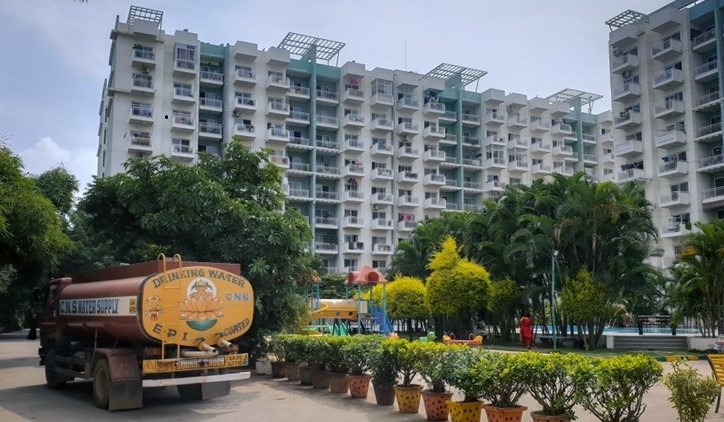
The WaterReuseLab project aims at analyzing whether and how a new generation of high-quality decentralized wastewater reuse systems could be developed in Bengaluru, India and scaled up to other cities in India and beyond. In close collaboration with local research partners and stakeholders, the project assesses technologies, water quality monitoring approaches, business models, user acceptance issues and governance models that taken together could help create water reuse solutions ‘that work’ in addressing booming megacitie’s complex water challenges.

Background

Providing a growing urban population with safe and affordable water is a key sustainability challenge of our time, especially in the booming megacities of low-and middle-income countries. Decentralized water treatment and reuse systems (DWTRS), which treat wastewater onsite and enable water reuse directly within buildings or in construction sites, laundries or public parks in the neighborhood offer a flexible and drought-resilient solution. However, few cities have successfully implemented DWTRS at scale, and research on how technological and social factors jointly influence the performance of this innovative water management approach is still scarce.

The WaterReuseLab project addresses this gap by exploring the development of DWTRS in Bengaluru, India—a case study exemplifying water and sanitation challenges in rapidly growing megacities. The project applies a socio-technical systems perspective for identifying success conditions for creating reliable, acceptable, affordable, and scalable DWTRS solutions. It will provide a holistic assessment of DWTRS development potentials and barriers and analyze how shifts in context conditions, incentives, and actor strategies impact the emergence of a new template for urban water management in Bengaluru. Additionally, the project will examine how local coalitions can navigate various development scenarios and how solutions developed in Bengaluru could diffuse into other Indian cities and beyond.

Project structure
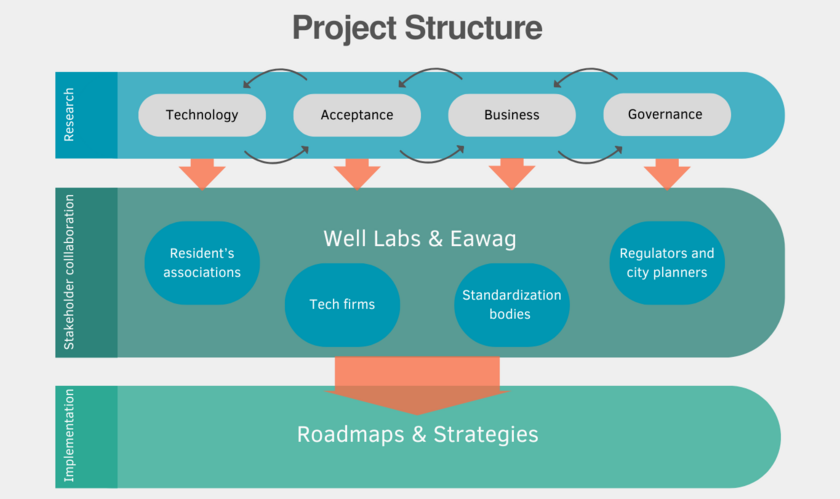
The project builds on intensive inter- and transdisciplinary exchanges among researchers from various Eawag departments, our local research and implementation partners, WELL Labs and CDD, as well as practice partners in Bangalore and Switzerland. Our research questions and outputs are defined and refeined through constant interactions with local partners and through a series of stakeholder workshops organized across the full duration of the project.

Work Package 1: Technology

Work Package 1 focuses on developing technologies and strategies for effective on-site wastewater treatment to ensure quality and microbial safety of treated wastewater for non-potable reuse. This includes the operation of membrane-based ultrafiltration systems and integration of simple sensors for online monitoring and control, with the goal of achieving a low-cost and robust treatment solution. Further, pathogen concentrations (viruses, bacteria, protozoa) will be determined in existing systems to conduct a microbial risk assessment and establish appropriate removal targets and treatment configurations.


Work Package 2: User acceptance

Technological advancements and the creation of viable business models to increase on-site wastewater treatment and reuse can only be successful if they are accepted by the users. Work Package 2 investigates the determinants of user acceptance. For example, we are interested in how different technological configurations (e.g. real-time monitoring of the water quality or differences in reuse purposes), different business models (e.g. on-site reuse vs. selling the water for off-site reuse), and different contextual factors (e.g. high or low water scarcity) relate to changes in user acceptance.


Dr. Nadja Contzen Group leader, Group: EHP Tel. +41 58 765 6892 Send Mail
Dr. Josianne Kollmann Scientist, Group: EHP Tel. +41 58 765 6420 Send Mail

Work Package 3: Business models

Work Package 3 analyzes how new business models can be created that guarantee save reuse while providing local businesses and residents with tangible financial, ecological and social benefits. Based on surveys with end users, expert interviews and a series of stakeholder workshops, we conduct a comprehensive system analysis and identify trajectories for scaling high-quality solutions for on-site and off-site water reuse.


Dr. Christian Binz Group Leader, Group: Cirus Tel. +41 58 765 5030 Send Mail
Prof. Dr. Bernhard Truffer Group leader, Group Cirus Tel. +41 58 765 5670 Send Mail

Dr. Johan Miörner
Guest Researcher, Group: Cirus
Send Mail

Muhil Nesi PhD student, Group: Cirus Tel. +41 58 765 5905 Send Mail
Djamila Lesch PhD Student, Group: Cirus Tel. +41 58 765 5660 Send Mail

Work Package 4: Governance

Work Package 4 aims to conduct a comprehensive study on the governance framework surrounding decentralized wastewater treatment and reuse, encompassing policies, institutional structures, and regulatory mechanisms. The analysis identifies gaps between policies and practice. Ultimately, it provides actionable recommendations to establish a functional reuse value chain.


Dr. Christoph Lüthi Dr. Eng. Infrastructure Planning Tel. +41 58 765 5614 Send Mail
Dr. Abishek Sankara Narayan Scientist / Project Manager Tel. +41 58 765 6771 Send Mail

Work Package 5: Stakeholder Interaction

WELL Labs is conducting research on and promoting the adoption of decentralised wastewater treatment and reuse in Bengaluru for improved water security through mapping existing decentralized sewage treatment plants, identifying commercial and industrial demands and interviews with RWAs. WELL Labs is also building and anchoring stakeholder relationships by bringing actors from the government, civil society organizations, RWAs, industries, and startups together to co-create strategies ranging from policies and guidelines to outlining design requirements for new technologies to boost wastewater reuse in the city.
Outputs

Related Publications


Extbase Variable Dump
array(2 items)
   publications => '32850' (5 chars)
   libraryUrl => '' (0 chars)
Extbase Variable Dump
array(1 item)
   0 => Snowflake\Publications\Domain\Model\Publicationprototypepersistent entity (uid=32850, pid=124)
      originalId => protected32850 (integer)
      authors => protected'Kollmann, J.; Nath, S.; Singh, S.; Balasubramanian, S.; 
         Scheidegger, A.; Contzen, N.
' (114 chars) title => protected'Perceived distributive fairness and public acceptance of a policy mandating
         on-site wastewater treatment and reuse
' (114 chars) journal => protected'Journal of Environmental Psychology' (35 chars) year => protected2024 (integer) volume => protected96 (integer) issue => protected'' (0 chars) startpage => protected'102292 (11 pp.)' (15 chars) otherpage => protected'' (0 chars) categories => protected'policy acceptance; distributive justice; decentralised wastewater treatment;
          wastewater reuse; climate change adaptation
' (120 chars) description => protected'Throughout the world, climate change, rapid population growth, and urbanisat
         ion raise the need for reducing freshwater consumption. One solution are on-
         site systems that treat wastewater for non-potable reuse near its source of
         generation, for example within a building. Policies mandating their installa
         tion can effectively increase installation rates and have been implemented i
         n several cities. Yet, such policies have the potential to impair distributi
         ve fairness in society and therefore also policy acceptance, because usually
          they cover only part of the population, which then has to carry most costs
         and risks. On the example of Bengaluru, India, where such a policy exists, t
         his online study (N = 350) analysed whether policy acceptance can be explain
         ed by the perceived policy outcome for different groups of society (i.e. the
          distribution of the policy's costs, risks, and benefits among these groups)
         , and whether this relation is mediated by perceived fairness. We further in
         vestigated whether these relations differed between participants covered and
          those not covered by the policy, since being personally affected may influe
         nce perceptions. Specifically, the outcomes for the following six groups wer
         e included: 1) participants themselves, 2) people covered by the policy, 3)
         people with a low income who are covered by the policy, 4) people vulnerable
          to water insecurity who are covered by the policy, 5) all inhabitants of Be
         ngaluru taken together, and 6) the environment and future generations. A mod
         erated mediation analysis showed that higher acceptance of the policy was ex
         plained by a higher perceived fairness, which, in turn, was explained by a b
         etter perceived outcome of the policy for different groups of society. Cover
         ed and non-covered participants differed with regard to which groups of soci
         ety they considered for evaluating fairness. While a better perceived outcom
         e for residents covered by the policy (compared with the outcome for those n
         ot covered) explained pe...
' (2550 chars) serialnumber => protected'0272-4944' (9 chars) doi => protected'10.1016/j.jenvp.2024.102292' (27 chars) uid => protected32850 (integer) _localizedUid => protected32850 (integer)modified _languageUid => protectedNULL _versionedUid => protected32850 (integer)modified pid => protected124 (integer)
Kollmann, J.; Nath, S.; Singh, S.; Balasubramanian, S.; Scheidegger, A.; Contzen, N. (2024) Perceived distributive fairness and public acceptance of a policy mandating on-site wastewater treatment and reuse, Journal of Environmental Psychology, 96, 102292 (11 pp.), doi:10.1016/j.jenvp.2024.102292, Institutional Repository
Extbase Variable Dump
array(2 items)
   publications => '33665,31131' (11 chars)
   libraryUrl => '' (0 chars)
Extbase Variable Dump
array(2 items)
   0 => Snowflake\Publications\Domain\Model\Publicationprototypepersistent entity (uid=33665, pid=124)
      originalId => protected33665 (integer)
      authors => protected'Narayan, A. S.; Dorea, C.; Willetts, J.; Friedman, 
         L.; Kalbar, P.; Chandran, K.
' (114 chars) title => protected'A portfolio approach to achieving universal sanitation' (54 chars) journal => protected'Nature Water' (12 chars) year => protected2024 (integer) volume => protected2 (integer) issue => protected'11' (2 chars) startpage => protected'1044' (4 chars) otherpage => protected'1047' (4 chars) categories => protected'' (0 chars) description => protected'Sanitation could evolve beyond its traditional focus on public health and en
         vironmental protection to address broader challenges. A portfolio approach i
         s proposed, integrating diverse systems at various scales to optimize benefi
         ts including economic value, resource efficiency, climate resilience and hum
         an dignity.
' (315 chars) serialnumber => protected'' (0 chars) doi => protected'10.1038/s44221-024-00336-0' (26 chars) uid => protected33665 (integer) _localizedUid => protected33665 (integer)modified _languageUid => protectedNULL _versionedUid => protected33665 (integer)modified pid => protected124 (integer)
1 => Snowflake\Publications\Domain\Model\Publicationprototypepersistent entity (uid=31131, pid=124) originalId => protected31131 (integer) authors => protected'Kollmann, J.; Nath, S.; Singh, S.; Balasubramanian, S.;
         Reynaert, E.; Morgenroth, E.; Contzen, N.
' (132 chars) title => protected'Acceptance of on-site wastewater treatment and reuse in Bengaluru, India: th
         e role of perceived costs, risks, and benefits
' (122 chars) journal => protected'Science of the Total Environment' (32 chars) year => protected2023 (integer) volume => protected895 (integer) issue => protected'' (0 chars) startpage => protected'165042 (11 pp.)' (15 chars) otherpage => protected'' (0 chars) categories => protected'wastewater treatment and reuse; on-site systems; user acceptance; decentrali
         sation; cost, risk, benefit perception
' (114 chars) description => protected'In dealing with water pollution and freshwater scarcity, on-site treatment a
         nd reuse of domestic wastewater has shown to be a promising solution. To inc
         rease on-site wastewater treatment and reuse, some cities, among them Bengal
         uru in India, have mandated the installation and use of the necessary techno
         logy in certain building types. However, even with a mandate, a successful a
         nd sustainable implementation of the technology, including reliable operatio
         n, monitoring, and maintenance, depends on the acceptance (i.e. positive val
         uation) of the technology and its use by the (prospective) users. Literature
          on technology acceptance indicates perceived costs, risks, and benefits of
         the respective technology as key predictors of acceptance. Therefore, the pr
         esent online study assessed this relationship for on-site systems in Bengalu
         ru. The relation was analysed separately for mandated users of on-site syste
         ms (<em>N</em> = 103) and current non-users (i.e. potential prospective us
         ers, should the mandate be expanded; <em>N</em> = 232), as the perceptions
          might differ between the two groups, due to the personal experience with th
         e technology among users. The results show that for mandated users and non-u
         sers, acceptance of on-site systems is explained by perceived benefits only,
          namely a positive image of users, environmental benefits, and, only for non
         -users, also financial benefits for the city. The findings suggest that inte
         rventions aimed at promoting on-site systems should include emphasis on the
         benefits of on-site systems. Whenever possible, interventions should be tail
         ored to the target group's individual cost, risk, and benefit perception.
' (1669 chars) serialnumber => protected'0048-9697' (9 chars) doi => protected'10.1016/j.scitotenv.2023.165042' (31 chars) uid => protected31131 (integer) _localizedUid => protected31131 (integer)modified _languageUid => protectedNULL _versionedUid => protected31131 (integer)modified pid => protected124 (integer)
Narayan, A. S.; Dorea, C.; Willetts, J.; Friedman, L.; Kalbar, P.; Chandran, K. (2024) A portfolio approach to achieving universal sanitation, Nature Water, 2(11), 1044-1047, doi:10.1038/s44221-024-00336-0, Institutional Repository
Kollmann, J.; Nath, S.; Singh, S.; Balasubramanian, S.; Reynaert, E.; Morgenroth, E.; Contzen, N. (2023) Acceptance of on-site wastewater treatment and reuse in Bengaluru, India: the role of perceived costs, risks, and benefits, Science of the Total Environment, 895, 165042 (11 pp.), doi:10.1016/j.scitotenv.2023.165042, Institutional Repository
Reynaert, E., Nagappa, D., & Morgenroth, E. (2023). Research brief: using sensors and automated chlorination to improve the microbial water quality of on-site sewage treatment plants in Bengaluru. doi:10.3929/ethz-b-000603755, Institutional Repository

Social Media

WELL Labs Blog

Bengaluru Has the Highest Number of Decentralised Sewage Treatment Plants Globally. Are They Effective?

Grey to Blue: What Can Bengaluru Learn From Chennai on Tertiary Treatment of Wastewater

Bengaluru’s Wastewater Market Experiment: A Promising Solution for Water-Scarce Cities Globally

Bengaluru Water Shortage: Where Does the City Get Water from? (welllabs.org)

Wastewater Reuse Policies across Indian States (welllabs.org)

What We Learnt from the Water Reuse Project in 2023 - WELL LABS

How We Can Make Bengaluru’s Water Systems More Sustainable and Affordable - WELL LABS

Wastewater Conference: Turning Bengaluru into the 'Silicon Valley for Water Innovation' - WELL LABS

Bengaluru has Highest Number of Decentralised STPS in the World' - WELL LABS

Why Better Wastewater Management Could Help Solve Bengaluru’s Water Crisis - WELL LABS


LinkedIn

Water, Environment, Land and Livelihoods (WELL) Labs on LinkedIn: how sewage treatment plants treat used water

Water, Environment, Land and Livelihoods (WELL) Labs on LinkedIn: how urban wastewater systems function in Indian cities

Water, Environment, Land and Livelihoods (WELL) Labs on LinkedIn: ‘Closing the Loop: Strategies for Decentralised Water Reuse in India’ workshop

Water, Environment, Land and Livelihoods (WELL) Labs on LinkedIn: #dyk #bengaluru

Water, Environment, Land and Livelihoods (WELL) Labs on LinkedIn: #wastewater #bengaluru #watercrisis #watermanagement | 11 comments

Water, Environment, Land and Livelihoods (WELL) Labs on LinkedIn: #wastewater #watermanagement #bangalorefloods

Water, Environment, Land and Livelihoods (WELL) Labs on LinkedIn: #bengaluru #wastewater #cauvery

Water, Environment, Land and Livelihoods (WELL) Labs on LinkedIn: #wastewater | 11 comments


Youtube

Wastewater Treatment Explained with Deepthi Nagappa | The WELL Labs Show

Explainer | How Can We Solve Bengaluru’s Water Crisis?

Conference | Building Water-Resilient Cities: Strategies for Wastewater Reuse in Urban India (youtube.com)